In recent years there has been a considerable interest in the cultural aspects of tourism such as the impacts of culture on tourism planning, development, management, and marketing. However, the focus has been on material forms of culture such as arts, music, or crafts. The impacts of national culture on tourist behavior and travel decision-making have not been paid much attention. Only in the last two years have cross-cultural issues begun to generate significant interest among academics.
An examination of cultural characteristics and differences is extremely important to the tourism industry because today's tourism environment is becoming increasingly international. Information on the nature of the cultural differences between international tourists and locals is not readily available in tourism literature. The concept of culture is very complex and includes such abstract concepts as satisfaction, attitude and loyalty.
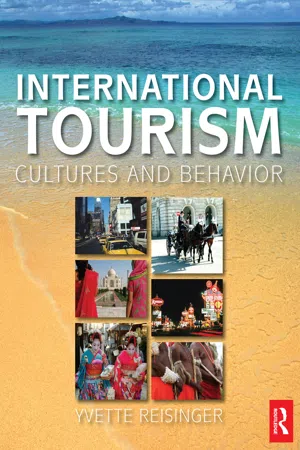
International Tourism brings these concepts to the undergraduate student in tourism, as well as students in the related fields of marketing, management, international business, and cross-cultural communication. Designed as a textbook, it isorganized and presented in an integrated and relevant way for the benefit of a worldwide audience.
- 416 pages
- English
- ePUB (mobile friendly)
- Available on iOS & Android
eBook - ePub
International Tourism
About this book
Part 1
International Tourism: The Global Environment
Part One discusses the concept of globalization, its impacts on international tourism, and the changes it brings in culture and tourist behavior.
The importance of cultural diversity in tourism is highlighted.
Chapter 1
Globalization, Tourism and Culture
The aim of this chapter is to explain the concept of globalization and its impact on international tourism and culture.
Objectives
After completing this chapter the reader should be able to:
- Understand the concept of globalization
- Identify benefits and criticism of globalization
- Understand the impact of globalization on tourism
- Understand the impact of globalization on culture
- Explain the challenges and future of globalization
Introduction
Today, there is a trend in the tourism sector towards globalization. Many tourism organizations are global organizations operating across national borders. But what is globalization, and how does it affect tourism and consumer behavior in tourism? This chapter explains the concept of globalization and its impact on tourism, tourist behavior, and culture.
1.1 The Concept and Roots of Globalization
Globalization is a complex and multidimensional process. There are five key related definitions of globalization that significantly highlight different elements. According to Scholte (2000), globalization should be defined in terms of internationalization,liberalization, universalization, Westernization or modernization, and deterritorialization. The explanation of the above terms is provided in Table 1.1.
Table 1.1 Definitions of Globalization
Globalization as internationalization |
A process of developing cross-border relations between countries and international exchange and interdependence between people in different countries; describes a growing flow of trade, capital, and goods beyond the border of a national economy to a stronger, globalized economy. |
Globalization as liberalization |
A process of removing government-imposed trade barriers, capital controls, and restrictions on the flow of goods between countries in order to create an open, borderless world economy or so-called “free-trade” economy. |
Globalization as universalization |
A worldwide process of spreading objects and experiences to people at all corners of the earth (e. g. spreading computing, television, etc.). |
Globalization as Westernization or modernization |
A process of Americanizing the economy; a dynamic process that spreads the social structures of modernity, such as capitalism, rationalism, and industrialism around the world, destroying pre-existing cultures and local self-identity. |
Globalization as deterritorialization |
A process of spreading supraterritoriality; reconfiguring geography so that territorial places, distances, and borders do not exist; linking distant places in such a way that what is happening locally is determined by events occurring many miles away. |
Source: Scholte, J. (2000). Globalization. A critical introduction. London: Palgrave. Source: http://www.infed.org/biblio/globalization.htm.
Globalization has powerful economic, cultural, social, environmental, political, and technological dimensions, and as such should be viewed from different perspectives. However, most definitions refer to globalization in economic terms as the process that merges national economies into an interdependent global economic system. This process includes forming regional economic trading blocs, growing local internationalization through developing economic ties, deepening multinationalization by multinational firms, introducing global norms and standards, developing global markets and strategies, and growing firms with no specific national operational base. The phenomenon of globalization has increased interconnectedness between societies in various areas of life (Saee, 2005). Various dimensions of globalization are explained in Table 1.2.
Table 1.2 Dimensions of Globalization
Economic dimension | Cultural dimension |
From the economic point of view, globalization is the process whereby the world economies are becoming increasingly integrated and interdependent, market-oriented approaches to development are spreading, the notion of state provision of privatization and deregulation are being withdrawn, trade and investment are being liberalized, and increased penetration of transnational corporations in life is being encouraged. | From the cultural point of view, globalization is the process of increasing homogeneity of lifestyles and aspirations via media, TV, films, tourism, etc., combined with the rapid spread of different views and greater opportunities for marginalized voices to be heard. |
Technological dimension | Social dimension |
From the technological point of view, globalization is the process of rapid innovation and increasing inter-connectivity, particularly for information and communication services, and biotechnologies. This is the process in which knowledge is the most important factor determining the standard of living, more than capital or labor. Today’s most technologically advanced economies are truly knowledge-based (World Bank, 1998). | From the sociological point of view, globalization is the process of incorporating people into a single world society. The world is becoming a “global village.” |
Political dimension | Environmental dimension |
From the political point of view, globalization is the new process of shifting the power from national governments in directing and influencing their economies, to global institutions, such as the World Bank, the European Union, the European Central Bank, the World Trade Organization, the World Health Organization, and the World Tourism Organization. In order to survive, national governments that can no longer manage their national economies must increasingly manage national politics by adapting them to the pressures of transnational market forces. | From the environmental point of view, globalization is the process of increasing inter-linkages between ecosystems, accelerating biological invasions, simplifying and homogenizing natural systems, and intensifying pressure on global commons. |
Source: Saee, J. (2005). Managing organizations in a global economy: An intercultural perspective. Australia: Thomson.
The concept of globalization has often been used in the past. For decades people referred to the process of globalization in terms of decentralizing production to different countries, and internalizing capital and labor markets, export, and imports. The concepts of modernization, capitalism, and economic interdependence have also often been used to understand the precursors of globalization. However, today, the form of globalization has changed. While in past decades globalization has been described as flows of goods and population, now globalization is described by the movements of services and flows of information and capital. Today, societies are services oriented and embrace new elements of globalization, such as information technology and experiences. Globalization is not just about modernization or Westernization and liberalization of markets; it is more than internationalization and universalization. Today, globalization is about an intensification of worldwide economic, socio-cultural, political and environmental relations. These relations link distant places in such a way that local events are determined by international events, or in other words, what is happening locally is determined by what is happening globally (Saee, 2005).
1.2 Benefits and Criticism of Globalization
Several benefits of globalization have been identified, such as
- Increased spread and connectedness of production and communication technologies across the world.
- Diffusion of ideas and practices around the world.
- New developments and technological improvements.
- Development of the knowledge economy.
- Growth and expansion.
- Increased economic and cultural activity.
- Gains in productivity and efficiency.
- Increases in revenues, profits and returns on investment, and raised incomes.
- Job creation.
- Growth in economies of scale achieved by centralizing the marketing and production activities.
- The rise of global brands and products that can be sold everywhere (e.g. Coca
- Cola, Nike, and Sony have become part of the lives of large numbers of people).
- Increased understanding of geography and experience of localness.
- Increased understanding of the world (Saee, 2005).
Some of the major benefits of globalization, such as the new developments in the life sciences and digital technology, have opened vast, new possibilities for world production and exchange. Innovations such as the Internet have made it possible to access information and resources across the world. Access to knowledge and the knowledge itself have become the most important factors determining the standard of living, beyond labor and capital of production. Knowledge generates new ideas, turns them into commercial products and services, and increases revenues and incomes of those who know how to use it. Those who have knowledge can develop, grow, and succeed. All technologically advanced economies are knowledge based. Knowledge makes the nations and their economies truly competitive and successful.
Unfortunately, not all nations and economies can benefit yet from globalization, developments in new information technology, and access to knowledge. Globalization is perceived by some as discriminatory and moving against human rights. Critics of globalization claim that globalization brings
- Decline in the power of national governments and an increase in the power of multinational corporations and supranational organizations. National economies become dependent on activities of the major multinational corporations that have the capital and technical expertise.
- An increased polarization of the world in favor of the stronger economies. Poorer countries become dependent on activities in major economies, such as the United States. The gap dividing rich and poor nations is rapidly increasing. Rich and powerful nations have capital and technology; poor and powerless nations do not have access to capital and information technology. Those with capital and technology do not allow for generating and spreading information and knowledge equally among the other nations. Large corporations claim intellectual property rights over new discoveries in physics, chemistry, biology, for example, in genetic research, and receive large profits from licensing their knowledge to others. There are doubts whether modern economies are indeed knowledge economies.
- Supraterritoriality. Although most employment is local or regional, the strategic activities have been spread around the world. What happens in a local neighborhood is increasingly dependent upon the activities of people and systems operating in different countries and on different continents. People’s lives and their activities across the globe have become increasingly interdependent and interconnected.
- Negative impact on local communities. The big multinational companies usually operate in regions where they can exploit cheap labor and resources. Although profits flow into the local communities, the local industries are taken over by multinational corporations. This generates social and economic inequalities, large unemployment, low wages, and generally poor working conditions. Since children and young people represent the cheapest source of labor, they are economically exploited. Also, multinational companies have significant influence on the provision of infrastructure, such as hospitals, roads, and housing, which are built mainly to meet corporate demands rather than public needs.
- Delocalization and outsourcing. Many of the activities that were previously local are now being performed across great distances and national borders. Banking, telecommunication, and retailing have adapted new technologies that allow them to operate in different parts of the world with less customer–seller face-to-face interaction and thus reduce the cost of their operations. They serve local clients on different continents. Similarly, local bakeries, restaurants, and boutique shops have been closed in favor of opening big, cost-effective shopping malls. The result of economic and social activities leaving local regions and cultures in pursuit of cheap labor over the border has been this: a significant de-localization in world operations.
- Separation of work from the home. Technology has allowed people to communicate and make transactions between different places, spaces, and communities. As a result, the work place has been separated from the home place. People move between cities, regions, states, countries, and continents in search of jobs. They relocate to different geographic and time zones.
- Decline in social capital and civic community. A large segment of tourism activities has been converted into commercialized and privatized activities. Many public parks, outdoor recreation areas, land where children could play, beaches, fields and plantations have been purchased or rented by developers to build new housing complexes, apartments, or shopping malls. These events have seriously decreased the quality of life and sense of well being within communities. The features that first attracted people to a local community, such as isolation, natural beauty, and peacefulness of landscape, have been gradually eroded by new developments and a faster pace of life.
- Imitation of Western culture. A large number of consumers, mainly from developing countries, have developed an interest in and demand for products and services that reflect the standards of the develo...
Table of contents
- Cover
- Half Title
- Title Page
- Copyright
- Contents
- Preface
- List of Tables
- List of Figures
- Introduction
- Acknowledgments
- Part 1: International Tourism: The Global Environment
- Part 2: Cultural Theories and Practices
- Part 3: Culture and Cultural Differences
- Part 4: Tourist Behavior
- Part 5:Cross-Cultural Comparison
- Part 6: Multicultural Competence
- Conclusion
- References and Further Reading
- Index
Trusted by 375,005 students
Access to over 1.5 million titles for a fair monthly price.
Study more efficiently using our study tools.
Frequently asked questions
Yes, you can cancel anytime from the Subscription tab in your account settings on the Perlego website. Your subscription will stay active until the end of your current billing period. Learn how to cancel your subscription
No, books cannot be downloaded as external files, such as PDFs, for use outside of Perlego. However, you can download books within the Perlego app for offline reading on mobile or tablet. Learn how to download books offline
Perlego offers two plans: Essential and Complete
- Essential is ideal for learners and professionals who enjoy exploring a wide range of subjects. Access the Essential Library with 800,000+ trusted titles and best-sellers across business, personal growth, and the humanities. Includes unlimited reading time and Standard Read Aloud voice.
- Complete: Perfect for advanced learners and researchers needing full, unrestricted access. Unlock 1.5M+ books across hundreds of subjects, including academic and specialized titles. The Complete Plan also includes advanced features like Premium Read Aloud and Research Assistant.
We are an online textbook subscription service, where you can get access to an entire online library for less than the price of a single book per month. With over 1.5 million books across 990+ topics, we’ve got you covered! Learn about our mission
Look out for the read-aloud symbol on your next book to see if you can listen to it. The read-aloud tool reads text aloud for you, highlighting the text as it is being read. You can pause it, speed it up and slow it down. Learn more about Read Aloud
Yes! You can use the Perlego app on both iOS and Android devices to read anytime, anywhere — even offline. Perfect for commutes or when you’re on the go.
Please note we cannot support devices running on iOS 13 and Android 7 or earlier. Learn more about using the app
Please note we cannot support devices running on iOS 13 and Android 7 or earlier. Learn more about using the app
Yes, you can access International Tourism by Yvette Reisinger, PhD,Frederic Dimanche,Yvette Reisinger in PDF and/or ePUB format, as well as other popular books in Business & Hospitality, Travel & Tourism Industry. We have over 1.5 million books available in our catalogue for you to explore.