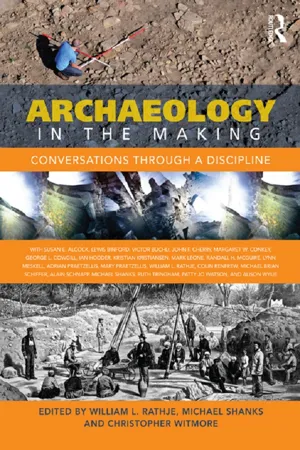
Archaeology in the Making is a collection of bold statements about archaeology, its history, how it works, and why it is more important than ever. This book comprises conversations about archaeology among some of its notable contemporary figures. They delve deeply into the questions that have come to fascinate archaeologists over the last forty years or so, those that concern major events in human history such as the origins of agriculture and the state, and questions about the way archaeologists go about their work. Many of the conversations highlight quite intensely held personal insight into what motivates us to pursue archaeology; some may even be termed outrageous in the light they shed on the way archaeological institutions operate – excavation teams, professional associations, university departments.
Archaeology in the Making is a unique document detailing the history of archaeology in second half of the 20th century to the present day through the words of some of its key proponents. It will be invaluable for anybody who wants to understand the theory and practice of this ever developing discipline.
eBook - ePub
Archaeology in the Making
Conversations through a Discipline
- 448 pages
- English
- ePUB (mobile friendly)
- Available on iOS & Android
eBook - ePub
Archaeology in the Making
Conversations through a Discipline
About this book
Information
1
Introduction
This book is intended to change the way we understand archaeology, the way it works, and its recent history. We offer seventeen conversations among some of its notable contemporary figures, edited and with a commentary. They delve deeply into the questions that have come to fascinate archaeologists over the last forty years or so, those that concern major events in human history such as the origins of agriculture and the state, and questions about the way archaeologists go about their work. Many of the conversations highlight quite intensely held personal insight into what motivates us to pursue archaeology, what makes archaeologists tick; some may even be termed outrageous in the light they shed on the way archaeological institutions operate – excavation teams, professional associations, university departments. Something of an oral history, this is a finely focused study of a creative science, a collection of bold statements that reveal the human face of archaeology in our contemporary interest in the material remains of the past.
The conversations took place at Stanford University, California, from 2002 to 2011. They began at the instigation of Bill Rathje and Michael Shanks who wanted to share their own conversation about all things archaeological with colleagues and visitors to Stanford. More of the circumstances under which the conversations occurred can be found, appropriately, in the Preface.
We are well aware that the group of archaeologists gathered here is not a representative sample. Neither are we naïve about this. While all hold academic positions at universities that are located in the Global North and West, all contributors have also worked across boundaries and borders; all have been involved in archaeology in the making. Indeed within these conversations can be found a persistent application to the political economy of archaeology in order that more equitable and inclusive distribution be made of the benefits of archaeological work and knowledge. We are all subject to our standpoints; the task is to recognize this and reflect upon the implications in order that we might do better archaeology. Archaeology, as is so well illustrated in these conversations, is located in lives and institutions as well as in aspiration to address matters of common human interest and concern, even, indeed, matters of cultural policy.
This consciousness of the politics of theory and of the role of critical scholarship is very prominent in our discussions and so well exemplifies David Clarke’s announcement in 1973 of the emergence of a critical self-consciousness in archaeology. But the evidence of these conversations also makes it hard to imagine how such reflexive self-consciousness implies Clarke’s corollary of a loss of innocence. Archaeologists, we suggest, were never innocent. Disciplines like archaeology never innocently pursue their purpose, to build knowledge of the past, or however they conceive it.
In order to achieve this aspiration to capture the humanity and working of archaeology, Shanks and Rathje adopted, precisely, an open and conversationalist attitude. Shanks, because of his fondness for wide reading in the reach of all things archaeological, aspiring to draw French or other European philosophies into the critical nuances of archaeological theory and practice, and in which Rathje was less interested, typically started the conversations with a gentle high-toned conundrum enmeshing all manner of interlacing practices. Rathje, trained in traditional American Processual approaches, would admire from afar, as he puts it, behind his more pragmatic understanding of the general theory of science. Shanks would encourage delving into philosophies bolstering high-arching theories, while Rathje would pursue queries about practical interpretations grounded in moving dirt and in bits of artifacts. Later conversations increasingly involve Witmore, who filled in for Rathje at a time when Bill’s health wasn’t so robust. Witmore brought an inflection that drew upon science studies, combined with a deep appreciation for the history of the discipline.
There is a rudimentary menu of questions asked in each conversation: they concern the changing state of the discipline in the direct experience and opinion of the discussants. The brief for each guest was to consider archaeology’s key questions, methods, and achievements, to outline trends and goals, as would be appropriate to an introductory seminar on archaeological thought. But tangents are followed and logical breaks occur as Shanks, Rathje, and Witmore try to weave theory and practice together, personal experience and blue-sky thinking, while letting their guests take the lead. The one bottom-line was to create an open and unfettered forum, serious, but not pompous, for everyone to say whatever they wanted about their work, their career, their colleagues, and the past, current state, and future of archaeology.
In a few cases, reviewers of the manuscript of transcribed conversations suggested that we tone down or delete some comments. We offered everyone the opportunity to do this in a revised draft. Changes received were minor and throughout retained the tone of the argument. We suggest this reflects the honesty of these conversations. The result is a kaleidoscope of personalities, their values and goals, their passions, what they saw as their successes and failures, and the realities of archaeology to which all have contributed so dramatically. A couple have expressed a mild concern that some of their comments were timely, that they would change now what they said then, or that their opinion, conveyed in conversation, is not so much of lasting concern, in the face of those histories of archaeology that, with hindsight, synthesize the to-and-fro of debate and practice. Such analysis, typical of the orthodox histories of disciplines can, however, appear over-coherent, delivering narrative that is often over-dramatized, missing the simple and messy nuances of the human experience of pursuing research and forging knowledge. The value of these conversations is that they reveal this human experience.
Looking over these nine years of conversation and one of editing, Rathje, Shanks, and Witmore offer this collection of conversations as a case study in that hybrid and relatively new field of science studies. Archaeological science is this flawed assemblage of thinking, aspirations, practices, highly personal, constantly confronting institutions and discourses. It is a weakly articulated assemblage because there is no teleology here, no great drama or inexorable journey from less ignorance to more enlightenment, from one paradigm to another, with debates between coherently constituted communities of processualists and Marxists, or fieldworkers and academics, whatever. Instead, in reading these conversations, look to and mark out the opportunities opened up (and as often closed down) for our labors as archaeologists, the potential to affect the manifestation and mediation of the past in the present, as we are led in such wondrous places as spelunking with Patty Jo Watson, among the Inuit with Lew Binford, into fieldwork with Victor Buchli, as we share with Colin Renfrew the concerns prompted by the contemporary looting of antiquity, read Ruth Tringham’s memories of setting out on her own archaeological journey, discuss field methodologies with Susan Alcock and John Cherry, and face the challenge of constructing prehistory for a new Europe with Kristian Kristiansen.
Though there is a great deal of common ground, the conversations have been divided into three groups. We have chosen headings for these groupings that reflect some of the challenges that the conversations make to orthodox treatments of archaeology. Each group is centered on a theme that cuts across what are typically kept separate in studies or introductions to academic disciplines: theories, methodologies, disciplinary expertise, specialist interest in a region or period of history, academics and heritage professionals, personal anecdote and institutional history. The parts of the book are instead intended to reflect aspects of archaeology in the making.
One group of conversations covers what we have termed The Archaeological Imagination. In a hybrid field between the sciences, humanities, and social sciences, archaeologists work on what remains of the past in practices that combine the analytical, empirical, interpretive, and creative. This group offers insight into attitudes and engagements with the objects of archaeological interest, in the quest to reconstruct, repair, respect the remains of the past, in creative use of whatever resources are available – material, social, cultural, emotional – to enable our archaeological purpose.
The second group is titled The Workings of Archaeology. This contains much reflection on the craft and science of archaeology, skills and competencies, and the institutional supports for archaeological work.
The third grouping is headed simply Politics. Here we read about commitment to certain common values, principles, and ethics that enable an authentic engagement with the past in, a fortiori, certain kinds of contemporary collaborations and communities. Involved are mindfulness and critique of stakeholder standpoints, interests, and ideologies.
The challenges found in this book to the way we typically think of archaeology are so great that they prompt us also to offer summary concepts to describe the work of archaeology. We introduce three new concepts, one to accompany each part: pragmata, tekhne, and demokratia. We make no apology for neologism and our use of old Greek terminology. We argue that new concepts are needed to see freshly into what the conversations are telling us about our discipline, to reframe our perspective on the workings of archaeology. Greek terms distance us from conventional common-sense understanding of academic disciplines. Again, we emphasize how much overlap there is across the three parts of the book. The new concepts are intended as a further aid in exploring these cross-connections.
We will introduce the new terms in our introductions to the three parts of the book. Here we mention that each term is meant to bridge some typical, and we argue confusing and debilitating, distinctions in the description and understanding of archaeology, and other disciplines. Pragmata is the concept associated with our first part. The term refers to both things and their constitutive practices: pragmata assumes the entanglement of things and practices, places and events, people and objects/instruments. Techne goes with the second part and describes the craft of archaeology, the art/science, the know-how, the competencies and agencies in pursuing (archaeological projects). Demokratia, associated with the third part, is not democracy, but the agency of the commons, the powers of association, issues of establishing a commons centered upon the past-in-the-present, bridging the past and its representation or mediation, connecting and acknowledging diverse interest. The commons refers to a community and its mode of inhabiting its world of goods, including tangible and intangible heritage. Ultimately demokratia is about the civility of archaeological practice, care and respect for people, sites, and things.
Part I
The Archaeological Imagination
Archaeologists do not discover the past as it was; they work on what becomes of what was, and they work with old things in order to achieve particular ends. These ends may be narratives related to long-term entanglements with wheels, stories concerning the origins of agriculture, the kinetic experiences of holding a pot, or the act of sharing the sensory intimacies of exploring a long-forgotten cave; they may be more tangible, such as the construction a museum or a visitor center. Archaeologists deliver stories, big and small. Archaeologists generate tacit experiences with the things of the past. This commitment is borne out in archaeology’s diversity as a bridging field connecting diverse ways of working with remains. The conversations in this part speak to the archaeological imagination; they reveal how an archaeological imagination hinges upon things and creative approaches to them. We therefore connect this field to the Greek notion of ta pragmata.
Encompassing the richness of the old Greek meaning of the term, pragmata are “things,” but also, “deeds,” “acts” (things done), “circumstances” (encounters), “contested matters,” “duties,” or “obligations.” The verb at the root of pragmata is prattein, to act in the material world, engaged with things. This is cognate, for us, with making as poetics (the Greek root is poiein) – a creative component to practice generally. Here we once again place emphasis upon the care archaeologists have for their “matters of concern,” and their larger loyalty to what we recognize as ta archaia, literally translated as old things. Remnants, vestiges, monuments, artifacts hold memories which archaeologists attentively piece together with, typically, an aspiration to fidelity and authenticity. Of course, archaia demand a particular orientation, both practical and imaginative. To regard these old things of archaeological interest as pragmata reminds us of the primacy of engaging with things, that many others are drawn to these matters in different ways, in different engagements or encounters, and so may even constitute them as different things, because material pasts become what they are through archaeological engagements with things and the rapports between things. This constitutive importance of particular engagements with the past, as the past comes to be what it is through our actions upon it, means that there is no definitive end to the past; the past lives on in our relationships with what remains, and so there is always more to be said and done; the challenge is to meet things, the past, halfway, in our future-oriented archaeological projects to make something of what remains.
In this part, readers learn of how Lew Binford’s interest in Nanamuit amulets and Neanderthal milk teeth are connected with a commitment to community; of Michael Schiffer’s passion for technological change, electric cars, and making pots; of Patty Jo Watson’s recollections of women in archaeology, experiences of caves in Kentucky, and the team practices they instigate; of Colin Renfrew’s worries over illicit antiquities and reflections on the conceptual art of Carl Andre; of Alison Wylie’s experiences of Fort Walsh and the ethical practices of stewardship; and of Ian Hodder’s thoughts on entanglements with wheels and the intimate practices behind the origins of agriculture.
We return to both pragmata and archaia in Ch. 19.
2
Lewis Binford†
Lewis Binford was a leading figure in the momentous changes in archaeological thinking and practice that came with the shift to anthropological science in the 1960s, ‘70s, and beyond – New and Processual Archaeology.
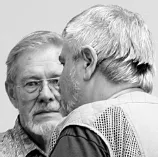
Lewis Binford looking on in discussion with Bill Rathje.
Conversation Précis
After squaring shoulders with Michael Shanks in a debate over fruitful learning strategies in archaeology – both emphasizing the pivotal importance of argument and the deployment of evidence – Lewis Binford reflects on the gains and losses of the New Archaeology of the 1960s and the Processual Archaeology it spawned. He goes on to discuss his ethnoarchaeological work with the Nunamiut and his relationship with these communities. He ends with an outline of what the academy should be doing for archaeology. (Editorial note: This conversation makes reference to a talk by Binford delivered on the previous evening at the Stanford Archaeology Center. Rather than remove references to this talk, an act that would obscure much of the flow of the conversation, the editors have provided contextualizing material where appropriate.)
Michael Shanks:
Can we begin by trying to summarize some of the points you raised in your talk yesterday afternoon. With great clarity and detail you made a case for archaeology as science. You emphasized the working of science as a process that suits archaeology. Rather than a body of knowledge, you described science a...
Table of contents
- Cover
- Half Title
- Title Page
- Copyright
- Dedication
- Contents
- Editorial Preface
- 1. Introduction
- Part I: The Archaeological Imagination
- Part II: The Workings of Archaeology
- Part III: Politics
- References
- Index
Trusted by 375,005 students
Access to over 1.5 million titles for a fair monthly price.
Study more efficiently using our study tools.
Frequently asked questions
Yes, you can cancel anytime from the Subscription tab in your account settings on the Perlego website. Your subscription will stay active until the end of your current billing period. Learn how to cancel your subscription
No, books cannot be downloaded as external files, such as PDFs, for use outside of Perlego. However, you can download books within the Perlego app for offline reading on mobile or tablet. Learn how to download books offline
Perlego offers two plans: Essential and Complete
- Essential is ideal for learners and professionals who enjoy exploring a wide range of subjects. Access the Essential Library with 800,000+ trusted titles and best-sellers across business, personal growth, and the humanities. Includes unlimited reading time and Standard Read Aloud voice.
- Complete: Perfect for advanced learners and researchers needing full, unrestricted access. Unlock 1.5M+ books across hundreds of subjects, including academic and specialized titles. The Complete Plan also includes advanced features like Premium Read Aloud and Research Assistant.
We are an online textbook subscription service, where you can get access to an entire online library for less than the price of a single book per month. With over 1.5 million books across 990+ topics, we’ve got you covered! Learn about our mission
Look out for the read-aloud symbol on your next book to see if you can listen to it. The read-aloud tool reads text aloud for you, highlighting the text as it is being read. You can pause it, speed it up and slow it down. Learn more about Read Aloud
Yes! You can use the Perlego app on both iOS and Android devices to read anytime, anywhere — even offline. Perfect for commutes or when you’re on the go.
Please note we cannot support devices running on iOS 13 and Android 7 or earlier. Learn more about using the app
Please note we cannot support devices running on iOS 13 and Android 7 or earlier. Learn more about using the app
Yes, you can access Archaeology in the Making by William L Rathje,Michael Shanks,Christopher Witmore in PDF and/or ePUB format, as well as other popular books in Social Sciences & Historiography. We have over 1.5 million books available in our catalogue for you to explore.