- 496 pages
- English
- ePUB (mobile friendly)
- Available on iOS & Android
eBook - ePub
About this book
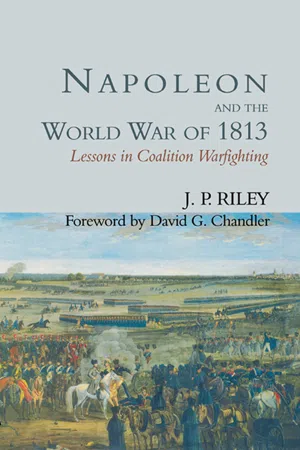
This analysis of the world war between Napoleon and the 6th coalition in 1813 covers operations in Europe, Spain and North America. It examines the differences between alliances and coalitions, comparing the long-term international relationships in alliances and the short-term union of coalitions.
PART ONE
COALITION AND
WORLD WAR
Chapter I
Introduction

IT IS AN undoubted fact that, since the Gulf War of 1991, there has been a considerable revival of interest in the mechanics of coalition war. This is probably because, despite the success of NATO over the past 50 years in deterring major war between existing states or alliances in Europe, the campaigns and small wars which have actually been fought outside Europe have been for the most part national affairs: one thinks of Vietnam, the Falklands War, Malaya and so on. The Gulf War reminded the world, after a long period of established alliance relation- ships, of the differences between established alliances and the essentially short term nature of coalitions. A successful alliance, like NATO, or like those which emerged in Europe during the nineteenth century, is often formed in peacetime against a readily identifiable, strategic threat, in order to provide long-term collective security for its members. Because of their long-term nature, alliances tend to produce political and military structures for consultation, liaison, command and control which over time become as well established as those of single nations. Military contributions tend to reflect the economic power of alliance members, but the mutual trust and co-operation which develops over time tends to overcome any tensions that differences in burden-sharing bring.
Coalitions, by contrast, are short-term, born for the moment: the individual members may be very diverse in political structure, economic power and culture, but are brought together in the face of a single unifying threat or common goal. Military contributions are inevitably based on more short-term considerations, and the resulting structures for consultation and decision-making are inevitably ad hoc. This is not to say that they do not work: the examples of Korea, and the Gulf, just as of the coalitions of 1813, prove that the achievement of a common purpose can be a powerful spur indeed.
It is always dangerous to try to draw direct parallels between the past and the present, and there are very great differences between the coali- tions of 1813 and the great peace-time alliance of NATO, or indeed the Gulf War coalition. Even so, when reflecting on the tensions within NATO which the Balkan Wars of 1991#x2013;#x2013;95 brought, for example, one can at least see that others have managed to deal with far greater stresses and strains, and yet remained effective partners. It is also apposite that the success of the 1991 Gulf coalition has since been further underscored by world-wide reductions in military power following the end of the Cold War, which have led most western European nations to the conclusion that if they are going to fight and win in the future, it will have to be in coalition. Even the mighty USA has come to this conclusion, if for a different reason — that of inter- national legitimacy.
It seems therefore that the time is ripe for an examination of coalition war as an historical phenomenon: what conditions bring coalitions together, and what tend to pull them apart? What are the peculiar difficulties — both political and military — which distinguish it from the wars of nations or established alliances? Such an examination would be a dry beast indeed if taken in the abstract, and so the subject will be examined through an example. There are very many of these — since coalition war is in many ways the normal state of affairs and the condi- tions of the last 50 years an aberration — but the events of one year, the momentous Napoleonic year of 1813, are as good an example as can be found.
The grand alliance of 1813 in central Europe is particularly interesting because it is a prototype of all modern coalitions, with all their troubles. Indeed when one reviews the command relationships, and the funda- mental disagreements of its members in terms of political ambition, it is hard to believe that it survived its first encounter with the enemy. It did so because of the existence of a threat greater than all considera- tions of mutual mistrust, a subject which will be explored more fully later.
The year 1813 holds an additional attraction because, long before 1914#x2013;#x2013;18, it is also an example of world war. Simultaneous campaigns were under way in central Europe, Italy, Spain, and North America — where two campaigns were waged. The campaigns of Central Europe, Spain and North America are of especial significance since not only were they simultaneous, but also they were inter-related at the strategic level of war. In Europe, the 6th Coalition was formed in the aftermath of Napoleon's Russian disaster and it was this coalition which, by forcing Napoleon to fight a war on two fronts, expelled French power from Germany, Italy and Spain. In doing so, it laid the foundations for the great power relationships in Europe which endured until 1878. The American war was a result of, and an influence on, the war in Europe: it arose from Napoleon's Continental System, it was connected to events in Spain through the Louisiana Purchase and trading interests, and it influenced British power both directly and indirectly.
Furthermore, 1813 is also illuminating in coalition war at the operational level. In each of the main theatres of war a different form of coalition was assembled. In Spain it was a British, Spanish, Hanoverian and Portuguese affair under British command. In central Europe it was a Russian, Prussian, Austrian and Swedish alliance, financed by Britain, and gradually joined by most of the smaller German states. In North America it was a combination of British, Canadian — including by a supreme irony French Canadian — and native American (Indian) interests. The political and diplomatic subtleties of the operational level therefore add to the picture of coalition war at the strategic level and this can be brought to life by an examination of war fighting, as an extension of the allied war aims, at the tactical level.
But Napoleon too was a coalition commander, a fact which is often forgotten and which is rarely addressed in any depth. It was Napoleon after all who created the Confederation of the Rhine, the Grand Duchy of Warsaw and the Kingdoms of Italy and Naples. In 1813 his armies contained formations of Poles, Danes, Saxons, Spaniards, Bavarians, Italians; a host of contingents from other smaller German states; and individuals from practically every nation in western Europe.
The difference between the Napoleonic model and the 6th Coalition was an important one: Napoleon retained sole command of his coali- tion, called no councils of war, consulted no allies and in doing so, exercised a power similar to that of the USSR in the Warsaw Pact, something which we today, in much watered-down form, would recognise as lead nation status. The 6th Coalition, by contrast, had to arrive at a common policy by the difficult processes of compromise, subordinating the separate interests of its members to the overriding common purpose of defeating Napoleon.
An additional reason for choosing 1813 is that it is a furrow which has not been much ploughed in this particular way. Most studies of the later Napoleonic period focus on the 1812 campaign in Russia or on 1815, neglecting the vital link which was made possible by the Russian disaster and which ended — a year to the day after Napoleon's departure from Moscow — in his defeat at Leipzig by the assembled nations of Europe. This defeat led directly to the allied invasion of France both from east of the Rhine and from over the Pyrenees. Across the Atlantic, after the British-Canadian-native American alliance spent 18 months on the defensive, late 1813 saw the first real prospect of an end to the war, following the frustration of the American invasion prospects and the allied attack on Buffalo. It also showed that Napoleon was right, that solidarity, or unity, is probably the centre of gravity in coalition warfare, and military defeat can shatter that essential unity.
The book is structured in five parts. Part One is a general discourse on coalition war, related directly to the situation of world war in 1813. This addresses not only the formation and conduct of coalitions as political expedients, but also the qualities required for coalition command, and the particular difficulties faced by coalition commanders at the operational level. The formation of the different coalitions underpinned by British finance, as well as the Napoleonic coalition, are traced and related as much to economic and political factors as to military events. This part of the book is the cornerstone: the essential glue which binds together the rest of the book. Parts Two, Three and Four are campaign studies. These pick up and illustrate the strategic concept outlined in Part One, at the operational level, through an examination of each theatre of war, and also outlines the links between each of the theatres.
Part Two considers Central Europe, excluding the peripheral Danish theatre, for it was in Germany that 1813 brought the decisive act in Napoleon's life-or-death struggle against the allies. It begins by considering the rearmament of Europe and then traces the offensive French campaign in the spring. The summer saw the transformation of Austria from neutral to belligerent, a transformation brought about by Napoleon's refusal to compromise. The accession of Austria to the allies led into the autumn campaign, which began with Napoleon on the defensive at Dresden; continued through the defeat of his lieutenants at Dennewitz, Kulm and the Katzbach; and ended with the culmination of the German War of Liberation, the great Battle of the Nations at Leipzig, the greatest battle in Europe before 1914.
Linked directly to events in central Europe was the war in the Iberian Peninsula and to a lesser extent in Italy, although this is only alluded to in passing here because major operations occurred only in 1814. The weakening of the French garrison there in order to shore up the posi- tion in central Europe, along with the growth of allied power, created the conditions for an allied offensive. This offensive, aft...
Table of contents
- Cover
- Half Title
- Full Title
- Copyright
- Contents
- List of Illustrations
- Foreword by Dr David G. Chandler, author of The Campaigns of Napoleon
- Legend to Maps
- PART ONE: COALITION AND WORLD WAR
- PART TWO: CENTRAL EUROPE
- PART THREE: SPAIN AND THE MEDITERRANEAN
- PART FOUR: AMERICA
- CONCLUSION
- Chronology of 1813
- Bibliography
- Index of Persons
Trusted by 375,005 students
Access to over 1.5 million titles for a fair monthly price.
Study more efficiently using our study tools.
Frequently asked questions
Yes, you can cancel anytime from the Subscription tab in your account settings on the Perlego website. Your subscription will stay active until the end of your current billing period. Learn how to cancel your subscription
No, books cannot be downloaded as external files, such as PDFs, for use outside of Perlego. However, you can download books within the Perlego app for offline reading on mobile or tablet. Learn how to download books offline
Perlego offers two plans: Essential and Complete
- Essential is ideal for learners and professionals who enjoy exploring a wide range of subjects. Access the Essential Library with 800,000+ trusted titles and best-sellers across business, personal growth, and the humanities. Includes unlimited reading time and Standard Read Aloud voice.
- Complete: Perfect for advanced learners and researchers needing full, unrestricted access. Unlock 1.5M+ books across hundreds of subjects, including academic and specialized titles. The Complete Plan also includes advanced features like Premium Read Aloud and Research Assistant.
We are an online textbook subscription service, where you can get access to an entire online library for less than the price of a single book per month. With over 1.5 million books across 990+ topics, we’ve got you covered! Learn about our mission
Look out for the read-aloud symbol on your next book to see if you can listen to it. The read-aloud tool reads text aloud for you, highlighting the text as it is being read. You can pause it, speed it up and slow it down. Learn more about Read Aloud
Yes! You can use the Perlego app on both iOS and Android devices to read anytime, anywhere — even offline. Perfect for commutes or when you’re on the go.
Please note we cannot support devices running on iOS 13 and Android 7 or earlier. Learn more about using the app
Please note we cannot support devices running on iOS 13 and Android 7 or earlier. Learn more about using the app
Yes, you can access Napoleon and the World War of 1813 by J.P. Riley in PDF and/or ePUB format, as well as other popular books in History & Military & Maritime History. We have over 1.5 million books available in our catalogue for you to explore.