The first of its kind, this book examines artistic representations of the brain after the rise of the contemporary neurosciences, examining the interplay of art and science and tackling some of the critical-cultural implications.
Weaving an MRI pattern onto a family quilt. Scanning the brain of a philosopher contemplating her own death and hanging it in a museum. Is this art or science or something in-between? What does it mean? How might we respond? In this ground-breaking new book, David R. Gruber explores the seductive and influential position of the neurosciences amid a growing interest in affect and materiality as manifest in artistic representations of the human brain. Contributing to debates surrounding the value and/or purpose of interdisciplinary engagement happening in the neuro-humanities, Gruber emphasizes the need for critical-cultural analysis within the field. Engaging with New Materialism and Affect Theory, the book provides a current and concrete example of the on-going shift away from constructivist lenses, arguing that the influence of relatively new neuroscience methods (EEG, MRI and fMRI) on the visual arts has not yet been fully realised. In fact, the very idea of a brain as it is seen and encountered today—or "The Brain," as Gruber calls it—remains in need of critical, wild and rebellious re-imagination.
Illuminating how artistic engagement with the brain is often sensual and suggestive even if rooted in objectivist impulses and tied to scientific realism, this book is ideal for scholars in Art, Media Studies, Sociology, and English departments, as well visual artists and anyone seriously engaging discourses of the brain.
Tucked between two bulbous hemispheres of tissue, deep inside the head, rests a tiny, hard pinecone. The pineal gland. Fascinated by its strange twirl, Descartes declared the gland the “principal seat of the soul, and the place in which all our thoughts are formed.”1
Pinecones, like pineal glands, are a magical shape. They are an inward-turning spiral. They direct all to the center and up to a single point. Their aesthetic charm and simplicity seduce. They reiterate a social semiotic tied to the environment and the body: they twirl toward the sky to a sun that burns in a hot circle. We are spellbound by the heavens. The stars circle us at night. The universe wraps around us in the ghostly span of the Milky Way. We gape in awe. The aesthetic from inside of the earth is a giant, magnificent spiral. Then, with luck, we discover the pineal gland, just there, absorbing the symbolic weight of our material world. It is a fitting representation of that feeling that we have—a vibrant connection to a geometric outside. And its location seems perfect for endowing us with heavenly significance: center of the head, behind the eyes, like a topper on a Christmas tree. Bodily flesh in the gland mirrors the rotunda of the heavens.
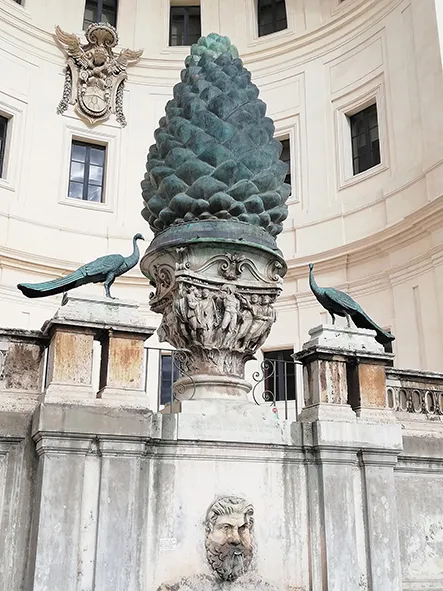
Today, contemporary neuroscientists believe that the pineal gland secretes melatonin, regulating when we are awake or asleep.2 This is a fortuitous connection to ancient imagery ascribing supernatural awareness and spiritual awakening to the pinecone. Packed with seeds, the cone grows into a majestic tree and can, in fact, generate a forest covering thousands of acres. Perhaps this connection to fertility is why the pinecone rests at the heart of the Vatican’s courtyard, at the top of the Pantheon, inside Roman governing buildings, in the hands of Sumerian gods, and on the staffs of the ancient Egyptians.
Figure 1 “Court of the pinecone, the Vatican,” Copyright David R. Gruber.
Whether the pinecone is anything other than a symbol of aesthetic perfection and a mathematical elegance, whether it exposes an underlying mystery about earthly materiality or holds many dark secrets of the mind, teeters on the edge of a question about what the body is, how we imagine our place in the cosmos, and how we collectively represent our Being. But whatever we think of the pinecone, we are desperate to find some greater meaning, to see and feel something bigger … but what?
Scan 1: seeking a One
Efforts to determine a founding principle, to unearth a One that explains human experience, are witnessed across history; they are not only repetitive exercises but central components of affective struggle in religion, mysticism, and the arts—and now in neuroscience.
On the left side of the body, we reach out with one hand to touch the sky; we roll the opposite hand to the chest, turning inward to reflect on personal experience. Like a statue in dramatic pose, we perform the dual pursuit of human understanding—outer sensation and inner reflection. We enact a little version of The School of Athens fresco where Plato points to the heavens and Aristotle to the earth. We mull space and time while taking apart the washing machine.
In The School of Athens, the temple of philosophers is a luxurious marble hall signifying a higher purpose—the search for truth and beauty. For us, neuroscience laboratories can act as another kind of temple, signifying a technical search for universal mechanisms explaining our behaviors. If the perfect geometric architecture of The School of Athens suggests an “onto-theological order” to the universe,3 then the mapping of the brain constructs another philosophical and material architecture, equally fascinated by harmony, grandeur, and governance.
The paleolithic brain
Once upon a time, the brain was nothing.
Paleolithic people who marked out the hunt in mineral pigments on cave walls chose to represent majestic bulls and horses, portraits of strength and beauty. They painted the necessity of killing food, the wildness of living ecologies, the intense struggle of life, and the splendor of ceremony. Nowhere do we find a brain.
Inscriptions of the human body in paleolithic cave drawings flash out of the darkness, but they glow from pigments the same as those used for birds and fish. The shapes seem rarely much different—a line extended out to an arm, extended further to an arrow that shoots off into the sky. The entwined aesthetic cannot be generalized across absolutely all cases, but singularity or division for the human body appears out of the norm.
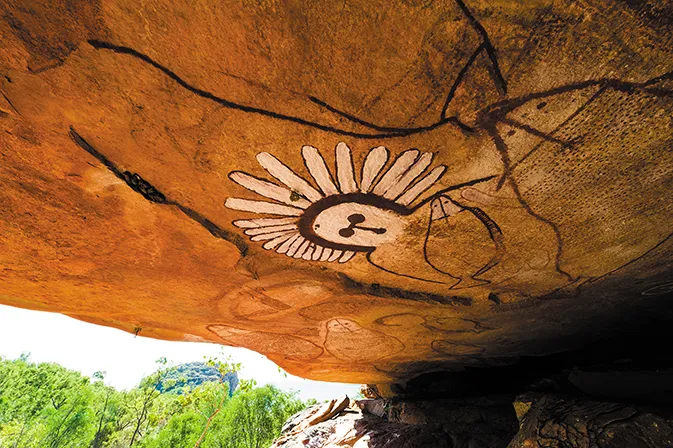
The striking human figures in the Gwion Gwion rock art, previously called the Bradshaw rock paintings of Western Australia, offer one interesting example to consider. They depict early human life but only inside of a permeable world. Elaborate dress and family groups swirl amid snakes and kangaroos, the sun and the desert. This record of coexistence with animals within voluptuous environments survives, and we can see in those images a type of thinking where life-worlds thrive as entwined expressions. Stress on the individual perspective distinct from any community, as scholars have noted, is not readily present.4
Of course, what it might mean to assert an individual perspective in an art image remains open to debate. That is to say, it is not entirely clear that the so-called “individual” would be the same kind of entity across spans of time and different cultures. Locating the “individual” would require criteria and a line of argument. Generally, we can assume at least a few universalizable aspects of “the Self” as a formation. To have a so-called “Self,” one likely needs awareness of a basic difference (me vs you), awareness of change or ideational and bodily development, the time and capacity for inner reflection, and some socio-cultural orders or oppressions and repressions wherein the “I” can be self-located in a hierarchy or realm of Things. But historical processes, technological change, mental adaptions to social conditions amid narratives that explain what the group is and what the hell an “I” is supposed to be doing in it, probably have wide-ranging effects.5 The Self is a concept breaking away from unification, dedicated inherently to diversification. Yet, in many ancient rock art depictions, we get the sense that breaking away is not the core idea. The human seems quite at home amongst a multiplicity of living things.
The idea of the individual in the paleolithic era remains elusive and mysterious, as does how the body relates to a concept of personhood. But perhaps we can look again at Gwion Gwion for some clues. One image is especially intriguing, a little haunting. We see there a burst of brilliance emanating from the head, which appears to show thinking; but the design could also take the shape of a headdress, or maybe it shows the sun, or maybe it references the cosmos. If feathered or sun-struck, the human body remains artistically enmeshed in environmental Being. This is not to say that the human face is not special or visually select in the image, but rather this is to say that thousands of years ago its chalky glow may not have been seen as self-generated mental power nor anything of the body as meat.
Chalky lines fatten and blur, making a semi-circle that spans the head of a ghostly figure. A halo complements the headdress, reminding the viewer of a tie to the earth and sky. The impression, to today’s art critic, probably automatically reminds of (much) later Renaissance paintings of saints illuminated with God’s divine glory. Here, the “halo” can be conceptualized as “a fossil of human experience” in as much as it is an aesthetic expression of a social designation for the person pictured;6 but anything like this remains speculation and anything more than this remains shadowy.
Of course, the halo, a distinct and important symbol in various Western artworks, symbolizes a connection to divine dimensions, displaying the communal belief that human reason equates to human exceptionalism. The suggestion that Western art practices are related to something here, something much further back, a kind of compulsion to seek the divine or to embody higher supernatural realms sensed and storied within communities, raises intrigue. But in the Gwion Gwion image, the lack of definition in the face and the absence of any directive gesture calls this narrowly Eurocentric interpretation into question. To go further: reading this rock art through the lens of the Renaissance and its distinct expressions of divinity constructs another Western colonialism scraping away the meanings attributed by ancient peoples and including now those local indigenous communities in Australia.
That these paintings were ever called Bradshaw rock art—in honor of the 1891 colonialist Joseph Bradshaw who refused to attribute them to aboriginal peoples—says something of the arrogance and power of colonial absorption and the failure to understand art on its own terms within its original contexts. A renaming exercise in Australia, now increasingly presenting these images as “Gwion Gwion rock art” across museums and archaeological sites, offers hope of overcoming the historical circulation of Bradshaw’s false notion that these paintings were too sophisticated for aboriginal peoples in Australia. Bradshaw was likely unable to see beyond “a 19th Century linear worldview in which societies progressed from primitive to advanced.”7 Indeed, the paintings clearly display “a developed culture,” showing human figures in ceremonial gowns, engaged in dance, surrounded by animals, arm in arm. And their age—at minimum, around 5,000 years old and at most 40,000 years8—surely stunned or confounded Bradshaw, who probably understood his own history of rational-minded civilization looking back not one-quarter of that span. Even so, some lingering controversy around who painted the images remains in Australian society, despite academic papers putting competing theories to rest.9 In short, no direct or easy comparison to g/God’s divine glory is necessitated here, no correlation to the social and political forces of the Enlightenment is needed when we view the faces in Australian rock art.
Because aboriginal rock art is designed for a community, interpreted within it, and made for a defined time and place, it remains difficult to say with any confidence or dimensionality what, exactly, these Gwion Gwion rock depictions once meant.10 As McNiven notes, when asked about the rock art, the aboriginal people in the Kimberly region of Western Australia tend to say, “‘They are before our time,” but they sometimes recall a myth of a beautiful bird (Gwion Gwion) that was believed to live in the mountains and paint them with its beak.11
We might then see the thick line around the head coupled with the headdress as a symbol of the bird or an expression of it. Or we might return to the alertness of human consciousness and tie that to the activities of the bird, the great height from which a bird can see. At that juncture, we might again encounter the image as a person thinking vast thoughts, staring right back at us with a kind of historical demand to think again about human life, to reassess the value and power ascribed to so-called “civilization,” and to realign the cosmos and see all of life moving together—both in geometric and figurative ways.
The image could, of course, be viewed as a representation of the aboriginal awareness of a majesty or magicalness of the world. But regardless, what strikes the viewer immediately is the depth of that blur around the head. The thick line provides some reason to believe that it stands for the figure’s own depth of thought or maybe depth of a perspective. The figure looks out at us. Perhaps it is a self-portrait. But what does the person pictured there see? Does it see me, or does it see an obvious “we” amid the creatures flying above and swimming within? Or does it see right through and beyond any individual viewer? Perhaps we, the viewers, can look back with this look, this looking, and not look at it as an image of someone looking at us.
Consider the hyper-simplified shape of the eyes and nose. Small and apotropaic. The human face holds an inescapable resemblance to what appears to be a fish swimming in and around it. Same shape, same beady eyes. And then, inside the body, we find another fish or maybe it is a satchel that looks similar to the animals on the outside of the body, which appear to be kis...
Table of contents
Cover
Half Title
Title Page
Copyright Page
Table of Contents
Acknowledgments
Preface
1. Ancient histories of the brain concept
2. Neurosensuality and brain art
3. Affective Realism and brain art
4. Brain art on the ontological stage
Conclusion: For the love of the momentary brain
Index
Trusted by 375,005 students
Access to over 1.5 million titles for a fair monthly price.
Study more efficiently using our study tools.
Frequently asked questions
Yes, you can cancel anytime from the Subscription tab in your account settings on the Perlego website. Your subscription will stay active until the end of your current billing period. Learn how to cancel your subscription
No, books cannot be downloaded as external files, such as PDFs, for use outside of Perlego. However, you can download books within the Perlego app for offline reading on mobile or tablet. Learn how to download books offline
Perlego offers two plans: Essential and Complete
Essential is ideal for learners and professionals who enjoy exploring a wide range of subjects. Access the Essential Library with 800,000+ trusted titles and best-sellers across business, personal growth, and the humanities. Includes unlimited reading time and Standard Read Aloud voice.
Complete: Perfect for advanced learners and researchers needing full, unrestricted access. Unlock 1.5M+ books across hundreds of subjects, including academic and specialized titles. The Complete Plan also includes advanced features like Premium Read Aloud and Research Assistant.
Both plans are available with monthly, semester, or annual billing cycles.
We are an online textbook subscription service, where you can get access to an entire online library for less than the price of a single book per month. With over 1.5 million books across 990+ topics, we’ve got you covered! Learn about our mission
Look out for the read-aloud symbol on your next book to see if you can listen to it. The read-aloud tool reads text aloud for you, highlighting the text as it is being read. You can pause it, speed it up and slow it down. Learn more about Read Aloud
Yes! You can use the Perlego app on both iOS and Android devices to read anytime, anywhere — even offline. Perfect for commutes or when you’re on the go. Please note we cannot support devices running on iOS 13 and Android 7 or earlier. Learn more about using the app
Yes, you can access Brain Art and Neuroscience by David Gruber in PDF and/or ePUB format, as well as other popular books in Psychology & History & Theory in Psychology. We have over 1.5 million books available in our catalogue for you to explore.