Chapter 1
Some basic mechanics
Water is now at the centre of world attention as never before and more professionals from all walks of life are engaging in careers linked to water – in public water supply and waste treatment, agriculture, irrigation, energy, environment, amenity management and sustainable development. This book offers an appropriate depth of understanding of basic hydraulics and water resources engineering for those who work with civil engineers and others in the complex world of water resources development, management and water security. It is simple, practical and avoids (most of) the maths in traditional textbooks. Lots of excellent ‘stories’ help readers to quickly grasp important water principles and practices.
This third edition is broader in scope and includes new chapters on water resources engineering and water security. Civil engineers may also find it a useful introduction to complement the more rigorous hydraulics textbooks.
1.1 INTRODUCTION
This is a reference chapter rather than one for general reading, but it will be useful as a reminder about the physical properties of water and for those who want to revisit some basic physics which is directly relevant to the behaviour of water.
1.2 DIMENSIONS AND UNITS
To understand hydraulics, it is essential to put numerical values on such things as pressure, velocity and discharge in order for them to have meaning. It is not enough to say the pressure is high or the discharge is large; some specific value needs to be given to quantify it. Also, providing just a number is quite meaningless – it needs a unit. To say a pipeline is 6 long is not enough. It might be 6 cm, 6 m or 6 km. So dimensions must have numbers and numbers must have units to give them some meaning.
Different units of measurement are used in different parts of the world. The United States still uses the foot, pound and second system (known as the FPS system), and to some extent, this system still exists in the United Kingdom. In continental Europe, two systems are in use depending on which branch of science you are in. There is the centimetre–gramme–second (CGS) and also the metre–kilogramme–second (MKS) system. All very confusing and so in 1960, after years of discussion and finally international agreement, a new International System of Units (known as SI system based on the French: Systeme International d’Unites) was established. Not everyone has switched to this, but most engineers now accept the system and so in order to avoid any further confusion, we shall use this throughout this book.
SI system is not a difficult system to grasp and it has many advantages over other systems. It is based mainly on the MKS system. All length measurements are in metres, mass is in kilogrammes and time is in seconds (Table 1.1). SI units are simple to use and their big advantage is they can help to avoid much of the confusion which surrounds the use of other units. For example, it is quite easy to confuse mass and weight in both FPS and MKS systems. In FPS, both are measured in pounds, and in MKS, they are measured in kilogrammes. Any mix-up between them can have serious consequences for the design of engineering works. In the SI system, the difference is clear because they have different units – mass is measured in kilogrammes, whereas weight is measured in Newtons. More about this is explained later in Section 1.7.
Note that there is no mention of centimetres in Table 1.1. Centimetres are part of the CGS system and play no part in hydraulics or in this text. Millimetres are acceptable for very small measurements and kilometres for long lengths – but not centimetres. The litre (L) is also not officially an SI unit, though most water supply engineers talk about megalitres when referring to water volumes. So even the SI system has its idiosyncrasies.
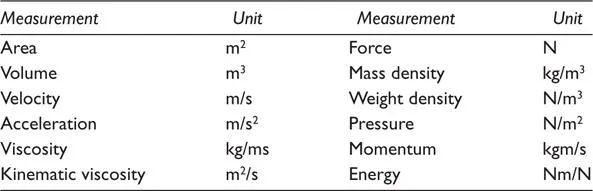
Every measurement must have a unit so that it has meaning. The units chosen do not affect the quantities measured and so, for example, 1.0 m is exactly the same as 3.28 feet. However, when solving problems, all the measurements used must be in the same system of units. If we mix them up in a formula (e.g. centimetres or inches instead of metres, or minutes instead of seconds), the answer will be meaningless. Some useful units which are derived from the basic SI units are included in Table 1.2.
Table 1.1 Basic SI units of measurement
Measurement | Unit | Symbol |
Length | Metre | m |
Mass | Kilogramme | kg |
Time | Second | s |
Table 1.2 Some useful derived units in this SI system
1.3 VELOCITY AND ACCELERATION
Most people use the terms velocity and speed to mean the same. But scientifically they are different. Speed is the rate at which some object is travelling and is measured in metres/second (m/s), but this does not tell you in which direction the object is going. Velocity is speed plus direction. It defines movement in a particular direction and is also measured in metres/second (m/s). In hydraulics, it is useful to know in which direction water is moving and so the term velocity is used instead of speed. When an object travels a known distance in a given time, we can calculate the velocity as follows (see example in Box 1.1):
Acceleration describes change in velocity. When an object’s velocity is increasing, it is accelerating; when it is slowing down, it is decelerating. Acceleration is measured in metres/second/second (m/s2). If the initial and final velocities are known as well as the time taken for the velocity to change, we can calculate the acceleration as follows:
BOX 1.1 EXAMPLE: CALCULATING VELOCITY AND ACCELERATION
An object is moving along at a steady velocity and it takes 150 s to travel 100 m. Calculate the velocity.
Calculate the acceleration when an object starts from rest and reaches a velocity of 1.5 m/s in 50 s.
1.4 FORCES
Force is not a word that we can easily describe in the same way as we can describe some material object. Instead, we talk about a pushing or pulling action and so we say what a forc...