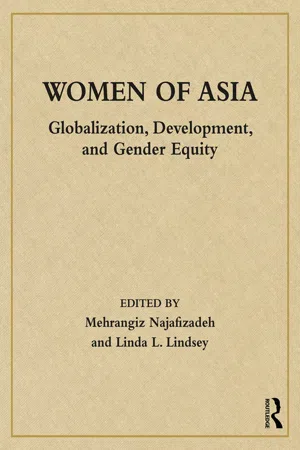
With thirty-two original chapters reflecting cutting edge content throughout developed and developing Asia, Women of Asia: Globalization, Development, and Gender Equity is a comprehensive anthology that contributes significantly to understanding globalization's transformative process and the resulting detrimental and beneficial consequences for women in the four major geographic regions of Asia—East Asia, Southeast Asia, South Asia, and Eurasia/Central Asia—as it gives "voice" to women and provides innovative ways through which salient understudied issues pertaining to Asian women's situation are brought to the forefront.
eBook - ePub
Women of Asia
Globalization, Development, and Gender Equity
- 446 pages
- English
- ePUB (mobile friendly)
- Available on iOS & Android
eBook - ePub
Women of Asia
Globalization, Development, and Gender Equity
About this book
Information
Part I
Introduction and Overviews of Women in Asia
Chapter 1 Globalization, Development, and Gender Equity: A Thematic Perspective on Women of Asia
Linda L. Lindsey and Mehrangiz Najafizadeh
Chapter 2 Gender Equality, Women’s Empowerment, and the Sustainable Development Agenda in Asia
Eugenia McGill
Chapter 3 Gendering Aid and Development Policy: Official Understanding of Gender Issues in Foreign Aid Programs in Asia
Patrick Kilby
Chapter one
Globalization, Development, and Gender Equity
A Thematic Perspective on Women of Asia
INTRODUCTION
The massive entry of women into the paid labor force is one of the most consequential socioeconomic transformations in twentieth-century Asia. Although this labor trend has recently slowed in urban, developed Asia, the ongoing rural transformation in developing Asia largely continues unabated in the new millennium. As the catalyst for these transformations, globalization has profoundly impacted virtually every social institution throughout Asia, all of which are associated with significant changes in the lives of women and how gender roles unfold. Fueled by scholarly inquiry, activism, and policy-making agendas, research on globalization and development has exploded in various disciplines but sources linking this work to gender equity are often difficult to uncover. Discussed mainly in the context of development, gender issues tend to be marginalized from the larger globalization picture. The globalization discourse is the centerpiece of the original articles in Women of Asia: Globalization, Development, and Gender Equity. As highlighted throughout the anthology, this discourse demonstrates a mixture of benefits and liabilities ushered in with globalization that may challenge as well as reinforce patriarchy. In turn, various routes to gender equality may be more or less obstructed. Although patriarchy is stubbornly persistent, we will see that women in Asia have mounted resourceful, creative modes that strategically seek to challenge and to weaken patriarchy’s foundation.
The authors, from over 20 countries, represent a range of disciplines, with scholarship overlapping with women’s activism, agency, and advocacy. Combined with innovative methodological techniques prompted by feminist insights, their work allows readers to better understand the connection between globalization and gender equity both with and without the entanglement of development. In this sense, development may be viewed as the intermediate step to determine how gender equity (or lack thereof) unfolds in various globalization scenarios. These scenarios are largely shaped by regional and national levels of economic integrity throughout Asia.
Developed and Developing Asia
Chapters throughout the anthology attest to the challenges faced by women in Asian nations more comfortably ensconced with globalization (richer, developed Asia) compared to nations in the continuing throes of globalization, especially those maneuvering rapid rural transformation (poorer, developing Asia). While the gap between developed and developing Asia remains wide, virtually every nation examined in the anthology paints gendered trends that speak to enhanced well-being or increased peril associated with globalization. They speak to the global consensus that legal rights for women in Asia must be ensured and enforced. They speak to the powerful role of feminist-inspired activism in monitoring progress on gender equity. Like globalization, they also speak to the role of culture in unfurling gender liabilities in the name of tradition or drawing on this very tradition, as a source of women’s agency.
GENDERED PATTERNS IN ASIA
Given its highly varied historical, cultural, demographic, and socioeconomic backdrop, Asia is perhaps the most diverse continent on the globe. Despite this diversity, and the intersectional risks to women emanating from region or nation, women of Asia represent remarkably similar patterns in carrying out their gendered lives. With globalization as the catalyst and overarching explanatory model to inspect gender equity, and with feminism as the catalyst to activism, these patterns allow readers to locate content according to how the patterns unfold, especially in the context of level of development. Although all chapters demonstrate some overlap, they are positioned according to the following patterns and help address the questions emerging from each.
• De jure/de facto: What are the successes and challenges to legal approaches for gender equity?
• Challenges of globalization: What are the benefits and liabilities of globalization for gender equity?
• Activism, advocacy, agency: What strategies and resources are leveraged by national and international networks in challenging patriarchy and navigating gender equity?
• Reconfiguring gendered lives and emergence of new womanhoods: How does globalization alter gender roles and relationships in women’s lives?
De jure/de facto: By Law and by Fact
Using language from civil rights history this pattern identifies the “de jure” (by law) and “de facto” (by fact) disconnect in ways formal mechanisms to address gender equity play out. This disconnect also targets unresolved issues and intersectional risks for women. The United Nations (UN) was one the first international organizations that spoke to this disconnect.
As early as 1946, with the establishment of the Commission on the Status of Women (CSW), a pivotal role in efforts forging international consensus on behalf of gender equity was carved out by the UN. With support from the growing international women’s movement, the Commission’s original focus on legal measures to protect the human rights of women amplified greatly, especially in relation to the global divide on women’s role in economic development (UNCSW 2017). Another key indicator of UN efforts was the adoption in 1979 of the Convention on the Elimination of All Forms of Discrimination against Women (CEDAW) during the UN Decade for Women (1976–1985). Described as an “international bill of rights for women,” CEDAW paved the way for UN Conferences on Women (1975, 1980, 1985, 1995) and the parallel non-governmental organization (NGO) forums in conjunction with each. The 1995 Fourth World Conference on Women, convened in Beijing under the banner “Action for Equality, Development and Peace,” brought together 50,000 women for the official conference and parallel NGO Forum. The seminal Beijing conference was arguably the most significant global women’s event in history to spotlight the women’s agenda. Its location in Beijing was also significant, allowing for more women in Asia to attend than any of the previous conferences. In addition to the 189 nations ratifying the “Beijing Platform of Action” that targeted critical areas of concern related to gender equality, then First Lady Hillary Rodham Clinton addressed the NGO Forum in the now famous speech where she declared “women’s rights are human rights.”
Many authors incorporate UN documentary material in their chapters. The UN became the springboard for the legal achievements on behalf of women that subsequently translated into public policy in many Asian nations, particularly in advanced economies such as Japan, Korea, Singapore, and Hong Kong, and in rapidly developing urban China. Laudable goals and achievements, of course, should not be easily dismissed, but laws, policies, regulations, rights-based frameworks, official commissions, and assessments on gender equity must be viewed in light of the cultural will to enforce them, as well as how they translate to the everyday lives of women. After a rapid period of progress on attaining development goals and advancing a gender equity agenda, there are many indicators that progress has stalled and efforts at goal attainment are languishing. The UN has limited sanctioning power and it is difficult to hold governments accountable for failure to achieve the goals. Ratifying a document is seemingly easier than enforcing it.
The UN offers another layer regarding the de jure/de facto disconnect, what can be referred to as “quasi de jure” protection. The UN Sustainable Development Goals (SDGs) offer a good example. SDGs are described by the UN as a “universal call to action to end poverty, protect the planet, and ensure that all people enjoy peace and prosperity” (UNDP n.d.). SDG #5 is the call for gender equality, including ending all forms of discrimination against women and girls. Eugenia McGill (Chapter 2) suggests that global consensus throughout Asia and the Pacific to achieve SDG targets is strong, and impressive strides have been made, particularly in the areas of education, health, and employment. Progress is uneven, however, and rising inequality engendered by globalization remains a formidable barrier in closing continuing gender gaps. Despite UN efforts, female unemployment and a persistent regional wage gap in developing Asia persist. Similarly, Patrick Kilby (Chapter 3) suggests that, regardless of the recognition that gender mainstreaming is necessary for meaningful development practices, aid organizations sometimes operate in ways that marginalize the very women they are expected to serve. The aid community is also caught in globalization’s neoliberal framework that ignores the structural causes of discrimination.
On the other hand, capitalizing on CEDAW and appropriating a UN framework on human rights for de jure purposes, Muslim women activists and secular feminists in Indonesia adopted a framework on gender violence that resonated with Islamic law and institutions, and lobbied successfully for the passage of Law 23/2004, “Elimination of Violence in the Household” (Shahirah Mahmood, Chapter 11). Challenges remain to assure that the law will be vigorously enforced, but gaining consensus from a range of women’s groups, religious leaders, state actors, and NGOs was an enormous accomplishment in Indonesia’s highly patriarchal society.
In Japan, with CEDAW at the forefront, strategies were successful for the passage of the Equal Employment Opportunity Law (1985) and the Basic Law for Gender Equality (1999). Chikako Usui (Chapter 8) discusses ambitious “gender-friendly” policies for women in light of pressing demographic challenges, particularly in relation to an aging population and shrinking labor force. Japan’s de jure successes fall short in de facto practices, however, with actual changes inhibited by cultural, institutional, and structural obstacles related to traditional views of women and marriage and the family in Japan. Such obstacles prevent women at all skill levels from being retained in a labor force that is in urgent need of them.
Also in wealthier East Asia, Amy Barrow and Sealing Cheng (Chapter 6) examine the limits of the law in securing the social change necessary to advance gender equality in Hong Kong. Compared to developing economies throughout Asia, the establishment of Hong Kong’s clear legal protections against discrimination on the grounds of sex, plus the establishment of both an Equal Opportunities Commission and a Women’s Commission, is enviable. Like in Japan, however, despite this rights-based legal framework, stereotypes and social conservatism around gender roles in general, and variant sexual identities in particular, continue to inhibit legal approaches for gender equality.
In rapidly developing urban China, ideals of gender equality are spotlighted in government policy related to marriage and family and employment but, like in other parts of Asia, implementing these ideals has been stalled. Since its founding in 1949, the People’s Republic of China (PRC) has been generally responsive to demands for securing women’s rights and has enacted policies to reverse ancient customs that disempowered women in their marriages and their homes. Adapting Marxist principles, Mao’s stance of “gender-erasure” invited women to the labor force and to the army (Lindsey 2015: 172–173). As a “state feminism” model, the All China Women’s Federation (ACWF) serves as the organization speaking for women and overseeing women’s organizations (Yingtao Li and Di Wang, Chapter 5). However, for the ACWF to advance a women’s agenda directed to gender equity, it needs more cooperative ties to grassroots women’s organizations. In this sense, the Marxist outlook related to partnership and equality should be strengthened to help counter increased essentialist messages directed at women that are reverberating throughout China. As Linda L. Lindsey (Chapter 4) argues, perhaps more than any other nation in Asia, because China’s gender equity policies are the most powerful at the de jure level, its de facto disconnect may also be the largest.
Challenges of Globalization
It is important to note that early efforts by the United Nations and other international organizations on behalf of women were already in play before the full brunt of globalization’s power became apparent throughout Asia. Whether in political, cultural, or religious contexts, and whether women’s work activities are in the formal or informal sectors, globalization sets the stage for how virtually all gendered patterns unfold. Although globalization scenarios in developing Asia are strikingly similar, there are clear differences according to level of development in nation and region that help explain how globalization may be mitigated or magnified to serve gender equity.
Southeast Asia demonstrates globalization’s influence in the rapid rural transformation associated with women’s loss of economic activities associated with subsistence farming and traditional economic niches. Rural transformation in Thailand (Buapun Promphakping, Chapter 19) is linked to increased inequality structured by gender. Relative to many other Asian regions, women historically enjoyed greater economic security in Thailand by means of land being passed down through female bloodlines. With increased agri-business and changes in land ownership patterns, women’s economic power declined. Economic diversity in livelihoods may be considered a globalization asset, but until it is played out across new economic niches, greater gender inequality will be fueled by loss of income which, in turn, intensifies women’s poverty.
In Lao PDR (People’s Democratic Republic), Nittana Southiseng and John Walsh (Chapter 18) show that women are increasingly entering “formalized” work that bridges the gap between family-oriented subsistence agriculture and market-based activities. Expanding their small businesses or microenterprises may offer better economic returns. However, they lack capital, knowledge of business techniques, and other services that thwart these returns. Women’s long established entrepreneurial niches in both the formal and semiformal sectors are not enough to overcome the gendered issues intruding from family and social relations in Laotian society. For globalization to be successful for women seeking other entrepreneurial options, strategies must account for these inter-institutional links.
Although the assumption that globalization is associated with increased availability of formal sector work offering greater economic returns for women, in parts of Malaysia Shanthi Thambiah and Tan Beng Hui (Chapter 15) show, perhaps incongruously, that informal sector work has increased in conjunction with rapid globalization. Already poor women are often forced into even more casualized, highly competitive informal sector roles that further deter their economic well-being. Unless globalization is somehow “rebooted” to serve rather than impede their economic interests, similar to the situation in Lao PDR, benefits derived from these work roles cannot be sustained.
Compared to displaced rural women working in informal sectors, globalization may offer benefits to urban, professional women who have already maneuvered some of the early repercussions of globalization. Middle-class professional women in urban Vietnam may find themselves in the privileged position of choosing whether professional work or marriage offers a more rewarding alternative and a better economic future (Catherine Earl, Chapter 17). In this sense, globalization’s channel related to increased education and expanded career options can well serve these middle-class women.
Globalization benefits are also mixed in South Asia. South Asia’s economies are marginally poorer and more rural than in Southeast Asia, and its rural transformation proceeded later and at a (...
Table of contents
- Cover
- Half-title Page
- Title Page
- Copyright
- Contents
- Preface and Acknowledgments
- Part I Introduction and Overviews of Women in Asia
- Part II East Asia
- Part III Southeast Asia
- Part IV South Asia
- Part V Eurasia and Central Asia
- Index
Trusted by 375,005 students
Access to over 1.5 million titles for a fair monthly price.
Study more efficiently using our study tools.
Frequently asked questions
Yes, you can cancel anytime from the Subscription tab in your account settings on the Perlego website. Your subscription will stay active until the end of your current billing period. Learn how to cancel your subscription
No, books cannot be downloaded as external files, such as PDFs, for use outside of Perlego. However, you can download books within the Perlego app for offline reading on mobile or tablet. Learn how to download books offline
Perlego offers two plans: Essential and Complete
- Essential is ideal for learners and professionals who enjoy exploring a wide range of subjects. Access the Essential Library with 800,000+ trusted titles and best-sellers across business, personal growth, and the humanities. Includes unlimited reading time and Standard Read Aloud voice.
- Complete: Perfect for advanced learners and researchers needing full, unrestricted access. Unlock 1.5M+ books across hundreds of subjects, including academic and specialized titles. The Complete Plan also includes advanced features like Premium Read Aloud and Research Assistant.
We are an online textbook subscription service, where you can get access to an entire online library for less than the price of a single book per month. With over 1.5 million books across 990+ topics, we’ve got you covered! Learn about our mission
Look out for the read-aloud symbol on your next book to see if you can listen to it. The read-aloud tool reads text aloud for you, highlighting the text as it is being read. You can pause it, speed it up and slow it down. Learn more about Read Aloud
Yes! You can use the Perlego app on both iOS and Android devices to read anytime, anywhere — even offline. Perfect for commutes or when you’re on the go.
Please note we cannot support devices running on iOS 13 and Android 7 or earlier. Learn more about using the app
Please note we cannot support devices running on iOS 13 and Android 7 or earlier. Learn more about using the app
Yes, you can access Women of Asia by Mehrangiz Najafizadeh, Linda Lindsey, Mehrangiz Najafizadeh,Linda Lindsey in PDF and/or ePUB format, as well as other popular books in Social Sciences & Gender Studies. We have over 1.5 million books available in our catalogue for you to explore.