In the 1960s, the governments of Colombia, Peru, and Bolivia launched agricultural settlement programs in each country's vast Amazonian frontier lowlands. Two decades later, these exact same zones had transformed into the centers of the illicit cocaine boom of the Americas. Drawing on concepts from both history and anthropology, The Origins of Cocaine explores how three countries with divergent different mid-century political trajectories ended up with parallel outcomes in illicit frontier economies and cocalero cultures. Bringing together transnational, national, and local analyses, the volume provides an in-depth examination of the deep origins of drug economics in the Americas. As the first substantial study on the shift from agrarian colonization to narcotization, The Origins of Cocaine will appeal to scholars and postgraduate students of Latin American history, anthropology, globalization, development and environmental studies.
eBook - ePub
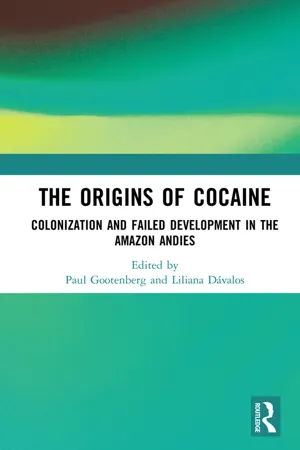
The Origins of Cocaine
Colonization and Failed Development in the Amazon Andes
- 178 pages
- English
- ePUB (mobile friendly)
- Available on iOS & Android
eBook - ePub
The Origins of Cocaine
Colonization and Failed Development in the Amazon Andes
About this book
Information
1Introduction
Orphans of development: the unanticipated rise of illicit coca in the Amazon Andes, 1950–1990
Paul Gootenberg
Coca contexts
For decades, conventional wisdom as to why so many poor farmers in the “global south” get lured into illegal drug crops—poppy, coca, cannabis—revolves around a broad mix of ideas: their marginality from “weak” or absent states, grinding poverty or immiseration, or proximity to porous, ungovernable borders and endemic armed conflicts that foster smuggling activities. Each of these explanations has a grain of truth for the myriad of zones in which drug crops thrive, and each has been used to design policies to discourage illicit crops. But this volume zeroes in on a more specific origin for the massive and unprecedented turn to illicit coca crops across the western Amazon during the middle of the last century, which jump-started the still thriving global cocaine boom of the mid-1970s and beyond. Thousands of migrating peasants, in Peru, Bolivia, and Colombia alike, adopted coca and became the modern cocalero (coca grower) classes of the Andes in the aftermath of failed or retreating state-led, mid-century modernizing colonization projects to develop the Amazon. The take-off of the Andean drug trades was thus a vast classic “unintended consequence of social action” (Merton 1936). Its actors on the ground were, in effect, the orphans of development.
This striking pattern of flight from failed development in the Andes is detailed here around three finely grained case studies of frontier sites that became hotbeds of cocaine trafficking by the 1980s: The Upper Huallaga Valley of east-central Peru, Bolivia’s lowland Chapare region, and southeast Colombia’s tropical Meta Department. These geographically disparate resettlement and agrarian modernization projects were related: connected by post-war dreams of building a vast Carretera Marginal de la Selva across the western Amazon from Venezuela to Santa Cruz in eastern Bolivia, promoted by national governments and United States foreign aid and such multilateral agencies as the Inter-American Development Bank (IDB) and the World Bank. For example, Peru’s reformist President Fernando Belaúnde Terry of the mid-1960s celebrated road-building and agricultural stations across Peru’s western Amazon as the “Conquest of Peru by Peruvians,” a militant 1959 colonizing metaphor in which fertile valleys such as the Huallaga would become the long-dreamed-of breadbasket for teeming coastal cities and exhausted sierran agriculture. This was before bitter agricultural experience and new-found environmental awareness belied longstanding myths of boundless Amazonian productivity.
Another political element at play across all three nations was the Cold War. All the Andean nations hosted an array of Cold War regimes across these four decades (1950–1990), most closely aligned with the United States, and all three political classes also feared restless campesino masses pressing against the old hacienda systems of their upland interior (Pike 1977). Population movement into a developing Amazon was viewed as a frictionless way of appeasing poor and rebellious rural folk as well as keeping them out of revolutionary shanty towns in cities (as they were also wrongly perceived at the time). The Cuban Revolution of 1960 added ideological urgency to this project. Troubling guerrilla focos (bands) quickly broke out in remote parts of Colombia (sparking the half-century struggle with the FARC) and Peru (more quickly squashed from above); in Bolivia’s Santa Cruz jungles, the iconic revolutionary Ernesto “Che” Guevara landed with the mistaken notion that Bolivian colonos (lowland colonists), some already with coca plots, would respond to his revolutionary zeal. Agrarian reform—of a non-Communist i.e., reformist, gradualist, non-redistributive kind—became the officially sanctioned policy of the brief but pivotal Kennedy-era U.S. “Alliance for Progress” (1961–1964). In Bolivia, the breakup of traditional estates often occurred erratically as peasants fled or empowered themselves to land after the 1950s urban revolution. Colombia enacted the narrowest of agrarian reforms, dubbed by Liberal politicians as “Making Tortillas without Breaking Eggs,” an obviously impossible political recipe. Confident, stage-based “Modernization Theory” was at its heyday in U.S. academia and governmental circles (Engerman et al. 2003; Latham 2000), and such abstract Cold War ideas were read and used by national regimes for their own purposes, often concretized (in contrast to industrializing plans) on such tropical development zones. In each country, by the end of the 1960s, tens of thousands of poor farmer colonos streamed into these jungles, either to hastily organized settlement poles with formal credits, land titles, warehouses, and other services, or “informally” spontaneously on their own, wherever the often unfinished roads led. To take the Peruvian example again, Huánuco Department, where the Río Huallaga starts its course towards the Amazon, became by far the country’s fastest-growing department from the 1950s through the 1970s, outside the coastal capital of Lima (Werlich 1968).
Then, in different ways and timings, these projects failed or were disbanded, with little to show in marketable agricultural goods or stable farming livelihoods. By the late 1970s, this left hundreds of thousands of impoverished non-indigenous peasants essentially stranded in the Amazon without the government credits, schools, social and judicial services, communications, and business opportunities or jobs originally promised by colonization schemes (Aramburú et al. 1982). In Peru, one of the country’s first modern feature-length films, Armando Robles Godoy’s La Muralla Verde (The Green Wall, 1970) captured the insecure mood of Amazonian colonists disillusioned with the distant state. In Bolivia’s tropical Chapare, below the highland Cochabamba Valley, many communities became self-regulated instead by “sindicatos,” “federaciones,” and “centrales.” Revealing of migrant roots in unionized altiplano mining camps (Sanabria 1993), this autonomous organization still marks Bolivia’s politically active lowland agriculturalists today. In Colombia, the promised electricity and sanitation never arrived and peasants drifted into itinerant subsistence plots on fragile soils, joined by migrants escaping the violent conflicts of the highlands on their own. As suggested in this volume, from the peasant vantage, a colonist culture of “dependency on the state” meant both autonomy from traditional power holders and an eventual deep sense of abandonment by authorities.
By the mid-1970s, in any case, a common and powerful ideological drift was perceptibly underway as well, away from democratic panacea of “development” to other Cold War projects (also emanating from the United States) of internal national security. Some militaries adopted a top-down developmental ideal, notably Peru’s left-wing military regime of 1968–1973. General Velasco’s far more radical agrarian reform—swift expropriation of the landed “Oligarchy”—aimed for “modernizing” highland cooperative estates, but ended up instead accelerating an outflow of landless farm laborers, many into Amazonia (Meyer 2009). But tropical frontiers were also fading from the states’ narrowing political vision and capacity. The dramatic debt and bankruptcy crises of the 1970s and 1980s felt across the Andes made national governments increasingly hard-pressed for funding any wider territorial or deeper social expansion. Instead “neo-liberalism,” the new gospel mandating the reduction of state roles, and the magic of the market instead, became dominant throughout the region by the 1980s, followed after 1989 (and the receding Cold War) by the mantra of “Globalization” over state-led bounded. National development. In short, the state became in a historical process increasingly “absent” in these now-populated lowland pockets.
These were the larger political and global conditions that by the mid-1970s led to coca’s rise as one of the most attractive goods to alienated refugees of development along the “Andean Ridge.” The majority of these campesinos had no earlier horticultural or cultural exposure to the coca shrub, Erythroxylum coca. Each of these tropical peasant zones, in another part of the story, had to link up to nascent drug trafficking and processing rings coalescing since the early 1950s, first in Bolivia, then Peru, and finally linked to coca in Colombia in the 1980s, a country bereft of previous contact with the shrub, given its small indigenous population using coca-leaf. Each group of autonomous farmers had to learn to plant, tend, harvest, hide and chemically process coca-leaf into PBC—pasta básica de cocaína or coca paste—an easily transportable and sellable form of cocaine sulfates conveniently made from common “developmental” wholesale goods like kerosene, plastic sheeting, and cement lime (León and Castro de la Vega 1989). By the mid-1960s it was the most easily marketable of goods in Chapare, linked to drug syndicates in Cochabamba and La Paz and funneled to newly rising recreational cocaine markets abroad through northern Chile. Paradoxically or not, coca became the perfect market—daresay “neo-liberal”-era—good, even if most peasants (as opposed to moneymen higher up the commodity chain) were barely eking a living from it in this highly unequal illicit economy. By the mid-1970s PBC acquired a similar role in the explosively expanding “green wall” of coca in the Huallaga, most of it flowing north through frontier Leticia to swiftly consolidating urban Colombian processing and distributive groups in Medellín, Bogotá, and Cali (Gootenberg 2008). Then between the mid-1980s and 1990s, Colombian colonos themselves, in a set of complex transformations outlined in Chapter 5, began to swiftly adopt the crop, completing the vertical integration of Colombia’s regional “cartel” cocaine industry.
In all three Andean nations, the epicenters for illicit cocaine—their geographies set by the 1980s—were the three central lowland ex-colonization zones: the Chapare, the Upper Huallaga, and the arc defined by Meta in the north and Putumayo in the south. By the 1990s, the Chapare alone had absorbed some 350,000 migrants, with its chief economic activity, coca cultivation, covering 55,000 hectares (the traditional Yungas coca-growing area near La Paz never re-oriented to cocaine). Further east, the lowland frontiers of Santa Cruz and Beni (adjacent to Brazilian and Paraguayan border smuggling) also experienced a lesser cocaine boom by the late 1970s, significantly, in the wake of oil and cotton development. Many traffickers of Bolivia’s notorious 1980s “narco-state” originated and operated from Santa Cruz, Bolivia’s wealthiest region. The Peruvian Huallaga, with its center around the former development pole of Tocache, by the early 1990s climaxed at 120,000 hectares in coca, before a sharp fall partly due to the swift Colombian peasant adoption of the crop. (Today’s Peruvian cocaine resurgence in the southern Valle de los Ríos Apurímac, Ene y Mantaro or VRAEM system is geographically apart from cocaine’s birthplace to its north). In Colombia, a more varied geography of coca ensued, starting from the initial former colonization zones of Guaviare and Sur de Meta (studied here in the Ariari) and in the 1990s into the southwestern rainforests of Putumayo (along fading frontier roads of former petroleum and rubber extraction) and Caquetá, and beyond, to areas like Vaupés and the middle Magdalena Valley. By the year 2000, Colombia’s 60–80,000 cocalero families supplied two-thirds of the world’s coca and cocaine, enough for about 700 exportable tons of the drug. Colombia’s pattern of more scattered coca likely stemmed from rival trafficker pole promotion of coca planting and the “balloon” dispersal effect of being the most consistent target of U.S.-funded coca eradication campaigns (at best intermittently enforced in Peru and Bolivia) by the 1990s. To reiterate the core thesis here: the initial historical path from Amazonian development to cocainization appears systematic and even in some sense of the word “structural.” It occurred in an archipelago of sites across the Amazonian Andes with shared social traits but in highly distinctive nation-state configurations. The three countries in play were marked by three contrasting ethnic regimes and longer cultural relationships to coca leaf—Bolivia, majority Aymara-Quechua indigenous and with widespread popular use of coca; Peru, by the 1950s becoming a majority cholo (mestizo) culture, with legal coca commercialized from sites in southern Cusco; and Colombia with few and scattered indigenous groups such as the Nasi of the Cauca region. It happened despite three different historical relationships with the industrial medicinal drug cocaine: Peru, with a long legal (1880s–1940s) cocaine-processing sector in the central high Amazon; Bolivia, with strong coca-leaf cultivation in the Yungas of La Paz for peasant and miner consumption but no cocaine whatsoever until illicit drugs erupted in the 1950s; and Colombia, with neither relationship prior to the 1970s. It unfolded under highly varying degrees and politics of U.S.-influenced drug enforcement. The three nations also underwent a gamut of agrarian reform transformations after mid-century: Colombia’s constricted under elite control, Bolivia’s a spontaneous, barely channeled takeover of estates by peasant groups, and Peru’s, after peasant turmoil in the early 1960s, undertaken by reformist and then radical government fiat. And cocainization occurred across a bewildering array of political regimes...
Table of contents
- Cover
- Title Page
- Copyright Page
- Contents
- List of illustrations
- List of contributors
- Acknowledgements
- 1 Introduction: Orphans of development: the unanticipated rise of illicit coca in the Amazon Andes, 1950–1990
- 2 The ghosts of development past: deforestation and coca in western Amazonia
- 3 Ideas of modernization and territorial transformation: the case of the Upper Huallaga Valley of Peru
- 4 Creating coca frontiers and cocaleros in Chapare: Bolivia, 1940 to 1990
- 5 Economic development policies in Colombia (1960s–1990s) and the turn to coca in the Andes Amazon
- 6 The making of a coca frontier: the case of Ariari, Colombia
- 7 Epilogue: will governments confront coca cultivation, or its causes?
- Index
Trusted by 375,005 students
Access to over 1.5 million titles for a fair monthly price.
Study more efficiently using our study tools.
Frequently asked questions
Yes, you can cancel anytime from the Subscription tab in your account settings on the Perlego website. Your subscription will stay active until the end of your current billing period. Learn how to cancel your subscription
No, books cannot be downloaded as external files, such as PDFs, for use outside of Perlego. However, you can download books within the Perlego app for offline reading on mobile or tablet. Learn how to download books offline
Perlego offers two plans: Essential and Complete
- Essential is ideal for learners and professionals who enjoy exploring a wide range of subjects. Access the Essential Library with 800,000+ trusted titles and best-sellers across business, personal growth, and the humanities. Includes unlimited reading time and Standard Read Aloud voice.
- Complete: Perfect for advanced learners and researchers needing full, unrestricted access. Unlock 1.5M+ books across hundreds of subjects, including academic and specialized titles. The Complete Plan also includes advanced features like Premium Read Aloud and Research Assistant.
We are an online textbook subscription service, where you can get access to an entire online library for less than the price of a single book per month. With over 1.5 million books across 990+ topics, we’ve got you covered! Learn about our mission
Look out for the read-aloud symbol on your next book to see if you can listen to it. The read-aloud tool reads text aloud for you, highlighting the text as it is being read. You can pause it, speed it up and slow it down. Learn more about Read Aloud
Yes! You can use the Perlego app on both iOS and Android devices to read anytime, anywhere — even offline. Perfect for commutes or when you’re on the go.
Please note we cannot support devices running on iOS 13 and Android 7 or earlier. Learn more about using the app
Please note we cannot support devices running on iOS 13 and Android 7 or earlier. Learn more about using the app
Yes, you can access The Origins of Cocaine by Paul Gootenberg, Liliana Dávalos, Paul Gootenberg,Liliana M. Dávalos,Liliana Dávalos, Paul Gootenberg, Liliana M. Dávalos in PDF and/or ePUB format, as well as other popular books in Social Sciences & Anthropology. We have over 1.5 million books available in our catalogue for you to explore.