![]()
p.16
1 | Development of the brain in relation to the emotional needs of very young children |
Key themes in this chapter
After reading this chapter you should be able to:
■ Understand the development of the brain from conception through to five years of age
■ Discuss the importance of the health and wellbeing of the Mother during antenatal and postnatal periods
■ Consider the impact on the brain of infections and trauma (accidents)
■ Discuss the effects of child abuse on brain development
■ Begin to relate and discuss behaviours exhibited by young children that may have been caused by interruptions in brain development
■ Reflect on and articulate the importance of in-depth observations in relation to children’s emotional development, emotional needs and their all-round development, including providing for their individual needs within your different settings
■ Analyse and critique the importance of understanding the development of the brain.
Introduction
Neuroscience is a very important area of research which, over the last three decades, has provided all professionals working with very young children with strong evidence of rapid brain development in the first years of life. This chapter provides an overview of the development of the brain from conception through to five years of age and beyond and discusses the ways in which the neural pathways are formed. Reference is made to the changes that occur during puberty and adulthood and to the changes that have been found to occur when children experience life changing events and, or, do not experience a loving, nurturing environment. The effects of child abuse, the health of the Mother prior to pregnancy, during the ante, peri- and post-natal periods are introduced. Issues that may arise from post-natal depression are discussed because Early Years Practitioners may well be the first persons to, perhaps, identify the fact that a Mother is unwell. The importance of Mother to Child and Child to Mother interactions, eye-contact and proto-conversations, linked to the work of Trevarthen (2002, 2004) is presented. Some aspects of attachment are referred to and lead into the chapter on Attachment theories, both past and present. One essential point to make here is, that whilst research by neuroscientists is increasing our knowledge of brain development and the effects of our lives and experiences on this development, a holistic approach to childcare and education must still be maintained. It must also be remembered that brain development continues well after a child’s third birthday. Moss (2014) provides food for thought here.
p.17
(Moss 2014 p. 22)
In some respects, this quote may sound contradictory to the points being made in this introduction and within the content of the chapter. However, it is so important that Early Years Practitioners retain a balanced view and reflect on their practice and incidents that may arise during their working days. It is essential to use your powers of observation, recording and reflection to ensure that you maintain an objective approach to all aspects of your care and education during your time with the children, parents and other professionals. Yes, the development of the brain and the formation of neural pathways is vitally important, but we must remember not to focus entirely on the brain. Meade (2000) wrote about the importance of the earliest years in relation to brain development.
(Meade (2000) cited in Roberts 2010 p. 5)
p.18
Every interaction you as practitioners have with the children in your settings will be helping this process. The following section on the development of the brain and situations that may affect this development will help to assist your observational and reflective skills. It will provide you with information to consider should you have concerns about the development and progress of a child.
The development of the brain
You will already know that from the point of conception when the sperm enters the ovum very rapid cell division commences, with differentiation into the different cell types. The initial development of the cardiac system, including cardiac muscle, the beginnings of the skeletal system, which includes cartilage, and the nervous system, including the creation of neurons, all occurs during the first three months of pregnancy, known as the first trimester.
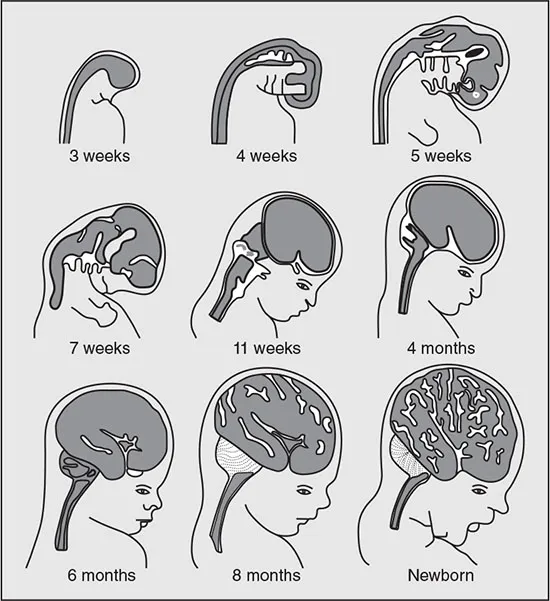
Figure 1.1 shows the development of the brain and spinal cord from the neural tube at 3 weeks through to birth. It is possible to see, in Figure 1.1, the way that the brain develops in complexity very quickly and that as early as eleven weeks’ gestation the spinal cord, the brain stem and the cerebral cortex/neocortex are already forming and relatively well defined. The brain can be seen developing in what Carter describes as a bulb like way, at the top of the neural tube. It is evident that by the time the baby is born the brain has increased in density and developed complex bulges (gyri) and valleys (sulci) (Carter,1998 and 2010).
p.19
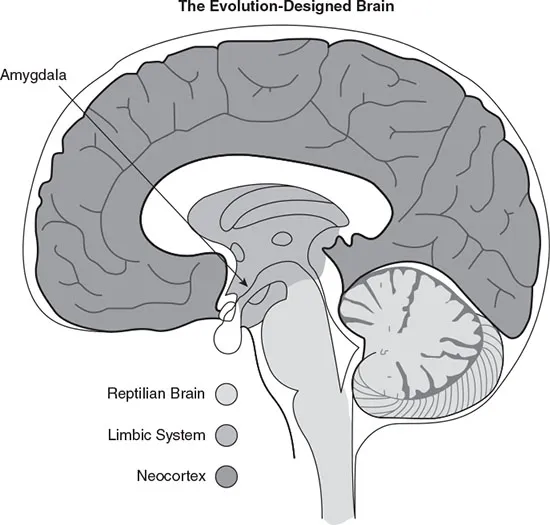
Compare the image of the newborn brain in Figure 1.1 with the image of the Evolution-Designed Brain in Figure 1.2. Take into account the fact that in Figure 1.2 the internal view of one hemisphere is shown, not an external view as in Figure 1.1.
Figure 1.2 has the title ‘the Evolution-Designed Brain.’ This is because it is thought that the human brain has gradually evolved from the basic neural tube still present in fish, through the simple spinal cord and brain required by reptiles. From this stage it developed into the limbic system of early mammals and finally the complex human brain with the ever-changing cerebral cortex that humans have today. (Carter 2010). All of the different areas are still present in the human brain and can be clearly seen in Figure 1.1, as the brain develops.
p.20
The evolutionary development of the different areas of the brain is clearly defined here using colour-coding. It can be seen that the shape closely resembles the image of the brain of a newborn:
■ The Reptilian Brain controls reflex actions, breathing, sleeping, waking and the heartbeat, all of which are required for survival (Pally 2000). It also includes the cerebellum which controls movement, and which, was the ‘main brain’ (Carter 2010) of mammals prior to mammalian evolution and the development of the neocortex.
■ The Limbic System, which includes the amygdala, controls emotions, memory, nursing, care and play, sometimes referred to as ‘our emotional brain’. (OECD 2007).
■ The Neocortex gradually increased in size as humans evolved. This area controls intelligence, language, movement, vision and reasoning, described by Pally as the ‘executive centre of the brain’ (Pally 2000 p. 4). The neocortex, also known as the cerebral cortex, is the main part of the brain that receives messages via the neural pathways (see Figures 1.2 and 1.3) and responds to the demands from within the body and the different environmental experiences of each baby throughout life. It, with the cerebellum and amygdala, controls who we are, as will become evident when examining Figure 1.4 where the functions of the brain are illustrated, and, as you progress through this and related chapters. The neocortex is the part of the brain that has evolved. It has a property, often described as ‘plasticity’, maintained throughout life, that enables changes to occur. However, plasticity within the brain is at its highest level in the early years, from birth until the age of three years. It is these findings that have, obviously, led to the focus on the development of the brain and experiences within the early years, especially the early interactions and development of a secure attachment. Secure attachment is discussed in depth in Chapter 2.
Areas of the brain
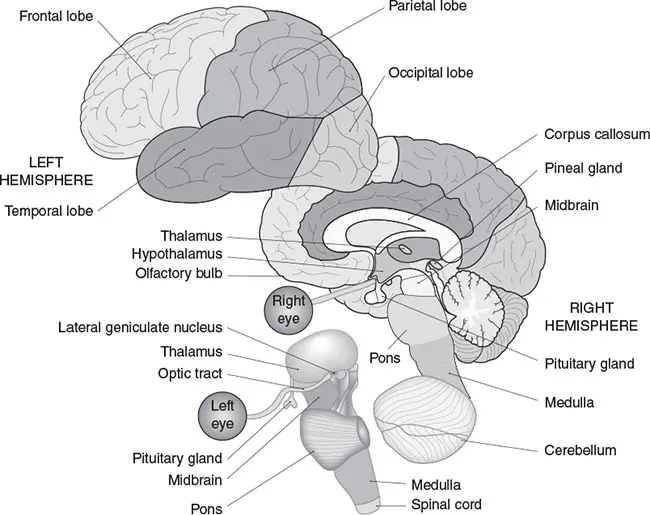
The diagram below, Figure 1.3 gives a more detailed view of the structure of brain, it is beginning to show the complexity of the brain. The cerebral cortex has been subdivided and two endocrine glands that are situated within the brain are included; these are the pituitary gland and the pineal gland.
p.21
Whilst the brain is being considered in some detail, how are the messages transferred from different parts of the body to the brain? The nervous system is divided in two parts, the central nervous system (CNS) which consists of the brain and the spinal cord and the peripheral nervous system (PNS) which is formed of the nerves that branch out from the brain and spinal cord to supply and connect to all parts of the body. This allows for the transmission of electrical impulses from our finger tips, skin, limbs, muscles and organs to the appropriate area of the brain where the electrical impulses are received and interpreted. However, the anatomy and functions of the brain are the main concentration in this chapter because the development of the brain is very closely related to the emotional needs of very young children, as stated above and in Chapter 2.
Figure 1.3 above shows:
■ the right and left hemispheres which are, when not illustrated as two separate hemispheres, joined together by the corpus callosum which allows stimuli to be transmitted across from one hemisphere of the brain to the other;
■ the four lobes, the frontal, the parietal, the occipital and the temporal, which form the cerebral cortex;
■ the cerebellum;
p.22
■ the brain stem which leads directly into the spinal cord;
■ the two endocrine glands which are:
● the pineal gland which secretes melatonin in young chil...