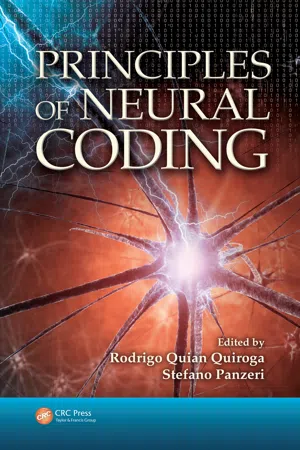
Understanding how populations of neurons encode information is the challenge faced by researchers in the field of neural coding. Focusing on the many mysteries and marvels of the mind has prompted a prominent team of experts in the field to put their heads together and fire up a book on the subject. Simply titled Principles of Neural Coding, this b
eBook - PDF
Principles of Neural Coding
- 625 pages
- English
- PDF
- Available on iOS & Android
eBook - PDF
Principles of Neural Coding
About this book
Information
Table of contents
- Front Cover
- Contents
- Preface
- Editors
- Contributors
- Chapter 1 - Physiological Foundations of Neural Signals
- Chapter 2 - Biophysics of Extracellular Spikes
- Chapter 3 - Local Field Potentials: Biophysical Origin and Analysis
- Chapter 4 - Spike Sorting
- Chapter 5 - Spike-Train Analysis
- Chapter 6 - Synchronization Measures
- Chapter 7 - Role of Correlations in Population Coding
- Chapter 8 - Decoding and Information Theory in Neuroscience
- Chapter 9 - Neural Coding of Visual Objects
- Chapter 10 - Coding in the Auditory System
- Chapter 11 - Coding in the Whisker Sensory System
- Chapter 12 - Neural Coding in the Olfactory System
- Chapter 13 - Coding across Sensory Modalities: Integrating the Dynamic Face with the Voice
- Chapter 14 - Population Coding by Place Cells and Grid Cells
- Chapter 15 - Coding of Movement Intentions
- Chapter 16 - Neural Coding of Short-Term Memory
- Chapter 17 - Role of Temporal Spike Patterns in Neural Codes
- Chapter 18 - Adaptation and Sensory Coding
- Chapter 19 - Sparse and Explicit Neural Coding
- Chapter 20 - Information Coding by Cortical Populations
- Chapter 21 - Information Content of Local Field Potentials: Experiments and Models
- Chapter 22 - Principles of Neural Coding from EEG Signals
- Chapter 23 - Gamma-Band Synchronization and Information Transmission
- Chapter 24 - Decoding Information from fMRI Signals
- Chapter 25 - Dynamics of Neural Networks
- Chapter 26 - Learning and Coding in Neural Networks
- Chapter 27 - Ising Models for Inferring Network Structure from Spike Data
- Chapter 28 - Vocal Learning with Inverse Models
- Chapter 29 - Computational Models of Visual Object Recognition
- Chapter 30 - Coding in Neuromorphic VLSI Networks
- Chapter 31 - Open-Source Software for Studying Neural Codes
- Back Cover
Trusted by 375,005 students
Access to over 1.5 million titles for a fair monthly price.
Study more efficiently using our study tools.
Frequently asked questions
Yes, you can cancel anytime from the Subscription tab in your account settings on the Perlego website. Your subscription will stay active until the end of your current billing period. Learn how to cancel your subscription
No, books cannot be downloaded as external files, such as PDFs, for use outside of Perlego. However, you can download books within the Perlego app for offline reading on mobile or tablet. Learn how to download books offline
Perlego offers two plans: Essential and Complete
- Essential is ideal for learners and professionals who enjoy exploring a wide range of subjects. Access the Essential Library with 800,000+ trusted titles and best-sellers across business, personal growth, and the humanities. Includes unlimited reading time and Standard Read Aloud voice.
- Complete: Perfect for advanced learners and researchers needing full, unrestricted access. Unlock 1.5M+ books across hundreds of subjects, including academic and specialized titles. The Complete Plan also includes advanced features like Premium Read Aloud and Research Assistant.
We are an online textbook subscription service, where you can get access to an entire online library for less than the price of a single book per month. With over 1.5 million books across 990+ topics, we’ve got you covered! Learn about our mission
Look out for the read-aloud symbol on your next book to see if you can listen to it. The read-aloud tool reads text aloud for you, highlighting the text as it is being read. You can pause it, speed it up and slow it down. Learn more about Read Aloud
Yes! You can use the Perlego app on both iOS and Android devices to read anytime, anywhere — even offline. Perfect for commutes or when you’re on the go.
Please note we cannot support devices running on iOS 13 and Android 7 or earlier. Learn more about using the app
Please note we cannot support devices running on iOS 13 and Android 7 or earlier. Learn more about using the app
Yes, you can access Principles of Neural Coding by Rodrigo Quian Quiroga, Stefano Panzeri, Rodrigo Quian Quiroga,Stefano Panzeri in PDF and/or ePUB format, as well as other popular books in Medicine & Biotechnology in Medicine. We have over 1.5 million books available in our catalogue for you to explore.