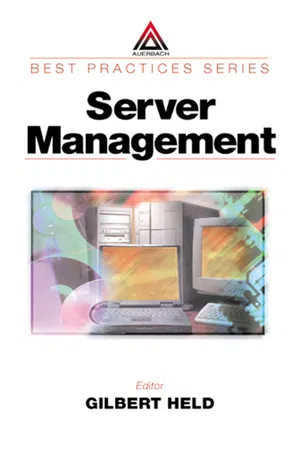
This single-volume desktop reference provides comprehensive information on all server issues - featuring contributions from experts in the field. Engineers for system vendors, systems integrators, major resellers, end-users, and representatives from Hewlett-Packard, Novell, IBM, Compaq, Microsoft, and NEC share their ideas and experience on such to
eBook - PDF
Server Management
About this book
Information
Table of contents
- Front cover
- Contributors
- Introduction
- Acknowledgments
- Contents
- Section I: The Role of the Server
- Chapter 1. The Client/Server Architecture
- Chapter 2. The Server at the Heart of Your Business
- Chapter 3. What Does a Server DO? A General Overview
- Chapter 4. The Case for Mainframe Servers in the Enterprise
- Section II: Server Functionality
- Chapter 5. Server Issues and Trends, 2000
- Chapter 6. Specifying Servers Based on Needs and Growth
- Chapter 7. Consolidated Server Overview
- Chapter 8. Server Installation Considerations
- Chapter 9. The Business of Managing Distributed Systems
- Chapter 10. Including End Users in the Planning of Integrated Systems Development
- Chapter 11. Business Continuity in the Distributed Environment
- Chapter 12. Developing Client/Server RDBMS Applications Using Java Servelets and JDBC
- Section III: Hardware
- Chapter 13. Server Memory
- Chapter 14. CPUs
- Chapter 15. Server Data Bus Structures
- Chapter 16. The RAID Advantage
- Chapter 17. Multiprocessing Servers
- Chapter 18. Super Servers-One Step Beyond
- Section IV: Network Operating Systems
- Chapter 19. NetWare 3.x
- Chapter 20. intraNetWare Overview
- Chapter 21. Migrating to intraNetWare 4.x and Novell Directory Services
- Chapter 22. WIndows NT Architecutre
- Chapter 23. Windows NT Workstation vs. Server 4.0
- Chapter 24. Evaluating Client/Server Operating Systems: Focus on Windows NT
- Chapter 25. A Look At Linux
- Chapter 26. With Linux and Big Brother Watching over Your Network, You Don't Have to Look over Your Shoulder (or Your Budget)
- Chapter 27. Changing Server Operating Systems
- Chapter 28. UNIX as an Application Server
- Section V: Application Servers
- Chapter 29. Print Servers and Network Printing
- Chapter 30. Fax Servers
- Chapter 31. Remote Access Concepts
- Chapter 32. Communication Servers
- Chapter 33. Internet Mail Server Overview
- Chapter 34. An Introduction to Microsoft Exchange Server
- Chapter 35. Virtual Server Overview
- Chapter 36. Text-to-Speech Server Overview
- Chapter 37. CD-ROM Servers
- Chapter 38. Choosing and Equipping an Internet Server
- Section VI: Server Performance
- Chapter 39. Selecting a Web Server Connection Rate
- Chapter 40. Working with Images in Clinet/Server Environments
- Chapter 41. Working with NT's Performance Monitor
- Section VII: Security
- Chapter 42. Server Security Policies
- Chapter 43. Security and Resource Sharing in an NT Environment
- Chapter 44. Windows NT Access Security
- Chapter 45. Evaluating Anti-Virus Solutions Within Distributed Environments
- Section VIII: Server Add-Ons and Troubleshooting Methodologies
- Chapter 46. Software Management: The Practical Solution to the Cost-of-Ownership Crisis
- Chapter 47. Inventory-Cornerstone Technology for Managing the Network
- Chapter 48. Software Distribution
- Chapter 49. Fault Tolerance Protection and RAID Technology for Networks: A Primer
- Chapter 50. Network Data and Storage Management Techniques
- Chapter 51. Acquiring and Using a UPS System
- Chapter 52. Troubleshooting: Resolution Methodologies
- Chapter 53.Troubleshooting: The Server Environment
- About the Editor
- Index
- Back cover
Trusted by 375,005 students
Access to over 1.5 million titles for a fair monthly price.
Study more efficiently using our study tools.
Frequently asked questions
Yes, you can cancel anytime from the Subscription tab in your account settings on the Perlego website. Your subscription will stay active until the end of your current billing period. Learn how to cancel your subscription
No, books cannot be downloaded as external files, such as PDFs, for use outside of Perlego. However, you can download books within the Perlego app for offline reading on mobile or tablet. Learn how to download books offline
Perlego offers two plans: Essential and Complete
- Essential is ideal for learners and professionals who enjoy exploring a wide range of subjects. Access the Essential Library with 800,000+ trusted titles and best-sellers across business, personal growth, and the humanities. Includes unlimited reading time and Standard Read Aloud voice.
- Complete: Perfect for advanced learners and researchers needing full, unrestricted access. Unlock 1.5M+ books across hundreds of subjects, including academic and specialized titles. The Complete Plan also includes advanced features like Premium Read Aloud and Research Assistant.
We are an online textbook subscription service, where you can get access to an entire online library for less than the price of a single book per month. With over 1.5 million books across 990+ topics, we’ve got you covered! Learn about our mission
Look out for the read-aloud symbol on your next book to see if you can listen to it. The read-aloud tool reads text aloud for you, highlighting the text as it is being read. You can pause it, speed it up and slow it down. Learn more about Read Aloud
Yes! You can use the Perlego app on both iOS and Android devices to read anytime, anywhere — even offline. Perfect for commutes or when you’re on the go.
Please note we cannot support devices running on iOS 13 and Android 7 or earlier. Learn more about using the app
Please note we cannot support devices running on iOS 13 and Android 7 or earlier. Learn more about using the app
Yes, you can access Server Management by Gilbert Held in PDF and/or ePUB format, as well as other popular books in Computer Science & Information Technology. We have over 1.5 million books available in our catalogue for you to explore.