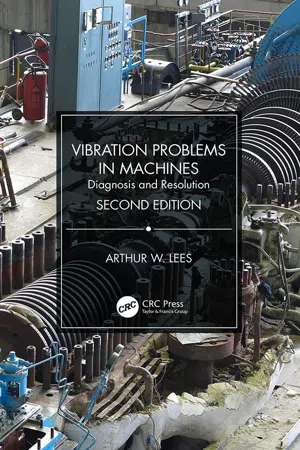
Vibration Problems in Machines explains how to infer information about the internal operations of rotating machines from external measurements through methods used to resolve practical plant problems. Second edition includes summary of instrumentation, methods for establishing machine rundown data, relationship between the rundown curves and the ideal frequency response function. The section on balancing has been expanded and examples are given on the strategies for balancing a rotor with a bend, with new section on instabilities. It includes case studies with real plant data, MATLAB® scripts and functions for the modelling and analysis of rotating machines.
- 362 pages
- English
- ePUB (mobile friendly)
- Available on iOS & Android
eBook - ePub
About this book
Information
1
Introduction

The general field of condition monitoring has received substantial attention over the last few decades, and it is worth reflecting on the state of the topic. Although it has always been practiced at some level, the manner of assessing the condition is constantly under review in the light of recent developments in understanding.
In assessing the condition of a piece of equipment, the operator gathers data such as vibration, operating temperature, noise, performance, and electrical parameters where appropriate. At one time, the comparison with normal condition was achieved largely on the basis of staff experience, but the general trend has been toward a more precise quantified approach. This has been required by revised patterns of working and increasing plant complexity, but it is, in essence, the same operation. A fundamental question arises as to how one can “codify” the knowledge of an experienced engineer and focus the knowledge on a specific area of plant. This presents a challenge that has shown significant progress in recent years, although the issue cannot be regarded as completely resolved. Important progress has been made in computational modeling (both finite element (FE) analysis and computational fluid dynamics), artificial neural networks (ANNs), statistical approaches, expert systems, and identification methods. All of these have a role to play in assessing the condition of a piece of equipment, and their role will be outlined in subsequent chapters. First of all, however, the general field of condition monitoring, as applied to rotating machines, is reviewed.
1.1 Monitoring and Diagnosis
Generally these two terms are linked under the general heading of condition monitoring, but, in fact, they are two quite distinct functions. In both areas, the first requirement is to gather and record all salient details of the operation of the piece of equipment; however, as will be discussed, the choice as to what details are salient is far from a trivial task. However, that discussion is deferred for the present.
To illustrate this point with a specific example, let us consider a centrifugal pump driven by an electric motor. In such a case, the monitored parameters may well include bearing vibration levels, temperature, water pressure, water flow rate, motor current, and voltage. Note that although this is a fairly long list, it is by no means exhaustive. In some circumstances, one may wish to record the rotor vibration (as opposed to that of the bearings) and bearing oil temperature. In fact, even a relatively simple piece of machinery may have a significant number of parameters, which may be useful for monitoring purposes, and a judicious choice is required to limit the measured set to cost-effective proportions: however, making this choice requires some appreciable physical insight.
Having decided on the set of monitored parameters, the method of recording is the next choice to be made, and this ranges from regular spot checks to some form of continuous monitoring, now almost invariably computer based. While the latter represents a more expensive option, it does offer more flexibility in terms of the ways in which data can be manipulated to offer insight into the underlying features of machine operation. Here again decisions demanding physical insight into machine operation and the relative failure scenarios are required.
We now consider some of the ways in which plant data may be analyzed, and how this may be used to form judgments about plant operation. Clearly, any general trend in the plant data, or indeed a sudden change suggests that the equipment has altered in some way and, subjected to some checks, may require the removal of the plant from service. Note that, realistically, all pieces of equipment are subjected to some random perturbations, and so statistical techniques are needed to form a valid decision as when to remove the plant from service.
To proceed further, we examine these three basic questions that are posed in Condition Monitoring systems:
- Has something gone wrong?
- What has gone wrong?
- How long can the plant run safely?
To address the first of these questions, it is often sufficient to adopt a purely statistical analysis of monitored data and seek trends and changes. At the most basic level, no knowledge of the internal operation of the machinery is required. For example, a monitoring system may simply plot the overall vibration levels at the bearings (or elsewhere) and not examine the (short-term) time variation. Some of the ways in which data can be examined are discussed in Chapter 2. As discussed in later chapters, a great deal depends on the frequency with which measurements are monitored, and provided several measurements are recorded during each rotor revolution, the orbit of the shaft may be traced and this gives some further insight into the machine’s behavior. In many cases, rudimentary measurements give some indications that something has happened to the machine and straightforward comparison with records will suffice to answer the first of the three questions. To answer the second, generally it requires considerably more insight, which may be provided by extensive experience, a detailed theoretical analysis or, very often, a combination of these. The third question, as to how long the plant will/can run safely is more difficult, and to a large extent, is still at the research stage. Nevertheless, an in-depth understanding of the machine’s operation is an essential prerequisite. Later chapters discuss the interpretation of plant data, but first we give a brief survey of quantities that may be useful in assessing a machine’s behavior.
1.1.1 Monitored Parameters
1.1.1.1 Vibration
In a rotating plant, vibration is the most commonly monitored parameter. There are two reasons for this: first, it is readily measured with convenient instrumentation and, perhaps more importantly, vibrations give a comprehensive reflection of the state of a rotating machine. The disadvantage is that much of the information for diagnosis can only be gained after extensive data processing, but standard techniques have now been developed, which go some way to relieving this burden. For basic monitoring, vibration levels can be, and are, used to a great effect.
1.1.1.2 Pressure, Flow, Temperature
In the case of pumps, pressure and flow represent the main performance parameters, and hence it is important to monitor them regularly, although clearly these will not be expected to vary as rapidly as the vibration. There may, of course, be fluctuations in pressure, but the flow rate will not track these, owing to substantial effects of inertia. Chapter 6 discusses some of the ways in which the pressure field within a typical centrifugal pump has a direct influence on the vibration characteristics. This treatment is by no means comprehensive and the interested reader is referred to the work of Childs (1993). The important point to emphasize here is that various pieces of information are interrelated; taken together, they present a complex picture. Temperature may be included in this section as another slowly varying parameter. It is the role of the diagnostic engineer to form an overall view from this complex pattern.
1.1.1.3 Voltage and Current
Electrical measurements also form an important part of this picture. A large number of machines are driven by electric motors, and the electrical measurements can be used to yield information on the overall machine efficiency, a key indicator of general deterioration. Being used at this level, periodic checks would suffice, but a more detailed analysis of fluctuations gives additional information on both the motor and the auxiliary machine that is being driven.
1.1.1.4 Acoustic Emission
Acoustic emission (AE) is, in one sense, simply vibration at very high frequency, but this description fails to give due recognition to its important distinction from conventional vibration data. As the name suggests in looking at AE, the engineer is monitoring the acoustic energy emitted by the material as changes (e.g., crack formation and propagation) take place. In effect, one is “listening” to the high-frequency waves generated by the breaking of intermolecular bonds within a component, rather than the direct consequences of externally applied forces. Until very recently, AE has been used as a rather course monitor to count so-called events as a guide to the presence or otherwise of cracking activity. For many years, it has been used to monitor the integrity of structures but only much more recently (Price et al., 2005, Sikorska and Mba, 2008) it has been applied to rotating machinery. Improving hardware and software has facilitated the examination of the frequency resolution of AE signals and this too has enhanced our understanding. Measurements are often made in the range of several hundred kHz as this is reasonably easy to obtain and process with modern equipment and, this in turn, yields information of interest. A common misunderstanding is that these frequencies are characteristics of the breaking bonds within the material but this is not the case: such bonds give frequencies that are several orders of magnitude higher. The more accurate picture is that a breaking bond generates a very short pulse, which contains a wide range of frequencies. As the waves travel, those which resonate within some part of the body become predominant and hence the spectrum of AE may be used to tell the operator the nature of the body around the fault. It is the essence of AE that it provides a good approach to the identification of highly localized phenomena.
1.1.2 Fault Localization
The effective use of condition monitoring and condition-based maintenance encompasses a whole hierarchy of interrelated disciplines. At level 1, purely statistical approaches can be applied to measured data to detect if there has been some underlying change to the condition of the machine, and some insight into such approaches is given in Chapter 2. This type of analysis can be carried out without any knowledge of the machine’s construction or operation and this is both a strength and a weakness: it means that the operator can determine if a fault/change has occurred without any assumptions as to the physical processes, but nothing further can be gleaned about the location or nature of the fault.
It may appear at first sight that the requirement to localize a fault is largely academic but this is far from the case. On large machines, such as turbo-alternators, many days of production can be saved by focusing maintenance work on the appropriate part of the machine. However, to make any valid progress on localization requires insight or prior knowledge into the machine’s design and dynamic properties. Foremost among the requirements is a knowledge of the machine’s natural frequencies (or more precisely, critical speeds) and mode shapes. This knowledge may be developed by operational experience, plant tests, and/or validated mathematical models, most commonly finite element (FE) models. More details on the requirements of these models are given in Section 1.3. The essential point at this stage is to emphasize that although condition monitoring is conducted without any reference to models for some simple machines, the potential is greatly extended by the use of models because their key role is to relate the external measurements to the internal operating conditions.
Having established a model, the determination of natural frequencies and mode shapes is a straightforward matter and is discussed in many text books (see, for example, Inman, 2008 or Friswell et al., 2010). The mode shapes will often give some clues as to the important locations for particular types of fault. Conclusive location identification may require further analysis.
1.1.3 Root Cause
The issue of root cause is a theme running throughout this text and embraces the issues of fault localization and frequency composition of the vibration signals. Chapters 4, 5, and 6 discuss a range of common machine faults and the types of vibration signal they give rise to. The process of fault identification is basically one of recognizing the appropriate patterns of response and matching them to fault types. More importantly, the process may be seen as one that is gaining insight into the physical processes within the machine.
One might imagine that it would be easy to automate this process, but while there has been progress, there is still need for a human expert on more complex machines. Recent research in this area has focused on two areas, the development of extended models as discussed in Chapter 7 and the development of neural network and expert systems as discussed in Chapters 8 and 10, respectively. For the most complex machines however, no fully automated system is likely to be available in the foreseeable future.
1.1.4 Remaining Life
While the issues of fault localization and root cause raise some problems, the identification of remaining life remains the “Holy Grail of all Condition Monitoring.” It is an extremely complex topic and involves input from a number of disciplines. While in some instances reasonable predictions can be made, in most case these rely substantially on practical experience of the plant involved. Predictions can be made on, for example, crack growth rates, but these rely heavily on materials data which is, in some instances, subject to substantial error.
1.2 Instrumentation
This book is primarily concerned with the understanding and interpretation of vibration signals from rotating machinery, but it is appropriate to give a brief summary of the main types of instrumentation used in the monitoring and investigation of machine operation.
1.2.1 Piezo-electric Accelerometers
Undoubtedly, the device used most commonly to measure machine vibration is the piezo-electric accelerometer. The basis of this device is a piece of piezoelectric material having the property that the dipoles within the crystal align when subjected to a strain.
This being so, when the device undergoes acceleration, the resulting strains will align the dipoles and this will lead to a build-up of charge on the surface of the crystal. The sensitivities of accelerometers vary in the range of 1–10,000 pC/g. It is important to recognize the fact that the quantity being measured is indeed acceleration rather than displacement.
Choosing the appropriate accelerometer requires some care: at first sight, one may be tempted to imagine that the highest sensitivity will give the best results, but there are some difficulties associated with this. Higher sensitivities result from large piezo-electric crystals and accompanying structures. This all means that the overall device will have a higher mass which in turn may modify the dynamics of the structure to which it is mounted. Consequently, accelerometer mass is a significant factor in choosing the appropriate device.
There are, however, a number of other factors to be considered. In some accelerometers, the internal structure is such that the piezo-electric crystal is subjected to a compressive strain, whilst in others the strain is shear. The latter tends to have better temperature stability whilst the compressive type tends to have higher resonant frequency. This is another important consideration. Because each accelerometer is a struct...
Table of contents
- Cover
- Half Title
- Title Page
- Copyright Page
- Table of Contents
- Preface
- Preface to the Second Edition
- MATLAB®
- About the Author
- 1. Introduction
- 2. Data Presentation
- 3. Modeling and Analysis
- 4. Faults in Machines (1)
- 5. Faults in Machines (2)
- 6. Rotor–Stator Interaction
- 7. Machine Identification
- 8. Some Further Analysis Methods
- 9. Case Studies
- 10. Overview and Outlook
- Solutions to Problems
- Index
Trusted by 375,005 students
Access to over 1.5 million titles for a fair monthly price.
Study more efficiently using our study tools.
Frequently asked questions
Yes, you can cancel anytime from the Subscription tab in your account settings on the Perlego website. Your subscription will stay active until the end of your current billing period. Learn how to cancel your subscription
No, books cannot be downloaded as external files, such as PDFs, for use outside of Perlego. However, you can download books within the Perlego app for offline reading on mobile or tablet. Learn how to download books offline
Perlego offers two plans: Essential and Complete
- Essential is ideal for learners and professionals who enjoy exploring a wide range of subjects. Access the Essential Library with 800,000+ trusted titles and best-sellers across business, personal growth, and the humanities. Includes unlimited reading time and Standard Read Aloud voice.
- Complete: Perfect for advanced learners and researchers needing full, unrestricted access. Unlock 1.5M+ books across hundreds of subjects, including academic and specialized titles. The Complete Plan also includes advanced features like Premium Read Aloud and Research Assistant.
We are an online textbook subscription service, where you can get access to an entire online library for less than the price of a single book per month. With over 1.5 million books across 990+ topics, we’ve got you covered! Learn about our mission
Look out for the read-aloud symbol on your next book to see if you can listen to it. The read-aloud tool reads text aloud for you, highlighting the text as it is being read. You can pause it, speed it up and slow it down. Learn more about Read Aloud
Yes! You can use the Perlego app on both iOS and Android devices to read anytime, anywhere — even offline. Perfect for commutes or when you’re on the go.
Please note we cannot support devices running on iOS 13 and Android 7 or earlier. Learn more about using the app
Please note we cannot support devices running on iOS 13 and Android 7 or earlier. Learn more about using the app
Yes, you can access Vibration Problems in Machines by Arthur W. Lees in PDF and/or ePUB format, as well as other popular books in Technology & Engineering & Mechanics. We have over 1.5 million books available in our catalogue for you to explore.