Implementing change is needed in every business. But how do you get started and ensure you actually realize the benefits you need? How do you direct and manage the tens, hundreds, or even thousands, of projects and the other pieces of work your business is undertaking? How do you make sure everyone is working towards the same goals? Building on five previous editions of The Project Workout, this book focusses on programme and portfolio management. It is a valuable companion for every business executive and programme manager as well as a comprehensive resource for students of business, portfolio and programme management.
The Programme and Portfolio Workout provides practical advice and techniques to direct and manage your business in a structured, yet agile, way. Aimed at both business and programme managers, it takes you through different approaches to portfolio, programme and project management and shows you how they can work together. The practical approach is enhanced throughout with a series of 'Workouts': exercises, techniques and checklists to help you put the book's advice into practice. The Workouts are supported by an on-line resource of tools.
This expanded edition contains a wealth of new material on the governance and management of portfolio and programmes, including how to work with standards and methods, such as GovS 002, ISO 21504, BS6079 and MSP. The companion to this book, The Project Workout, deals with directing and managing individual projects. It uses the same concepts and approaches so that you know, when directing your portfolio or programme, that your project sponsors and managers are taking the same approach. Together, these books give you what you need to ensure your organization succeeds.
“Minds are like parachutes; they only work when open.”
LORD DEWAR, 1864–1930
In this part of the book I set out the challenges many organizations face in driving through the changes necessary to achieve their strategic objectives. This is followed by a review of good practice used by some of the world’s leading companies.
How to use Part I
Part I is for you to read and learn from. Put aside your own situation and the problems in your organization. Open your mind to what others are saying and doing. If you find yourself thinking “but we don’t do it like that, we are different!” pull yourself back – you are different. So is everyone else. BUT other people’s experience, even from dissimilar industries or sectors, may give you a clue to dealing with the issues confronting you.
The workouts in Part I are designed to help you think about your organization and your programmes and projects; they should prompt you to think about, discuss and take action on the aspects you feel will benefit you most. You won’t be able to address everything at once; there will be too much, bearing in mind you also have a business to run! Part VI of this book will, however, give you some ideas on how to decide your priorities.
You can share your own experience with the author on projectworkout.com.
1
Challenges we need to face
Problems, more problems
Initiatives fail, are cancelled, or never get started – why?
In our new world of the twenty-first century no organization is immune from ‘shut down’ if it fails to perform.
“Facts do not cease to exist because they are ignored.”
ALDOUS HUXLEY, 1894–1963
Problems, more problems
All organizations have problems with the way they undertake their work and tackle change. Problems might be related to any aspect of the business, technology, people, processes, systems or structure. There is always something somewhere that needs to be created, dropped or improved. A plethora of techniques are available to business leaders to enable them to improve their organizations, most with three- or four-letter acronyms to add to their mystique; some even gain cult status. These include, but are by no means limited to:
Business agility;
Management by Objectives (MBO);
Total Quality Management (TQM);
Quality Function Deployment (QFD);
Design for Manufacture and Assembly (DFMA);
Business Process Reengineering (BPR);
LEAN Six Sigma;
Value Management and Engineering.
All these approaches, and many more, have contributed to the performance of a significant number of organizations, but it is a sad fact that many organizations have failed to secure the enduring benefits initially promised. What has gone wrong? Maybe we are not all as good as we should be at managing and controlling change and achieving sustained benefits from such initiatives.
‘Grand’ initiatives of the kind just mentioned are not the only ones that can fail. Organizations must continually strive to solve problems or achieve specific objectives. For example:
new products and services need to be developed and old ones are updated or withdrawn;
supply chains need rationalizing;
manufacturing processes are altered to take account of new methods and technologies;
sales channels are developed;
new plant and offices are opened and old ones are closed;
key business functions are outsourced; some are brought back in-house;
businesses are disposed of; others are acquired and integrated into the mainstream business;
information systems are built to give greater efficiency and add to the overall effectiveness of the operation.
Again, many of these initiatives fail. Either they:
didn’t fit the organization’s strategy;
cost too much;
take too long;
are inadequately scoped and specified;
don’t work as expected, having undesired side effects;
or simply don’t realize the expected benefits.
This amounts to failure on a scale which costs billions every year and can result in the demise of an organization.
This amounts to failure on a scale which costs billions every year and can result in the demise of an organization. It happens in the private, public and charitable sectors, small undertakings and major multinational enterprises. In the twenty-first century, no organization is immune from ‘shut down’ if it fails to perform.
Initiatives fail, are cancelled or never get started – why?
A review of a representative cross-section of large companies reveals a common pattern of cause and effect with two fundamental causes:
Organizations don’t know HOW to control change. There is no ‘organization-wide’ way of undertaking business change initiatives and management. Consequently, team members follow different or even conflicting approaches and have different norms of behaviour.
Organizations don’t know WHAT they should be doing or WHY. There is no clear strategy driving requirements or decision making. Consequently, an organization can waste money on the wrong projects or activities.
This book concentrates on solving the first of these root causes (how), but because success also relies heavily on the latter (strategy) being in place, you will see frequent references to business strategy throughout the book.
What can go wrong, other than the sponsor or manager of the initiative just doing a bad job? Without a clear strategy, you cannot hope to ensure your initiatives are aligned. As a result, decisions might be contradictory, and people will tend to focus on short-term needs because that is all they can be certain about. In some cases, the wrong projects are started, and the right ones never see the light of day. If it is left to each departmental head to decide how their people work, cross functional working will be problematic, with each team using different approaches, terminology and concepts which are likely to be incompatible. There might not be a consistent list of current initiatives as each department might use different names or not even have a list at all. Too many projects might be started, resources might get overloaded and then each departmental head might reallocate those resources based on their own priorities, rather than what is best for the organization as a whole.
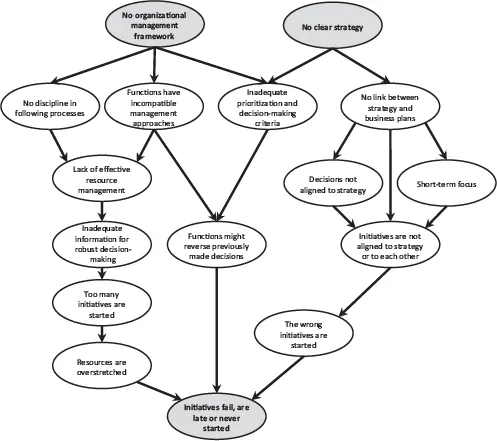
Figure 1.1 Problem analysis
A cause and effect analysis of the reasons for the failure of business initiatives shows two fundamental reasons: (a) a lack of clear strategy and (b) a lack of a rational way of managing the required changes. If your initiatives fail, then ultimately so will your business. Note how many of the problems can’t be solved at a project or initiative level but require a shift in how the organization, as a whole, is directed and managed.
It all sounds like a bit of a disaster, but even in such chaos, departmental managers can often meet their annual cost centre targets, giving the false impression of everything being under control. As we will see in this book, nothing could be further from the truth.
Figure 1.1 shows many of the issues facing organizations. Notice how most issues included in the figure can only be solved by changing the way the organization, as a whole, is directed and managed. An individual programme sponsor, project manager or functional manager is powerless to make a difference. Some organizations are so poor at providing the right enterprise wide environment and support that they are condemning their project teams to inevitable failure, and only the rare ‘heroic’ sponsor or manager will succeed, and then, despite the organization, not because of it.
If any of the problems identified in this chapter or drawn out from Figure 1.1 are familiar to you and recognizable in your organization, you will need to solve a number of issues:
the solution to issues relating to the undertaking of a large number of programmes and projects, together with ‘business-as-usual’, is known as business portfolio management;
the solution to issues relating to groups of closely connected projects and other related work, is known as programme management;
the solution to issues relating to single initiatives in isolation, is known as project management.
Organizations must be competent at all three of these management approaches. Further, those management approaches must be implemented in a mutually consistent way if the organization to work both effectively and efficiently.
Workout 1.1 – Self-diagnosis
This workout is best done by a group of executives or business leaders from across the organization. Remember, business initiatives cross functional and departmental boundaries, so doing this within a single department will not help you. The term ‘initiative’ is used here to represent a project or a programme.
Use the following questions as prompts to establish the areas of competence you might need to address.
Have you a list of all the initiatives being undertaken in your organization?
Can you establish a clear link between your organization’s business strategy and each of your in...
Table of contents
Cover
Half Title
Title
Copyright
Contents
List of Workouts
Foreword
Acknowledgements
About the author
Introduction
Part I Challenges to be faced
Part II The essence of project management
Part III Portfolio management – dealing with many projects and beyond
Part IV Programme management
Part V The supporting activities
Part VI Implementing the framework
Appendix A Glossary
Index
Trusted by 375,005 students
Access to over 1.5 million titles for a fair monthly price.
Study more efficiently using our study tools.
Frequently asked questions
Yes, you can cancel anytime from the Subscription tab in your account settings on the Perlego website. Your subscription will stay active until the end of your current billing period. Learn how to cancel your subscription
No, books cannot be downloaded as external files, such as PDFs, for use outside of Perlego. However, you can download books within the Perlego app for offline reading on mobile or tablet. Learn how to download books offline
Perlego offers two plans: Essential and Complete
Essential is ideal for learners and professionals who enjoy exploring a wide range of subjects. Access the Essential Library with 800,000+ trusted titles and best-sellers across business, personal growth, and the humanities. Includes unlimited reading time and Standard Read Aloud voice.
Complete: Perfect for advanced learners and researchers needing full, unrestricted access. Unlock 1.5M+ books across hundreds of subjects, including academic and specialized titles. The Complete Plan also includes advanced features like Premium Read Aloud and Research Assistant.
Both plans are available with monthly, semester, or annual billing cycles.
We are an online textbook subscription service, where you can get access to an entire online library for less than the price of a single book per month. With over 1.5 million books across 990+ topics, we’ve got you covered! Learn about our mission
Look out for the read-aloud symbol on your next book to see if you can listen to it. The read-aloud tool reads text aloud for you, highlighting the text as it is being read. You can pause it, speed it up and slow it down. Learn more about Read Aloud
Yes! You can use the Perlego app on both iOS and Android devices to read anytime, anywhere — even offline. Perfect for commutes or when you’re on the go. Please note we cannot support devices running on iOS 13 and Android 7 or earlier. Learn more about using the app
Yes, you can access The Programme and Portfolio Workout by Robert Buttrick in PDF and/or ePUB format, as well as other popular books in Business & Business General. We have over 1.5 million books available in our catalogue for you to explore.