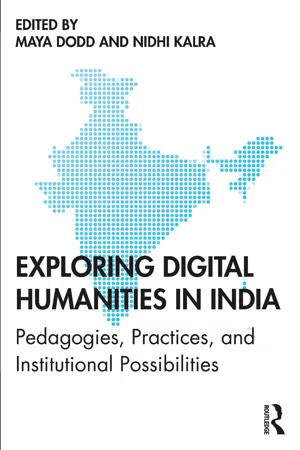
Exploring Digital Humanities in India
eBook - ePub

Exploring Digital Humanities in India

Pedagogies, Practices, and Institutional Possibilities

  1. 208 pages
  2. English
  3. ePUB (mobile friendly)
  4. Available on iOS & Android
eBook - ePub

Exploring Digital Humanities in India

Pedagogies, Practices, and Institutional Possibilities

About this book

This book explores the emergence of digital humanities in the Indian context. It looks at how online and digital resources have transformed classroom and research practices. It examines some fundamental questions: What is digital humanities? Who is a digital humanist? What is its place in the Indian context?

The chapters in the volume:

• study the varied practices and pedagogies involved in incorporating the 'digital' into traditional classrooms;

• showcase how researchers across disciplinary lines are expanding their scope of research, by adding a 'digital' component to update their curriculum to contemporary times;

• highlight how this has also created opportunities for researchers to push the boundaries of their pedagogy and encouraged students to create 'live projects' with the aid of digital platforms; and

• track changes in the language of research, documentation, archiving and reproduction as new conversations are opening up across Indian languages.

A major intervention in the social sciences and humanities, this book will be of great interest to scholars and researchers of media studies, especially new and digital media, education, South Asian studies and cultural studies.

Frequently asked questions

Yes, you can cancel anytime from the Subscription tab in your account settings on the Perlego website. Your subscription will stay active until the end of your current billing period. Learn how to cancel your subscription.
No, books cannot be downloaded as external files, such as PDFs, for use outside of Perlego. However, you can download books within the Perlego app for offline reading on mobile or tablet. Learn more here.
Perlego offers two plans: Essential and Complete
  • Essential is ideal for learners and professionals who enjoy exploring a wide range of subjects. Access the Essential Library with 800,000+ trusted titles and best-sellers across business, personal growth, and the humanities. Includes unlimited reading time and Standard Read Aloud voice.
  • Complete: Perfect for advanced learners and researchers needing full, unrestricted access. Unlock 1.4M+ books across hundreds of subjects, including academic and specialized titles. The Complete Plan also includes advanced features like Premium Read Aloud and Research Assistant.
Both plans are available with monthly, semester, or annual billing cycles.
We are an online textbook subscription service, where you can get access to an entire online library for less than the price of a single book per month. With over 1 million books across 1000+ topics, we’ve got you covered! Learn more here.
Look out for the read-aloud symbol on your next book to see if you can listen to it. The read-aloud tool reads text aloud for you, highlighting the text as it is being read. You can pause it, speed it up and slow it down. Learn more here.
Yes! You can use the Perlego app on both iOS or Android devices to read anytime, anywhere — even offline. Perfect for commutes or when you’re on the go.
Please note we cannot support devices running on iOS 13 and Android 7 or earlier. Learn more about using the app.
Yes, you can access Exploring Digital Humanities in India by Maya Dodd,Nidhi Kalra in PDF and/or ePUB format, as well as other popular books in Education & Information Management. We have over one million books available in our catalogue for you to explore.

Information

Year
2020
Print ISBN
9780367347932
eBook ISBN
9781000078800

Table of contents

  1. Cover
  2. Half Title
  3. Title
  4. Copyright
  5. Contents
  6. List of figures
  7. Notes on contributors
  8. Acknowledgements
  9. Introduction
  10. Part I Digital histories
  11. Part II Digital institutions and pedagogies
  12. Part III Subaltern digital humanities
  13. Part IV Digital practices
  14. Index