Introduction
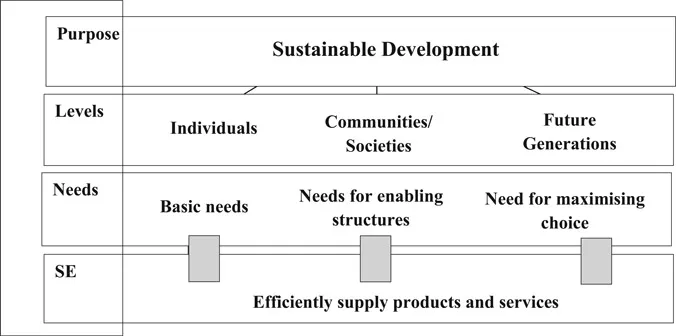
The concept of sustainable development (SD) has received multidisciplinary attention since it appeared in the 1987 United Nations Brundtland Report (Shao, Li, & Tang, 2011). SD has been defined in many ways. One of the most commonly used definitions of SD is that “sustainable development is development that meets the needs of the present without compromising the ability of future generations to meet their own needs” (WCED, 1987, p. 41). In general, SD encompasses three interrelated fundamental approaches—economic, environmental, and social development—which are complementary (Shao et al., 2011). Hence, SD can be conceived of in terms of increases in the quality of life which are equitable (Qizilbash, 2001). Unfortunately, that did not happen in many of the poorest countries across the globe (Pritchett, 1997; Gottschalk & Smeeding, 1997 mentioned in Seelos & Mair, 2005b) or even in developed countries like the USA, UK, and Australia (Diesendorf, 1999). Despite impressive economic growth since the 1990s, inclusive growth has not been achieved in developing countries (UN, 2017). It is clear that sustainable development, involving improvements to the natural environment and in the social and economic domains, is needed in the ‘rich’ countries as well as in the poor (Diesendorf, 1999). However, a lot of studies (Pandey, Mukherjee, & Kumar, 2009; Dale & Sparkes, 2011; Ashoka, n.d.) witnessed the contribution of social entrepreneurs towards achieving the goal of sustainable development, especially in the poor-country context (Seelos & Mair, 2005a). They contribute to sustainable development by creating innovative organisations and new models for the provision of products and services that cater directly to the social needs underlying sustainable development goals (ibid.). Social entrepreneurship has the potential to address social problems, reduce inequality and poverty, and also tackle environmental challenges (UN, 2017).
The scholars see social enterprise (SE) as an enterprise with a purpose that helps a large number of people in a positive way, and while doing so, it may or may not earn surpluses (Sriram, 2011). For the purpose of this chapter, the organisation created by a social entrepreneur to create social change and social impact is termed as ‘social enterprise’. However, it is important to emphasise here that unlike traditional entrepreneurs, the motivation of social entrepreneurs is not the creation of an organisation, but the creation of a path defined so that participants can alleviate a complex social problem (Dorado, 2006). So, they may or may not create an organisation, because creating social change is the most important goal for them. From the perspective of the value creation model in social entrepreneurship, social activism is also a form of social entrepreneurship. Martin and Osberg (2007) mentioned, “social activists may or may not create ventures or organisations to advance the changes they seek” (p. 38).
Social entrepreneurs follow an entrepreneurial approach or activities to meet social goals (Nicholls, 2006), and for sustainable entrepreneurship towards meeting societal goals and changing market contexts, sustainability innovation is emphasised (Schaltegger & Wagner, 2010). ‘Sustainable entrepreneurship’ focuses on the preservation of nature, life support, and community in the pursuit of perceived opportunities to bring into existence future products, processes, and services for gain, where gain is broadly construed to include economic and non-economic gains to individuals, the economy, and society (ibid.). Haldar (2019) studied how social enterprises generated innovations aimed at sustainability. In this context, sustainability of the social enterprises or the process of creating social value and bringing about social change (i.e. social entrepreneurship) becomes significant to attain its social and environmental goals in order to contribute towards sustainable development. How can one achieve the goal of sustainable development through social entrepreneurship without having sustainability in their approach? Thus, ‘sustainability’ becomes an essential part of the practical process of working towards sustainable development. Foster, Kim, and Christiansen (2009) also mentioned that most of the time, even donors want to partner with and invest in sustainable projects rather than simply give money to the needy organisations.
Thus, recognising the importance of ‘sustainability’ of social enterprises for them to play a role in sustainable development, and also due to my awareness that social entrepreneurship can emerge across all the sectors—non-profits (including charitable), public, for-profit, and cross-sector partnerships (Nicholls, 2006)—with the condition of its primary focus on social mission, the concept of ‘sustainability’ in the context of social enterprises or social entrepreneurship caught my attention. When, I looked at the definition of SD mentioned in the Brundtland Report for clarity on ‘sustainability’, I found that it gives little interpretation of the concept of ‘sustainability’ in the context of the process of achieving sustainable development goals. Diesendorf (1999) clearly mentioned that this definition only emphasises the long-term aspect of the concept of sustainability and introduces the ethical principle of achieving equity between the present and future generations. Although, other SD literature discussed sustainability by focusing on what is to be sustained, namely, nature, life support systems, and community, and what is to be developed, namely, individuals, the economy, and society (Shepherd & Patzelt, 2011), but that too does not give any clear interpretation of sustainability in the context of efforts of social enterprises to attain the goal of sustainable development.
Sustainability is about an organisation’s capacity to endure over time (Burkett, n.d., p. 1). In the context of social enterprises, sustainability has two sides: first, an enterprise needs to be able to survive and endure financially over time, and second, it needs to maintain or deepen its impact over time. Impact and financial sustainability cannot be separated in social enterprises (Burkett, n.d.). Moddie (n.d.) further clarified the concept of ‘sustainability’ in the context of social entrepreneur-ship and social enterprises. She mentioned four critical elements for sustainability in the change-making process: a) benefit sustainability (activities continue to be felt by beneficiaries), b) organisational sustainability (enabling environment inside the project), c) financial sustainability, and d) community sustainability (capacity to sustain itself).
Using this conceptual understanding, this chapter explores sustainability in different types of social enterprises supporting sustainable development goals. Despite my belief in the social value creation model of social entrepreneurship, not in the enterprise model, I have purposely restricted the discussion of sustainability to enterprise models only for better clarity and understanding. The multiple case studies provided context to discuss this issue. This chapter aims to bring to the forefront emerging research issues in this context. I suggest several research issues related to sustainability in the efforts of social entrepreneurs to attain the goal of sustainable development, which emerged from the grounded data of multiple case studies of social entrepreneurship. I believe it will help future scholars to explore sustainability in-depth in the context of social entrepreneurship to contribute towards sustainable development in the real sense.