One of the major discussions in the business world is: How do we get our human capital assets more engaged in the organization? Current Gallup Polls state that 85% of our employees are not engaged within their organizations.
Employee Empowerment fully analyzes this workplace condition, which is a major concern for most CEOs. The solution proposed by this book is the introduction of the TLS (Theory of Constraints - Lean - Six Sigma) Continuum Empowerment model, which comprises three levels of empowerment – Management, Cross-Functional Team, and Individual. The first is the empowerment that comes from upper management to the organization as a whole. The second level is the empowerment that comes from the various cross-functional teams and the final level is from the individuals themselves through their ability to take ownership in the processes in which they are involved. The end solution in the book is that if we can get the human capital assets to take ownership of the processes (that is, empower the front-line employees), it will increase the level of engagement. If they become more engaged they will empower the organization at all levels to introduce sustainable change management to resolve problems within the organization. One of the tools of individual empowerment is the use of the Six Sigma toolbox.
This book makes the case that when human capital assets take ownership of the processes, then we have greater engagement, and thus a more empowered organization.
In her best-selling album Luck of the Draw1, Bonnie Raitt recorded a song titled “Something to Talk About” in which she sang the words “let’s give them something to talk about.” Look at the media and hear what they are saying. Political activists. Social activists. The question of empowerment of one group or another comes up almost daily. Even classic literature got in the game more than three centuries ago. In 1667, in his book Paradise Lost, John Milton wrote “Within Hell Gates til now, thou us impow’rd.2” But with all the media chatter, the real question that arises is just what is meant by the term empowerment?
Like beautify, it has many connotations and rests in the eye of the beholder. That does not help us much in the context of this book. There is a wide variety of responses that can be found in the literature. If I Google the term empowerment, Google tells me that there are 265,000,000 hits for the term. If I narrow the search to “workplace and empowerment”, the results are reduced to 34,100,000 hits. To ensure we have a common lexicon for empowerment, let me explain the concept.
Let’s consider some of the alternatives.
The Merriam-Webster Dictionary3, one of the oldest and most well-known dictionaries, defines empowerment as being a noun meaning: the act or action of empowering someone or something; the granting of the power, right or authority to perform various acts or duties; the state of being empowered to do something; the power, right or authority to do something. The website Study.com4 defines employee empowerment as giving employees a certain degree of autonomy and responsibility for decision-making regarding their specific organizational tasks. It allows decisions to be made at the lower levels of an organization where employees have a unique view of the issues and problems facing the organization at a certain level.
If we go the website Roget’s InternationalThesaurus.com5, we find that there are various words that can also be used to define the term empowerment, such as authorize, strengthen, enable, entrust and delegate. Each of these terms represents an action by someone or something leading to a much greater organization or entity. But the words also imply that there is someone outside of yourself granting you authority to do something.
Suggested Activity
Try using Jay Leno’s Jaywalking Exercise with your peers at work. Ask them what empowerment means to them both on a personal level and on a work level. As an aside, try asking the management team the same questions. Ask them what the term empowerment means to them. I guarantee that you will receive a wide variety of answers as empowerment lies in the eyes of the beholder. Their responses will be guided by the biases and cultural upbringing that have shaped their growth as human beings. Their responses will also be guided by the biases and cultural upbringing that have shaped their work environment.
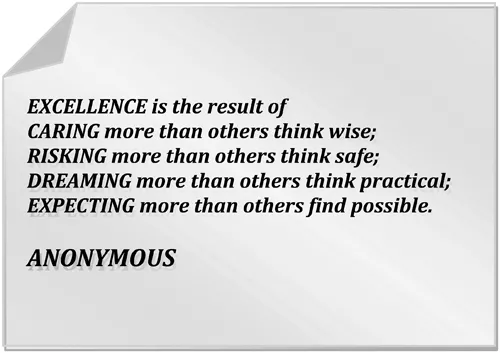
Consider your response through two sets of glasses. The first is from a personal stance. The second is to look at the term from an organizational stance. In the previous work, Achieving HR Excellence through Six Sigma (2013), we referenced an anonymous quote reportedly on the wall of a building at the US Military Academy at West Point. The words of the quote can be equally applied to the term empowerment. Let me dissect and expand upon the quote.
Empowerment Is the Result of:
CARING More Than Others Think Wise
As an office holder in the C-Suite, you understand that the power of your organization lies within the strengths, knowledge and skills of your human capital assets. In one of our programs available to organizations I pose the question: How do you classify your human capital assets? Are they just a number to you or do they mean something to you in your corporate culture? Do you value your employees as people who can make a meaningful contribution to the success of the organization? Empowerment means that you value the input from the total organization.
RISKING More Than Others Think Safe
Do you recognize who your subject matter experts are in your organization? When a problem arises who do you turn to for resolution? The empowerment effort means that you make a concerted effort to involve the people at the front line as they are the subject matter experts, right to and including the individual contributors. They are the first to see the problems and the first to recognize the solutions to resolve the problems.
DREAMING More Than Others Think Practical
Corporations today rely on an environment based on the idea of VUCA. David Ulrich, in his book Victory through Organization (2017), suggests that VUCA defines the intensity and rate of change in an organization6. Your organizations need to envision not what is happening today, but what could be tomorrow with every action that you take. Understand that the organization is going to find that circumstances change with each drop of a coin, that there is nothing to guarantee that what works today is going to work in the future. Marshall Goldsmith told us so in his best-selling book, What Got You Here Won’t Get You There7, where he observes that the business future is not only surrounded by uncertainty in operations but also financially. The other added factor is the complexity of what we do. Things are not as simple as they used to be. With all the other stresses in the workplace we are also finally confronted with things not being as clear as they used to be. We find ourselves in a world where things don’t always mean the same thing to two different audiences. With these factors combined we need to take the time to envision where we believe your organization can be five, ten years out and how the human capital assets are going to play a role in reaching that vision.
EXPECTING More Than Others Find Possible
The time for command and control operations is over. It is time that you understand the impact your human capital assets have on the organization. You need to understand that they are your subject matter experts. They might make decisions that vary from your own but are better for solving the problem and building a stronger organization.
Both the definition for excellence and the definition of empowerment share a common basis. They both require active involvement within the organization. This is the basis of this work. How do we raise the level of human capital involvement within the organization?
You have lived in this global environment and as such your environment has generated certain feelings towards what is empowerment and what is not. Empowerment to an individual living in a democratic society will be much different than to an individual living in, say, a Russia-like environment.
Sharon Grimsley takes the definition a step further by suggesting that empowerment is based in your organizational policies, mission statements and organizational structure8. It is also centered on the work environment and the treatment of your human capital assets.
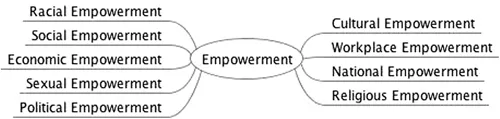
One of the most beneficial tools for use in a continuous process improvement effort is the use of a mind map to visually show your thought process. An example of a mind map can be found in Figure 1.1. As can be seen, empowerment can actually be broken down into nine subtypes of empowerment. It is also important to understand that while each of the nine can stand on its own, it is our central theme of empowerment that integrates them into a larger concept. Let’s look at these empowerment types in more detail.
Figure 1.1 Kinds of Empowerment in Society9.
Racial Empowerment
Throughout history there are examples of civilizations and/or societies who have chosen to marginalize segments of their societies, whether it is African Americans after the Emancipation Proclamation or the ongoing racial divide in general across the world.
There is a worldwide effort on some fronts to reverse this tendency, through racial empowerment programs which represent our first empowerment category in Figure 1.1. Consider these situations: Certain racial backgrounds are relegated to certain professions; certain racial backgrounds are deemed to have less intellect due to their background. What we are referring to here is the instances where particular races of individuals have been accidentally or intentionally left out of functions of the society in which they live and work. We are referring to groups of people who have a history of being considered property rather than a resource for new ideas or innovation. Whether it is African Americans, Latin Americans or people from the Pacific Rim, they have been exposed to conduct which has limited their success in the world as a whole.
Racial empowerment means providing these groups with a new vision of their place in the organization. It talks about programs and services available to these individuals to become vital contributing individuals to both the creation of new ideas and to increasing the introduction of innovations in the way the organization functions. These programs may be financial in nature or they may mean enhanced educational programs. It means elevating their worth in the workplace to provide them greater meaning and purpose. It means empowering them to contribute their ideas and thoughts to the organizational teams.
Social Empowerment
In March of 1969, while serving as an advisor to the Iowa High School Model UN from the Midwest Division of the Council on International Relations and UN Affairs (CIRUNA)10, I was asked to deliver the keynote to the 1969 Session. The centerpiece of the presentation was a quote that, while I can’t find in its original form after more than half a century, I do remember its essence however. It stated the success of a civilization is not judged by the laws it passes, but rather on how it treats its cit...
Table of contents
Cover
Half-Title
Title
Copyright
Dedication
Contents
List of Figures
Foreword
TLS Continuum Empowerment Model Acronyms
Introduction
1 How Do We Define Empowerment?
2 The Role of DNA in Life
3 The Role of DNA in Business
4 The TLS Continuum Empowerment Model
5 The Empowered Manager
6 Empowerment through Cross-Functional Teams
7 Empowerment of Human Capital
8 Empowerment and Engagement
Acknowledgments
Further Reading
Index
Trusted by 375,005 students
Access to over 1.5 million titles for a fair monthly price.
Study more efficiently using our study tools.
Frequently asked questions
Yes, you can cancel anytime from the Subscription tab in your account settings on the Perlego website. Your subscription will stay active until the end of your current billing period. Learn how to cancel your subscription
No, books cannot be downloaded as external files, such as PDFs, for use outside of Perlego. However, you can download books within the Perlego app for offline reading on mobile or tablet. Learn how to download books offline
Perlego offers two plans: Essential and Complete
Essential is ideal for learners and professionals who enjoy exploring a wide range of subjects. Access the Essential Library with 800,000+ trusted titles and best-sellers across business, personal growth, and the humanities. Includes unlimited reading time and Standard Read Aloud voice.
Complete: Perfect for advanced learners and researchers needing full, unrestricted access. Unlock 1.5M+ books across hundreds of subjects, including academic and specialized titles. The Complete Plan also includes advanced features like Premium Read Aloud and Research Assistant.
Both plans are available with monthly, semester, or annual billing cycles.
We are an online textbook subscription service, where you can get access to an entire online library for less than the price of a single book per month. With over 1.5 million books across 990+ topics, we’ve got you covered! Learn about our mission
Look out for the read-aloud symbol on your next book to see if you can listen to it. The read-aloud tool reads text aloud for you, highlighting the text as it is being read. You can pause it, speed it up and slow it down. Learn more about Read Aloud
Yes! You can use the Perlego app on both iOS and Android devices to read anytime, anywhere — even offline. Perfect for commutes or when you’re on the go. Please note we cannot support devices running on iOS 13 and Android 7 or earlier. Learn more about using the app
Yes, you can access Employee Empowerment by Daniel Bloom in PDF and/or ePUB format, as well as other popular books in Business & Management. We have over 1.5 million books available in our catalogue for you to explore.