Particulate Plastics in Terrestrial and Aquatic Environments
  1. 440 pages
  2. English
  3. ePUB (mobile friendly)
  4. Available on iOS & Android
eBook - ePub

About this book

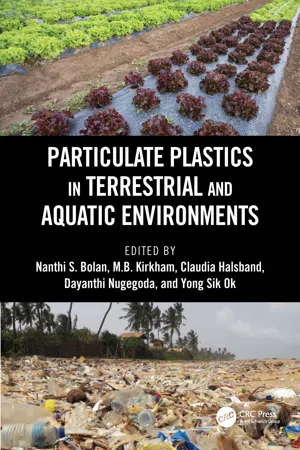
The manufacture of plastic as well as its indiscriminate disposal and destruction by incineration pollutes atmospheric, terrestrial, and aquatic ecosystems. Synthetic plastics do not break down; they accumulate in the environment as macro-, micro-, and nanoplastics. These particulate plastics are a major source of pollutants in soil and marine ecosystems. Particulate Plastics in Terrestrial and Aquatic Environments provides a fundamental understanding of the sources of these plastics and the threats they pose to the environment. The book demonstrates the ecotoxicity of particulate plastics using case studies and offers management practices to mitigate particulate plastic contamination in the environment.

Features

· Describes physical and chemical properties of particulate plastics in terrestrial and aquatic ecosystems

· Presents information on characteristics of particulate plastics as impacted by weathering processes

· Provides numerous approaches for managing particulate plastic contamination

· Identifies sources of particulate plastics in the environment; distribution and characteristics of particulate plastics; and management strategies of particulate plastics

Written by a global team of scientists, this book is for researchers in the fields of environmental safety and waste management or individuals interested in the impact of particulate plastics on environmental health.

Frequently asked questions

Yes, you can cancel anytime from the Subscription tab in your account settings on the Perlego website. Your subscription will stay active until the end of your current billing period. Learn how to cancel your subscription.
No, books cannot be downloaded as external files, such as PDFs, for use outside of Perlego. However, you can download books within the Perlego app for offline reading on mobile or tablet. Learn more here.
Perlego offers two plans: Essential and Complete
  • Essential is ideal for learners and professionals who enjoy exploring a wide range of subjects. Access the Essential Library with 800,000+ trusted titles and best-sellers across business, personal growth, and the humanities. Includes unlimited reading time and Standard Read Aloud voice.
  • Complete: Perfect for advanced learners and researchers needing full, unrestricted access. Unlock 1.4M+ books across hundreds of subjects, including academic and specialized titles. The Complete Plan also includes advanced features like Premium Read Aloud and Research Assistant.
Both plans are available with monthly, semester, or annual billing cycles.
We are an online textbook subscription service, where you can get access to an entire online library for less than the price of a single book per month. With over 1 million books across 1000+ topics, we’ve got you covered! Learn more here.
Look out for the read-aloud symbol on your next book to see if you can listen to it. The read-aloud tool reads text aloud for you, highlighting the text as it is being read. You can pause it, speed it up and slow it down. Learn more here.
Yes! You can use the Perlego app on both iOS or Android devices to read anytime, anywhere — even offline. Perfect for commutes or when you’re on the go.
Please note we cannot support devices running on iOS 13 and Android 7 or earlier. Learn more about using the app.
Yes, you can access Particulate Plastics in Terrestrial and Aquatic Environments by Nanthi S. Bolan, M.B. Kirkham, Claudia Halsband, Dayanthi Nugegoda, Yong Sik Ok, Nanthi S. Bolan,M.B. Kirkham,Claudia Halsband,Dayanthi Nugegoda,Yong Sik Ok in PDF and/or ePUB format, as well as other popular books in Biological Sciences & Ecology. We have over one million books available in our catalogue for you to explore.

Information

Publisher
CRC Press
Year
2020
eBook ISBN
9781000081497
Edition
1

Section III

Ecotoxicity of Particulate Plastics

11

Environmentally Toxic Components of Particulate Plastics

Sanchita Mandal, Nanthi S. Bolan, Binoy Sarkar, Hasintha Wijesekara, Lauren Bradney, and M. B. Kirkham

CONTENTS
11.1 Introduction
11.2 Manufacture of Plastics
11.2.1 Thermoplastics
11.2.2 Thermosets
11.3 Presence of Chemicals in Plastics and Their Toxicity
11.3.1 Hazardous Metals
11.3.2 Bisphenols
11.3.3 Phthalates
11.3.4 Per- and Polyfluoroalkyl Substances
11.3.5 Additives
11.4 Leaching of Chemicals from Plastics
11.5 Toxicity of the Chemical Components of Plastics
11.6 Conclusions
References

11.1 INTRODUCTION

The plastic revolution in our daily life enormously increased within the last few decades. It was estimated that around 348 million metric tons of plastics were produced globally in 2017, with around 40% used for packaging purposes (Statista 2018). This increasing amount of plastics ultimately get introduced to the terrestrial (i.e., soil) and aquatic (i.e., marine) ecosystems by generating a considerable amount of litter. About 10 million tons of plastic litter is migrating into the marine ecosystems each year and creating a “plastic footprint” in the environment (Boucher and Billard 2019). The concerns about plastic production and usages are multi-directional, such as: (a) accumulation of a huge amount of non-degradable plastics in the environment, (b) release of toxic chemicals during manufacturing and exposure of plastics to the environment, (c) generation of secondary micro- and nanoplastics during the production and usage of plastics, and (d) improper disposal of plastics into the soil and ocean (Jambeck et al. 2015; Thompson et al. 2009; Galloway 2015; Galloway and Lewis 2016; Biryol et al. 2017; Caporossi and Papaleo 2017; Gallo et al. 2018; Hahladakis et al. 2018). Table 11.1 summarizes information on selected synthetic polymers made of plastics, their origin, and characteristics.
Crude oil is the main source of synthetic plastics, whereas coal and natural gas are also used for plastic production. During the refining process of crude oil, several toxic by-products are produced, such as petrol, paraffin, lubricating oils, and petroleum gases. Plastics are diverse in nature and made of a range of different polymers and additives along with other components, such as adhesives and/or coatings. Furthermore, plastics can also contain the residues from the materials used for plastic production, such as solvents and additives. To understand and characterize the potential risks associated with the production, usage, disposal, and recycling of plastics and plastic packaging materials, comprehensive information of all the chemicals involved is needed. A study by Groh et al. (2018) compiled a list of chemicals associated with plastic manufacturing and those present in the final packaging materials. The identified most common hazardous chemicals from plastic productions are: monomers, intermediates, solvents, surfactants, plasticizers, stabilizers, biocides, flame retardants, accelerators, and colorants (Groh et al. 2018). However, achieving a completely comprehensive list of chemicals used in plastic manufacturing is not a straightforward task because plastics are made of a large variety of polymers and additives, and furthermore, the identity of the chemicals in finished plastic packaging is seldom measured. It was estimated that among 906 chemicals likely to be associated with plastic packaging, 63 rank the highest for human hazards, and 68 for environmental hazards, according to the harmonized hazardous classifications assigned by the European Chemicals Agency (Table 11.2) (EU 2018; European Commission 2018). Most of the recent studies have assessed the ultimate fate and impacts of plastics and their leachates or adsorbed contaminants without being able to separate the individual effects of hazardous chemicals, or, on the contrary, they examined only one specific substance/chemical without considering the integrated amount of chemicals/substances present in the plastic wastes (Auta et al. 2017; Anderson et al. 2016; Gallo et al. 2018). Therefore, this chapter aims to understand the manufacturing processes of plastics and to present an overview of environmentally hazardous components and chemicals in various plastics and their final states after manufacturing.
TABLE 11.1
Summarized Information on Selected Synthetic Polymers Made of Plastics, Their Origin, and Characteristics
Chemical Compound
Chemical Formula
Origin or Source to Environment
Characteristics
References
Low-density polyethylene (LDPE)
(C2H4)n
Squeeze bottles, toys, carrier bags, chemical tank linings, heavy duty sacks, general packaging, and gas and water pipes
Low density 0.91–0.94 g/cm3, non-biodegradable, most common plastics
Lambert et al. (2014); Lassen et al. (2015)
High-density polyethylene (HDPE)
(C2H4)n
Chemical drums, toys, household and kitchenware, cable insulation, and carrier bags
High density 0.92–0.99 g/cm3, non-biodegradable
Lambert et al. (2014); Lassen et al. (2015)
Acrylic
Acrylate polymers: based with acrylic acid: CH2=CHCOOH
Most used fibers in textiles: knitware and plastic flakes
High density 1.16 g/cm3
Lassen et al. (2015)
Polyethylene terephthalate (PET)
(C10H8O4)n
Drinks bottles, oven-ready meal trays cable lining
High density 1.41 g/cm3
Lambert et al. (2014); Lassen et al. (2015)
Polypropylene (PP)
(C3H6)n
Food containers and microwavable meal trays
Low density 0.90–0.91 g/cm3
Lambert et al. (2014); Lassen et al. (2015)
Polystyrene (PS)
(C8H8)n
Food containers, stuffed animals, and protective packaging
High density 1.04–1.13 g/cm3
Lassen et al. (2015)
Polyvinyl chloride (PVC)
(C2H3Cl)n
Water pipes, cable insulation, packaging, and healthcare applications
High density 1.39–1.43 g/cm3, non-biodegradable
Lassen et al. (2015)
Source: Adapted from Wijesekara et al. (2018).
TABLE 11.2
List of Hazardous Chemicals Associated with Plastic Production and Packaging
Function
Chemical Group
Chemical Name
Colorants
Dye, azo
1.8-Dihydroxynaphthalene-3,6-disulfonic acid-[2-(4-Azo)]-N-(5-methyl-3-isoxazolyl) benzenesulfonamide
Pigment
Cobalt (II) diacetate
Fire retardants
Boron
Sodium tetraborate, pentahydrate
Boric acid
Sodium tetraborate, anhydrous
Sodium borate, decahydrate
Organophosphate
Tris(2-chloroethyl) phosphate
Triphenyl phosphate
Trixylyl phosphate
Others
Tetrachlorophthalic anhydride
2,2′,6,6′-tetrabromobisphenol A
Foaming agents
Simple hydrocarbon
Isobutane
Biopolymer
Azodicarbonamide
Starch
Sodium bicarbonate
Powdered sodium bicarbonate
Plasticizers
Chlorinated paraffin
Alkanes
Medium-chain chlorinated paraffins, >17 carbon atoms
Phthalate
DEHP (Di-ethylhexyl phthalates)
DINP (Di-isononyl phthalate)
Diallyl phthalate
Dimethoxyethyl phthalate
Diethyl phthalate
Dioctyl phthalate
Diundecyl phthalate
Lubricants
Perflourinated hydrocarbons
Polytetrafluoroethylene (PTFE)
Synthetic hydrocarbon
Polyalpha-olefin (PAO) synthetic esters
Monomers
Acrylic
Isooctyl acrylate
Acrylonitrile
Amine
Aziridine
m-Phenylenediamine
Bisphenol
Bisphenol A
Bisphenol F
Bisphenol S
Naphthalene
Antioxidants
Hydrocarbon polymers
Bis(2,4-di-tert-butylphenyl) pentaerythritol diphosphate and magnesium aluminum hydroxy carbonate hydrate
2H-benzimidazole-2-thione, 1,3-di-hydro-4(or 5)-methyl
Tris(mono-nonylphenyl) phosphite with up to 1% triisopropanol amine
Benzenamine, N-phenyl, reaction products with 2,4,4-trimethylpentene
1,3-Diethyl-2-thiourea
Disodium 4,4′-bis(2-sulfonatostyryl) biphenyl
1,2-Bis(2-methylphenyl) guanidine

11.2 MANUFACTURE OF PLASTICS

Plastics are commonly derived from various natural and organic materials, such as cellulose, coal, natural gas, and crude oil. Due to the complex nature of crude oil and the presence of thousands of components, it needs to be processed and refined before it can be used. The main production of plastic usually begins with the distillation of crude oil in the oil refineries. During the distillation process, heavy crude oil gets separated into lighter component groups, and they are termed as fractions (Gervet 2007). Each of these fractions is a mixture of hydrocarbon chains, which is made up of carbon and hydrogen atoms. According to the size and the structure of the molecules, the hydrocarbon chains are converted to fuels and other derivatives, such as lubricants, wax, petroleum products, and so on. One of the components of these hydrocarbon fractions is naphtha, which is considered as the most crucial raw material for plastic production. Figure 11.1 represents the production steps of plastics from crude oil in oil refineries.
The two main techniques for plastic production are polymerization and polycondensation, and these require specific catalysts. In the polymerization reactor, monomers, such as propylene and ethylene are combined in order to develop a long polymer chain. Therefore, each polymer has its own structure and size depending on the different varieties of basic monomers used to form the chains. Plastics have a wide range of types based on different base chemistries, additives and derivatives formulated to obtain desired functional properties. Thus, there may be thousands of different plastic types. To simplify their classification, plastics are mainly grouped into two polymer families, namely, thermoplastics and thermosets.

11.2.1 THERMOPLASTICS

Thermoplastics are the most common types of plastics used nowadays. The main feature is that it can undergo several melts and solidification processes without significant ...

Table of contents

  1. Cover
  2. Half Title
  3. Title Page
  4. Copyright Page
  5. Table of Contents
  6. Foreword
  7. Preface
  8. Acknowledgments
  9. Editors
  10. Contributors
  11. SECTION I Sources of Particulate Plastics in the Environment
  12. SECTION II Distribution and Characteristics of Particulate Plastics
  13. SECTION III Ecotoxicity of Particulate Plastics
  14. SECTION IV Case Studies of Particulate Plastics in the Environment
  15. SECTION V Management of Particulate Plastics
  16. Index