This book is designed to support the transformation of educators into strategic talent leaders. The author's research-based "Strategic Talent Leadership Framework" gives leaders the tools for acquiring, accelerating, advancing and assessing educator talent. Each chapter features an illustrative case, best practices, a ready-to-use tool for advancing those practices, a set of "talent analytics" and an action step planner. This guidebook is for education leaders who seek to assess current performance, adopt research-based strategies for engaging in strategic human capital practices, set goals around the use of those practices and measure the impact of their work on student outcomes. Accessible and actionable, Strategic Talent Leadership for Educators is not only a guide, but a toolkit for putting research into practice.
- 232 pages
- English
- ePUB (mobile friendly)
- Available on iOS & Android
eBook - ePub
About this book
Information

Felicia Jeffries is a highly effective 5th-grade math teacher at a Title I elementary school. Year after year, her students achieve the highest growth in her school and some of the highest growth in the entire district. She is proud of her impact and does all that she can to mentor new teachers in her building to duplicate her results. Any time her principal asks her to sit on a committee, take charge of a project or organize the 5th-grade field trip, she enthusiastically says yes. Recently, the superintendent announced a program to recruit new STEM teachers to all 10 Title I elementary schools in the district. All newly hired STEM teachers would receive a $5,000 signing bonus and a $10,000 salary increase for as long as they remained at their schools. Unfortunately, as a current teacher, Felicia was not eligible for the bonus or salary increase. When asked by parents at her supper club what she thinks about the new compensation program, Felicia shared that it was a waste of taxpayer money.
Compensating Talent
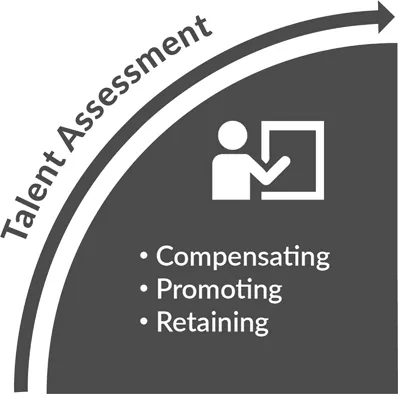
Compensating is the practice of providing monetary and nonmonetary rewards to employees in exchange for time, effort and expertise. Monetary compensation is traditionally provided in the form of a salary, stipends, retirement and health benefits. Nonmonetary compensation can include leave days, attendance at conferences, opportunities to participate in activities, the provision of classroom supplies/resources and even preferential room assignments and class schedules. Ensuring that employees understand the full range and value of their compensation can be challenging. A well-explained and strategic compensation package can make recruiting and retention easy. For that reason, compensation is a key function of a strategic talent leadership approach.
Educator Compensation
For most of the 20th and 21st centuries, the American education system has used a compensation model made up of steps and lanes where the steps represented years of experience and the lanes, educational level or degree attainment. For example, Lane A might be for those with a bachelor’s degree, Lane B, a master’s degree and Lane C, a doctorate. Thus, if I am a teacher with a master’s degree and 10 years of experience, my pay grade would be described as B-10. The strengths of this long-standing model are its clarity and perceived fairness. The system virtually eliminates pay previously differentiated by gender, race and age. Unfortunately, experience and degree attainment “have consistently failed to correlate with student outcomes leaving districts basing teacher pay on factors unrelated to performance in the classroom” (Podgursky & Springer, 2007). Annually, school districts across the nation spend $8.6 billion dollars to pay for advanced degrees that show no correlation or a negative correlation between degree status and student achievement outcomes (NCTQ, 2010).
In addition to the majority of school districts using a compensation model not connected to student outcomes, a disadvantage of the step and lane structure is that it significantly delays the age at which a teacher will realize his or her highest level of pay. In a 2010 study of teacher pay, researchers at the National Council on Teacher Quality (NCTQ) found that while doctors and lawyers reach peak earnings at ages 35 and 40, respectively, it takes a teacher 20–25 additional years of work to reach top earnings at 55. This is discouraging for highly effective educators who would be recognized as, and rewarded for, being top performers in their field regardless of age and experience. In their extensive review of teacher performance pay, Podgursky and Springer (2007) also discovered that since 1950, the percentage of school districts using this type of compensation model has only decreased by one percentage point from 97 down to 96 percent. And so, the federal government decided to incentivize states and local school districts to begin moving away from the step and lane system and begin thinking about how to connect teacher pay and student performance.
In 2005, the federal Department of Education created Teacher Incentive Fund grants, designed to support strategic talent leaders in designing differentiated teacher compensation programs. Just ten years later, a study by the Center for American Progress (Konoske-Graf, Partelow, & Benner, 2016) identified that one-third of districts were offering some form of pay incentive, increase or bonus. Twenty-five percent of districts were using these differentiated structures to incent recruitment, retention or both. Jonathan Eckert, National Institute for Excellence in Teaching, followed these trends as districts were shifting away from traditional salary models and beginning to adopt differentiated pay practices. Across the Teacher Incentive Fund grant sites (including one that I was leading), he identified six themes:
- Theme 1: Performance compensation is most effective when integrated with professional development, collaboration and evaluation as a comprehensive approach to system-wide improvement.
- Theme 2: Wide stakeholder involvement is essential to the design, implementation and effectiveness of compensation reform efforts.
- Theme 3: Financial incentives reward additional work and success, but they are valued as a component of a broader emphasis on improving teaching and learning.
- Theme 4: Nearly all of the sites created teacher leader positions with significant additional compensation to provide school-based support, evaluation and oversight for instructional improvement.
- Theme 5: Success in implementing these challenging reforms with fidelity is enhanced when states and districts provide staff positions, offer programmatic support and tie local efforts to state policies and funding.
- Theme 6: Financial sustainability is enhanced when state and district funds are reallocated to support performance compensation reforms (Eckert, 2013).
What Eckert recognized, and what we all learned, is that educator pay is not a stand-alone solution for improving student outcomes. It must play a critical role within an aligned strategic talent leadership framework. The pay structure must support recruitment and retention. But, it must also be aligned to and in support of robust evaluation systems, professional development that is responsive to evaluation results, coaching and mentoring that help in increasing educator effectiveness. And, all of that must be situated within working conditions that are conducive to both educator and student success.
Strategic Talent Leadership Insights for Compensating
With your Strategic Talent Leadership Team, review the strategic talent leadership practices for compensating (see Table 10.1). If you are currently engaging in a practice, check ‘yes.’ If not, check ‘not yet’ and consider how this practice could be adopted by your organization as you read through the best practices described in this chapter.
Strategic Practice | Yes | Not Yet |
|---|---|---|
Our organization ensures that educator base salaries (without additional incentives) are equitable across Title I and non-Title I schools. | ||
Our organization’s educator compensation plan includes monetary and nonmonetary rewards. | ||
Our organization’s compensation plan is structured to be responsive to market demands. | ||
Our organization’s compensation plan is designed to achieve locally identified talent goals. | ||
Our organization’s compensation plan is accurately understood by current and potential employees. |
Best Practices for Compensating
Ensure Pay Equity across Schools
Across the nation, there are hidden pay inequities between Title I and non-Title I schools. As a best practice for compensating educators, this should be regularly analyzed and addressed. Teachers who work at Title I schools, the nation’s hardest-to-staff schools, tend to be younger and have less experience (Carver-Thomas & Darling-Hammond, 2017). And, because most of our districts still use a traditional step and lane pay schedule, this translates into ‘cheaper.’ By way of years of experience, the average salary of a teacher at a Title I school tends to be less that at non-Title I schools. Therefore, districts are making a greater talent investment in non-Title I schools that are staffed with ‘more expensive’ teachers, giving further advantage to those schools that already educate populations of students that come from homes with greater monetary resources.
While still working in a large, urban school district, I collaborated with our team to pull all teacher salaries across the district in an effort to highlight this hidden inequity. We sor...
Table of contents
- Cover
- Half Title
- Series Page
- Title Page
- Copyright Page
- Dedication
- Contents
- List of Illustrations
- Introduction
- DOMAIN I: TALENT ACQUISITION
- DOMAIN II: TALENT ACCELERATION
- DOMAIN III: TALENT ADVANCEMENT
- DOMAIN IV: TALENT ASSESSMENT
- Appendix A
- Appendix B
- Appendix C
- Appendix D
- Appendix E
Trusted by 375,005 students
Access to over 1.5 million titles for a fair monthly price.
Study more efficiently using our study tools.
Frequently asked questions
Yes, you can cancel anytime from the Subscription tab in your account settings on the Perlego website. Your subscription will stay active until the end of your current billing period. Learn how to cancel your subscription
No, books cannot be downloaded as external files, such as PDFs, for use outside of Perlego. However, you can download books within the Perlego app for offline reading on mobile or tablet. Learn how to download books offline
Perlego offers two plans: Essential and Complete
- Essential is ideal for learners and professionals who enjoy exploring a wide range of subjects. Access the Essential Library with 800,000+ trusted titles and best-sellers across business, personal growth, and the humanities. Includes unlimited reading time and Standard Read Aloud voice.
- Complete: Perfect for advanced learners and researchers needing full, unrestricted access. Unlock 1.5M+ books across hundreds of subjects, including academic and specialized titles. The Complete Plan also includes advanced features like Premium Read Aloud and Research Assistant.
We are an online textbook subscription service, where you can get access to an entire online library for less than the price of a single book per month. With over 1.5 million books across 990+ topics, we’ve got you covered! Learn about our mission
Look out for the read-aloud symbol on your next book to see if you can listen to it. The read-aloud tool reads text aloud for you, highlighting the text as it is being read. You can pause it, speed it up and slow it down. Learn more about Read Aloud
Yes! You can use the Perlego app on both iOS and Android devices to read anytime, anywhere — even offline. Perfect for commutes or when you’re on the go.
Please note we cannot support devices running on iOS 13 and Android 7 or earlier. Learn more about using the app
Please note we cannot support devices running on iOS 13 and Android 7 or earlier. Learn more about using the app
Yes, you can access Strategic Talent Leadership for Educators by Amy A. Holcombe in PDF and/or ePUB format, as well as other popular books in Éducation & Éducation générale. We have over 1.5 million books available in our catalogue for you to explore.