The role and influence of building services engineers are undergoing rapid change and are pivotal to achieving low-carbon buildings. However, textbooks in the field have tended to remain fairly traditional with a detailed focus on the technicalities of heating, ventilation and air conditioning (HVAC) systems, often with little wider context. This book addresses that need by embracing a contemporary understanding of the urgent challenge to address climate change, together with practical approaches to energy efficiency and carbon mitigation for mechanical and electrical systems, in a concise manner.
The essential conceptual design issues for planning the principal building services systems that influence energy efficiency are examined in detail. These are HVAC and electrical systems. In addition, the following issues are addressed:
background issues on climate change, whole-life performance and design collaboration
generic strategies for energy efficient, low-carbon design
health and wellbeing and post occupancy evaluation
building ventilation
air conditioning and HVAC system selection
thermal energy generation and distribution systems
low-energy approaches for thermal control
electrical systems, data collection, controls and monitoring
building thermal load assessment
building electric power load assessment
space planning and design integration with other disciplines.
In order to deliver buildings that help mitigate climate change impacts, a new perspective is required for building services engineers, from the initial conceptual design and throughout the design collaboration with other disciplines. This book provides a contemporary introduction and guide to this new approach, for students and practitioners alike.
1 Background for an energy-efficient and low-carbon built environment
1.1Introduction
This chapter provides a brief introduction and background on the urgent need for energy-efficient, low-carbon buildings to mitigate climate change impacts arising from the use of fossil fuels. It starts by looking at the principal threats to the global environment and the need to undertake development in a sustainable way. The background issues of global warming and climate change are summarised briefly, together with an outline of the likely impacts, which indicate the immense scale and urgency of the challenge. The recent and emerging trends in the energy supply scenario for buildings are outlined, together with the implications for designers as the energy supply infrastructure goes through a transition to reduce carbon impacts. In order to show the wider relevance of these issues for building services design, some of the other environmental impacts of the built environment are also described.
A separate impact of fossil fuel usage is examined through looking at the adequacy of infrastructures to meet the anticipated energy requirements in the near future. A further aspect of energy strategy relates to materials used in building construction and operation and to identifying ways in which their impact can be reduced.
The final part of the chapter looks at general holistic principles that apply to the design of sustainable products and services. These are put into the context of energy performance of buildings, with an emphasis on the need for an integrated and interdisciplinary whole-life approach, with a primary focus on demand reduction.
It should be noted that this chapter focuses primarily on the energy and carbon aspects of built environment sustainability, rather than the wider factors.
1.2Principal threats to the global environment
To understand the exceptional challenge for sustainable development in the context of the built environment, it is necessary to start from a perspective of the wider nature and range of environmental factors that threaten man’s continued habitation on Earth and then identify those causes that specifically arise from the built environment. By identifying the priorities for attention, it is possible to focus on the key aspects related to design for buildings, while accepting that a wider range of environmental factors will require attention to contribute to the broader objective of sustainability in practice.
A major study was undertaken by a group of scientists in 2009 to identify the principal environmental processes that could cause significant disruption to human life on Earth. The study, which was under the auspices of the United Nations, also sought to calculate boundaries for these processes which, if exceeded, could limit the planet’s ability to sustain human life. Summaries of this study were reported by Foley (2010) and Pearce (2010) and identified nine key environmental processes:
climate change
ocean acidification
stratospheric ozone depletion
nitrogen and phosphorous cycles
fresh water use
biodiversity loss
land use
aerosol loading
chemical pollution.
The study identified target values for all the processes (except for the last two, because it was felt that there was insufficient understanding to do this). Of the seven processes where targets were set, it was found that three processes have already passed their safe limit: climate change, biodiversity loss and nitrogen pollution. It was also found that the others were moving closer to their safe boundary level. For two of the processes – climate change and the increasing acidification of the oceans – the principal cause is increased levels of CO2 in the atmosphere arising from mankind’s use of fossil fuels (Foley 2010; Pearce 2010). As the movement of any of these key processes towards their threshold levels could result in significant environmental damage, the imperative for society is to ensure that each process be maintained as safely within the boundary figure as is practically possible. While the processes and limits were presented separately, it was acknowledged that they were interconnected in many ways. For example, the increased acidification of the oceans could have a severe impact on their ecosystems, with implications for biodiversity and, as a consequence, threaten the food chain. A further consequence is that the ocean’s ability to absorb CO2 would reduce with acidification, with implications for the rate of climate change as a positive feedback relationship (Foley 2010; Pearce 2010). Climate change is likely to have severe implications for fresh water, biodiversity and land use.
The key message that emerges is that mankind now has a clearer indication of the limitations of the Earth’s resources and their rate of usage. There is also better understanding about the ability of the Earth to absorb the waste and emissions arising from their use. There is, therefore, an urgent need for society to ensure that its activities are maintained within the limiting operational boundaries of the Earth’s environmental systems.
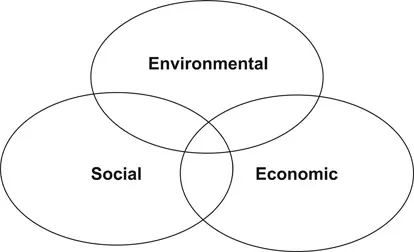
The issues outlined previously relate to the key environmental processes that needed to be addressed on an urgent basis. It has, however, been recognised that development in all senses needs to adopt principles that will allow continued and sustainable habitation on Earth. Sustainable development has been defined in the 1987 Brundtland Report as ‘development that meets the needs of the present without compromising the ability of future generations to meet their own needs’ (UN 1987). This introduced the concept of sustainable development being a satisfactory balance between environmental protection, social equity and economic development, sometimes known as the ‘triple bottom line’, as shown in Figure 1.1. While a wide range of challenges was involved in achieving such a balance, there is now a compelling scientific view that the most significant threat to a sustainable future is climate change arising from ‘anthropogenic’ (i.e. caused by mankind’s activities) global warming. This is mainly due to the presence of greenhouse gases (GHGs) in the troposphere, as described in the following section.
Figure 1.1 Sustainable development: the ‘triple bottom line’
Source: UN (1987)
To stimulate international efforts to address the broad range of sustainability challenges, in 2015, the UN created an agenda with a series of objectives and targets. Their General Assembly adopted the 2030 Agenda for Sustainable Development, which included 17 Sustainable Development Goals (SDGs) (UN 2015). These objectives include several goals that are directly relevant to the built environment and construction industry. These include good health and wellbeing; clean water and sanitation; affordable and clean energy; industry, innovation and infrastructure; sustainable cities and communities; and climate action. Two other objectives are more general and are indirectly relevant: responsible consumption and production; and partnerships to achieve the goal (UN 2015). In September 2019 the UN held its first Sustainable Development Goals Summit since adoption to discuss the 2019 Global Sustainable Development Report, which included an assessment of progress towards the goals. The report noted that progress made in the previous two decades was in danger of being reversed, in part due to potentially irreversible declines in the natural environment, and that the present development model had brought the global climate system and biodiversity loss close to tipping points. The report highlighted the need for developed countries to change their patterns of production and consumption, which needs to include limiting the use of fossils fuels (UN 2019a).
1.3The greenhouse effect, global warming and climate change
A variety of natural factors have altered the climate of the Earth in the past, and there is a natural ‘greenhouse effect’ that has warmed the Earth’s surface for millions of years. However, the scientific consensus in the past two decades has increasingly indicated that these natural factors alone cannot account for the extent of warming that has been observed. The evidence from observation and modelling indicates that this warming has largely been due to increased emission and accumulation of GHGs caused by mankind’s activities. This has created an ‘enhanced greenhouse effect’, alongside which are feedback processes that cause amplification of the warming (Romm 2018).
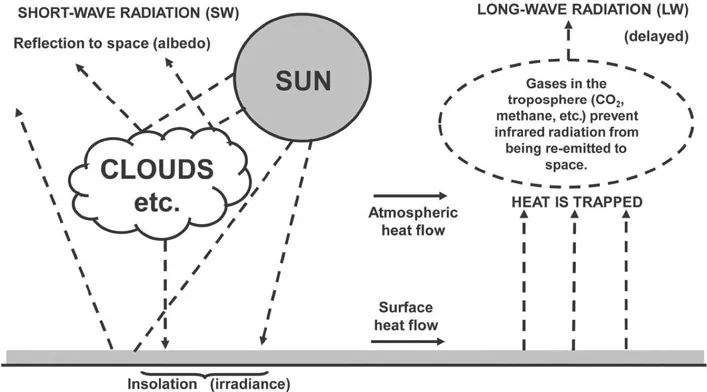
The physics and mechanisms associated with the interaction between the Earth’s atmosphere and GHG emissions are, obviously, extremely complicated and well beyond the scope of this book. For the purpose of understanding the basic concepts and terminology related to climate change, a highly simplified approach is sufficient, as shown in Figure 1.2.
Figure 1.2 The greenhouse effect relationships (greatly simplified)
Source: Derived from Christopherson (1997: figure 4.1)
The sun’s rays are the sole energy input, and the radiation is mostly in the visible part of the spectrum (Coley 2008). This short-wave, high-frequency radiation reaches the Earth’s atmosphere, where it is absorbed, reflected or scattered. A proportion (about 31%) is reflected back into space by the atmosphere, clouds and the lighter-coloured areas of the Earth’s surface. This fraction is termed the ‘albedo’ (Coley 2008). Therefore, the whiteness of cloud cover and the relative lightness of the different parts of the Earth’s surface play a significant factor in the proportions reflected or absorbed. The residual radiation heats the atmosphere and the Earth’s surface. The relatively low temperature of the Earth’s surface gives rise to long-wave, low-frequency (infrared) radiation back to space.
The radiation from the Earth is thus a mix of radiation in the visible range that is directly reflected and radiation in the infrared range that is re-radiated. Over time, the Earth re-radiates an average 69% of incoming energy to space. The presence of certain GHGs in the troposphere traps the heat and delays it in the atmosphere. Some of the energy is re-radiated back towards the Earth. This is known as ‘back radiation’ and warms the surface and the lower atmosphere. This warming phenomenon is known as the ‘greenhouse effect’, as the GHGs create an effect similar to that created by the glass in a greenhouse, letting heat in but preventing it from escaping. These climate mechanisms, outlined in very simple terms earlier, are described in detail in various texts (Boyle 2004; Christopherson 1997; Coley 2008; Goudie 2000; Romm 2018). To provide a perspective in terms of heat alone, it has been estimated that the total heat arising from all human activities is only about 0.01% of the solar energy absorbed at the surface (Goudie 2000).
The overall increase in heat that results is called ‘global warming’. It is estimated that the Earth is warmer than it has been at any time during the past 2,000 years (Coley 2008). The atmosphere close to the surface of the Earth has risen in temperature by about 1 degree C since the Industrial Revolution, and much of this temperature rise is estimated to have occurred in recent decades. After the year 2000, emissions growth began to accelerate (Romm 2018). There has been other evidence linked to global warming in recent times, including rises in sea level and reduced levels of sea ice in the Arctic, which have been widely reported in the scientific literature.
‘Global warming’ is a term that is generally used to refer to observed warming of the Earth due to GHG emissions caused by humans. Global warming has already affected, and will continue to affect, the world’s climate in numerous complicated ways, giving rise to climate change. ‘Climate change’ is a more useful term than ‘global warming’, because it refers more generally to a variety of long-term changes in climate, including rises in sea level, extreme aspects of weather and acidification of the oceans, and is considered to be more accurate, as other non-temperature weather impacts may be bigger than those just caused by increases in temperatures (Romm 2018). It is also necessary to distinguish between weather and climate. Weather relates to the short-term variability in a particular location, whereas climate relates to the long-term pattern of statistics for conditions in a particular region (Coley 2008).
The principal international body on this subject is the United Nations Intergovernmental Panel on Climate Change (IPCC). This panel is made up of respected scientists from around the world and has been publishing comprehensive reports every few years on the scientific viewpoint. The IPCC’s 4th Report (IPCC 2007) (also known as Assessment Report 4 or AR4) of 2007 was regarded as pivotal because it provided a consensus of certainty on the influence of human activities on climate change. The report concluded that most of the global warming that had been seen since the mid-20th century was very likely to have been due to the increase which has been observed in the concentration of GHGs caused by human activity creating an ‘enhanced greenhouse effect’ (IPCC 2007). Subsequent IPCC reports have provided increased levels of certainty and raised growing concerns about the urgency and scale of the challenge to prevent the likely impacts on human societies and the natural world. A particular concern is that it is not only the absolute level of CO2 that is unprecedented but also the rate of change, meaning that all life on Earth would have to adapt faster, which would be extremely difficult, so climate change has been described as an ‘existential issue for humanity’ (Romm 2018).
The most important GHGs are carbon dioxide, methane, chlorofluorocarbons, nitrous oxide and ozone. The relative contribution of each gas to the enhanced greenhouse effect depends on its global warming potential and the level of concentration in the atmosphere. The relative contributions have been noted by Coley (2008):
CO2
65%
Methane
20%
CFCs, HCFCs
10%
N2O
5%
Because so much impact arises from CO2 emissions, a key question is: What is the upper threshold of CO2 that can be tolerated in the long term (in relation to anticipated impacts) and that can therefore be a target? The generally assumed figure for pre-industrial CO2 is about 280 parts per million (ppm). Scientists had previously indicated that a level of about 350 ppm by volume might be a target that would avoid the worst impacts, typically related to a temperature rise of 2 degrees C above the pre-industrial level. Recent data on CO2 l...
Table of contents
Cover
Half Title
Title Page
Copyright Page
Contents
Acknowledgements
Introduction
1 Background for an energy-efficient and low-carbon built environment
2 Interdisciplinary design collaboration for energy-efficient buildings
3 Generic design strategies for energy-efficient, low-carbon buildings
4 Post occupancy evaluation for optimal energy and environmental performance
5 Health and wellbeing
6 Energy-efficient ventilation
7 Air conditioning systems
8 Energy-efficient thermal energy generation and distribution in buildings
9 Low-energy approaches for the thermal control of buildings
10 Energy-efficient electrical systems, controls and metering
11 Building thermal load calculations
12 Building electric power load assessment
13 Space planning and design integration for services
References
Index
Trusted by 375,005 students
Access to over 1.5 million titles for a fair monthly price.
Study more efficiently using our study tools.
Frequently asked questions
Yes, you can cancel anytime from the Subscription tab in your account settings on the Perlego website. Your subscription will stay active until the end of your current billing period. Learn how to cancel your subscription
No, books cannot be downloaded as external files, such as PDFs, for use outside of Perlego. However, you can download books within the Perlego app for offline reading on mobile or tablet. Learn how to download books offline
Perlego offers two plans: Essential and Complete
Essential is ideal for learners and professionals who enjoy exploring a wide range of subjects. Access the Essential Library with 800,000+ trusted titles and best-sellers across business, personal growth, and the humanities. Includes unlimited reading time and Standard Read Aloud voice.
Complete: Perfect for advanced learners and researchers needing full, unrestricted access. Unlock 1.5M+ books across hundreds of subjects, including academic and specialized titles. The Complete Plan also includes advanced features like Premium Read Aloud and Research Assistant.
Both plans are available with monthly, semester, or annual billing cycles.
We are an online textbook subscription service, where you can get access to an entire online library for less than the price of a single book per month. With over 1.5 million books across 990+ topics, we’ve got you covered! Learn about our mission
Look out for the read-aloud symbol on your next book to see if you can listen to it. The read-aloud tool reads text aloud for you, highlighting the text as it is being read. You can pause it, speed it up and slow it down. Learn more about Read Aloud
Yes! You can use the Perlego app on both iOS and Android devices to read anytime, anywhere — even offline. Perfect for commutes or when you’re on the go. Please note we cannot support devices running on iOS 13 and Android 7 or earlier. Learn more about using the app
Yes, you can access Building Services Design for Energy Efficient Buildings by Paul Tymkow,Savvas Tassou,Maria Kolokotroni,Hussam Jouhara in PDF and/or ePUB format, as well as other popular books in Technology & Engineering & Architecture General. We have over 1.5 million books available in our catalogue for you to explore.