Big Ideas in Outdoor Primary Science takes a fresh approach to learning science in outdoor contexts. It combines new thinking in science teaching using big ideas, with our growing need to look after our planet, and encourages children to learn from what scientists have to say about issues which will impact their lives today and in the future.
The book offers primary teachers the subject and pedagogical knowledge, as well as the confidence they need, to integrate the seeds of big ideas into their curriculum. To this end, it provides models of good practice which exemplify how primary-aged children can work towards understanding some of science's big ideas and engage with important issues related to wildlife conservation.
The easy-to-use book covers topics such as:
Interdependence
Adaptation
Inheritance
Following in Darwin's footsteps
Protecting ecosystems
Full of ideas for outside learning, this book is a comprehensive, valuable and essential resource for all teachers of primary science.
Scientific ideas are created by communities of scientists to help explain and predict how the natural world works. The world is very complex, and hence science has a lot of ideas to help explain it. When ideas are combined they produce bigger, more powerful ideas which can be used to explain a progressively wider range of events and related phenomena, and hence a more comprehensive picture of the way the world works. The bigger the idea the more explanatory power it has.
The optimistic aim of this book is not just for children to learn scientific ideas but to learn to adopt them as their own so they can think with them when they are experiencing and talking about the natural world. This requires children to understand science not as a series of separate facts, but as a way of seeing and thinking about the living world.
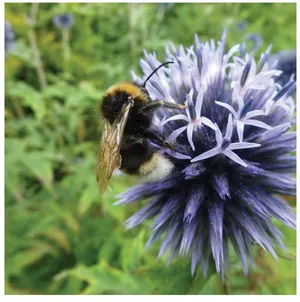
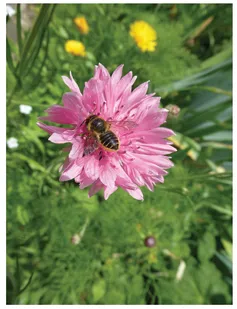
To be useful, scientific ideas need to provide understanding which can influence our thinking about aspects of the natural world in which we have an interest. For example, imagine sitting in a garden surrounded by a wide variety of different kinds and colours of flowering plants. What first catches your eye are the plants with the brightest flowers, such as the double-stemmed red roses and the tall purple foxgloves. Past your ear flies a lone bumblebee. You feel compelled to keep an eye on it as it makes a ‘bee line’ for the nearest foxglove. As you watch the bee moving from flower to flower, you now notice that there are quite a lot of other bees in the garden who are also attracted to the foxgloves. As you continue to watch the bumblebee it flies away from the foxgloves, straight past the bright red roses and lands none too securely on a verbena with small, delicate purple/pink flowers. As the sun comes out from behind a cloud, a butterfly flutters past your ear and you start to wonder whether these flying insects are attracted to your perfume. What you have noticed is that none of the bees or butterflies seem attracted to the sweet smelling red roses, which puzzles you and you wonder why.
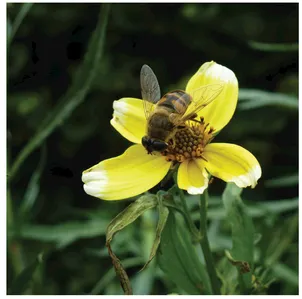
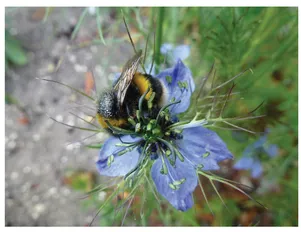
In a garden there are lots of things happening which can be explained with the help of scientific ideas. For example, it is not surprising that bees are not attracted to the red rose, as scientists have discovered that bees cannot see the colour red and to the bee the rose looks much like the surrounding green foliage. However, bees are highly attracted to shades of purple, blue and yellow and look out for plants with flat, single blossoms which are easiest to access. The colour of the flower makes them stand out, but it is the stuff inside the flower that they are really after. Bees are looking for ways to get at the pollen and nectar, and certain plants have evolved in ways which make it easy for bees to get what they want. Although we can only see them with an ultraviolet camera, there are markings (guides) inside some flowers which direct bees to the nectar and pollen. Once inside the flower the bees unwittingly pollinate the plant and help it to reproduce. As they say, a win-win situation for both parties!
Charles Darwin described pollination as an act of contrivance, by which the plant uses its flowers as devices to attract pollinators. The flower is a device which provides benefits for both the plant and the pollinator. Knowing what colour flowers attract bees is a small idea, which is useful information for gardeners. However, it is of limited use when trying to make sense of what is really going on between plants and bees. Thinking of the flower as a device for reproduction is a bigger idea because it not only enables us to picture in our minds what is going on between plants and bees, but also what is going on between all the other types of pollinators and their preferred plants. We can now start to think of the structure of any flower and how it suits the types of pollinators it attracts.
Interdependence is an even bigger idea which can be witnessed in the behaviour of the bee and flower. Both the bee and the plant are dependent on each other for their survival. Without the plant the bee would have no food, while the plant cannot reproduce without the help of the bee. It is not only the bees and flowering plants which depend on each other – the idea of interdependence can be witnessed through the interconnected behaviours of all the living things in the garden and throughout the living world. With the idea of interdependence underpinning our thinking we can now start to see the garden as an ecosystem in which interdependent organisms are living together in particular environmental conditions.
A stable ecosystem generally contains primary producers (plants) capable of harvesting energy from the sun. Plants use the energy to produce and store food through the process called photosynthesis. When animals eat the plants, the energy is passed through the food chain by primary consumers (herbivores) and secondary consumers (carnivores). Primary consumers such as caterpillars feed directly on the plant, while secondary consumers get their share of the energy by consuming the caterpillars. Decomposers (bacteria and fungi) work at the bottom of the food chain, feeding on waste products and dead plant and animal tissue. The decomposers recycle organic materials back into the soil so new plants can grow. Animals such as worms, slugs and snails break down dead leaves and other organic material, helping to make the job of the decomposers a bit easier. The relationship amongst plants and animals can be represented as food chains and food webs which show how energy is passed along from the primary producer to the different types of consumers.
In an ecosystem some animals will be dependent on plants to provide for their other needs, as well as for food. For example, trees and other plants release the vital oxygen animals need to survive. Trees also provide shelter and nesting sites for birds and small mammals as well as homes for bees, beetles and other invertebrates. Understanding how living things depend on each other for their survival helps children to think and talk about their experiences of the natural world in new ways. Ideas such as interdependence and ecosystems can excite children’s minds and move their imaginations. No longer will they see a tree as just something to climb; when looked at through scientific eyes they can see the vital role it plays in supporting the biodiversity of the ecosystem. By understanding ecosystems, children are able to visualise the bigger picture of how living things are connected and the effect destroying vegetation can have on animal populations.
Further understanding of ecosystems comes from ideas such as adaptation and inheritance. Adaptation is the way living things change over time to suit their environment. Adaptation to their environment happens because of the small differences that occur in offspring as a result of reproduction. Over generations, the small changes accumulate so that living things become progressively better suited for a particular way of life. Eventually they can become so well adapted to a way of life that they cannot survive in any other way. Imagine what this means to birds and other woodland animals when a woodland is cleared to make way for urban development. Where do they go? Where else can they find similar habitats? As ever more woodlands are destroyed, gardens and green spaces in the towns become their only refuge. By understanding the science, children appreciate the reasons why nature is in such serious trouble and become aware of the potentially devastating consequences unnatural changes to the environment can have for wildlife. By adopting the big ideas as their own, children are able to develop informed arguments about the need to protect the natural environment and decide for themselves how to act.
Inheritance and adaptation also underpin our understanding of evolution. Evolution through natural selection is the process that has created the remarkable diversity of wildlife which enriches our lives and is essential for our health and wellbeing. By learning about evolution children are able to see the bigger picture of how life developed on earth and are able to make sense of their place on the evolutionary ‘tree of life’. By looking back at their common ancestors children learn to see the living world with new eyes and are able to see themselves as part of nature, rather than just an observer.
Working towards understanding big ideas such as interdependence, inheritance and adaptation can be used to inform children’s thinking about issues related to their own wellbeing, as well as the wellbeing of the natural world. The activities and projects set out in this book support the progressive development of these scientific ideas, which can influence the way children relate to the natural world.
CHAPTER 2OUTDOOR LEARNING
Benefits of outdoor learning
There is wide-ranging evidence for the benefits of learning outside the classroom in natural environments. A large-scale study carried out by Plymouth University (2016) found that learning outdoors can have positive impacts for both children and their teachers.
The message is clear – getting children outdoors is fantastic for their health, wellbeing and learning and can set them on a pathway to happy, healthy and environmentally sustainable life styles.
(Natural Connections, Martin Gilchrist, 2017)
Evidence shows that giving children well-managed opportunities to discover, learn about and experience the living world is highly beneficial in a number of ways. In addition to enhancing their health, wellbeing and educational outcomes, learning in natural environments can have positive effects on children’s resilience, self-esteem, communication skills, team work and behaviour.
The Plymouth University results are consistent with other studies which suggest teachers particularly value outside learning because it inspires creativity, supports conceptual learning and makes the curriculum come alive for children. There is also substantial evidence for the positive impact outside learning has on children’s attitudes to learning. Schools and teachers consistently report that outdoor learning enthused and motivated children, resulting in greater engagement with learning.
Learning outdoors offers diverse experiences that encourage active engagement with stimulating settings that not only help develop children’s scientific knowledge and skills, but also aid their personal and social development. Children who sometimes struggle in the confines of the classroom can flourish outdoors where they have greater freedom and have the opportunity to learn in different ways. Children benefit because the range of locations and experiences afforded by the outdoor environment are far wider and more comprehensive than those available in the classroom (Loxley et al., 2018).
Regular diet of outside learning
Outdoor learning is considered to be a key aspect of a child’s education in the early years. However, as children get older, they go outside to learn less frequently. The...
Table of contents
Cover
Half Title
Title Page
Copyright Page
Contents
Preface
Acknowledgements
1. Big idea thinking
2. Outdoor learning
3. Working towards big ideas
4. Interdependence
5. Adaptation
6. Inheritance
7. Following in Darwin's footsteps
8. Protecting ecosystems
Index
Trusted by 375,005 students
Access to over 1.5 million titles for a fair monthly price.
Study more efficiently using our study tools.
Frequently asked questions
Yes, you can cancel anytime from the Subscription tab in your account settings on the Perlego website. Your subscription will stay active until the end of your current billing period. Learn how to cancel your subscription
No, books cannot be downloaded as external files, such as PDFs, for use outside of Perlego. However, you can download books within the Perlego app for offline reading on mobile or tablet. Learn how to download books offline
Perlego offers two plans: Essential and Complete
Essential is ideal for learners and professionals who enjoy exploring a wide range of subjects. Access the Essential Library with 800,000+ trusted titles and best-sellers across business, personal growth, and the humanities. Includes unlimited reading time and Standard Read Aloud voice.
Complete: Perfect for advanced learners and researchers needing full, unrestricted access. Unlock 1.5M+ books across hundreds of subjects, including academic and specialized titles. The Complete Plan also includes advanced features like Premium Read Aloud and Research Assistant.
Both plans are available with monthly, semester, or annual billing cycles.
We are an online textbook subscription service, where you can get access to an entire online library for less than the price of a single book per month. With over 1.5 million books across 990+ topics, we’ve got you covered! Learn about our mission
Look out for the read-aloud symbol on your next book to see if you can listen to it. The read-aloud tool reads text aloud for you, highlighting the text as it is being read. You can pause it, speed it up and slow it down. Learn more about Read Aloud
Yes! You can use the Perlego app on both iOS and Android devices to read anytime, anywhere — even offline. Perfect for commutes or when you’re on the go. Please note we cannot support devices running on iOS 13 and Android 7 or earlier. Learn more about using the app
Yes, you can access Big Ideas in Outdoor Primary Science by Peter Loxley in PDF and/or ePUB format, as well as other popular books in Education & Education General. We have over 1.5 million books available in our catalogue for you to explore.