Expanding the definition and use of literacies beyond verbal and written communication, this book examines contemporary literacies through action-focused analysis of bodies, places, and media. Nexus analysis examines how people enact and mobilize meanings that are largely unspoken. Wohlwend demonstrates how nexus analysis can be used as a tool to critically analyze and understand action in everyday settings, to provide a deeper understanding of how meanings are produced from a mix of modes in daily social and cultural contexts. Organized in three sections—Engaging Nexus, Navigating Nexus, and Changing Nexus—this book provides a roadmap to applying nexus analysis to literacy research, and offers tools to enable readers to compare methods across contexts.
Designed to help readers understand the theoretical and methodological assumptions and goals of nexus analysis in classroom and literacy research, this book provides a comprehensive understanding of the theory, framework, and foundations of nexus analysis, by using multimodal examples such as films and media, artifacts, live action performances, and more. Each chapter features consistent sections on key ideas and methods, and a description of procedures for replication and application.
Brian Street, James Paul Gee, Ron Scollon, Suzanne Wong Scollon
Key Concepts
Literacy as Social Practice
Shared Meaning–Making and Cultural Participation
Situated Literacies
Methods Focus
Filtering Ethnographic Data to Locate Nexus
Video–prompted discussion groups
Movement maps
Location–based video recording
Some Methods Mapped to Concepts
Discourses in Place (DP): photo surveys => material meanings in sensory environment
Interaction Order (IO): interviews and sociograms => typical groups
Historical Body (HB): frequency counts => routine practices
Navigating Nexus
Inquiry 6: What Do I Do With All This Data? Using Three Flows as Filters
Inquiry 7: What’s at Issue? Asking Participants
Inquiry 8: Which Things Matter Here? Locating Discourses in Place
Inquiry 9: Who’s Usually With Whom? Finding Interaction Orders
Inquiry 10: What Are People Expected to Do? Revealing Historical Bodies
Inquiry 11: What Is Literacy Doing Here? Finding Nexus Within an Activity Model
Examples
Classroom Video and Teachers’ Concerns
Playing to Read
Reading to Play
Nexus and Situated Literacies
Ron Scollon and Suzanne Wong Scollon’s (1981) early work on intercultural communication examined the mesh of largely tacit ways of doing culture through language and literacy. They conceptualized the nexus of practice to situate literacies in social practices and cultural contexts in two ways: 1) literacies create cultural meanings to be shared with others during everyday activities, and 2) these literacy practices materialize expectations for ways of behaving as a member within a particular culture. Because situated literacies are a powerful means of enacting, displaying, and invoking cultural norms, literacy learning is crucial in developing expertise in the expected ways of doing and being needed to pull off the identity of a full-fledged member (Gee, 1996; Lave & Wenger, 1991).
Nexus analysis provides a work-around for the critique that ethnography is too local or culturally idiosyncratic by acknowledging and looking beyond the situatedness of the ethnographic data. After gathering in-depth understanding of participants’ concerns and insights within a here-and-now place, the Scollons looked both closely and globally to track an action with a tool or materials over years of use to see how these histories shape normative expectations. Nexus analysis is the name they gave to their micro-/macro-ethnographic methodology that situated cultural practices in global histories. A parallel development in New Literacy Studies (Street, 1995; Gee, 1996) was the shift to literacy practice that unhinged the culturally situated and bounded time and space of a literacy event (Heath, 1983). Brian Street (1995) conceptualized literacy not as abilities or skills but as social practice, a way of getting things done within a cultural sphere. He unmasked the dominant model of literacy that (still) circulates widely in educational discourse. In this autonomous model, literacy appears universal, mechanical, and benign, a single set of skills unproblematically acquired through repeated practice to mastery. However, when analyzed through Street’s ideological model of literacy as social practice, we can see literacies are multiple, steeped in power relations, and in tension with other culturally situated ways of making meaning. In an ideological model, literacy practices are not only ways of making meaning but also ways of “doing and being” as we take up and pull off particular identities that enact recognized ways of belonging in a particular discourse (Gee, 1996).
Nexus analysis recognizes that while the semiotic potential of literacy practices can create new meanings or content, the ways of doing literacies can remain unchanged. In this way, literacy practices that intend to be critical may “sound” critical and express social justice in discourse—on paper or in a classroom discussion—while still reproducing the same inequities by enacting the old established ways of participating (Wohlwend & Lewis, 2011). However, the creativity in literacy practices also enables new actions that veer off or run counter to expected identities and practices. In this way, literacy practices can produce novel combinations of actions for pulling off identities that might not be expected, providing the means for transgressing or remaking the nexus.
Of course, we are always immersed in nexus of practice, and uncovering the nexus and making it visible and ultimately malleable requires extensive ethno-graphic research. The nexus analyst must filter through the meanings and materials in a place to locate the combinations of practices needed to pull off the dominant ways of belonging here. Along the way, analysts are interested in unmasking the meanings and practices that are so familiar they are under the radar—meanings and actions that our participants and we ourselves as researchers may not easily recognize. In other words, we need to filter through ethnographic data to uncover:
the unspoken meanings of materials and designs that make up discourses in place
the multimodal production of spaces of belonging that make up interaction orders
the automatic practices and engrained expectations that make up historical bodies
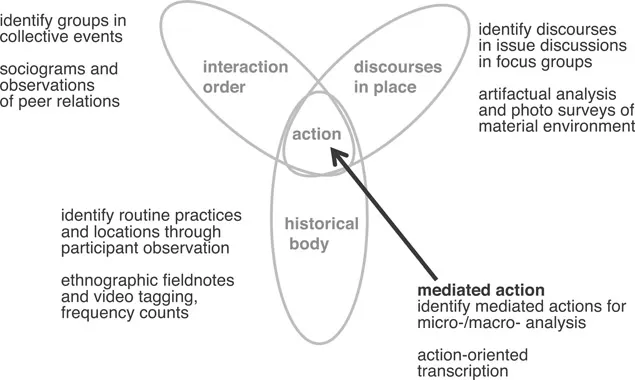
FIGURE 4.1 Initial Methods of Nexus Analysis Mapped Onto Three Flows in a Mediated Action
A nexus analysis examines these three flows that cycle in and out of any moment of activity in order to get at the mediated actions that materialize and anchor nexus of practice. The end goal is to search to locate a small yet key action that could open possibilities to change the nexus in ways that would make a difference to the people in this place. Figure 4.1 shows one way that methods of nexus analysis could materialize the model of the three flows of a nexus of practice.
INQUIRY 6 WHAT DO I DO WITH ALL THIS DATA? USING THREE FLOWS AS FILTERS
OK, so how does all this work? Where do you look for this tiny, inconspicuous, yet consequential action? How will you know it when you see it? How many moments can you feasibly analyze? Because micro- and macro-analysis of a single mediated action require an intense investment of time, you need a clear process with a compelling rationale for prioritizing your analysis and selecting a few moments to analyze out of a large and messy corpus of ethnographic and video data. In this exploration, I describe a filtering process that can help focus your analysis and inform your emerging analysis.
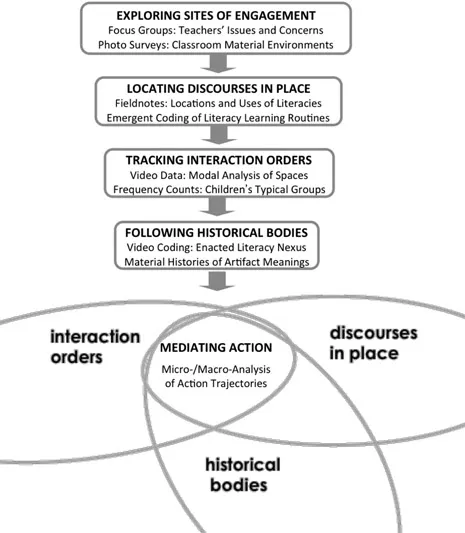
One strategy is to keep methods and theory tightly linked by thinking with a set of guiding concepts and following these throughout the study. For example, throughout this book, I’m thinking with three flows that make up a mediated action. In this chapter, I’ve incorporated the three flows into an adaptation of the Scollons’ nexus filtering process (2004) to illustrate how thinking with each component could inform early stages of your inquiry as you narrow your search for potential sites of engagement.1Figure 4.2 shows how this process organizes and screens initial data during the search for a research site and then focuses inquiry during early visits as you engage the nexus at the selected site.
The first filter gives you a sense of what matters here as you learn about core issues from participants (IO) and seek to understand how their issues are reflected in the material environment (DP) and routine practices (HB) (see examples in the next section).
The next three filters help you focus systematically on each flow (DP, IO, or HB) as you collect initial data and more of the nexus becomes apparent.
The filters funnel data to moments for micro-/macro-analysis of an action in the convergence of these flows so that you can explore its impact and potential for changing nexus.
Finally, the last steps are to think practically and imaginatively to improvise and reassemble the typical ways of doing things by altering this small action as a means to help participants reshape the nexus.
FIGURE 4.2 Nexus Analysis Filters, Using Three Constitutive Flows
These filters can organize your research chronologically as well as analytically. For example in the first months as I began to study kindergarten play, in the initial selection to early exploration of a place to study, I worked through four filters: the first filter identified one classroom as a site of engagement, the second located discourses in place to determine where to station the video cameras to capture daily literacy routines, the third followed interaction orders to see how children worked in social groups, and the fourth uncovered historical bodies by tallying the most frequent practices (see Figure 4.2). This filtering led to dense spots in the nexus where close analysis of actions—taping a piece of paper, tapping on a screen—could reveal how shared meanings and social interactions were mediated, negotiated, and produced.
After an action is identified, analysis continues, moving recursively across micro- and macro-analyses, to unpack and situate actions in immediate contexts in their far-reaching histories and trajectories. In this way, the overall filtering process sifts through a large amount of messy data to find a focus, but with a fluid design that cycles over and over, in and out and back again. Paradoxically, it widens the lens while narrowing the search, following histories and expectations in global circulations of literacy practices and artifacts at every step, putting the research in constant motion, moving back and forth across time and space.
Exploring Potential Sites
This chapter provides a sequence of initial emergent steps in a nexus analysis; as you consider potential sites, begin collecting and constructing data, and ...
Table of contents
Cover
Half Title
Series Page
Title Page
Copyright Page
CONTENTS
EXPANDED TABLE OF CONTENTS
List of Excerpts from Previous Publications
Photo Credits
Series Editor Introduction
Preface
Engaging Nexus
Navigating Nexus
Changing Nexus
Appendix A: Research Studies Mapped to Methods and Publications
Appendix B: Glossary of Key Terms
Index
Trusted by 375,005 students
Access to over 1.5 million titles for a fair monthly price.
Study more efficiently using our study tools.
Frequently asked questions
Yes, you can cancel anytime from the Subscription tab in your account settings on the Perlego website. Your subscription will stay active until the end of your current billing period. Learn how to cancel your subscription
No, books cannot be downloaded as external files, such as PDFs, for use outside of Perlego. However, you can download books within the Perlego app for offline reading on mobile or tablet. Learn how to download books offline
Perlego offers two plans: Essential and Complete
Essential is ideal for learners and professionals who enjoy exploring a wide range of subjects. Access the Essential Library with 800,000+ trusted titles and best-sellers across business, personal growth, and the humanities. Includes unlimited reading time and Standard Read Aloud voice.
Complete: Perfect for advanced learners and researchers needing full, unrestricted access. Unlock 1.5M+ books across hundreds of subjects, including academic and specialized titles. The Complete Plan also includes advanced features like Premium Read Aloud and Research Assistant.
Both plans are available with monthly, semester, or annual billing cycles.
We are an online textbook subscription service, where you can get access to an entire online library for less than the price of a single book per month. With over 1.5 million books across 990+ topics, we’ve got you covered! Learn about our mission
Look out for the read-aloud symbol on your next book to see if you can listen to it. The read-aloud tool reads text aloud for you, highlighting the text as it is being read. You can pause it, speed it up and slow it down. Learn more about Read Aloud
Yes! You can use the Perlego app on both iOS and Android devices to read anytime, anywhere — even offline. Perfect for commutes or when you’re on the go. Please note we cannot support devices running on iOS 13 and Android 7 or earlier. Learn more about using the app
Yes, you can access Literacies that Move and Matter by Karen Wohlwend in PDF and/or ePUB format, as well as other popular books in Education & Early Childhood Education. We have over 1.5 million books available in our catalogue for you to explore.