If you don’t have access to How to Read a Book (Alexander, 2018), we recommend searching for the title on YouTube so you can watch someone read it. This advice goes for the numerous picture books we will introduce to you. You’ll have a better idea about the content of these books and what you can do with them if you can see the pictures and hear the text.
Meet Our Mantra
It is no coincidence that enjoy is the first word in our mantra: “Enjoy! Dig deeply! Take action!” (Leland, Lewison, & Harste, 2013, Leland & Lewison, with Harste, 2018). While enjoyment always comes first, the idea of digging deeply follows close behind and means that readers are also paying attention to what’s going on in texts and how they and others are being positioned by them. Kwame Alexander (2018) addresses the need to linger in books with his advice to avoid rushing when you read: “Your eyes need time to taste. Your soul needs time to bloom.” Although the idea of giving your eyes “time to taste” supports the notion of digging deeply, we see the third part of the mantra represented in Alexander’s concept of what it means for a “soul to bloom.” When readers are so affected by what they read that they want to take action, we can almost see their souls blooming. And we know that we have succeeded in nurturing the empathetic and caring kind of citizen we need for the future. Because our mantra is a theme throughout this book, we show it in bold and italic print whenever it appears. We hope that this will serve as a kind of “heads up” for you that enjoying, digging deeply, and taking action are too important to forget when teaching reading.
This book differs from most reading methods textbooks in several ways. First, as mentioned above, we are primarily interested in developing students’ enjoyment of reading. We want them to grow into adults who love to read, read frequently, and are able to “read between the lines.” A second difference is our intentional goal of disrupting a number of common instructional practices that we see as harmful to children. Some of these practices represent traditional thinking that needs to be updated and some represent specific sociopolitical perspectives that empower certain groups of students while marginalizing others. Regardless of their origins, these practices are better seen as myths that need to be challenged, not tacitly accepted simply because they represent the status quo.
We are aware that encouraging you to be disruptive might seem counterintuitive. Most parents don’t encourage their children to be disruptive, either at home or in school. And predictably, most teachers are not thrilled to learn that disruptive students are headed their way. After all, who needs more discipline problems? But there are other ways to think about what it means to be disruptive, especially when it comes to teaching reading and literacy more generally. This book makes the case that disrupting or interrupting some commonly accepted literacy practices is not only beneficial but is urgently needed.
Although the title of the book identifies reading as the major topic of interest, it is important to remember that language practices also include writing, speaking, and listening. Since these components overlap in significant ways, references to disrupting myths about reading also apply to disrupting myths about writing, speaking, and listening. Pushing our understanding even further, the idea of multiple literacies suggests that along with language, humans use other modalities like art, music, drama, etc. to make meaning. This is “why movies have sound tracks, textbooks have pictures, and why malls select what music they play very carefully” (Harste, 2014, p. 91). A willingness to question and disrupt any of these literacies can open up new ways for students to “read” the world and become active participants in it.
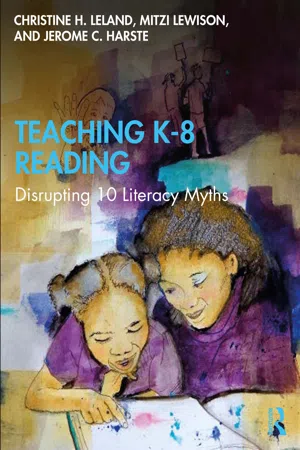
Our intention to highlight multiple modalities in this book is demonstrated by numerous references to the roles that music, art, and drama can play in supporting reading. You will also have noticed, no doubt, that each chapter begins with a striking illustration that relates to the content of the chapter. These nine pictures plus the one on the cover of the book are original paintings by Jerry Harste, who is both a reading educator and an artist. We invite you to make your own connections to the art and what you are reading and hope that the pictures inspire you to consider perspectives you might not have thought about if you simply read the text. Our intention in beginning each chapter with artwork is to help you focus on the positive power that results when literacy is supported by other sign systems or ways of knowing.
Disrupting Mythical Thinking
Mythical thinking about how reading should be taught permeates our cultural understanding at the most basic level, as shown by the widely accepted belief that good reading is defined by someone’s ability to decode words accurately. This reasoning is faulty because it ignores the fact that real reading has to make sense, regardless of how well or how poorly the individual words are decoded. If no sense is being made, then real reading is not happening. When you are reading silently and suddenly realize that the text is not making sense, you probably know enough to stop and reread until a better understanding is achieved. A willingness and ability to take corrective action provide evidence that you are a good reader. Reading is always an active, meaning-making process.
The same principle applies when we are listening to oral reading. There is no need to worry about every word being read correctly because the meaning is what matters. An extensive body of research suggests that teachers can learn a lot about their students’ strengths by analyzing the “miscues” they make while reading aloud (Goodman, Goodman, & Burke, 1978). While the traditional or commonplace view is that errors show readers’ weaknesses and must be immediately corrected, a miscue perspective argues that studying readers’ errors helps teachers to understand their strengths and furthermore that all errors need not be corrected. Teachers who have developed a “miscue ear” (Leland et al., 2018, pp. 52–53) know how to listen for signs of the strategies a reader is using to make sense of the text. If a miscue doesn’t interfere with the meaning, then it’s best to ignore it and allow the reader to keep going. Stopping to point out every miscue can diminish a reader’s enjoyment and lead to less reading rather than more. Even when a miscue is problematic, our advice is to wait until the end of the sentence before asking the reader if it made sense to him or her. It’s helpful to stop and talk about the characters and what’s going on in the story, but we see these as enjoyable conversations, not corrections or criticisms of someone’s reading.
Miscues are windows into readers’ strengths.
A second example of mythical thinking is the idea that readers need to do little more than figure out an author’s message. As stated earlier, we want readers to dig deeply and go further in terms of critically evaluating authors’ messages. We want them to make reasoned decisions about whether they agree with the messages or not. For example, we expect that students’ reading will be disrupted when they realize that what they thought was a piece of nonfiction is actually an advertisement. We hope that their inner voices say something like, “Hey! They are trying to convince me to buy or do (whatever) and I’m not interested.”
A similar disruption needs to occur when students encounter a point of view they don’t share. If they are reading a news article and notice that the author is not treating a person or group fairly, we want them to think, “Hold on… I’m not sure I believe that.” Again, the disruption leads to some sort of action—like putting that particul...