This book offers a comprehensive and current look at the complex relationship between anthropology and activism. Activism has become a vibrant research topic within anthropology. Many scholars now embrace their own roles as engaged social actors, which has compelled reflexive attention to the anthropology/activism intersection and its implications. With contributions by emerging scholars as well as leading activist anthropologists, this volume illuminates the diverse ways in which the anthropology/activism relationship is being navigated. Chapters touch on key areas including environment and extraction, food sustainability and security, migration and human rights, health disparities and healthcare access, class and gender identities and empowerment, and the defense of democracy. Case studies (drawn mainly from North America) encourage readers to think through their own experiences and expectations and will serve as durable documentation of how movements develop and change. This timely survey of the activist anthropological landscape is valuable reading in an era of widely perceived ecological and political crisis, where disinterested data collection increasingly appears to be a luxury that neither the discipline nor the world can afford.
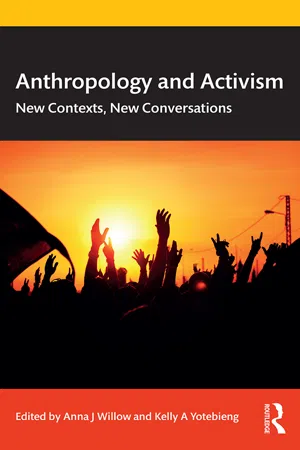
eBook - ePub
Anthropology and Activism
New Contexts, New Conversations
- 220 pages
- English
- ePUB (mobile friendly)
- Available on iOS & Android
eBook - ePub
Anthropology and Activism
New Contexts, New Conversations
About this book
Information
PART I
Anthropology OF Activism
1
Environmental Justice in White Working Class Communities
A Chemosocial Perspective
In 1970 the United States employed some 18 million workers in manufacturing, comprising a third of its working population. Midwestern states including Ohio, Pennsylvania, Wisconsin, and Michigan were global hubs for extracting resources, processing them into goods, and eliminating their wastes. Their cities and towns were bustling centers of family life and labor union politics. Today, the number of manufacturing employees in the United States stands at a mere ten million—a loss of eight million, with five million of those losses coming since 2000 (Smil, 2013). The hemorrhaging of manufacturing jobs led to a decline in social capital and civic engagement in the part of the USA known as the “Rust Belt.” Nowhere can this be seen more clearly than in the sharp shift of the US Midwest away from progressive politics and toward a politics of resentment. In 2016 a series of global elections, culminating with the US presidential election in which Donald J. Trump narrowly won the electoral college (despite losing the popular vote), thrust deindustrialization to the forefront of our collective political conscious (Gusterson, 2017). Much of the national conversation has focused on the supposed role played by a group known as the “white working class”—a loosely defined category of people who generally lack a college education and work for an hourly wage rather than a salary (Walley, 2017)—in advancing populist politics. While anthropologists have begun to make significant contributions to the study of groups opposing these changes (see Kline et al. and Smith-Cavros and Widener in this volume), there has been comparatively little attention paid to the values and attitudes that underlie the conservative activists and voters who propelled leaders like Boris Johnson (the Prime Minister of the United Kingdom) and Trump to power.
A common narrative has emerged that this group is experiencing a “culture in crisis,” (Vance, 2016) in which traditional values are incompatible with modern realities like globalization and deindustrialization. In the face of economic and cultural transformation, white Americans have indeed experienced increases in morbidity and mortality, especially related to drug abuse and suicide (Case and Deaton, 2015; 2017). The story goes that working class whites, distressed by the loss of their communities, are driven to their own doom by seeking to numb the pain somehow, whether through biochemical or geopolitical means. This conversation has taken on increasing importance as activists and politicians on the left debate whether to try to reclaim these voters or abandon them forever. Without anthropological voices contributing to this debate, the conversation about how and why the US white working class manages their social suffering has become dominated by stereotyping and agenda promotion. Recently, in their introduction to a special section of American Anthropologist titled “The Anthropology of White Supremacy,” Aisha Belisio-De Jesús and Jemima Pierre (2019) noted that the Anthropocene is just one area of anthropology where scholars have failed to engage critical theories of race. It is not enough for anthropologists to simply collaborate with groups who share our values. If we desire to affect meaningful change that will improve people’s lives, it is first necessary for us to go into the weeds and conduct ethnographies of people with whom we may not necessarily agree—or even like.
I want to believe that there is a space for thinking anthropologically about white working class political ecologies. Our popular narrative about the impacts globalization and deindustrialization have had on non-college educated whites glosses over several decades of abuse imprinted on Midwestern bodies and landscapes. The story of Midwestern decline is tied up in place, with the Appalachian Mountains to the East supplying coal, the iron mines of the Great Lakes to the North supplying iron ore, and the Great Plains to the West and metropolises of the Northeast gobbling it all up. That unique geography led to the strategic placement of economic firms which exploited resources, technologies, and populations (Kern and Wilson, 2014; Feather, 2017). As deindustrialization progressed throughout the Midwest, the departure of extractive and manufacturing industries left behind entire communities once built on their foundation. This is an important and often overlooked part of our narrative on the white working class, and it deserves more attention. How were white Midwestern bodies treated as disposable, both during and after the heyday of US manufacturing? Why did the new politics of white racial resentment happen to emerge in the same places where economic decline was most acute? As anthropologists seek to expand our role outside of academia and into the public and activist spheres, these are important questions with which we must contend. In order to understand how activism manifests, it is necessary to examine it in all places and forms.
Here, I suggest that the concept of chemosociality, or how we become through chemical interactions, is among anthropology’s key contributions to understanding the white working class (Shapiro and Kirksey, 2017). The social suffering wrought by deindustrialization is not merely seen as a decline in paycheck; it is also embodied through illnesses, injuries, and emotions. To understand suffering, we must understand how humans and industrial chemicals have combined to form an Anthropocene where working class whites are cast out and forgotten, relegated to Midwestern blasted landscapes (Kirksey, Shapiro, and Brodine, 2013). This chapter adopts chemo-ethnography as a framework for examining the lived experiences of white working class people in Ashtabula, Ohio. I examine the impact of the Comprehensive Environmental Response, Compensation, and Liability Act (also known as CERCLA or Superfund) on the politics of deindustrialization in Ashtabula. CERCLA was passed by the United States Congress in 1980 following the Love Canal environmental disaster in Niagara Falls, New York, and immediately transformed Ashtabula as five sites around the county were placed on the National Priorities List (NPL) for cleanup under the legislation. Most prominent among these is Fields Brook, a stream in the northern part of Ashtabula County that was surrounded by more than 20 different industrial facilities. I argue that the impacts of the contaminants on human and environmental health are an important and often overlooked part of the feelings of resentment attributed to rural white America. The novel chemosocialities that emerge from human interactions with chemicals have given rise to a form of environmental justice activism that is unique to white working class Americans. While environmental justice is usually examined in communities of color and is seen as being a domain of socially liberal politics, the environmental injustices that occurred in Ashtabula County produced a different range of strategies, coalitions, and ideals. These novel assemblages transcend political boundaries, and proponents of environmental justice remain split to this day over whether the Superfund designation was helpful or harmful. Human-chemical interactions, such as chemical reactions themselves, produce emergent phenomena and novel material conditions to which anthropologists seeking to understand post-industrial political upheaval must pay attention. While this chapter will not discuss the full origins and impacts of white nationalist sentiments, it will hopefully shed light on how those movements come to be normalized and destigmatized.
Furthermore, it is important to note that I hold a personal stake in this matter. I grew up in Ashtabula Township, two miles from the chemical industrial complex that produced Fields Brook Superfund Site and less than a mile from the facility where the dredged soils and all of their contaminants were incinerated. I can vividly recall walking to the school bus stop as a child, taking in the smells of ash and rotten eggs upwind. Since the 2016 election I have been disappointed to hear many of my liberal colleagues—including many in anthropology—criticizing the people, places, and lifeways I grew up among. The current characterization of rural America as a “culture in crisis,” irredeemably racist and conservative, is an injustice against my hard-working, progressive-minded friends and family who are actively working to make a difference in their communities. It also fails to acknowledge and address the anxieties and challenges that arose from deindustrialization, possibilizing the synthesis of nationalism and populism. To be clear, I am not suggesting that populist conservatism is solely a product of economic anxiety. Contrarily, I am suggesting that white racial identity is inseparable from such feelings of economic anxiety, coupled with the industrial legacy of the Midwest. To this end, it is necessary to understand how the political economy of industry gave shape to white racial identity in the United States.
Who is the “White Working Class”?
The theoretically problematic nature of defining a white working class demands anthropological attention. Ethnographic insights into the formulation of class and ethnic identities subsumed under the category “white” are vital to producing a more vibrant portrait of the lives that occupy this group. The historical division between sociology and anthropology as the respective studies of “self” and “other” has meant that the former has been the hub of scholarship on whiteness and class. Anthropological attention to the white working class has been limited in both breadth and scope, with works such as Sherry Ortner’s New Jersey Dreaming (2003) among the most prominent investigations of culture and class among US whites. However, the ethnography only briefly explores racial identity, instead focusing on conceptions of upward mobility and class.
The thinness of anthropological literature on white working class political activism is a shortcoming in our discipline that must be corrected. In Tobacco Capitalism, Peter Benson (2011) coins the term “plighted citizenship” to describe the affective, resentful acts that white Americans take to express discontent with their modern government. Plighted citizenship refers to political action borne out of a feeling that one has been a victim of injustice. Other anthropologists including Willow (2014) and Westermeyer (2016) have suggested that white working class activisms are a product of the growing reach of neoliberalism that render them newly precarious. Anthropological engagement with whiteness can expand our understanding of the white working class by revealing how lived experiences of race, class, and power shape our engagements with the world. In light of recent global political events, there is indeed a space for anthropologists of activism to begin to engage with activisms with which we may not necessarily agree.
The white working class is a social category used to describe workers who make an hourly wage and lack a college degree. This stands in contrast to workers in the middle or professional classes, who are better educated and were historically salaried. The difference has also long been one of productivity: many members of the working class, particularly those in manufacturing, work with commodities, while the professional classes manage ideas or capital. Members of the white working class in the US Midwest are the descendants of European immigrants from nations including Italy, Ireland, Hungary, Czechoslovakia, Germany, Portugal, Sweden, Poland, and Norway. Most of these migrants arrived in the Northeastern United States in the late 19th and early 20th centuries. Many, especially from northern European countries, initially settled in mining towns throughout Appalachia, where jobs in the coalmines provided upward mobility for the new migrants. Coal experienced a bust period following the Great Depression from which it never fully recovered as new technologies allowed it to be replaced by oil and natural gas. Insecure once again, some traveled north to states such as Ohio and Michigan, where they found work in the burgeoning factories (Feather, 1998). Settlements frequently created ethnic enclaves of people with similar backgrounds living and working closely. However, whiteness as a category is vague, and so the white working class also includes people of national origins other than those that I mentioned. I will return to this point in a moment.
The white working class looms in the American imaginary as the picture-perfect representation of the American Dream. It is often mentioned, but seldom defined. Economists and pollsters who remain attuned to electoral politics have dominated the conversation, all but ensuring a limited scope of whom or what constitutes the white working class. Since the New Deal in the 1930s and the advent of organized labor, the national Democratic Party has made working class whites a pillar of its base of support. Following the 2016 Presidential election there has been an almost unending stream of punditry about how best to “win back” those voters. Thus, there is renewed and ongoing concern with white working class people insofar as they are viewed as fundamental instruments for levers of political power (Kline and Vickers, in this volume).
The white working class refers to a triadic status of racial, economic, and political citizenship. However, the role of each is vaguely defined and elides historical and modern social realities. First, regarding race, the white working class is a category that homogenizes groups of people from diverse geographic backgrounds without regard to their unique values and experiences. The purpose of establishing white identity in the United States, according to historian Grace Elizabeth Hale (1995), was to formulate political coalitions that could continue to advance a segregationist agenda. This is reflected in the history of the national Democratic Party as a predominately southern enterprise in the early 20th century. The ascent of race, especially whiteness, in substitution for ethnicity as a marker for identity among European migrants is a problematic construction that substitutes an identity based on heritage for one based on racial supremacy. New migrants were absorbed into the white political majority through this mechanism in an effort to consolidate political power among segregationists. Whiteness, then, exists as a social construct rather than a biological one.
“Working class” has historically denoted workers who lack a college degree, earn an hourly wage, and produced commodities with their labor. However, the term is increasingly inappropriate, given modern economic realities, if it ever really did describe many of these jobs to begin with (Walley, 2017). For instance, many workers with college degrees now work in jobs that pay an hourly wage, especially those who are unable to find positions that utilize their specific skill sets. By comparison, many manufacturing sector workers, especially those who have been union members, earn wages that rival that of their college educated peers. In one factory examined for this research, the starting wage is $30 per hour, with some long-term employees making as much as $250,000 annually at the time of retirement. Such wages are typically associated with the professional class. Moreover, the growth in service sector employment means that many people with college degrees now face the same insecurity as their less educated counterparts. Furthermore, to reiterate an earlier point, the category “white working class” is a political construction, and hence it is assumed that members of the category will vote together. These simultaneous homogenizations of racial, class, and political identity make problematic narratives such as the one this chapter argues against possible.
A Chemo-Ethnography of Fields Brook Superfund Site
An anthropological investigation of the white working class begins with the embodied. The white working class was initially identified as a political category designed to unite people of disparate geographic and historical backgrounds into a common coalition. Political associations were thus based on conjoined mo...
Table of contents
- Cover
- Half Title
- Title Page
- Copyright Page
- Dedication
- Table of Contents
- List of Figures
- Foreword: Activism as Service
- Acknowledgements
- List of Contributors
- Introduction: Doing Good Anthropology
- PART I: Anthropology OF Activism
- PART II: Anthropology AS Activism
- PART III: Anthropology AND Activism
- Afterword
- Index
Trusted by 375,005 students
Access to over 1.5 million titles for a fair monthly price.
Study more efficiently using our study tools.
Frequently asked questions
Yes, you can cancel anytime from the Subscription tab in your account settings on the Perlego website. Your subscription will stay active until the end of your current billing period. Learn how to cancel your subscription
No, books cannot be downloaded as external files, such as PDFs, for use outside of Perlego. However, you can download books within the Perlego app for offline reading on mobile or tablet. Learn how to download books offline
Perlego offers two plans: Essential and Complete
- Essential is ideal for learners and professionals who enjoy exploring a wide range of subjects. Access the Essential Library with 800,000+ trusted titles and best-sellers across business, personal growth, and the humanities. Includes unlimited reading time and Standard Read Aloud voice.
- Complete: Perfect for advanced learners and researchers needing full, unrestricted access. Unlock 1.5M+ books across hundreds of subjects, including academic and specialized titles. The Complete Plan also includes advanced features like Premium Read Aloud and Research Assistant.
We are an online textbook subscription service, where you can get access to an entire online library for less than the price of a single book per month. With over 1.5 million books across 990+ topics, we’ve got you covered! Learn about our mission
Look out for the read-aloud symbol on your next book to see if you can listen to it. The read-aloud tool reads text aloud for you, highlighting the text as it is being read. You can pause it, speed it up and slow it down. Learn more about Read Aloud
Yes! You can use the Perlego app on both iOS and Android devices to read anytime, anywhere — even offline. Perfect for commutes or when you’re on the go.
Please note we cannot support devices running on iOS 13 and Android 7 or earlier. Learn more about using the app
Please note we cannot support devices running on iOS 13 and Android 7 or earlier. Learn more about using the app
Yes, you can access Anthropology and Activism by Anna J Willow, Kelly A Yotebieng, Anna J Willow,Kelly A Yotebieng in PDF and/or ePUB format, as well as other popular books in Social Sciences & Anthropology. We have over 1.5 million books available in our catalogue for you to explore.