This textbook provides a framework for teaching children's language and literacy and introduces research-based tactics for teachers to use in designing their literacy programs for children. Exploring how sense-making occurs in contemporary literacy practice, Murphy comprehensively covers major topics in literacy, including contemporary multimodal literacy practices, classroom discourse, literacy assessment, language and culture, and teacher knowledge.
Organized around themes—talk, reading and composing representation—this book comprehensively invites educators to make sense of their own teaching practices while demonstrating the complexities of how children make sense of and represent meaning in today's world. Grounded in research, this text features a wealth of real-world, multimodal examples, effective strategies and teaching tactics to apply to any classroom context.
Ideal for literacy courses, preservice teachers, teacher educators and literacy scholars, this book illustrates how children become literate in contemporary society and how teachers can create the conditions for children to broaden and deepen their sense-making and expressive efforts.
Language and literacy are expressions of the sense we have made of situations, things, people, places and relations as well as of our desires to share that meaning with others. Yet, language and literacy can only partially represent what we know, think and feel. Whether we describe an image through oral or written language, talk about a meal we ate at a restaurant, compute a mathematical problem, write a poem or read a science fiction book, language and literacy can never quite capture the full sense of the moment. However, language and literacy are indispensable in that they enable us to take part in our social world. As the German philosopher Klaus Mollenhauer (2014) says, “language plays a pivotal role…since it is language that gives rise to intersubjectivity—providing the capacity for participation in human society” (Chapter 4, Section 1, para. 7).
Because of the centrality of language and literacy in social life, our work as language and literacy educators supports who our students become as they engage in the world. Our students come to school with experience in making sense of and representing the sense they make of their world through language and literacy. Their experiences are not the idealized hierarchically organized experiences found in curriculum documents produced by governments, nor are they fully captured by the many different theories that describe them; language and literacy development is not marked by a specific point in time, nor is it always visible and neatly organized. Instead, language and literacy are embedded in and emerge from the happenstance and circumstance of daily living and we (teachers, theorists and researchers) gaze upon it trying to find patterns that turn into theories and curricula.
Reflecting on our own experiences may help us think about patterns of language and literacy in our own lives, how language and literacy operate inside and outside of formal schooling, and how our experiences form a point of departure for our own thinking about language and literacy. Our experiences may be relatively unfettered, or we may have encountered barriers, struggles and detours that influence our ideas about what is important in language and literacy learning. To get started in thinking about our language and literacy pasts, consider the questions (adapted from Goodman, Watson, & Burke, 1987) below which focus on language and literacy experiences in early childhood, school and everyday life:
1. What is your earliest memory of reading or composing?
2. Do you remember learning to read? What did it involve? Did you learn in more than one language? Were there differences in how you learned in different languages?
3. Do you remember learning to write? What did it involve? Did you learn in more than one language? Were there differences in how you learned in different languages?
4. Do you think of yourself as a good reader, writer, illustrator, photographer, filmmaker? Why or why not?
5. Are there any differences in the ways fiction and non-fiction are valued in your home? Are there different values associated with reading/viewing on digital platforms compared with paper?
6. If you are proficient in more than one language, do you think being multilingual aided or hindered your reading and writing?
7. If you look back on your elementary school years, what memories do you have of being taught to read or write? How do they inform what you think about teaching language and literacy?
8. What memories do you have of being taught how to use digital platforms?
9. What kinds of reading/viewing and composing do you do as part of daily life? If you had the time, would you like to do other kinds, and what would they be?
10. What do you like most about reading and writing? What do you think children like most about reading and writing? What do you think teachers like most about reading and writing?
11. Do you think of non-school/work digital platform activities as literacy activities? Why or why not?
12. If you are multilingual, do you ever switch back and forth between languages in mid-sentence? What values do you think are associated with people who code-switch like this?
13. What is the most memorable text you have ever read/viewed? What is the most memorable text you have ever composed?
14. Do you write fiction, non-fiction, poetry, letters to the editor or letters of complaint/service, song lyrics or plays? If you do, what motivates you?
15. Do you blog, text, use Facebook or other social media? Do you think about these as literacy experiences or as something else and, if so, what?
What Can Language and Literacy Autobiographies Teach Us?
Our memories of early language and literacy experiences may be very specific or quite partial or even non-existent. Highly proficient readers, for instance, remember very little of how they learned to read (Durkin, 1966). I was one of those readers. My first distinct memory of reading was in first grade (there was no Kindergarten at that time). The principal of the school called me out of a class to go to the music room where I was asked to read from books she had selected. I recall having trouble with one word which I remember had something to do with splashing in a puddle of water. I was being considered for promotion to second grade because of my proficiency in reading—that is how important reading is. All the reading experiences that led to that moment are unremembered…just this moment is one that I recall. Some of what I know about my early literacy experiences I learned from others who recounted to me how I would sit listening to my brother practicing his oral reading for first grade, or how my mother had to curtail the number of pages I completed in a large book of school readiness activities because I wanted to do all of the pages. But my own first memory of reading is of my encounter with “splashing.”
I remember that when I was growing up, I read mystery series such as Nancy Drew, the Hardy Boys and the Bobbsey Twins. I don’t recall the particulars of the books, but I do remember striving to read every book in each mystery series and somehow never being able to read every single one because the books simply weren’t available or in our town’s small public library. I also recall saving up potato chip bags to send to the Scottie potato chip company that was running a promotion in which 20 potato chip bags got you a “free” book. Again, I don’t recall any of the stories in those books. Instead, what I remember are the feelings of anticipation as I worked to collect the number of potato chip bags needed to get a book, waiting until the book came and being a little disappointed at the plain pictureless cover.
I also have vivid memories of some images from my school-based language arts reading series—one for its particularly compelling colors of a snowclad fir tree set against the most indigo of indigo-blue starlit skies, and another of a golden, almost glowing, bin of maize (I had no idea what maize was. It was such a mystery to me, how this gift of golden food and the knowledge from aboriginal peoples helped early settlers of North America survive, especially as corn was not grown where I grew up nor was it a common staple). These memories, scant as they are, suggest that language and literacy are not just about words but are also about images, knowledge, feelings and place. Of course, my recollections are just the recollections of one person, someone who grew up in a small, rural, unilingual English-speaking community on an island.
The students I teach today in a large North American multicultural city have much different experiences. Many of the university students I teach are proficient in several languages. Their memories of the teaching of reading and writing in one language compared to another language reveal extraordinary differences. Knowledge of such differences can go some way toward heightening everyone’s sensitivity to the repertoire of experiences children bring along with them to school. I am always fascinated by my students’ responses to questions about whether they are good readers and writers. Invariably there will always be a small group of students who believe that they are not good readers; for writing, the size of the group believing in their inability to write is much larger. When we talk about this pattern, usually a conceptualization of reading emerges as involving a high degree of accuracy and perfect understanding, and a conceptualization of writing as an effortless task that occurs without errors or struggles. Yet, I also find that, among these same students, there are poets, songwriters and playwrights who undoubtedly know differently! Such patterns demonstrate that the sense we make of language and literacy in our lives is complex and contradictory. As we consider our own language and literacy biographies, we may find evidence that our sense-making of language and literacy is driven by different assemblages of knowledge (e.g., cultural, familial, linguistic, spiritual, emotional and social) operating in different ways in different contexts. These “cognitive assemblages”1 allow us to engage in “flexibly attending to new situations, incorporating this knowledge into adaptive strategies, and evolving through experience to create new strategies and kinds of responses” (Hayles, 2016, p. 33).
The Context of Situation as a Heuristic for Thinking about Language and Literacy Classrooms
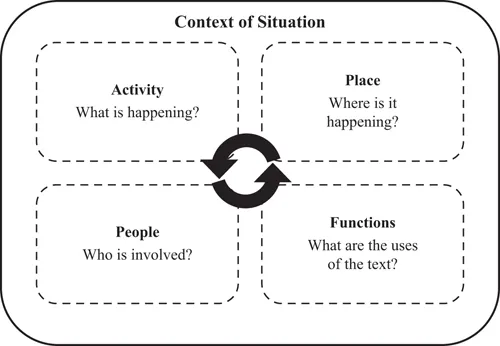
If our sense-making is so situational, then it stands to reason that structures or models that parse out the elements of any situation might be helpful. The “context of situation” is one such model that helps explain “how a text relates to the social processes within which it is located” (Halliday, 1978, p. 10). Each context of situation involves an activity being undertaken, the people undertaking it and the functions accorded to the text within the activity (see Figure 1.1). Returning to my recollection of reading a text for the principal, the activity in which I was involved was an oral reading of a school-based text. As for the people involved, I was a student who, if truth be told, was afraid of the principal. The principal had not had much to do with me personally but would have known that my brother was enrolled in another grade in the school. She probably knew that we had cousins in the school, as this kind of information was widely known in the small rural community in which I was raised. Perhaps the principal undertook the assessment in response to my teacher’s comments. Certainly, at that time period, school principals in small communities had a great deal of standing and authority. As for the functions that the text served, there were several. The text was not being read for pleasure. Nor was I, as a reader, reading the text aloud for the edification of the other person in the room—a room which, as a place,2 amplified the extraordinariness of the situation because it was not used for oral reading of books by children to adults, but for choral singing classes. I wasn’t reading to communicate to the listener. The function of the reading for me was to perform an oral reading for the principal, and the function of the reading for the principal was to gauge my competence. I don’t recall whether the fact that I was being assessed for promotion was communicated to me or not; I think it probably wasn’t because when I went home to tell my mother about my reading, she reported that she had received a telephone call from the school about the assessment. As for the activity of the oral reading itself, rarely, outside of school contexts, would I engage in an on-the-spot reading for someone who I feared and did not know well. Because the oral reading was being conducted for the purpose of assessment in school, and because I was a successful student, I also would have learned the paramount importance of accuracy which probably accounts for the heightened sense of the situation and my memory of it.
Figure 1.1 Context of situation as a set of interrelations Source: Adapted from Halliday, 1978
The theoretical construct of the context of situation can help us highlight the values that underlie our language and literacy autobiographies. More importantly, though, this model can become a way for us to think about the language and literacy events that can be orchestrated throughout our careers in teaching. In such contemplations, it is important to consider not only what is occurring, but also what is not occurring, why that might not be occurring and whether we and/or our students wish to ...
Table of contents
Cover
Half-Title
Title
Copyright
Contents
1 A Point of Departure
2 Frames for Sense-Making and Sharing Meaning
3 What Happens After “Hello”: Talk in the Language and Literacy Classroom
4 Tactics and Strategies: Oral Expression
5 Early Moves in Reading
6 Reading as Sense-Making: Beyond the Early Years
7 Tactics and Strategies: Reading Expressions of Meaning
8 Representing Meaning
9 Tactics and Strategies: Representing Meaning
10 Pedagogical Arcs in Literacy Teaching
11 Knowing Well and Doing Well: Responsible Literacy Assessment
Index
Trusted by 375,005 students
Access to over 1.5 million titles for a fair monthly price.
Study more efficiently using our study tools.
Frequently asked questions
Yes, you can cancel anytime from the Subscription tab in your account settings on the Perlego website. Your subscription will stay active until the end of your current billing period. Learn how to cancel your subscription
No, books cannot be downloaded as external files, such as PDFs, for use outside of Perlego. However, you can download books within the Perlego app for offline reading on mobile or tablet. Learn how to download books offline
Perlego offers two plans: Essential and Complete
Essential is ideal for learners and professionals who enjoy exploring a wide range of subjects. Access the Essential Library with 800,000+ trusted titles and best-sellers across business, personal growth, and the humanities. Includes unlimited reading time and Standard Read Aloud voice.
Complete: Perfect for advanced learners and researchers needing full, unrestricted access. Unlock 1.5M+ books across hundreds of subjects, including academic and specialized titles. The Complete Plan also includes advanced features like Premium Read Aloud and Research Assistant.
Both plans are available with monthly, semester, or annual billing cycles.
We are an online textbook subscription service, where you can get access to an entire online library for less than the price of a single book per month. With over 1.5 million books across 990+ topics, we’ve got you covered! Learn about our mission
Look out for the read-aloud symbol on your next book to see if you can listen to it. The read-aloud tool reads text aloud for you, highlighting the text as it is being read. You can pause it, speed it up and slow it down. Learn more about Read Aloud
Yes! You can use the Perlego app on both iOS and Android devices to read anytime, anywhere — even offline. Perfect for commutes or when you’re on the go. Please note we cannot support devices running on iOS 13 and Android 7 or earlier. Learn more about using the app
Yes, you can access Sense-Making and Shared Meaning in Language and Literacy Education by Sharon Murphy in PDF and/or ePUB format, as well as other popular books in Education & Education General. We have over 1.5 million books available in our catalogue for you to explore.