Turning Psychology into Social Contextual Analysis
eBook - ePub

Turning Psychology into Social Contextual Analysis

  1. 162 pages
  2. English
  3. ePUB (mobile friendly)
  4. Available on iOS & Android
eBook - ePub

Turning Psychology into Social Contextual Analysis

About this book

This groundbreaking book shows how we can build a better understanding

of people by merging psychology with the social sciences. It is part of a

trilogy that offers a new way of doing psychology focusing on people's

social and societal environments as determining their behaviour, rather than

internal and individualistic attributions.

Putting the 'social' properly back into psychology, Bernard Guerin turns

psychology inside out to offer a more integrated way of thinking about and

researching people. Going back 60 years of psychology's history to the

'cognitive revolution', Guerin argues that psychology made a mistake, and

demonstrates in fascinating new ways how to instead fully contextualize the

topics of psychology and merge with the social sciences. Covering perception,

emotion, language, thinking, and social behaviour, the book seeks to

guide readers to observe how behaviours are shaped by their social, cultural,

economic, patriarchal, colonized, historical, and other contexts. Our brain,

neurophysiology, and body are still involved as important interfaces, but

human actions do not originate inside of people so we will never fi nd the

answers in our neurophysiology. Replacing the internal origins of behaviour

with external social contextual analyses, the book even argues that thinking

is not done by you 'in your head' but arises from our external social, cultural,

and discursive worlds.

Offering a refreshing new approach to better understand how humans

operate in their social, cultural, economic, discursive, and societal worlds,

rather than inside their heads, and how we might have to rethink our

approaches to neuropsychology as well, this is fascinating reading for

students in psychology and the social sciences.
Frequently asked questions

Yes, you can cancel anytime from the Subscription tab in your account settings on the Perlego website. Your subscription will stay active until the end of your current billing period. Learn how to cancel your subscription.
No, books cannot be downloaded as external files, such as PDFs, for use outside of Perlego. However, you can download books within the Perlego app for offline reading on mobile or tablet. Learn more here.
Perlego offers two plans: Essential and Complete
  • Essential is ideal for learners and professionals who enjoy exploring a wide range of subjects. Access the Essential Library with 800,000+ trusted titles and best-sellers across business, personal growth, and the humanities. Includes unlimited reading time and Standard Read Aloud voice.
  • Complete: Perfect for advanced learners and researchers needing full, unrestricted access. Unlock 1.4M+ books across hundreds of subjects, including academic and specialized titles. The Complete Plan also includes advanced features like Premium Read Aloud and Research Assistant.
Both plans are available with monthly, semester, or annual billing cycles.
We are an online textbook subscription service, where you can get access to an entire online library for less than the price of a single book per month. With over 1 million books across 1000+ topics, we’ve got you covered! Learn more here.
Look out for the read-aloud symbol on your next book to see if you can listen to it. The read-aloud tool reads text aloud for you, highlighting the text as it is being read. You can pause it, speed it up and slow it down. Learn more here.
Yes! You can use the Perlego app on both iOS or Android devices to read anytime, anywhere — even offline. Perfect for commutes or when you’re on the go.
Please note we cannot support devices running on iOS 13 and Android 7 or earlier. Learn more about using the app.
Yes, you can access Turning Psychology into Social Contextual Analysis by Bernard Guerin in PDF and/or ePUB format, as well as other popular books in Psychology & Emotions in Psychology. We have over one million books available in our catalogue for you to explore.

Information

1 Where psychology went wrong 60 years ago

An erroneous turn at the fork in the Gestalt road

For a long time now, psychology has had some unchallenged but wrong assumptions. From all the pre-psychology era and then through the first 100 years of a named ā€˜psychology’, the following were assumed to be obviously true by all but a few:
•People function both with a body and also with something else separate and hard to describe—the mind, soul, mentality, consciousness, thoughts, experience.
•The two parts work together in some way but …
•Sometimes the second part has been said to be ā€˜immaterial’ and sometimes ā€˜embodied’ in some vague way within the body.
•Sensations on our sensory organs are ā€˜taken in’ and used to build the mind or ā€˜mental parts’, usually said to occur in the brain.
•Thinking is a private process originating deep inside us that no one else can experience.
•We function as individuals in this world.
•What we do originates ā€˜inside us’ as choices or decisions, usually taken to mean ā€˜in the brain’.
•Our thinking then determines what we do.
There has also been a hidden history of a few people saying that all of these assumptions are wrong.

Turning psychology inside out

In this book I wish to bring together what is wrong with the aforementioned assumptions, and then, more importantly, spend time showing how we can still understand what people do without all that baggage. Doing this changes the whole nature of the ā€˜psychology enterprise’ that began in the late 1800s, and will especially change:
•How ā€˜psychology’ needs to merge with the other social sciences (V5).
•How we think about and ā€˜treat’ the range of ā€˜mental health’ issues (V6).
I see the Gestalt theorists, from roughly the 1920s to the 1940s, as pivotal in modern psychology, not so much by what they tried to develop but by the criticisms they raised of the current psychology of that time. Sadly, most of this has been ignored ever since except in a few little pockets of psychology. Other extremely powerful criticisms were also made by others, but were ignored in subsequent discussions of psychology (Bentley, 1935; Guerin, 2016a).
The point will be that the Gestalt theorists posed difficult questions for any ā€˜psychology enterprise’, and there were two paths that followed from this ā€˜fork in the road’. I will argue that psychology took the wrong path 60 years ago, based on a mistake to be outlined later in this chapter.

What can we learn from a broken triangle?

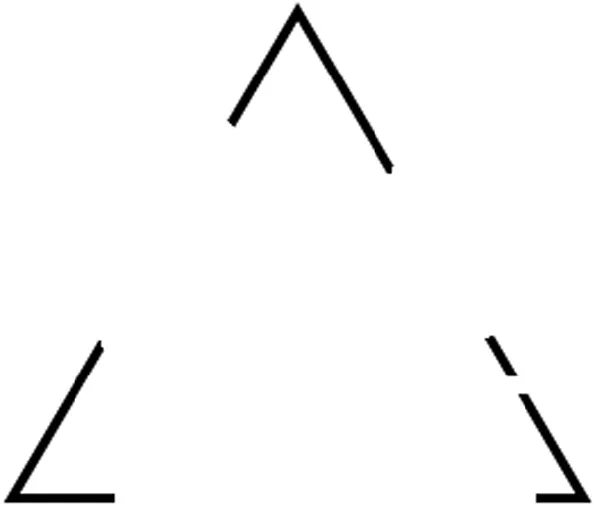
As a quick rundown, there were three main characters involved initially in the Gestalt criticisms, Max Wertheimer, Kurt Koffka, and Wolfgang Kƶhler, from roughly the 1920s to the 1940s. They published articles on some perceptual effects that were immediate and real, as opposed to the sensory experiments that had been taking place in psychology labs all around the world following from Wundt, Titchener, and others. Have a look at the sensory experiment shown in Figure 1.1, which is similar to the other Gestalt demonstrations.
Figure 1.1The Gestalt triangle sensory experiment
What do you see in Figure 1.1? Answer this first!
According to the psychology wisdom at that time and also now, light rays make sensations on our retinas of four black lines, some with angles, and our brain constructs a triangle from these sensations. But when I ask what you see, however, you see a triangle. A ragged, broken old triangle, but still a triangle. And we see it immediately, 100 per cent, without a time lag. We do not see four bits of black line and—hey presto!—a few seconds later, we see a constructed triangle.
So, what is the big deal about this? Well, these and other demonstrations like it were all immediate and compelling (ā€œI see a triangleā€), with about 100 per cent agreement (unlike the introspective reports of ā€˜sensations’). From this, the Gestaltists argued that we must see in some bigger organizational units. What we do as humans is done in terms of bigger units (ā€œI see a triangleā€), but we cannot see a triangle just from the immediate sensory-datum of light impinging in the retina. What we ā€˜see’ does not appear to be the ā€˜raw’ units of elementary sensations. (Caveat: as a very important point that will come up later in this chapter to resolve this puzzle, notice the ambiguity of the word ā€˜see’ in this sentence: ā€œWe do not see four black lines we see a triangle.ā€ Before going on, try to ā€˜draw’ what you ā€˜see’ above in Figure 1.1. I will come back to this as it shows the mistake that propelled current psychology along the wrong path.)
The work of the Gestaltists started with perceptual phenomena but eventually broadened into the units of everyday social life as well (Kurt Lewin). Koffka (1935) famously used the expression, ā€œThe whole is other than the sum of the partsā€, meaning that adding up all the retinal sensations from the diagram in Figure 1.1, the whole is more—it is a triangle!
Another point from the Gestalt demonstrations was that most work stemming from Wundt and Titchener would have focused on the black lines, aka the black triangle. The white ā€˜background’ would not have been thought about. But, the Gestaltists emphasized in their demonstrations that the background context was also important in understanding the bigger units being studied (such as triangles). They started talking in terms of ā€˜field’ theory, borrowing that word from physics. Answering the question ā€œWhat do you see?ā€ is not about isolated light waves hitting the retina, but of bigger units that must also include the field of other events going on at the same time (I prefer the word ā€˜context’ to ā€˜field’). But the problem I will get to next is whether the white background is enough of the context to consider? Are there even more relevant contexts in this simple example? (Spoiler: the social and discursive contexts are actually important also, even in this triangle example.)
None of this meant that physiology was not important. The Gestaltists, like everyone else, made little diagrams of what the brain and neurological circuits might look like in the details of what was available at that time. But for them, there needed to be bigger organizational units within the neurological circuitry. And some, like Donald Hebb in 1949, tried to conceptually do something in line with this, with what was known about brain physiology in his slightly later period.
We can also take some of the criticisms further. The Gestaltists emphasized that there was no passive reception of sensory input, but that perception was an active and more complex set of events. Later in the chapter we will see James Gibson’s (1979) criticism that the majority of perception experiments had the head fixed in place and showed participants static ā€˜stimuli’, meaning that real perception was being prevented! This was also true, of course, for Gestalt’s own demonstrations, which were two-dimensional, had plain backgrounds with no texture, and were fixed.
The Gestalt criticisms can also be taken even further in a way that will become important later in this book. They argued that the approach used by Wundt was flawed because the method he used of having participants ā€˜introspect’ on basic ā€˜elements’ of the senses and report their ā€˜experience’, was not how real perception works (like our triangle), and the ā€˜units’ Wundt and Titchener found were therefore flawed and not real units. Taking this further, the introspection of sensations and reporting on sensory experience, therefore, somehow artificially created the ā€˜elements’ that were reported. That is, Wundt’s participants had been shaped by the experimenters (they were often colleagues and students who were ā€˜trained’ to do this ā€˜properly’) and any reporting on basic sensations was artificial and any ā€˜elements’ or ā€˜patterns’ found were due to language shaping rather than seeing.

What did the Gestaltists do with this?

Despite the good criticisms and a shake-up for psychology, which I will argue later in the chapter put psychology at an important but mistaken fork in the road, the Gestaltists never galvanized a solid core of theory or methods that lasted. But beyond a few small groups (ecological psychology, field psychology), this never took off in the mainstream. Most psychologists referred to Gestalt theory when making criticisms of what was being done, but without showing how to go forward until the late 1950s and 1960s.
I think a problem was that they never found a way to pursue their own criticisms. They continued to carry out more traditional ā€˜experiments’ and not just demonstrations, and there were a lot of conceptual attempts to move psychology into a new set of practices. But having stated loudly that the field or context is important, they never went beyond a perceptual field to say what these might look like (except occasionally Kurt Lewin). What was needed was some form of analysis of the actual contexts for human behaviours.
The main conceptual attempt at moving forward made by Gestaltists was to get away from the idea of behaviour as being determined by objects, units, things, and ā€˜stimuli’, and arguing that the whole field or context needs to be taken into account. This was sometimes called a ā€˜molar’ view (e.g. Brunswik, 1950), as opposed to Descartes’s push to build from the molecular upwards. This was reflected by Gestaltists in phrases such as: psychology is ā€œthe study of behavior in its causal connections with the psychophysical fieldsā€ and ā€œbehavior in its psychophysical fieldā€. Humans do not act and behave in a geographical or microphysics field, but in a ā€œbehavioral fieldā€.
Of course, this does not help us much unless more is known about what these fields are and how to track them (what are the contexts for behaviour?). But it is reflected in the triangle in Figure 1.1—that we do not see precisely defined black bits of a certain physical wavelength of light and a measured shape, but instead we immediately report ā€˜s...

Table of contents

  1. Cover
  2. Half Title
  3. Series Information
  4. Title Page
  5. Copyright Page
  6. Table of Contents
  7. List of Figures
  8. List of Tables
  9. Preface
  10. Acknowledgements
  11. 1 Where psychology went wrong 60 years ago: An erroneous turn at the fork in the Gestalt road
  12. 2 Going back to the ā€˜fork in the road’ and starting a fresh contextual approach
  13. 3 Language is a socially transitive verb—huh?
  14. 4 How can thinking possibly originate in our environments?
  15. 5 Contextualizing perception: Continuous micro responses focus-engaging with the changing effects of fractal-like environments?
  16. 6 Contextualizing emotions: When words fail us
  17. 7 The perils of using language in everyday life: The dark side of discourse and thinking
  18. 8 Weaning yourself off cognitive models
  19. Index