Surviving Domestic Abuse examines how formal and informal supports and services can mitigate the damaging, and sometimes fatal, social cost of domestic violence. The book highlights victims' perceptions of supports and lays a foundation for professionals and family members to effectively assist victims of domestic abuse.
The book offers actionable recommendations and multiple-use cases to fill gaps in the understanding of the complexities that exist in domestic violence dynamics. Dr Finneran uses real-life interviews with victims to inform action and intervention for policy, strategy and decision-making for support and service providers including law enforcement, healthcare, social services and employers. Identification of successful supports and services can assist in preventing victims from returning to their abusive relationships, and the author provides real-life examples and a sounding board for the voices of real women who have endured domestic abuse.
Spanning the gulf between research and practice, this is the ideal book for a range of professional communities including psychologists, social workers and healthcare professionals, and victims and survivors themselves. It's also suitable for academics and researchers, and students taking domestic violence treatment and prevention courses.
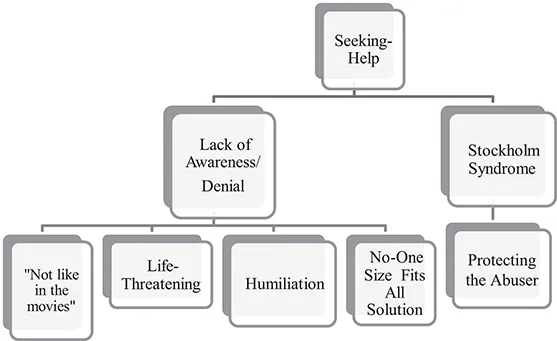
If there is one question that victims of domestic abuse often hear (from people who are either formal or informal supports), that question would be “Why don’t you just leave the relationship?” This compounded question is the main premise and partial rationalization as to why women are initially resistant to seek help in the first place. This chapter will share victims’ comments regarding the main reasons why they did not seek support earlier and the overall lack of awareness they encountered. By giving these victims voices to share their stories, they also shared their overall lack of awareness in not realizing their relationships were abusive. In addition, this chapter will summarize “Stockholm Syndrome,” which emphasizes the victims’ inability to psychologically break free from their abusers. Finally, victims comment on the complex, psychological process of Stockholm Syndrome.
Figure 1.1 Seeking Help
1 Seeking Help
Lack of Awareness and Denial
The overall lack of awareness of victims of domestic abuse is significant, due to their inability in identifying the actual abuse and if they felt that their experiences were even considered abusive. Victims shared that violence escalated slowly and they did not recognize that what they were enduring was actual abuse. Some of the victims thought abuse was going to be a single episode or a different phase in the relationship that was triggered by stress. Some victims denied or did not perceive their relationships as being abusive. These victims may have felt something was wrong, but they could not pinpoint what exactly was wrong. Therefore, this ambivalence caused the victims to hesitate in making the conclusion that something truly was wrong. Some victims voiced that they did not even realize that anything was wrong and began to normalize the abuse. In some instances, victims did not identify what was happening was abuse and this lack of awareness that abuse was manifesting in their relationship prevented them from seeking help.
Melissa indicated that she was married for an eight-year period. She mentioned that she dated her husband for one year prior to being married. She said that she became engaged, married and had her first child all within a two-year period. She also commented that her abuse started out with verbal arguments, which eventually led to physical violence. Melissa shared that she never thought of getting any type of help for her abuse. She reported, “I did not think about getting some type of support in order to help myself or prevent the abuse from occurring.” This reinforces the finding that many victims do not realize that abuse is occurring, as they don’t identify their partners’ behaviors as being abusive.
Monique met her partner when she was a teenager in high school. She indicated that she was married for 15 years and they had been together for 18 years. She reported that her abuse involved neglecting and ignoring, verbal abuse, being non-supportive of personal crises and incidences of physical abuse. Similarly, Monique indicated, “I did not know it was abuse that prevented me from seeking help; I didn’t know anything was wrong.” In Monique’s case, she was not aware that what she was experiencing was considered abuse. As a result, this mindset prevented her from seeking help. At times, victims often disclose that they know “something” is wrong, but do not identify it as abuse, therefore, they never seek out help from supports.
When Cindy met her abuser, she was in her early twenties and her abuser was in his mid-thirties. She stated that she had been previously married with a child and they moved in together after a year. Cindy also mentioned that she did not have a job and had few business clients, whom were friends. Cindy was also unaware that she was being abused. She did not understand that what she was experiencing was abuse until she reported she “was in the midst of it.” Cindy summarized, “I did not realize that I was being abused. I did not understand that kind of abuse, until you are in the middle of it, you don’t know it at all.” Cindy described when she was involved in her abusive relationship; she was unaware that it was abusive because of her involvement in the dynamic of the relationship. Cindy also admitted that she did not understand the true meaning of abuse, nor associated it with what she was experiencing. Many domestic abuse victims are in denial and do not want to believe they are being abused. They do not seek support until others bring it to their awareness. Cindy explained that she did not seek counseling because “I was in such denial with it before; it just did not even occur to me that I was in an abusive relationship.”
Susan stated that she married her husband in order for him to stay in the country. She also did not label her experiences as domestic abuse. She felt as though it was more like sexual assault. Susan had some level of denial when talking about her relationship being physically violent. Susan stated, “I did not know to label it domestic violence. I still don’t consider it domestic violence. It is more like sexual assault.” Susan did not categorize her experiences as sexual assault encompassed in domestic abuse and failed to recognize these sexually abusive occurrences as part of the domestic abuse. She also let the sexual abuse override the physical abuse she endured; therefore, she did not consider it being domestic abuse. Many victims are unable to differentiate what is domestic abuse and what is not domestic abuse.
Denice was with her partner for nine years. She indicated that she was married to her ex-husband four years prior to leaving him. She relayed that it was her brother who called attention to the red flags in her partner: “my brother said that he (her husband) has symptoms of an abuser. Relying on what he would say to me, he validated what my other friends were saying, that I was in an abusive relationship.” Denice listened to her brother, who told her that her husband was an abuser and explained the overall behaviors of an abuser. Other informal supports (who were around Denice) were seeing that her husband was abusive. Due to Denice’s lack of awareness and her denial of her husband being abusive, she didn’t listen to the concerns of other informal supports until her brother explained it to her. Many victims (like Denice) do not understand or recognize abuse for what it is, until it is explained in a way that the victims are able to receive that information.
Maria stated that her abuser was her boyfriend and they lived together and had a son together. She indicated that at the beginning of the relationship, she was getting divorced from a previous marriage. She stated that it was very fast, and she got pregnant within a couple of weeks of being with her abuser; “It was great for the first six months and all of a sudden he started getting more and more possessive and jealous.” Maria explained that at first she did not realize anything being wrong until her abuser’s ex-girlfriend showed up at their doorstep. Maria listened to what the ex-girlfriend had to say:
I did not realize that anything was wrong at first, until his ex-girlfriend showed up and said “I have flashbacks, panic attacks and I cannot sleep at night, I want my dignity and self-respect back. I want everything that he took from me.” His ex-girlfriend told me that he hit her all the time, even while she was pregnant. She was saying she had a miscarriage because of him. That is when things changed for me, when his ex-girlfriend showed up.
Maria again was not aware, until she witnessed her abuser’s ex-girlfriend in such distress, that the abuser was doing the same thing to her as he did to his ex-girlfriend. As a result from this incident, she developed a sense of reality and acute awareness of what she experienced.
As previously noted from the victims’ accounts, many of them were completely unaware that something was wrong. If they did understand something was wrong, they did not consider it abuse. It was not until something or someone significant showed them that they were being abused. This lack of awareness prevented victims from realizing the abuse or even defining it as such, which hindered them from seeking help in the first place.
Not like in the Movies
Women who have endured domestic abuse perceived the abuse as how it is portrayed in the media. Television, books and movies often portray domestic abuse as constant aggressiveness, bloodshed and brutalization. However, many victims, based on their experiences, believe that domestic abuse is wrongly portrayed in the media versus domestic abuse “real life” scenarios. For example, Maria described her idea of what she felt domestic abuse was: “I felt that if I was not being strangled or beaten to death, it felt like this was a minor case. I felt that my case did not warrant support. I was not murdered or attempted to be murdered.” Maria had a stereotypical perception of domestic abuse, based on media portrayal of domestic abuse. She felt that if she was not on the brink of death, her situation did not warrant attention.
In movies, such as The Burning Bed and Sleeping with the Enemy, domestic abuse is the primary focus. Nonetheless, it is depicted that the victim had to reach extreme deadly measures for it to be defined as domestic abuse. However, the reality of domestic abuse is any type of emotional, physical and/or sexual abuse that may or may not result in brutalization, constant physical or emotional tormenting for it to be considered abusive. Maria explained,
I did not know anything about domestic violence. You see in the movies these girls getting punched, I was not getting punched. I was getting slapped and pushed around. I did not know that is what it was. I was seeing it on TV and felt like since he was not breaking my jaw, then I am not in a domestic violence situation. I really did not know.
Maria described her abuse as “little facial slaps of humiliation,” or “two hour screaming matches,” where her abuser criticized everything that she did from driving to shopping.
This unrealistic media portrayal prevents women, who have endured abuse, to seek help initially. Domestic abuse is viewed, in our societal culture, as being a spontaneous act or acts. A more realistic view of domestic abuse is that it often occurs slowly – beginning with emotional and/or mental abuse, which can lead to escalation and increase tension building between partners manifesting into more severe, physical abuse. This is all done with an element of manipulation, power and control tactics utilized by the abuser.
Life-Threatening
Many women who endure abuse do not seek help to get out of their relationships until the relationship becomes life-threatening to them or their families. For many victims to escape, the relationship has become too volatile (mentally, emotionally, physically and/or sexually) for the victims to think about discontinuing their relationship. Many women, who endured abuse, continued with their toxic relationships until things took a turn of disparity and “ending of life” scenarios.
Cindy described:
I feared that I was not going to wake up. He was a pill user and knocked himself out. I was safe, but I did not feel safe at the time. It got to the point that you think you are going to die.
Cindy was scared for her life, since her abuser was so erratic and unpredictable, especially when he was under the influence of drugs. However, she realized that because of her abuser’s addiction, she had more of a chance of not dying because of his blacking out from abusing pills. Many times, the victim is known to make several attempts to leave the relationship only to come back to the abuser. They even could visualize their own deaths, as a result of the development of their abuse becoming more of a threat to their lives. Melissa indicated that “at the end of the day and climax […] he basically tried to kill me and leave me to die.”
Stacy also feared for her own life and the lives of her loved ones. She felt a threat for their safety and said “If I had gone to the court two and a half months prior, we would not be in this position. I felt like I would have been dead, along with my family right now.” Stacy felt that both she and her family members were endangered by the severity and complexity of the abuse. This is a blockade which again prevents victims from seeking help.
Laura discussed that she was forced into her relationship and marriage, as her abuser was continuously threatening her and her child. Laura realized that she was in a domestic abusive relationship when she was faced with death. For Laura, it did occur to her to reach out previously; she reported however, that she was in such denial looking back on her abusive relationship, “I did not realize that I was in a domestic violence relationship until it got so severe that I had to go to a shelter, but I did not understand the relationship being potentially fatal.” For Laura, Stacy and Cindy, the realization was not until the abuse became so severe that their lives were at risk and death was impending if they did not seek out help. When their circumstances became brutal and violent, they finally reached out for help … but only at that time. These victims were facing death and they became instinctively aware that they needed to dissolve their relationships in order to save themselves and/or their families.
Humiliation
Many victims felt embarrassed or humiliated in speaking with others about their abuse. Victims can be embarrassed, as they think that formal and informal supports would “look down on them”. The overall notion of having someone being abusive toward them is humiliating for victims. Maria shared, “If I did not feel so humiliated, I would have told more people. It is that you are looked down as a victim; that is something that happens to trashy people, right?” Maria felt as though she could not have told more people, since she was concerned about what other people thought of her. She indicated that she would have earlier reached out to supports for help, but she felt ashamed and humiliated in doing so.
Cindy distracted herself from her relationship being intentionally involved in other things because she felt ashamed and humiliated being a part of an abusive relationship. Some victims do not want to inform their family members, since their family members would be disapproving. Cindy stated, “My family did not know that we were living together … they thought I was living with friends. I lived a double life.” Some family members did not know their daughters’ involvement or details of their destructive relationships, until their daughters made them aware.
Victims did not reach out for supports or did not speak out due to their humiliation and embarrassment that they experienced being involved in an abusive dynamic. Therefore, it can be noted that interviewed victims felt the social stigma of domestic abuse and their perceived outlook of what a “victim” looks like prevented them from seeking help (either earlier in their abusive relationships or at all). Anita indicated that her abusive relationship started in high school and lasted for ten years. She reported that she ended up marrying her partner, even as the verbal violence continued. Anita recalled from early in the relationship, there was a lot of screaming and arguing back and forth. She stated that after the birth of her son, the relationship began to get more emotionally abusive and became physically abusive. Anita expressed, “I was embarrassed to seek help and to speak out.”
Natasha was in her twenties and coming out of another relationship that had all the potential to become abusive. At first, she shared that she and her partner did not have a “relationship title”. She stated that she could not deal with anything and never considered herself as “fragile.” Natasha indicated that when the abuse began, she
did not tell anybody. I did not have too many people to count on and I did not want people to know. It was a very shameful situation to tell people that someone is beating on you. It is not something that you want to talk about.
Many victims feel the same way as Natasha and they do not want to voice their abuse to supports because of the humiliation and embarrassment attached to being a victim, another reason that prevents victims from seeking help. They feel ashamed, humiliated and e...
Table of contents
Cover
Endorsements
Half Title
Title Page
Copyright Page
Dedication
Table of Contents
Acknowledgements
Introduction
PART 1: Seeking Help
PART 2: Formal Supports
PART 3: Informal Supports
Epilogue
References
Index
Trusted by 375,005 students
Access to over 1.5 million titles for a fair monthly price.
Study more efficiently using our study tools.
Frequently asked questions
Yes, you can cancel anytime from the Subscription tab in your account settings on the Perlego website. Your subscription will stay active until the end of your current billing period. Learn how to cancel your subscription
No, books cannot be downloaded as external files, such as PDFs, for use outside of Perlego. However, you can download books within the Perlego app for offline reading on mobile or tablet. Learn how to download books offline
Perlego offers two plans: Essential and Complete
Essential is ideal for learners and professionals who enjoy exploring a wide range of subjects. Access the Essential Library with 800,000+ trusted titles and best-sellers across business, personal growth, and the humanities. Includes unlimited reading time and Standard Read Aloud voice.
Complete: Perfect for advanced learners and researchers needing full, unrestricted access. Unlock 1.5M+ books across hundreds of subjects, including academic and specialized titles. The Complete Plan also includes advanced features like Premium Read Aloud and Research Assistant.
Both plans are available with monthly, semester, or annual billing cycles.
We are an online textbook subscription service, where you can get access to an entire online library for less than the price of a single book per month. With over 1.5 million books across 990+ topics, we’ve got you covered! Learn about our mission
Look out for the read-aloud symbol on your next book to see if you can listen to it. The read-aloud tool reads text aloud for you, highlighting the text as it is being read. You can pause it, speed it up and slow it down. Learn more about Read Aloud
Yes! You can use the Perlego app on both iOS and Android devices to read anytime, anywhere — even offline. Perfect for commutes or when you’re on the go. Please note we cannot support devices running on iOS 13 and Android 7 or earlier. Learn more about using the app
Yes, you can access Surviving Domestic Abuse by Michele A. Finneran in PDF and/or ePUB format, as well as other popular books in Psychology & Behavioural Management. We have over 1.5 million books available in our catalogue for you to explore.