Psychological Perspectives on Walking provides a comprehensive overview of the benefits of walking and shows how we can encourage people to walk more based on psychological principles. It examines how walking significantly improves health, positively impacts the environment, contributes to resolving social issues, and boosts the local micro-economy. This pioneering book discusses psychological motivations for walking versus not walking and asserts research-based arguments in favour of walking, including both theoretical considerations and everyday concerns.
The book investigates the motivations that can lead to increased walking, advises on how to build walking-conducive habits, and recommends strategies for decision makers for promoting changes that will allow walking to thrive more easily. The authors include success stories and lessons learned from what have become known as 'walkable' cities to show how interventions and initiatives can succeed on a practical basis.
This accessible, practical book is essential for urban planners; health specialists; policy makers; traffic experts; psychology, civil engineering, and social sciences students; and experts in the field of sustainable mobility. Psychological Perspectives on Walking will appeal to anyone in the general population in favour of a sustainable and healthy lifestyle.
The aim of this chapter is to ‘set the scene’ for readers – to introduce the history of traffic, human needs, and different transport modes and describe what sustainability in transport means and which transport modes are sustainable and why.
The topic of walking is very challenging in times of intensive discussions concerning sustainability. The authors of this book are psychologists and social scientists, and therefore the approach will be via road users: if people do not move, there is no traffic; if people do not walk, there is no walking; and if people do not behave in a sustainable way, traffic will not be sustainable. To make road users – to make ourselves – behave in a sustainable way, we will need behavioural sciences.
What are the problems and challenges of the general situation? Where is the place for pedestrians, and what are the dangers and vulnerabilities they face? What solutions can make people walk more, at least over short distances and instead of short car trips? Just as a reminder, the EU project WALCYNG – Walking and cycling instead of short car trips (Hydén, Nilsson, & Risser) – was finalised in 1998, 20 years ago. So, at that time, there was obviously already the goal of achieving improvements in this respect. Can we say that the situation today is satisfactory? Are things nowadays organised according to the European Charter of Pedestrian Rights? The simple answer is: No, they are not!
But let us start at the beginning.
1.1 The individual has to be addressed
Walking is the first and original way for human beings to move about. Like most other animals, moving about is necessary for them in order to fulfil their needs for nourishment, protection against the weather and enemies, social contacts, and reproduction. This is in contrast to plants, most of which are sedentary in a strict sense – a plant usually does not move away from the place where it is ‘planted’.
Without being mobile in the sense of being able to leave the place where we live, we could not exist (unless someone brings all the things that we need to our home or even to the place where we sit or lie), and without the use of our legs (or of a substitute for our legs), we could not even move to our car or to the means of public transport. And, of course, we could not ride a bicycle. Anyone who cannot use his/her legs is handicapped and cannot even manage all the things to be managed indoors, in which case he or she has to be taken care of by other people. We have to move about both indoors and outdoors in order to get the things necessary for our lives done. But this need is not only about getting somewhere or getting something done. One of the curious laws of traffic is that people all over the world spend roughly the same amount of time each day getting to where they need to go. Whether the setting is an African village or an American city, the daily round-trip commute clocks in at about one hour (Vanderbilt, 2008). The noted Italian physicist Cesare Marchetti has taken this idea one step further and pointed out that throughout history, well before the car, humans sought to keep their commute to about one hour. This ‘cave instinct’, as he calls it, reflects a balance between our desires for mobility (the more territory, the more resources one can acquire and the more mates one can meet) and domesticity (we tend to feel safer and more comfortable at home than on the road). In any case, we are not plants. We were evolved to move from one place to another.
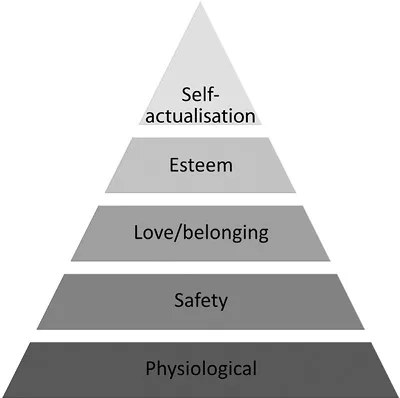
Coming back to the headline: moving from place to place is an inherent human need. But this need does not necessarily have to be satisfied solely by walking. Maybe on some or many occasions some or many of us even want to avoid walking. When looking at Maslow’s overview of human needs (Maslow, 1943; see Figure 1.1) we see that there are a lot of needs that push us to look for other mobility modes than walking: comfort, status, the need for achievement, hurry, long distances to be covered, protection (e.g. against adverse weather conditions), safety (by sitting ‘safely’ in a car in contrast to being exposed as a pedestrian), and so on. Some or all of these needs certainly lie behind the fact that since a very long time ago people have tried to replace walking with other modes and that the portion of walking trips – at least in the industrial world – has constantly gone down in recent decades, when such trips were counted. This aspect will be taken up at several points subsequently.
Figure 1.1 Maslow’s hierarchy of human needs (Maslow, 1943).
As we will also see subsequently, there are good reasons to try to stop this trend. Nowadays the following reasons more or less belo...
Table of contents
Cover
Endorsements
Half Title
Title Page
Copyright Page
Contents
Introduction
1. Setting the scene
2. Features and manifestations of walking
3. Human behaviour and its change
4. How to support walking
5. Success stories
6. Instead of conclusion: The story of Walkington
References
Index
Trusted by 375,005 students
Access to over 1.5 million titles for a fair monthly price.
Study more efficiently using our study tools.
Frequently asked questions
Yes, you can cancel anytime from the Subscription tab in your account settings on the Perlego website. Your subscription will stay active until the end of your current billing period. Learn how to cancel your subscription
No, books cannot be downloaded as external files, such as PDFs, for use outside of Perlego. However, you can download books within the Perlego app for offline reading on mobile or tablet. Learn how to download books offline
Perlego offers two plans: Essential and Complete
Essential is ideal for learners and professionals who enjoy exploring a wide range of subjects. Access the Essential Library with 800,000+ trusted titles and best-sellers across business, personal growth, and the humanities. Includes unlimited reading time and Standard Read Aloud voice.
Complete: Perfect for advanced learners and researchers needing full, unrestricted access. Unlock 1.5M+ books across hundreds of subjects, including academic and specialized titles. The Complete Plan also includes advanced features like Premium Read Aloud and Research Assistant.
Both plans are available with monthly, semester, or annual billing cycles.
We are an online textbook subscription service, where you can get access to an entire online library for less than the price of a single book per month. With over 1.5 million books across 990+ topics, we’ve got you covered! Learn about our mission
Look out for the read-aloud symbol on your next book to see if you can listen to it. The read-aloud tool reads text aloud for you, highlighting the text as it is being read. You can pause it, speed it up and slow it down. Learn more about Read Aloud
Yes! You can use the Perlego app on both iOS and Android devices to read anytime, anywhere — even offline. Perfect for commutes or when you’re on the go. Please note we cannot support devices running on iOS 13 and Android 7 or earlier. Learn more about using the app
Yes, you can access Psychological Perspectives on Walking by Ralf Risser,Matúš Šucha in PDF and/or ePUB format, as well as other popular books in Psychology & Urban Planning & Landscaping. We have over 1.5 million books available in our catalogue for you to explore.