India and China
eBook - ePub

India and China

Economics and Soft Power Diplomacy

  1. 162 pages
  2. English
  3. ePUB (mobile friendly)
  4. Available on iOS & Android
eBook - ePub

India and China

Economics and Soft Power Diplomacy

About this book

This book looks at the changing dynamics of diplomacy of the two emerging global powers – India and China. It examines trade relations, cultural ties and economic engagements of both countries and their shifting influence in the region surrounding them.

This volume takes an in-depth look at the trade and economic strategies of India and China through the prism of soft power diplomacy. It reflects on the challenges the two countries face over bilateral trade negotiations, BRICS and China's Silk Road project, along with other issues of foreign policy. The book underlines the decisive role of the soft power approach and greater people-to-people contact in the global strategies of India and China and in fostering greater cooperation in the region.

The book will be of great interest to researchers and students of international relations, political science, public policy and international communications. It will also be useful for think tanks, policy makers and general readers who are interested in the India-China relationship and the politics of soft power diplomacy.
Frequently asked questions

Yes, you can cancel anytime from the Subscription tab in your account settings on the Perlego website. Your subscription will stay active until the end of your current billing period. Learn how to cancel your subscription.
At the moment all of our mobile-responsive ePub books are available to download via the app. Most of our PDFs are also available to download and we're working on making the final remaining ones downloadable now. Learn more here.
Perlego offers two plans: Essential and Complete
  • Essential is ideal for learners and professionals who enjoy exploring a wide range of subjects. Access the Essential Library with 800,000+ trusted titles and best-sellers across business, personal growth, and the humanities. Includes unlimited reading time and Standard Read Aloud voice.
  • Complete: Perfect for advanced learners and researchers needing full, unrestricted access. Unlock 1.4M+ books across hundreds of subjects, including academic and specialized titles. The Complete Plan also includes advanced features like Premium Read Aloud and Research Assistant.
Both plans are available with monthly, semester, or annual billing cycles.
We are an online textbook subscription service, where you can get access to an entire online library for less than the price of a single book per month. With over 1 million books across 1000+ topics, we’ve got you covered! Learn more here.
Look out for the read-aloud symbol on your next book to see if you can listen to it. The read-aloud tool reads text aloud for you, highlighting the text as it is being read. You can pause it, speed it up and slow it down. Learn more here.
Yes! You can use the Perlego app on both iOS or Android devices to read anytime, anywhere — even offline. Perfect for commutes or when you’re on the go.
Please note we cannot support devices running on iOS 13 and Android 7 or earlier. Learn more about using the app.
Yes, you can access India and China by Geeta Kochhar,Snehal Ajit Ulman in PDF and/or ePUB format, as well as other popular books in Politics & International Relations & Diplomacy & Treaties. We have over one million books available in our catalogue for you to explore.

1
SCOPE FOR POWER TRANSITIONS THROUGH SOFT POWER DEPLOYMENT

A comparative study of China and India
Salonee Shital

Soft power and middle powers

Joseph Nye came up with term soft power in his book Bound to Lead in 1990. Nye argues that in today’s world the traditional understanding of power is insufficient because the definition of power is ‘losing its emphasis on military force and conquest that marked earlier eras’. He also argues that ‘proof of power lies not in resources but in the ability to change behaviour of states’ (Nye, 1990:155). Nye suggests that states need to accept the limitations of military power and try to supplement it. In modern times the complex interdependence has increased considerably. The information revolution has changed how states interact with each other and also how citizens interact and engage with each other. It changes international relations dramatically. It’s easy for the modernists to get swept away by the information revolution. Some go as far as to call the states redundant. However, Keohane and Nye argue that Politics will affect the information revolution as much as vice versa (Keohane and Nye, 1998:85).
If a state can make its power legitimate in the eyes of others and establish international institutions that encourage others to define their interests in compatible ways, it may not need to expend as many costly traditional economic or military resources.
(Keohane and Nye, 1998:86)
Nye notes that power has always been less fungible than money, especially now more than ever. Hence military or economic power cannot be considered as a means to another end. With nationalism on the rise in poor or weak states, great powers won’t be able to use military power as easily as they used to before (Nye, 1990:156). Great powers can no longer just rely on the traditional sources of power. It therefore becomes important that states consciously develop what he calls soft power.
Nye defines soft power as:
getting others to want the outcomes that you want-co-opt people rather than coerce them.
(Nye, 2004:5)
On the sources of soft power, he writes,
The soft power of a country rests primarily on three resources: its culture (in places where it is attractive to others), its political values (when it lives up to them at home and abroad), and its foreign policies (when they are seen as legitimate and having moral authority.
(Nye, 2004:11)
He clarifies that its more than just influence, it’s also the ability to attract. The increase in significance of soft power has made room for the middle powers to expand power in untraditional ways without fear of balancing due to a security dilemma, precisely because the opening up of Confucius institutions doesn’t seem threatening enough to start balancing against. Middle powers thus can safely aspire to generate more soft power to enhance their footing in the international world order. Middle powers are powers that can’t be called great powers but are not insignificant in the world politics because of their size, economy, military power and other power attributes. According to the Realist assumptions, these are most usually power seekers who won’t be satisfied with the status quo.
Writing in 1998, Keohane and Nye predicted that in the next century information technology is likely to be the most important power resource. It should therefore not come as a surprise that two old civilisation powers, i.e. China and India, that now boast of a considerable chunk of information technology are trying to be more than middle powers, a designation that both have had for a long time now. In the coming section the chapter looks into the various ways in which these two middle powers have tried to expand their power in world politics to claim a bigger piece of pie.

Great power transitions

The world has witnessed great power transitions a number of times in history and it has resulted in wars on most of these occasions. However, a power transition might not necessarily lead to a dyadic warfare, although it could very well be one of the reasons behind it. Power transitions also tend to generate fear and hope (Houweling and Siccama, 1991:643). Lemke and Tammen believe that the power transition theory has grabbed the attention of scholars precisely because it offers falsifiable expectations about the future of world politics (2003:270). Nye notes that in the 21st century the sources of power may undergo some major changes. He also maintains that it would be a lot more difficult for any state to control the political environment (Nye, 1990:155).
The no effect theory led by Organski propounds that possession of nuclear weapons has no effect on the incidence of war:
possession of nuclear weapons by one or both countries in a pair of states does not suppress the willingness to take risks or embark on conflict within that dyad.
(Houweling and Siccama, 1988:87)
Organski argues that transitions of power are the mechanisms that produce major war and under this approach even nuclear arms are not capable of neutralising readiness to embark on conflict and war (ibid.). This is opposed to the beliefs of Kenneth Waltz, who maintains that nuclear weapons are:
a tremendous force for peace and affords nations that possess them the possibility of security at reasonable cost.
(Waltz, 1990:731)
Organski believes that nuclear weapons cannot put an end to the willingness of the nations to go on war with each other and although he admits that the cost of war has increased considerably, the pattern and challenge remain the same. In fact, according to him, the higher the position of a nation in international hierarchy, the more often the state would go to war. He concludes that there won’t be a military conflict among the most powerful nations if the power is shared equally by both members of each pair, and when one member is not in the process of overtaking another. However, he makes an exception in cases where great powers are involved since they can go to war if the balance of power is unstable and if one member of the pair is in the process of overtaking the other in power (Houweling and Siccama, 1988:93).

Reasons for the peaceful rise of China

It is argued by Chinese scholars as well as Chinese leadership that China is aiming for a ‘Peaceful Rise’ (和平崛起, Heping jueqi) (Li, 2009b:36). The term Heping jueqi, or Peaceful Rise, is used quite often by Chinese scholars when they refer to China’s rise. It would obviously imply that although China has goals to be a regional hegemon, it does not aim to even initiate a process to ‘overtake’ the United States of America (US) anytime soon. China has resisted the urge to translate its ambitions of being economically powerful to concrete military superiority over the US. Johnston notes that ‘China moved from being a revolutionary revisionist state to a more status quo-oriented one in forty-odd years’ (Johnston, 2003:49).
Lemke and Tammen state that
Should China surpass the United States as the world’s most powerful state while having no substantial demands for change to the international system’s organizing principles, power transition theory postulates that catastrophic war likely will be averted.
(2003:270)
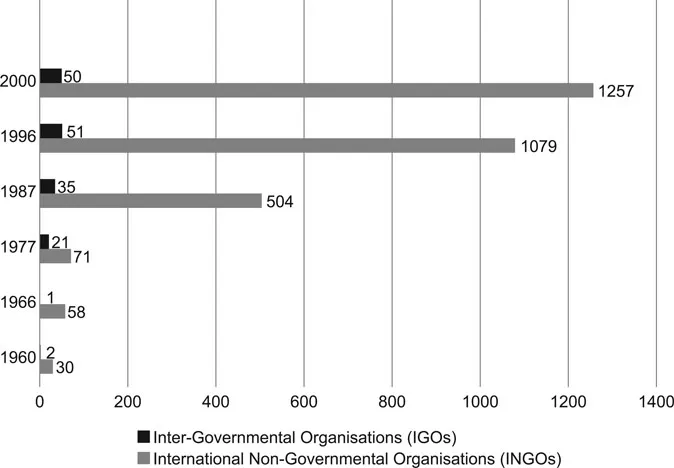
China has also actively tried to be a part of the international community by joining a large number of international organisations, entering into free trade agreement with other states, signing the Comprehensive Nuclear-Test-Ban Treaty (CTBT), etc. Till the year 2000 China had about 50 international memberships; although fewer than US and India, it scored well above the world average (Johnston, 2003:13). Figure 1.1 clearly shows the increase in the number of memberships that China held from 1966 through 2000. Some scholars have argued that warfare between major states is not a purely dyadic affair and a lot depends on what the bystanders do or do not do. Since both the countries are very active in international organisations, there is a lot of scope for intervention by other states and organisations, hence limiting the friction between the two major powers.
FIGURE 1.1 China’s International Memberships
Sources: Yearbook of International Organizations, 38th ed., cited in Johnston (2003); Yearbook of International Organizations, 3rd ed. vol. 2, cited in Kim (1999)

The liberal theory

The other compelling reason against any confrontation among these two states would be the standard liberal argument that states would rather trade than go to war with each other. Any confrontation between the two states could eventually escalate to war and hamper the more than healthy trade that has been going on between the two states for more than two decades now. According to simple liberal logic, both the states would want to maintain the interdependence and benefit from the mutual trade. In modern times information technology has integrated societies further (Keohane and Nye, 1998:82). Trade between US and China is flourishing. It has been on an increase ever since China adopted liberal policies (Figure 1.2).
FIGURE 1.2 Indian and Chinese Trade With the US
Sources: US Census Bureau (2020a; 2020b)

The deterrence theory

Both the US and China are two of the five ‘legitimate’ nuclear weapon states. Any conventional war or military confrontation between the two states has the potential to escalate into a nuclear war. As discussed earlier, Organski believes that even nuclear weapons cannot stop major powers from going to war with each other in a power transition. Kenneth Waltz on the other hand argues that with nuclear weapons in the picture, the political leaders will be wary of any threat of war since they will have to consider not just the first phase, as is true in many cases where only conventional weapons are at disposal. In these cases the leaders will also weigh in what their last step might be before they get involved in a conflict (Waltz, 1990:734). Waltz claims that nuclear weapons dominate strategy and that probability of a major war between two nuclear powers approaches zero. If Waltz is to be believed, the US and China would avoid any major confrontation at all costs simply because it would be detrimental to their existence.
It could be concluded from the liberal trade argument and the deterrence theory as well as the complex interdependence in the information age that war among these two major powers is highly unlikely. There has been little evidence to support that American cynicism regarding China is true or that China would want to draw more attention towards its rise to power. It however doesn’t mean that China is not trying to acquire more powers and challenge the US hegemony at all. Soft power has obviously caught the attention of the leaders in China who envisage soft power as the best means to expand Chinese power. Chinese authors have often defined soft power as ‘soft use of power’ (Li, 2009a:7). It shows the Chinese eagerness to avoid any all-out conflicts with the big guys.
Li quotes Fareed Zakaria in his book Soft Power: China’s Emerging Strategy in International Politics:
China has used soft power only in the sense that it has exercised its power softly. It does this consciously to show that it is not a bully.
(Li, 2009a:2)
The...

Table of contents

  1. Cover
  2. Half Title
  3. Series Page
  4. Title Page
  5. Copyright Page
  6. CONTENTS
  7. List of figures
  8. List of tables
  9. List of contributors
  10. Foreword
  11. Preface
  12. List of abbreviations
  13. Glossary
  14. 1 Scope for power transitions through soft power deployment: a comparative study of China and India
  15. 2 Whither Pax Indica and Pax Sinica? Indian and Chinese soft power strategies
  16. 3 Sino-Indian economic relations: cooperation or conflict?
  17. 4 Irony of India-China engagement at the global forum
  18. 5 Rise of the BRICS and changing world order: role of India and China
  19. 6 India and China in contemporary times: interactions and challenges in the Indian Ocean
  20. 7 The Sagarmala Project and the One Belt One Road Project: the convergence of India-China national interests
  21. 8 India China bilateral trade through Nathu-La Pass: past and present
  22. 9 Indo-Sino trade in the post-globalisation era
  23. 10 China’s Silk Road economic project, Central Asia and India’s interests
  24. Index