What counts as 'indigenous religion' in today´s world? Who claims this category? What are the processes through which local entities become recognisable as 'religious' and 'indigenous'? How is all of this connected to struggles for power, rights and sovereignty?
This book sheds light on the contemporary lives of indigenous religion(s), through case studies from Sápmi, Nagaland, Talamanca, Hawai`i, and Gujarat, and through a shared focus on translations, performances, mediation and sovereignty. It builds on long term case-studies and on the collaborative comparison of a long-term project, including shared fieldwork. At the center of its concerns are translations between a globalising discourse (indigenous religion in the singular) and distinct local traditions (indigenous religions in the plural).
With contributions from leading scholars in the field, this book is a must read for students and researchers in indigenous religions, including those in related fields such as religious studies and social anthropology.
Educative encounters in Talamanca, Tromsø, and elsewhere
Bjørn Ola Tafjord
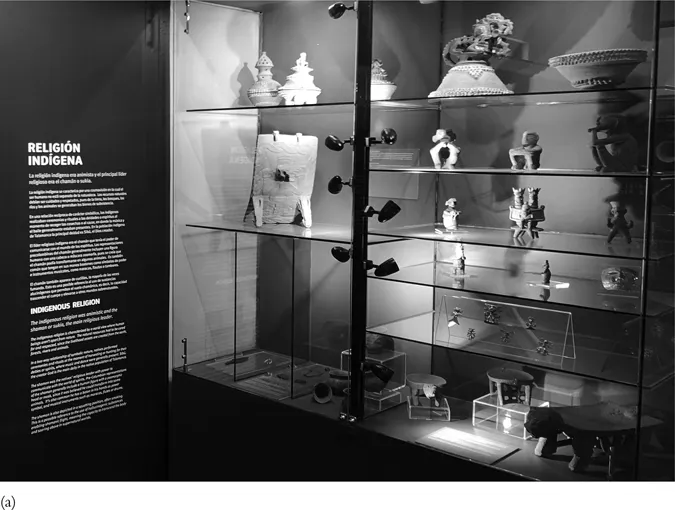
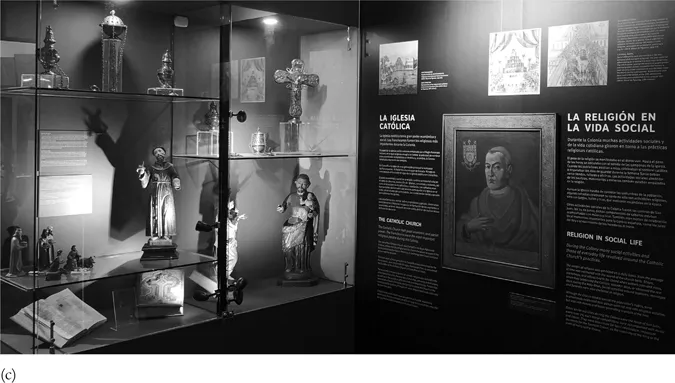
“To me, this is not religion. It is more like a juridical system”. Heidi Mayorga Escalante took me aside and lowered her voice. Heidi is the Bribri lawyer and activist who in January 2018 guided our group of researchers at the National Museum of Costa Rica. We had just entered a room where ‘INDIGENOUS RELIGION’ was written with bold and large letters on one wall, and ‘THE CATHOLIC CHURCH’ with equally bold and large letters on the opposite wall. Glass boxes with select objects, accompanied by snippets of text, representing indigenous religion and Catholicism respectively, stood on each side of the room, creating a neat symmetry, gesturing a comparison. Heidi was referring to the assemblage of objects and texts that articulated, exhibited, and explained an indigenous religion.
In her view, these objects and the practices and specialists mentioned in the texts did not constitute a religion. The museum had got it wrong. When I asked her to lead us here, both as an expert and as a representative of a community who sees itself as the proper owner of many of the objects kept in the museum, I had told her that we were particularly interested in indigenous religions, that this is what our joint research project focuses on. Was she indirectly saying that we were wrong too? She confessed, quietly, that she had read up on the topic in preparation for our visit. She said she had learnt a lot from doing that, and thanked me for the invitation that had incited her to do so, but she could not agree with how all these authors – anthropologists, archaeologists, historians, and sociologists – present her community and culture as pervaded by an indigenous religion.1
With that said, she turned her attention back to the group and clearly asserted that the objects in the glass boxes and the practices they have been part of are very indigenous and priceless to the indigenous communities. Unfortunately, she added, many items like these now dwell in faraway museums and illegal private collections, instead of in the indigenous communities where they belong. She was making these authoritative claims both as a Bribri and as a scholar of law. Her eyes sought Arkotong Longkumer, who nodded in approval. She had been very pleased to learn that he is indigenous too, and of a tiger clan, like herself. Greg Johnson gently offered to put her in contact with people in Hawai‘i and Colorado who have experiences with repatriation processes. We then moved to the next room.
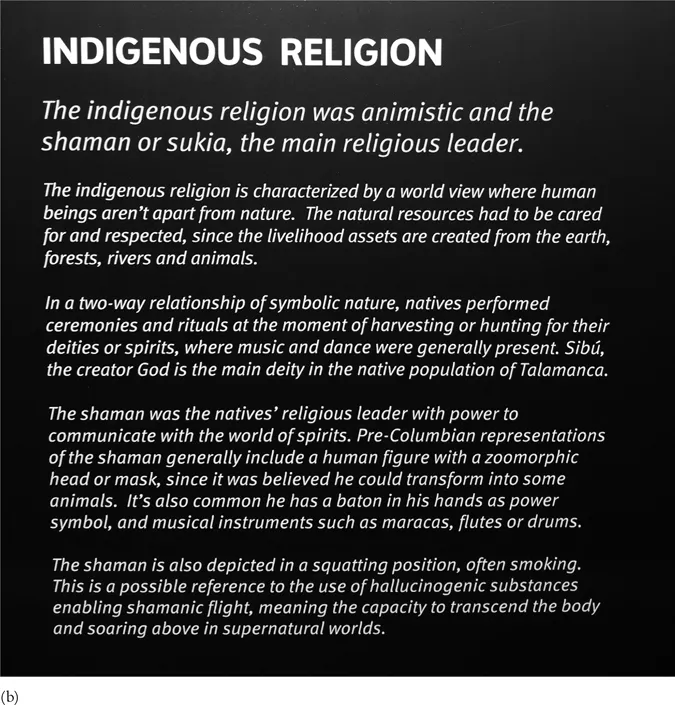
FIGURE 1.1–1.3 The exhibition of indigenous and Catholic religion, side by side, in the National Museum of Costa Rica. The text on the wall describes the indigenous religion very much in line with old theoretical presumptions about animism and shamanism.
That afternoon we went on to visit the Pre-Columbian Gold Museum and dine at a touristy restaurant, while Heidi continued to tell us about the situations for indigenous peoples in her country. She spoke especially about Talamanca, the territory she grew up in and where most of her relatives live. We were all set to travel there in a few days. Heidi told us about things we would see, hear, and otherwise sense in Talamanca, as opposed to here, in the capital San José. She was alerting us to differences and particularities, including divergent conceptions of indigeneity and religion. What she shared with us, and her presence alongside her Chilean husband and their young son, complicated and disturbed the stories that the museums and other powerful actors in this city otherwise convey – stories that tend to relegate the indigenous population to a bygone time and to marginal spaces, and that religionise, primitivise, homogenise, and other them.
Heidi’s interventions made it evident that we are partaking in multiple and sometimes contradictory didactic exchanges: with indigenous experts, with other academics, with each other, with communities, with places, with institutions, with objects and exhibitions, and with words and stories. Translations and comparisons are at the heart of all these interactions, suggesting certain identities and relationships, or unsettling them. They are at once pedagogical, political, and analytical.
*
Over many years, as I have been travelling between Talamanca in the south of Costa Rica and Tromsø in the north of Norway, I have learnt how conceptions of indigeneity and indigenous religions differ in these two places. I have also learnt how helpful it is for the detection of such differences to work in more than one place where articulations of indigeneities and indigenous religions abound. In Talamanca, I do research with Bribris who teach me about their history and society, including their indigeneities and religions. In Tromsø, I teach religious studies in an environment where Sámis in particular, but also members of other indigenous peoples, have a strong presence. On a few occasions, I have organised or co-organised workshops that have brought together representatives of indigenous peoples and researchers from Costa Rica, Norway, and other places. Lately, I have also had the privilege to visit indigenous communities in Nagaland and Hawai‘i together with colleagues in the collaborative research project Indigenous Religion(s): Local Grounds, Global Networks (INREL).2
This chapter focuses on encounters that have revealed to me and to other participants in them how there are different notions of indigeneity and indigenous religions circulating. These encounters also illustrate how efforts are made to translate and compare distinct people and practices, through recognisable gestures and common concepts such as indigeneity and indigenous religion, in order to suggest similarities or stress specialness.3 Based on what I have learnt from these encounters, I argue that it is enlightening to think of indigeneity and indigenous religion as methods. Indigeneity and indigenous religion are conceptual tools with which people do things. They are employed to make understandable, to make relevant, and to shed a sharper light on who some people are in relation to other people, and what some practices are in relation to other practices. In other words, they are used at once pedagogically, politically, and analytically. This is done both by scholars and others.4
My approach brings to the fore operations and processes similar to the ones that the anthropologists Mario Blaser and Marisol de la Cadena (2017, 2018) call ‘commoning’, which imply translating someone or something into a subject or entity that is recognisable to more parties, a process which also entails the outlining of a shared domain, and a scaling of the thereby constituted community. This, Blaser and de la Cadena argue, should ideally be done through ‘controlled equivocations’, a concept of translation they borrow from fellow anthropologist Eduardo Viveiros de Castro (2004), in order not to lose sight of and rule out the ‘uncommons’, divergent subjects or entities involved in the translation but familiar to only some of the parties.5
In the encounters that I describe in this chapter, if we apply this perspective, we witness how indigeneities and indigenous religions become actualised in acts of commoning, or through translations of ‘uncommon’ identities and practices, which also emerge and are affected in the encounters, but whose properties and worlds exceed that which is carried across in the translations (cf. de la Cadena 2015, 2018). In some of the encounters we also witness how indigeneity or indigenous religion is contested through acts of uncommoning, and alternative commoning, like Heidi’s “this is not religion” but “more like a juridical system”. Indigeneity and indigenous religion can thus be grasped and ungrasped as subjects or entities, as shared domains, and as scaled communities, in addition to being methods. And they can be seen as methods of their own making, since long found in an arsenal available to non-academic and academic actors alike. Examples provided in this chapter, and in the other chapters of this book, show that non-academic actors – especially but not only those who somehow self-identify as indigenous – often make strong and highly conscious efforts to control the equivocations that their own and others’ pedagogical, political, and analytical translations necessarily bring about.
In what follows, I will describe some of the events that have made me aware of these issues. Through descriptions of episodes, some from moments when I did not recognise that I was doing fieldwork, others from moments when I did not realise that I was doing more than fieldwork, I try to highlight complexities, reflexivities, frictions, and fusions that characterise and challenge exchanges in our field of study. Of this book’s orienting themes, translation and comparison are most salient in this chapter, although it also addresses performances, media and technologies, and sovereignty.
Encountering Talamanca
When I first went to Talamanca, on the border between Costa Rica and Panama, almost 20 years ago, my ambition was to study the roles of religions among the Bribri, a people who self-identify also as ditsöwö and skowak (in Bribri), as indios and indígenas (in Spanish), and as indigenous (in English).6 To my surprise, most residents in Barrio Escalante, the neighbourhood where I ended up staying, claimed that the Bahá’í Faith was their religión indígena or indigenous religion. It is a religion for indígenas all over the world, they explained. Many added that, in the future, because of their spirituality and experience with suffering, the indígenas will illuminate all of humankind.7
The elders in Barrio Escalante had become Bahá’í in the 1960s. Nicaraguan and North American ‘pioneers’ (Bahá’ís insist they have no missionaries) then came to Talamanca to introduce this religion that had begun as a Shia Islamic millenarian movement in Persia and the Ottoman Empire in the mid-19th century.8 Although all Bribri Bahá’ís also recognised it as an exogenous and new religion, most of those who I spoke with presented it as another version of their tradiciones indígenas (Sp. ‘indigenous traditions’). According to Bribri history, Sibö – the akeköl (Br.) or progenitor and guardian of the Bribri, and the protagonist in the creation of the world in which we live – taught the very first generation of Bribris, who were also the very first human beings, all they needed to know.9 Applying the basic Bahá’í (and Islamic) doctrine about successive messengers from one God, residents of Barrio Escalante avowed that Sibö was the very first of the messengers from God, while Bahá’u’lláh, the founder of the Bahá’í Faith, was the latest. Their Bahá’í Faith, many told me, was not only compatible with their indigenous traditions but also reinstalling and reinforcing them.
Nevertheless, on most occasions, Bribris would stress that their indigenous traditions should not be mistaken for a religion. Christian Bribris, who are the majority in other parts of Talamanca, have also taken this stance. To Bribri youngsters, and to me, the elders have repeatedly explained how religions are important but limited and largely optional sets of teachings and practices, whereas the indigenous traditions are fundamental since they pertain to everything and are impossible to opt out of for Bribris. Confidently they have declared that the Bribri never had a religion before they began to adopt and adapt Bahá’í or Christian teachings and practices that foreigners brought to Talamanca two generations ago. Before this, they did not need religion, they assert, because the ancestors knew and lived in accordance with ‘the law of Sibö’ or ‘the law of God’ (for a fuller account, cf. Tafjord 2004, 2006).
Bribris consistently present themselves as a sovereign people with a sovereign territory. From their perspective, the Costa Rican state, like the Spaniards before it, is an intruder. At the same time, they do have a strong identity as Costa Ricans, but as the original citizens of this land. They see themselves as continuing a five-centuries-long resistance. Their history and the enduring conflicts with colonisers constitute an axis that strongly contributes to shaping their perceptions of themselves. It forges a dichotomy between an unremittingly autonomous ‘We’ and a continuously threatening ‘Other’ – ditsöwö, skowak, indios or indígenas versus sìkuapa (Br.) or blancos (Sp.).
The concepts that Bribris use to identify and classify themselves imply different scales. They denote what we might think of as particular indigeneities within or across other indigeneities. Ditsöwö (Br. literally ‘seed’) refers to their internal matrilineal kinship structure and the distribution of clanes (Sp. ‘clans’) and their lands, a relational and geographical order that also includes the Cabécar, with whom the Bribri share many traditions, institutions, and bordering territories (cf. Bozzoli 1979). Skowak, indio, and indígena are statuses that Bribris attribute to a much broader set of peoples, like the eight officially recognised pueblos indígenas or indigenous peoples in Costa Rica (Bribri, Brunca, Cabécar, Chorotega, Huetár, Maleku, Ngäbe, and Teribe), and comparable peoples elsewhere in the Americas, and sometimes even – although only as indígenas, not as skowak or indios – comparable peoples globally (Tafjord 2016b).
*
According to Bribri history, that is, history told authoritatively by Bribris, Talamanca has never been conquered by outsiders. But there have been many struggles, including periods of widespread violence and warfare. Foreigners have persistently tried to take control over the territory and the people and extract their resources. The Bribris have always resisted and, in the end, expelled the intruders. Historical enquiries by academics largely confirm this narrative.
Spaniards first arrived in 1502, but they never got a lasting foothold in Talamanca (Solórzano 2013; cf. Boza 2014). Franciscan missionaries operated in the area during most of the...
Table of contents
Cover
Half Title
Title Page
Copyright Page
CONTENTS
List of figures
Acknowledgements
Introduction
1 Translating indigeneities: educative encounters in Talamanca, Tromsø, and elsewhere
2 Indigenous religion(s) – in the making and on the move: Sámi activism from Alta to Standing Rock
3 Indigenous futures: the practice of sovereignty in Nagaland and other places
4 Imagining global adivasi-ness: celebrating World Adivasi Day in Chhotaudepur
5 Engaged indigeneity: articulating, anticipating, and enacting tradition on Mauna Kea
Conclusion
Index
Trusted by 375,005 students
Access to over 1.5 million titles for a fair monthly price.
Study more efficiently using our study tools.
Frequently asked questions
Yes, you can cancel anytime from the Subscription tab in your account settings on the Perlego website. Your subscription will stay active until the end of your current billing period. Learn how to cancel your subscription
No, books cannot be downloaded as external files, such as PDFs, for use outside of Perlego. However, you can download books within the Perlego app for offline reading on mobile or tablet. Learn how to download books offline
Perlego offers two plans: Essential and Complete
Essential is ideal for learners and professionals who enjoy exploring a wide range of subjects. Access the Essential Library with 800,000+ trusted titles and best-sellers across business, personal growth, and the humanities. Includes unlimited reading time and Standard Read Aloud voice.
Complete: Perfect for advanced learners and researchers needing full, unrestricted access. Unlock 1.5M+ books across hundreds of subjects, including academic and specialized titles. The Complete Plan also includes advanced features like Premium Read Aloud and Research Assistant.
Both plans are available with monthly, semester, or annual billing cycles.
We are an online textbook subscription service, where you can get access to an entire online library for less than the price of a single book per month. With over 1.5 million books across 990+ topics, we’ve got you covered! Learn about our mission
Look out for the read-aloud symbol on your next book to see if you can listen to it. The read-aloud tool reads text aloud for you, highlighting the text as it is being read. You can pause it, speed it up and slow it down. Learn more about Read Aloud
Yes! You can use the Perlego app on both iOS and Android devices to read anytime, anywhere — even offline. Perfect for commutes or when you’re on the go. Please note we cannot support devices running on iOS 13 and Android 7 or earlier. Learn more about using the app
Yes, you can access Indigenous Religion(s) by Siv Ellen Kraft,Bjørn Ola Tafjord,Arkotong Longkumer,Gregory D. Alles,Greg Johnson in PDF and/or ePUB format, as well as other popular books in Ciencias sociales & Biografías de ciencias sociales. We have over 1.5 million books available in our catalogue for you to explore.