This text outlines for the first time a structured articulation of an emerging Islamic orientation to psychotherapy, a framework presented and known as Traditional Islamically Integrated Psychotherapy (TIIP).
TIIP is an integrative model of mental health care that is grounded in the core principles of Islam while drawing upon empirical truths in psychology. The book introduces the basic foundations of TIIP, then delves into the writings of early Islamic scholars to provide a richer understanding of the Islamic intellectual heritage as it pertains to human psychology and mental health. Beyond theory, the book provides readers with practical interventional skills illustrated with case studies as well as techniques drawn inherently from the Islamic tradition. A methodology of case formulation is provided that allows for effective treatment planning and translation into therapeutic application. Throughout its chapters, the book situates TIIP within an Islamic epistemological and ontological framework, providing a discussion of the nature and composition of the human psyche, its drives, health, pathology, mechanisms of psychological change, and principles of healing.
Mental health practitioners who treat Muslim patients, Muslim clinicians, students of the behavioral sciences and related disciplines, and anyone with an interest in spiritually oriented psychotherapies will greatly benefit from this illustrative and practical text.
Foundations of Traditional Islamically Integrated Psychotherapy (TIIP)
Chapter 1
Foundations of Traditional Islamically Integrated Psychotherapy (TIIP)
Hooman Keshavarzi and Bilal Ali
Chapter Summary
This chapter introduces the basic foundations of Traditional Islamically Integrated Psychotherapy (TIIP). TIIP is a psychotherapeutic framework that is rooted in an inherently Islamic foundation. Its epistemological foundations are sourced in the Sunni Islamic intellectual and spiritual tradition and offer a reconciliatory holistic approach to the construction of a spiritually integrated psychology that draws from empirical, rational, and revelatory sources. TIIP also draws from the Islamic intellectual heritage in outlining a proposed ontological composition of the human psyche, drives, nature, health, pathology, and its treatment. Psychological interventions arise as a natural consequence of attempting to restore the health of the human psyche (psycho-spiritual equilibrium) through working on the appropriate components of the psyche that are consistent with a TIIP diagnostic formulation. This formulation includes an assessment of the dominant locus of the source of pathology in the primary components of the human psyche that include the nafs (behavioral inclinations), ‘aql (cognition), rūḥ (spirit), or secondary emotional expressions of the primary components (iḥsās). Thus, interventions that target these components can either be (a) inherently Islamic interventions found solely within the Islamic intellectual heritage or (b) Islamic adaptations of mainstream psychologies that are consistent with TIIP principles and goals. The ultimate goal is the nurturance of equilibrium across all components of the human psyche that lead to an integrative whole or unity of being (ittiḥād ) that is accompanied by a healthy heart (qalb salīm).
A Classical Islamic Epistemological Framework for Integrating Secular and Sacred Sciences
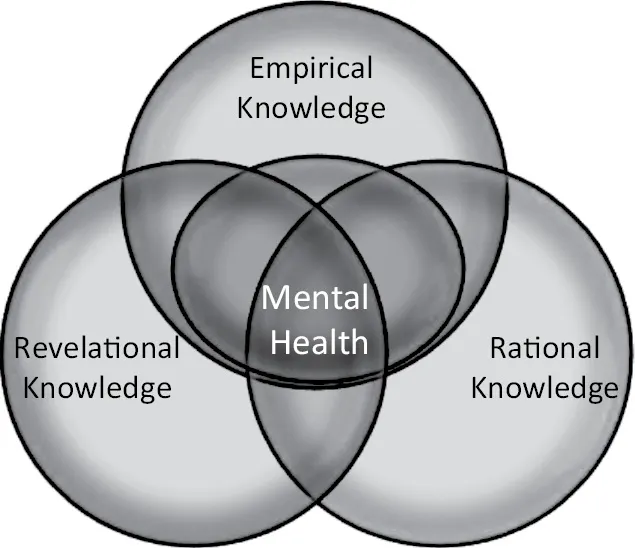
In a traditional Islamic epistemological framework, “Islamic” issues are divided into those that relate to faith, i.e. foundational (aṣlī ) or theological (iʿtiqādī ) issues, and those that relate to practice, i.e. subsidiary (far‘ī ) or practical (‘amalī ) issues (al-Taftāzānī, 2000, pp. 13–14). The knowledge of the former is what defines the classical field of study called ʿaqīdah (creed) while the latter comprises the science referred to as fiqh (law). For both creedal and legal issues, Islamic scholastic theologians assert that knowledge of things is attainable for humans by means of three sources: reliable sensory or empirical evidence (ḥawāss salīmah), reason (‘aql ), and truthful reports (khabar ṣādiq) (al-Nasafī, 2013) (see Figure 1.1). The sense-knowledge that traditional Islamic scholastic theologians refer to is the sensory evidence acquired by means of observation that informs what is referred to today as empirical study, a cornerstone of the scientific method. The second knowledge source, reason (‘aql ), refers to the primordial, a priori human faculty that is capable – when all senses are healthy – of realizing not only the probabilistically true but also certain necessary truths (al-Taftāzānī, 2000, p. 81). When a rational conclusion is self-evident and intuitive, such as the whole of something being greater than its part, such rationally established knowledge is called necessary knowledge (ḍarūrī ), while rational conclusions requiring deduction through evidence, such as the conclusion upon observing smoke that there must be fire, are called acquired knowledge (iktisābī ) (al-Bazdawī, 2014, p. 23; al-Nasafī, 2013, pp. 70–71). Knowledge acquired through truthful reports (khabar ṣādiq) is also divisible into similar categories: (1) reports that establish knowledge necessarily (ḍarūrī ) due to their self-evident veracity, and (2) reports that establish knowledge through evidence-based deduction (istidlālī ), such as those reports transmitted by prophets whose prophethood is corroborated by miracles. Knowledge in this category includes divine revelation (waḥy) and is the sole source of knowledge available to humans which provides insight into the empirically and rationally inaccessible, i.e. the unseen (ghayb). Reliable and unadulterated reports of revelation are accessible today in two forms: (1) the Qurʾān, or recited revelation (waḥy matluww), and (2) the Ḥadīth (prophetic tradition), or non-recited revelation (waḥy ghayr matluww). While both are harmonious with other sources of knowledge, and in fact provide humans access to a higher form of rationality, they also more importantly deliver otherwise unknowable knowledge, i.e. knowledge not accessible through empirical data and analytical reasoning. The utilization of this source of knowledge, namely divine revelation, represents perhaps the greatest divergence between the two epistemic frames of modern psychology and cognitive neuroscience on the one hand and Islamic theology on the other, whereby the former dismisses the admissibility of such information in both the building of models and in methods of practice.
Figure 1.1Islamic epistemological approach used to guide the development of the TIIP model of care.
In an Islamic epistemology, all of the three above sources of knowledge are understood to be legitimate and harmonious knowledge sources. Any contradictions (taʿāruḍ) between conclusions originating in these sources are understood to be only apparent and demand resolution through (1) reconciliation (taṭbīq), (2) abrogation (naskh), or (3) interpretation (taʾwīl ) (Farfūr, 2002, ‘Abd al-Laṭīf, p. 155). Such interpretive methods and harmonization between the various knowledge sources are in fact inherent to the Islamic intellectual tradition. For example, classical Qurʾānic exegetes had few qualms about proposing that the Qurʾānic verses that mention Allah’s creation of the universe in six “ayyām” (lit. days) denote in their use of the term ayyām not the customary 24-hour cycle of day and night or simply daytime (as opposed to nighttime) (Ibn ʿĀbidīn, al-Ḥaṣkafī, & al-Nasafī, 2006), but broad and ambiguous “periods” of time due to the rational unlikelihood that ayyām is restricted to earthly, normative time. The classical attempt at synthesizing Qurʿānic texts with reason in a way that is accommodated by the language additionally allows for the accommodation of scientific theories on the timespan of the known universe (Usmani, n.d.). Thus, in an Islamic epistemology objective facts do not have a particular cultural origin. Scientific findings that can be safely regarded as objective fact, regardless of their Eastern or Western origin, are not to be disputed or hastily assumed to be at odds with divine revelation. As such, Muslim scholars should not find the task of synthesizing empirical findings on the brain’s role in cognition with Islamic theologians’ understandings of the heart and the spiritual self an impossible one. In fact, some Muslim jurists had no problem in suggesting that the metaphysical ʿaql is physically located in the brain on account of cognitive faculties being impaired through brain damage, despite the Qur’an’s apparent attribution of cognitive faculties to the heart in Sūrat al-Ḥajj, verse 22 (al-Bāyjūrī, 2002, p. 273). Exegetes have offered several potential meanings to this verse that consider empirical information and reason. Meanwhile, the majority (jumhūr) of discursive theologians have maintained that the metaphysical ʿaql is localized to the heart, but its metaphysical light stimulates the cognitive faculties in the brain, thereby reconciling the conflict between empirical information, rationality, and revelation (al-Bāyjūrī, 2002, p. 273).
Another critical Islamic epistemological understanding to the process of integrating Islam and psychology is the hierarchic arrangement of knowledge into (1) the definitive/certain (qaṭʿī ) and (2) the probabilistic/inferential (ẓannī ). While both categories of knowledge may contribute to discussions of what is “Islamic”, it is only evidence that is indisputably established (qaṭʿī al-thubūt ) (such as reports transmitted through widely dispersed chains of narrators, or tawātur ) and that lack ambiguity in their indication (qaṭʿī al-dalālah) that are considered definitive and objective “fact” (Farfur, 2002, pp. 17–30). Even statements sourced in divine revelation that do not meet the criterion of being both certain in establishment and in indication are to be considered ẓannī, and thereby disbelief in them does not constitute blasphemy or departure from the religion. A great number of claims made in Islamic texts, be they theological, legal, or ethical in nature, are in this category. While they contribute to definitions and understandings of what is “Islamic”, issues of a ẓannī nature are open to contention. This does imply that probabilistic proofs do not constitute ḥujjah, or proof, in Islamic epistemology, only that the category of ẓannī is to be evaluated according to its degrees of probability, and that it affords a degree of flexibility in determining what is true and Islamic that qaṭʿī proofs do not.
This demarcation between the certain and probabilistic is critical in discussions of what defines “Islamic”, especially in defining an Islamic psychology. The vast corpus of Islamic literature produced by Muslim theologians, exegetes, historians, jurists, and spiritual guides comprises a wide spectrum of both qaṭʿī and ẓannī issues. In theological discussions, for example, definitive claims of God’s unity and the falsehood of polytheism may accompany subsidiary and probabilistic discussions of the nature of God’s attributes. Similarly, Muslim theologians considered the existence of the rūḥ (soul ) as certain, but discussions of its exact nature and its relation to other metaphysical components of the self to be probabilistic at best. Imam Shihāb al-Dīn Yaḥyā al-Suhrawardī (d.632 AH/1244 CE), an ascetic scholar, in his ʿAwārif al-Maʿārif, offers that it is permissible to discuss the nature of the rūḥ or metaphysical essence of the human being. However, it must be considered as a possible meaning (taʾwīl ) and not an interpretation (tafsīr ) of the Qurʾānic term asserted with certainty (qaṭʿī ) (al-Suhrawardī, 1993, p. 243). Th...
Table of contents
Cover
Endorsements
Half Title
Title Page
Copyright Page
Contents
Contributors
Foreword
Preface
Editors’ Introduction
Part I Foundations of Traditional Islamically Integrated Psychotherapy (TIIP)
Part II Introducing the Islamic Intellectual Heritage
Part III Case Formulation and Assessment
Part IV Treatment of the Domains of the Human Psyche
Index
Trusted by 375,005 students
Access to over 1.5 million titles for a fair monthly price.
Study more efficiently using our study tools.
Frequently asked questions
Yes, you can cancel anytime from the Subscription tab in your account settings on the Perlego website. Your subscription will stay active until the end of your current billing period. Learn how to cancel your subscription
No, books cannot be downloaded as external files, such as PDFs, for use outside of Perlego. However, you can download books within the Perlego app for offline reading on mobile or tablet. Learn how to download books offline
Perlego offers two plans: Essential and Complete
Essential is ideal for learners and professionals who enjoy exploring a wide range of subjects. Access the Essential Library with 800,000+ trusted titles and best-sellers across business, personal growth, and the humanities. Includes unlimited reading time and Standard Read Aloud voice.
Complete: Perfect for advanced learners and researchers needing full, unrestricted access. Unlock 1.5M+ books across hundreds of subjects, including academic and specialized titles. The Complete Plan also includes advanced features like Premium Read Aloud and Research Assistant.
Both plans are available with monthly, semester, or annual billing cycles.
We are an online textbook subscription service, where you can get access to an entire online library for less than the price of a single book per month. With over 1.5 million books across 990+ topics, we’ve got you covered! Learn about our mission
Look out for the read-aloud symbol on your next book to see if you can listen to it. The read-aloud tool reads text aloud for you, highlighting the text as it is being read. You can pause it, speed it up and slow it down. Learn more about Read Aloud
Yes! You can use the Perlego app on both iOS and Android devices to read anytime, anywhere — even offline. Perfect for commutes or when you’re on the go. Please note we cannot support devices running on iOS 13 and Android 7 or earlier. Learn more about using the app
Yes, you can access Applying Islamic Principles to Clinical Mental Health Care by Hooman Keshavarzi, Fahad Khan, Bilal Ali, Rania Awaad, Hooman Keshavarzi,Fahad Khan,Bilal Ali,Rania Awaad in PDF and/or ePUB format, as well as other popular books in Psychology & Clinical Psychology. We have over 1.5 million books available in our catalogue for you to explore.