Trends in Policing
eBook - ePub

Trends in Policing

Interviews with Police Leaders Across the Globe, Volume Six

  1. 155 pages
  2. English
  3. ePUB (mobile friendly)
  4. Available on iOS & Android
eBook - ePub

Trends in Policing

Interviews with Police Leaders Across the Globe, Volume Six

About this book

This volume is a collection of interviews with policing leaders that explores their understanding of policing developments and current challenges in their own countries and internationally, and examines how they evaluate or interpret these developments. The book is based on the premise that police officials have a wealth of experience that can make significant contributions to our understanding of the prospects and problems of policing today.

In this book, ten police leaders from the continents of North America, Asia, Australasia, Africa, and Europe offer their combined experiences in policing. The interviews, conducted by experienced policing academics, capture how these officers personally, as well as through their organizations, have confronted many waves of change – political, social, and institutional. Interviews examine each professional's assessment of their career path; changes experienced during their career; their personal policing philosophy; problems and successes experienced in leadership; their views on the contribution of theory to practice; their experience of transnational relations; their understanding of nature of democratic policing; and their assessment of how policing will change in the future.

As police and policing across the world face a turning point, this book offers ideas and best practices from the front lines on ways to respond with vigor, creativity, and sensitivity to the challenges of repositioning police in the twenty-first century.

Frequently asked questions

Yes, you can cancel anytime from the Subscription tab in your account settings on the Perlego website. Your subscription will stay active until the end of your current billing period. Learn how to cancel your subscription.
No, books cannot be downloaded as external files, such as PDFs, for use outside of Perlego. However, you can download books within the Perlego app for offline reading on mobile or tablet. Learn more here.
Perlego offers two plans: Essential and Complete
  • Essential is ideal for learners and professionals who enjoy exploring a wide range of subjects. Access the Essential Library with 800,000+ trusted titles and best-sellers across business, personal growth, and the humanities. Includes unlimited reading time and Standard Read Aloud voice.
  • Complete: Perfect for advanced learners and researchers needing full, unrestricted access. Unlock 1.4M+ books across hundreds of subjects, including academic and specialized titles. The Complete Plan also includes advanced features like Premium Read Aloud and Research Assistant.
Both plans are available with monthly, semester, or annual billing cycles.
We are an online textbook subscription service, where you can get access to an entire online library for less than the price of a single book per month. With over 1 million books across 1000+ topics, we’ve got you covered! Learn more here.
Look out for the read-aloud symbol on your next book to see if you can listen to it. The read-aloud tool reads text aloud for you, highlighting the text as it is being read. You can pause it, speed it up and slow it down. Learn more here.
Yes! You can use the Perlego app on both iOS or Android devices to read anytime, anywhere — even offline. Perfect for commutes or when you’re on the go.
Please note we cannot support devices running on iOS 13 and Android 7 or earlier. Learn more about using the app.
Yes, you can access Trends in Policing by Bruce F. Baker, Dilip K. Das, Bruce F. Baker,Dilip K. Das in PDF and/or ePUB format, as well as other popular books in Business & Business General. We have over one million books available in our catalogue for you to explore.

Information

Publisher
Routledge
Year
2020
Print ISBN
9780367533106
eBook ISBN
9781000168235

Chapter 1
Jonathan Lewin

Chief Information Officer, Chicago Police Department, USA
Dennis P. Rosenbaum

Content

Introduction
Career
Changes Experienced
Personal Policing Philosophy
Problems and Successes Experienced
Theory and Practice
Transnational Relations
Democratic Policing
Looking Ahead
Conclusion

Introduction

Chief Jonathan Lewin has emerged as one of the foremost authorities on police technology and its application to crime control and prevention. Because I have worked with the Chicago Police Department for many years, I have had the good fortune of observing Lewin’s influence on this organization and on innovations nationwide since his first day on the job. Through a series of in-person and telephone interviews, Chief Lewin shared with me a wide range of information about himself and his approach to policing.
Law enforcement is very decentralized in the United States, with nearly 18,000 agencies at four levels of government – local (city), county, state, and federal. More than 12,000 of these are local police departments, the focus of this chapter. Of the local police, most agencies are small – 48 percent employ fewer than ten officers and 71 percent serve fewer than 10,000 residents. At the other end of the continuum, only about 3 percent of local police agencies (329) employ 54 percent of all local police officers and serve populations of 100,000 or more. Roughly 12 percent of officers from local police departments are female and 27 percent are members of racial/ethnic populations. For more on US policing see Walker and Katz (2011); for an introduction, see Reaves (2015); for recent statistics, see Rosenbaum (2007).
Chief Lewin works for the Chicago Police Department, which is the second-largest local police department in the United States, employing roughly 12,800 sworn and 1,200 civilian employees (only 43 local police departments employ more than 1,000 officers). The department serves an estimated 2.7 million people who live in Chicago, as well as some portion of the 9.5 million people living in the Chicago Metropolitan Area. With 24-hour service as first responders, local police in the United States are generalists who handle every imaginable type of problem or crisis.
Policing in a democratic society has always been a challenge, as illustrated by repeated efforts to professionalize American policing over the past 100 years. Facing difficult times, especially the civil rights and Vietnam War protests and riots in the 1960s, American policing was required to innovate and engage in community-oriented reforms. US police agencies became world leaders in community policing and problem-oriented policing in the 1980s. Today they are leaders in the application of technology resulting in new models of policing, such as predictive policing, illustrated by Chief Lewin’s work. Beginning in 2014, American policing faced its latest crisis of legitimacy resulting from the use of deadly force against persons of color and persons with mental illness or other vulnerable populations. The public outcry has resulted in new levels of accountability, transparency, and community engagement, including the use of technology to achieve these objectives. Historically, technology has always been a major source of innovation and change in American policing, from the introduction of automobiles and two-way radios to the types of advanced information systems introduced by Chief Lewin today.

Career

DR: Tell us about your background and factors that may have influenced your desire to enter police work and pursue technology.
JL: I grew up in Chicago and always had a passion for technology. As a kid in the Hyde Park neighborhood of Chicago, I would go to the University of Chicago computer lab with my best friend, whose father worked at the University. We would play around on the mainframe terminals.
Lewin was writing code at the age of ten and had his first computer at the age of 12. At the age of 15 he won a programming contest at the University of Illinois at Urbana. He attended the prestigious Whitney Young Magnet High School, where he took Advanced Placement Computer Science course-work. Later he enrolled in Southern Illinois University at Carbondale (SIU-C), where he majored in law enforcement and was given an opportunity to apply his technology skills.
DR: What happened at SIU-C that sparked your interest in policing?
JL: I worked as a student for the SIU-C Police Department, where I immediately found a paper card filing system where incident reports and citizen contacts were stored in filing cabinets. I proposed to automate the process, and at 17 completed the effort. This included five workstations and a local area network with a database where these paper documents were data entered and made searchable. This began my passion for integrating technology with law enforcement to improve outcomes.
Chief Lewin’s interest in law enforcement also stems from personal family trauma and discrimination, and a deep desire to help achieve a just society for all.
DR: Aside from your computer precociousness, did your family life or background influence your career trajectory in any way?
JL: I was motivated to enter police work out of that stereotypical desire to ‘do good’, but I also think that my father, having been in a Nazi concentration camp (Dachau) during World War II, and losing his parents and sister, motivated me to join the fight on the side of good. My mother always worked on behalf of the disenfranchised. In fact, I was arrested before I was born! My mom was locked up during a civil rights sit-in in Chicago in 1967, while pregnant with me. She spent her career working with battered women and abused children, and was very much an activist. These factors motivated me to want to go into policing – to protect the rights of all people, and to help ensure that the kinds of abuses that occurred in Nazi Germany would never occur in an agency I was part of.
DP: Can you comment on your early years at the Chicago Police Department (CPD) and any individuals who may have influenced your career trajectory?
JL: During my time at CPD, where I started in 1991, I was lucky to have served under some incredibly innovative leaders. One that stands out is Charles Ramsey, who later became Chief of Washington, DC Metropolitan Police and then Philadelphia. In the early 1990s I had been on patrol as an officer in Chicago’s Roger’s Park community, when I was given the chance to interview for a position in Research and Development. I was offered the detail, and my first assignment was given to me by Ramsey, who was in charge of our new community policing program at the time (CAPS, the Chicago Alternative Policing Strategy). Ramsey asked me to develop a mapping system so easy that ‘even [he] could use it’. At the time, police officers had no easy way to access crime data, let alone map it. CAPS required that officers become intimately familiar with crime conditions at the beat level, yet they couldn’t easily monitor these conditions. I brought a small team together and we developed ICAM (Information Collection for Automated Mapping system), which I believe was the first ‘walk up and use’ crime mapping system for police officers in the United States. Rolling out in 1993, ICAM allowed officers to easily and quickly generate crime maps at the beat or district level to enable them to develop strategies to solve problems. This system became the subject of a National Institute of Justice Program Focus (www.ncjrs.gov/pdffiles/icamprog.pdf).
During the early days of CAPS, and as part of my job in the Research and Development Division, I was also lucky enough to meet and work with some of the pioneers in community policing research, including Dennis Rosenbaum and Wes Skogan. They were working on evaluations of CAPS and published a number of reports. This early exposure to the power of academic partnerships made me value the importance of working with the research and academic communities to help quantify what works and what doesn’t.
I also realized that technology can help drive process improvements and can have a profound impact on how a police department operates. This encouraged me to pursue a career track that was heavily technology-focused and motivated me to progress through the ranks. After making sergeant in 1996, I was assigned to one of Chicago’s busiest police districts (Garfield Park on the West Side), but soon returned to the Research and Development Division. There I supervised the department’s statistical section and continued to work on various automation efforts, including our agency’s first use of mobile computer-based incident reporting in the field. After promotion to lieutenant in 2001, I was assigned to another busy police district (Englewood, on the South Side) and again was soon brought back to an administrative role, this time overseeing in-service training. In this position I developed our agency’s first use of computer-based training (CBT) and after a brief time working for the Chief of Patrol at Headquarters, I was promoted to Commander of Information Services in 2005. In this position, I oversaw all technology for the agency. In 2010, we consolidated police, fire, and emergency management technology into a new Public Safety Information Technology (PSIT) group, which I oversaw from 2010 to 2015 at the City’s Office of Emergency Management and Communications (detailed as a sworn commander). In 2015, I was promoted to deputy chief and returned to headquarters, taking police technology back to the police department. Finally, I was promoted to chief of a newly resurrected Bureau of Technical Services in 2017.

Changes Experienced

DR: What do you see as the most important changes which have happened within your organization over the course of your career? And how have you contributed to these trends or initiatives?
JL: I think our agency has become more professional over the years. Like any large police department in the United States, we’ve had some bad things happen, especially with regard to the use of force. I think every large organization of any kind has experienced things they’re not proud of. And on a national level, we are now experiencing a crisis of legitimacy in American policing.
We should not be discouraged by this. The hallmark of a good organization is its resilience, and its ability to recover from the negative and become stronger. After a tragic incident in 2015 and a decline in public trust, the Chicago Police Department is emerging as a learning organization that seeks to be more responsive to internal and external input. The CPD developed a framework for reform that outlines an aggressive timeline for implementing positive improvements in a variety of areas (https://home.chicagopolice.org/reform/). I am overseeing the technology components of this effort, which includes a new early intervention system (EIS) to identify and help at-risk officers, a new training management system, and a new internal affairs case management platform. The reform efforts include partnerships with national experts. For example, we’re working with experts from the University of Chicago Crime Lab and the Los Angeles Police Department, along with a national advisory board consisting of respected professionals from around the country, to guide our EIS system development.
Taking a step back from recent events, Chicago has been a pioneer in community policing. Our CAPS program (Chicago Alternative Policing Strategy) was rolled out in 1993 and touched every member of the agency. During the 1990s CAPS was a highly regarded initiative that influenced many police organizations worldwide. Rather than creating a specialized community policing unit, the entire department was expected to embrace the philosophy. Every officer was a community policing officer. Unfortunately, the attention and resources devoted to CAPS has varied over the years. We are now re-focusing our community policing efforts and have a newly appointed Deputy Chief of Community Policing who reports directly to the superintendent.
Good twenty-first-century policing means being engaged with the community and accountable to the community as well. Technology has a strong role to play here, including the development of a strong EIS program. In addition, I co-authored a successful grant application from the Department of Justice Bureau of Justice Assistance (BJA) to develop a collaboration platform that will define problems and routinize direct engagement among public policy stakeholders to develop collaborative problem-solving strategies. This platform will leverage our rich technology environment to create a space where problems are identified and intervention activities are managed and measured through real-time information-sharing with external stakeholders (the public, businesses, religious institutions, city agencies, and law enforcement agencies).
DR: Can you address the issue of diversity within your agency and your community and how you feel personally about police-community relations in this regard?
JL: The Chicago Police Department benefits from the diverse cultural base of the City of Chicago itself, and the agency reflects this diversity. I’m proud to be an openly gay police officer and an early member of the Lesbian and Gay Officers Association (now known as GOAL, the Gay Officers Action League). Over the years, I have ridden on the police float in Chicago’s Gay and Lesbian Pride Parade in the 1990s. Today, Chicago has officers who are transgender, gay, and lesbian, along with people from probably every national origin. While I deeply respect First Amendment rights, it pains me to see a small number of community activists paint the entire profession of policing as racist or ‘killer cops’, when we are made up of every community and are the community. Every large organization will have some individuals who do not follow policy or exhibit bias in some way, and this problem should be addressed. However, they do not represent the vast majority of good cops who work hard every day to protect the public.
DR: Have there been changes in the level of diversity within the Chicago Police Department and how has the CPD responded to issues of bias and use of force against people of color or people having a mental health crisis?
JL: I have seen our agency become even more diverse and more professional over the years. Today, roughly 50 percent of our officers are non-white. Also, we have made a significant effort to improve officers’ decision-making about use of force, especially when the situation involves racial and ethnic populations or persons who are having a mental health crisis. We have developed more innovative training programs, including a focus on crisis intervention certification for thousands of Chicago police officers. We have more scena...
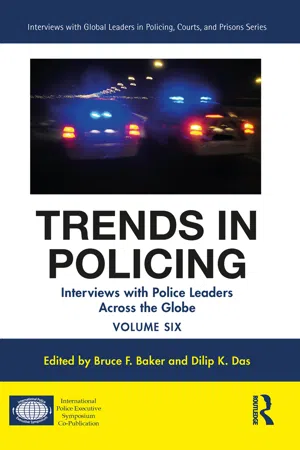
Table of contents

  1. Cover
  2. Half Title
  3. Series Page
  4. Title Page
  5. Copyright Page
  6. Contents
  7. Series Editors’ Preface
  8. List of Contributors
  9. List of Interviewees
  10. Introduction: Can Policing Keep Pace with Social Change?
  11. 1 Jonathan Lewin, Chief Information Officer, Chicago Police Department, USA
  12. 2 Trond Eirik Schea, Director of the Norwegian National Authority for Investigation and Prosecution of Economic and Environmental Crime (ØKOKRIM) and Senior Public Prosecutor, Norway
  13. 3 Ng Ser Song, Director of the Central Narcotics Bureau, Singapore
  14. 4 Adam Palmer, Chief, Vancouver Police, Canada
  15. 5 Milan Stanic, Head of Police, Belgrade, Serbia
  16. 6 Steve Conrad, Chief, Louisville Metro Police Department, Kentucky, USA
  17. 7 Ian Stewart, Commissioner of Queensland Police Service, Australia
  18. 8 Jabeer Takiar, Deputy Chief Superintendent, Danish National Police
  19. 9 Neil Dubord, Chief Constable, Delta, British Columbia Police Department, Canada
  20. 10 Benedicte Bjørnland, Director, Norwegian Police Security Service (PST) and Incoming National Police Commissioner of Norway
  21. Index