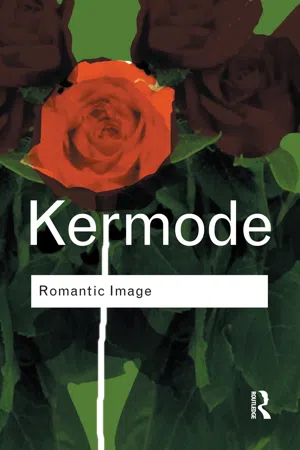
For the past four decades Frank Kermode, critic and writer, has steadily established himself as one of the most brilliant minds of his generation. Questioning the public's harsh perception of 'the artist', Kermode at the same time gently pokes fun at artists' own, often inflated, self-image. He identifies what has become one of the defining characteristics of the Romantic tradition - the artist in isolation and the emerging power of the imagination. Back in print after an absence of over a decade, The Romantic Image is quintessential Kermode. Enlightenment has seldom been so enjoyable!
- 224 pages
- English
- ePUB (mobile friendly)
- Available on iOS & Android
eBook - ePub
Romantic Image
About this book
Information
Part I
Dancer and Tree
How can we know the dancer from the dance?
YEATS
1
___________________
THE ARTIST IN ISOLATION
Je ne suis pas fait comme aucun de ceux que j’ai sus. Mais si je ne vaux pas mieux, au moins je suis autre.ROUSSEAU
We poets in ouryouth begin in gladness, But thereof comes in the end despondency and madnessWORDSWORTH
As its title is intended to indicate, this essay is primarily concerned with the evolution of assumptions relating to the image of poetry; it is an attempt to describe this image in a new way, and to suggest new ways of looking at contingent issues, in poetry and criticism. The main topic is, in fact, that ‘esthetic image’ explained in Thomist language by Stephen Dedalus in Portrait of the Artist as a Young Man: it is for him that beauty which has the three attributes of integrity, consonance and clarity; which is “apprehended as one thing … self-bounded and self-contained upon the immeasurable background of space or time which is not it”; apprehended in its guidditas by the artist whose mind is arrested in “a luminous stasis of esthetic pleasure”.
This is only one famous — and rather obscure — way of putting it, and the conclusions concerning poetry at which Joyce, starting from this position, arrives are characteristic of the whole movement I shall discuss. One such conclusion is that the artist who is vouchsafed this power of apprehending the Image — to experience that ‘epiphany’ which is the Joycean equivalent of Pater’s ‘vision’ — has to pay a heavy price in suffering, to risk his immortal soul, and to be alone, “not only to be separate from all others but to have not even one friend”.
These two beliefs — in the Image as a radiant truth out of space and time, and in the necessary isolation or estrangement of men who can perceive it — are inextricably associated, and because of their interdependence I find that I must begin this essay on the Image with a few pages on what is for me the subsidiary theme, this ubiquitous assumption that the artist is cut off from other men; and even these notes will contain some anticipations of later chapters on the Image proper.
The author to whom it would be natural to turn for a fully developed view of both themes is Thomas Mann, who sets them, so to speak, in the full context of modern life and learning. They occur in singular and suggestive purity — if that is the word — in the early stories Death in Venice and Tonio Kröger, and later receive encyclopaedic enlargement. The first of these stories is nevertheless the most systematic exposition, in art, that I have so far encountered. But for my purposes the topic of isolation is more directly relevant as it occurs in poetry, and more particularly in English poetry, since what I have to say later about Yeats is the heart of this essay. The real difficulty about this topic is to know where to start; the literature of the past hundred and fifty years has millions of texts for discourses upon it, and in any case the ‘difference’ of artists is common ground to the artists themselves and to those who hate them. Perhaps we need an exhaustive study in critical, psychological, and sociological terms; that would be a daunting task, involving the history of the very tools one was using. All I intend here is to recall to mind a few aspects of the subject which seem indispensable to what I have to say about the Image.
Occasionally one encounters the paradox that the artist is magnificently sane, only the quality of his sanity distinguishing him from other men. His sensibility (in Henry James’s sense, the ‘very atmosphere of his mind’) is more profound, subtle and receptive, and his powers of organising experience very much greater. His art is not made of stuff inaccessible to them; there is no qualitative difference between his way of knowing and theirs; all depends upon this intensity of organisation. Pater said it in his liturgical monotone; Dr. Richards said it in his scientific parables, making the point with the aid of diagrams. (These critics, saying the same thing in their so different ways, span a period in which many voices, proclaiming novelty, seem on analysis to be saying much the same thing.) But Pater also knew the cost of this intensity; the Cyrenaic visions, “almost beatific”, of ideal personalities in life and art were “a very costly matter”, requiring “the sacrifice of a thousand possible sympathies” and so effectively setting the visionary apart. And this is characteristic of the way in which the paradox of the artist’s ‘normality’ melts away into the received opinion: artists are different, isolated.
It is important to distinguish, in passing, between this opinion as a serious belief held by and about artists, and the vulgarised bohemian tradition that the artist is poor, immoral, and marked by an eccentricity of costume. This is really a confused echo from the Paris of Mürger and Huysmans and the poètes maudits, with a few collateral English rumours. As an example (rather a sophisticated one, indeed) of the persistence of the lowbrow version, here is a passage from a notice in a London evening paper of an exhibition of paintings by M. Bernard Buffet (1955):
Three years ago you could have bought a Buffet for the cost of a meal but now the Buffet price is £300-£500. He has just been voted France’s leading young painter in a ballot run by a glossy art magazine … which says one of the causes of his success is that he painted the miseries of youth after the war. Only 27 now, he was 18 when the critics first acclaimed him. At the time he was living the real, un-glamorised Bohemian life, going without food to buy canvas … He works entirely from memory and imagination, and by electric light. The house he has had built in the Basses Alpes is specially designed to exclude the beautiful views that other people would dote upon. Nothing must disturb his imagination.
An accompanying reproduction of a painting by M. Buffet shows that he takes his isolation as his subject. What is expected to appeal to the public is the ‘human interest’ of such eccentricity. Why build the house there, amid the ‘beautiful views’ (it is ‘natural’ and decent to admire the view, and normal painters, not these modem madmen, would be outside with an easel), if you are going to work out of your own head? ‘Imagination’ is what M. Buffet works by; but “it’s all imagination” can mean different things to different people, and the meaning the public is here expected to supply is that which places ‘imagination’ in an antithetical relationship with ‘reality’. The philistines, though they were long ago bludgeoned into accepting ‘nature’ as a mysteriously good thing, cannot see M. Buffet’s work as anything but fantastic nonsense, whereas for him their ‘nature’ is dead, and the concern only of a science which specialised in measuring dead things. He is interested in what he has access to, and they have not — the image that is truth because he makes it up; because it has nothing to do with ‘nature’. There was once a New Yorker joke about a haggard genius who said “I paint what I don’t see”. This joke, good as it is, depends on our readiness to think of ‘modern art’ as fantastic nonsense, and the drawing has to show a Simeon Solomon type, garret-dwelling, ragged, pitiable but also odious; for nearly two centuries there have been painters who would not have seen this joke (except by some special effort of sympathy) because the old scarecrow is saying something that has, for them, a great deal of truth in it. For them, and for M. Buffet, these public misunderstandings are merely another aspect of their isolation. For we may roughly distinguish two aspects of the condition. The first is represented by M. Buffet’s voluntary, even somewhat ostentatious, retreat to the Alps, his blocking the windows to keep out the normally beautiful views and the normally welcomed daylight; this is the cult of isolated joy, the pursuit of the Image by the specially fated and highly organised artist, a man who gets things out of his own head. He excludes society and its half-baked sensibilities. The second is the reaction of astonishment and contempt in those who ‘dote upon’ beautiful views. Whether he likes it or not, society excludes him.
Each of these aspects is in turn presented (though of course not in this very simple way) as the whole truth about the estrangement of the modern artist, though the second is the more popular. Of course they are really inseparable. The artist’s devotion to the Image developed at the same time as the modern industrial state and the modern middle class. From the beginnings of Romantic poetry the artist has been, as M. Béguin says of Lichtenberg, “malade de sa différence avec son temps”. The great poet of the modern city, Baudelaire, was a self-confessed ‘seer’. The frisson nouveau upon which Hugo congratulated him proceeded from the study of a fallen humanity in the new con-text; his mythology is of the perversion, the ennui, the metaphysical despair of men and women subjected to what Dickens (in this respect Baudelaire’s English equivalent — compare Le crépuscule du matin with certain passages in Little Dorrit) called “the shame, desertion, wretchedness and exposure of the great capital”. The poet, though devoted to the Image, belongs to this city, his place in which Baudelaire notoriously compares with that of the prostitute. All men, he says, have an “invincible taste for prostitution”, and he calls this the source of man’s “horror of solitude”; the poet is different in that he wants to be alone, but this is only “prostituting yourself in a special way”; as Mr. Turnell says in his recent book on Baudelaire, this attempt at unity in solitude fails because of internal stress and division, and the poet can claim not unity but only difference in the manner of his prostitution. Yet Baudelaire, so sensitive to the horror of the modern city, remains true to a central Romantic tradition in abstaining from any attempt to alter the social order, and despises the “puerile Utopias” of some other Romantic poets. And his answer to the question, what has the movement, whose poets find themselves in this dreadful situation, done for us, is striking: it has “recalled us to the truth of the image”. The Image is the reward of that agonising difference; isolated in the city, the poet is a ‘seer’. The Image, for all its concretion, precision, and oneness, is desperately difficult to communicate, and has for that reason alone as much to do with the alienation of the seer as the necessity of his existing in the midst of a hostile society.
Baudelaire is a famous case, but there is nothing specifically French about his difficulties, and these notions of Image and isolation developed independently in England, from native Romantic roots. The Symbol of the French is, as we shall see, the Romantic Image writ large and given more elaborate metaphysical and magical support; and, if we go back far enough, we can see that English poets — using the same ultimate sources, Boehme and Swedenborg, the Germans of the later eighteenth century — developed their own way of “recalling us to the truth of the image”. This native tradition is in some ways more significant for modern poetry than imported Symbolism; Blake and Pater stand behind Yeats at his most magnificent, and in the thought of Arthur Symons, crucial for the historian, they are at least as important as the French poets. And an awareness of the Image involves, for English poets also, a sense of powerful forces extruding them from the life of their society, a sense of irreconcilable difference and precarious communication. Here too we encounter that ambiguity concerning the degree of responsibility for the poet’s estrangement. Obviously it is too simple to say, with the prose Arnold and with Mencken, each criticising the materialism of his own society, that the artist is forced into seclusion; that is where, on his own view, he has to be. The ambiguity is very acutely presented by D. H. Lawrence (who certainly earned the right to understand it) in a comment on Beethoven’s letters: “always in love with somebody when he wasn’t really, and wanting contacts when he didn’t really — part of the crucifixion into isolated individuality — poveri noi. The crux of the matter is in this colloquial ‘really’; did he or didn’t he want such contacts, was he natural man or artist, did he want to ‘go out of himself or not? ‘Crucifixion’ (a word that recurs with significant frequency in this context, from Kierkegaard to Yeats and Wilde) does not completely exclude the idea of torment freely though painfully chosen; poveri noi, however you look at it we artists are all in the same boat, whether we ‘really’ like it or not. To be cut off from life and action, in one way or another, is necessary as a preparation for the ‘vision’. Some difference in the artist gives him access to this — an enormous privilege, involving joy (which acquires an almost technical sense as a necessary concomitant of the full exercise of the mind in the act of imagination). But the power of joy being possible only to a profound ‘organic sensibility’, a man who experiences it will also suffer exceptionally. He must be lonely, haunted, victimised, devoted to suffering rather than action — or, to state this in a manner more acceptable to the twentieth century, he is exempt from the normal human orientation towards action and so enabled to intuit those images which are truth, in defiance of the triumphant claims of merely intellectual disciplines. But that is pushing too far ahead. I have now introduced into the discussion the crucial concept of joy, of which the locus classicus is Coleridge’s Ode; and I now turn more specifically to the English tradition.
The ‘difference’ of some of the English Romantic poets is almost too well known; they were outcast because they had to pay for their joy and their vision. Sometimes they attributed their condition to some malady in themselves, but they also blamed the age in which they lived, as Hazlitt did when he measured the sad alteration of the world by comparing the art of West with that of Raphael, in which “every nerve and muscle has intense feeling”. How often are we to hear this repeated! For Yeats the painters to be compared are Sargent and Titian. The alienation of the artist and this despair at the decay of the world are two sides of one coin; the present age is the one that hates art, some earlier age loved the poet without corrupting him. So it was that Hazlitt found in Godwin’s St. Leon a magician who could stand for the modern artist, and who might just as easily have come from some fantasy after Villiers de l’Isle Adam:
He is a limb torn off from society. In possession of eternal youth and beauty he can feel no love; surrounded, tantalized and tormented by riches, he can do no good. The faces of men pass before him as in a speculum; but he is attached to them by no common tie of sympathy or suffering. He is thrown back into himself and his own thoughts. He lives in the solitude of his own breast, without wife or child or friend or en...
Table of contents
- Cover
- Half Title
- Title Page
- Copyright Page
- Table of Contents
- Preface
- A Note on the Frontispiece
- Part I Dancer and Tree
- Part II The Twentieth Century
- Epilogue
- Index
Trusted by 375,005 students
Access to over 1.5 million titles for a fair monthly price.
Study more efficiently using our study tools.
Frequently asked questions
Yes, you can cancel anytime from the Subscription tab in your account settings on the Perlego website. Your subscription will stay active until the end of your current billing period. Learn how to cancel your subscription
No, books cannot be downloaded as external files, such as PDFs, for use outside of Perlego. However, you can download books within the Perlego app for offline reading on mobile or tablet. Learn how to download books offline
Perlego offers two plans: Essential and Complete
- Essential is ideal for learners and professionals who enjoy exploring a wide range of subjects. Access the Essential Library with 800,000+ trusted titles and best-sellers across business, personal growth, and the humanities. Includes unlimited reading time and Standard Read Aloud voice.
- Complete: Perfect for advanced learners and researchers needing full, unrestricted access. Unlock 1.5M+ books across hundreds of subjects, including academic and specialized titles. The Complete Plan also includes advanced features like Premium Read Aloud and Research Assistant.
We are an online textbook subscription service, where you can get access to an entire online library for less than the price of a single book per month. With over 1.5 million books across 990+ topics, we’ve got you covered! Learn about our mission
Look out for the read-aloud symbol on your next book to see if you can listen to it. The read-aloud tool reads text aloud for you, highlighting the text as it is being read. You can pause it, speed it up and slow it down. Learn more about Read Aloud
Yes! You can use the Perlego app on both iOS and Android devices to read anytime, anywhere — even offline. Perfect for commutes or when you’re on the go.
Please note we cannot support devices running on iOS 13 and Android 7 or earlier. Learn more about using the app
Please note we cannot support devices running on iOS 13 and Android 7 or earlier. Learn more about using the app
Yes, you can access Romantic Image by Frank Kermode in PDF and/or ePUB format, as well as other popular books in Literature & Literary Criticism. We have over 1.5 million books available in our catalogue for you to explore.