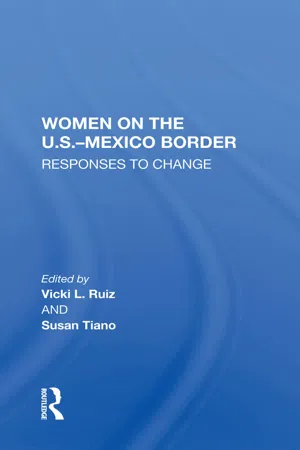
This book illuminates the reality of border women's lives and challenges the conventional notion that women need not work for wages because they are economically supported by men. It offers insight into the lives of undocumented women.
- 262 pages
- English
- ePUB (mobile friendly)
- Available on iOS & Android
eBook - ePub
About this book
Information
I
LABOR, MIGRATION, AND RELATIONS OF PRODUCTION
1
Women's Work and Unemployment in Northern Mexico
Susan Tiano
A recent pattern in the internationalization of production involves transferring the labor-intensive phases of manufacturing from more- to less-industrialized nations possessing abundant low-waged labor. Proponents of "offshore" manufacturing claim that it provides the Third World worker with employment, a steady income, and useful skills. Critics object, however, that export processing does not alleviate unemployment, for its work force is predominantly female, and unemployment in the Third World is essentially a male problem (Woog, 1980:101; Fernández, 1977:141). Such a claim reflects an inaccurate but common image about women's labor force participation in developing nations. This essay challenges this view with aggregate data on men's and women's employment patterns in northern Mexico. The data indicate that unemployment persists despite considerable investment in export processing industrialization. They provide little evidence, however, that the chief cause of this continuing unemployment is the preferential hiring of women.
Export Processing and Female Employment
Since World War II, the large-scale corporation, spurred by the need to maintain profit margins by minimizing production costs and by expanding sales, has evolved into a global enterprise. The constant search for new markets, inexpensive labor, and reliable sources of raw materials has led North American companies and their European and Japanese competitors to expand into developing nations. This process has dramatically transformed capitalist investment in the Third World. Whereas in previous epochs foreign capital financed the extraction of primary products, today it concentrates in manufacturing. Through "import substitution industrialization," corporations have avoided protective tariffs by establishing subsidiaries in the Third World nations whose markets they have supplied. Because these firms have been equipped with the same capital-intensive technologies employed in the home countries, import substitution has tended to displace Third World workers, thereby limiting the internal markets on which it depends (Barnet and Muller, 1974:123-1147; MacEwan, 1978:481-491).
I am grateful to David Maciel, Richard Riger, Barbara Kohl, Karen Bracken, Richard McCleary, and Robert Fiala for their comments on earlier versions of this chapter.
In the mid-1960s, North American firms developed an alternative investment strategy. "Export processing industrialization" uses inexpensive Third World labor to produce intermediate products for reexport to home markets. Items 806.3 and 807 of the U.S. Tariff Schedules facilitate this process by allowing the export of components, equipment, and raw materials for assembly by foreign subsidiaries or subcontractors. Tariff duties apply only to the value added outside the United States, largely the relatively low cost of foreign labor (Fernández, 1977: 36; Woog, 1980:16- 18). Export processing is suitable not only for laborintensive industries such as garments and textiles, but also for high technology industries with labor-intensive phases, such as electronics. Third World governments have encourged it as a way to provide jobs, incomes, and skills to their underemployed populations; to reduce foreign exchange deficits; and to augment industrialization through transferring labor-intensive technologies. Incentives to multinational investment have included establishing free trade zones, offering tax exemptions, and constructing industrial parks. Some governments have attempted to increase their nation's "comparative advantage" by waiving worker-protection legislation which increases labor costs (Safa, 1980:16). Between 1960 and 1968 the number of less-developed nations which were significant exporters of manufactured goods jumped from four to thirty (Barnet and Muller, 1974:196). Key sites for offshore sourcing include the Caribbean, Southeast Asia, and the United States-Mexico border (Hymer, 1978:492-498; Safa, 1980:1-14; Lim, 1981:181-190; Barnet and Muller, 1974:123-147).
That export processing is leading to a new international division of labor is demonstrated by the increasing geographical dispersion of the electronics industry (Safa, 1980:10). Because this competitive industry is subject to rapid technological innovation, existing production methods soon become obsolete. Firms find it less costly to retrain workers than to continually replace outdated machinery, and thus use labor-intensive techniques for certain production phases. Training is usually minimal, for the labor process has been decomposed through scientific management principles into a series of repetitive, deskilled tasks that are easily transferred to new production sites. By the late 1960s, U.S. electronics firms had removed 90 percent of their labor-intensive assembly operations to the Third World (Lim, 1981:182). Much of this investment has been in Asian nations, which have been integrated into a network of specialized production sites on the basis of labor costs. Headquartered in Hong Kong and Singapore, the industry has concentrated testing operations in Malaysia, and has located the most labor-intensive assembly operations in poorer nations such as Indonesia, the Philippines, and Thailand. By the mid-1970s, semiconductor production had become the fastest growing industry in Southeast Asia, employing over 1 million workers, the vast majority of whom were women (Lim, 1981: 181-190; Grossman, 19792-17).
Women, typically aged 16 to 24, constitute 80 to 90 percen...
Table of contents
- Cover
- Half Title
- Series Page
- Title
- Copyright
- Contents
- List of Contributors
- Acknowledgments
- Introduction
- I LABOR, MIGRATION, AND REIATIONS OF PRODUCTION
- II CONSCIOUSNESS, ORGANIZATION, AND EMPOWERMENT
- III CULTURE, CREATMIY, AND REIATIONS OF REPRODUCTION
- Conclusion
- Index
Trusted by 375,005 students
Access to over 1.5 million titles for a fair monthly price.
Study more efficiently using our study tools.
Frequently asked questions
Yes, you can cancel anytime from the Subscription tab in your account settings on the Perlego website. Your subscription will stay active until the end of your current billing period. Learn how to cancel your subscription
No, books cannot be downloaded as external files, such as PDFs, for use outside of Perlego. However, you can download books within the Perlego app for offline reading on mobile or tablet. Learn how to download books offline
Perlego offers two plans: Essential and Complete
- Essential is ideal for learners and professionals who enjoy exploring a wide range of subjects. Access the Essential Library with 800,000+ trusted titles and best-sellers across business, personal growth, and the humanities. Includes unlimited reading time and Standard Read Aloud voice.
- Complete: Perfect for advanced learners and researchers needing full, unrestricted access. Unlock 1.5M+ books across hundreds of subjects, including academic and specialized titles. The Complete Plan also includes advanced features like Premium Read Aloud and Research Assistant.
We are an online textbook subscription service, where you can get access to an entire online library for less than the price of a single book per month. With over 1.5 million books across 990+ topics, we’ve got you covered! Learn about our mission
Look out for the read-aloud symbol on your next book to see if you can listen to it. The read-aloud tool reads text aloud for you, highlighting the text as it is being read. You can pause it, speed it up and slow it down. Learn more about Read Aloud
Yes! You can use the Perlego app on both iOS and Android devices to read anytime, anywhere — even offline. Perfect for commutes or when you’re on the go.
Please note we cannot support devices running on iOS 13 and Android 7 or earlier. Learn more about using the app
Please note we cannot support devices running on iOS 13 and Android 7 or earlier. Learn more about using the app
Yes, you can access Women On The U.S.-Mexico Border by Vicki Ruiz in PDF and/or ePUB format, as well as other popular books in Politics & International Relations & Politics. We have over 1.5 million books available in our catalogue for you to explore.