- 256 pages
- English
- ePUB (mobile friendly)
- Available on iOS & Android
eBook - ePub
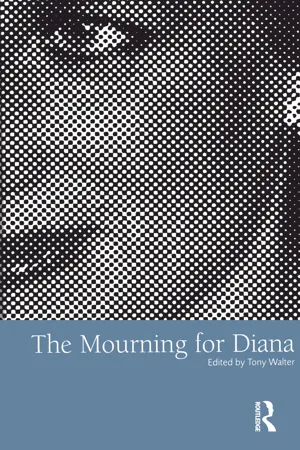
The Mourning for Diana
About this book
The unexpected death of Diana, Princess of Wales, in Paris on August 31st 1997 led to a period of mourning over the next week that took the world by surprise. Major institutions - the media, the royal family, the church, the police - for once had no pre-planned script. For the public, this was a story with an ending they had not anticipated. How did these institutions and the public create a cultural order in the face of such disorder? Both those involved in the mourning and those who objected to it struggled to understand the depth and breadth of emotion shaking Britain and the world. Mourning was focused on London, where Diana's body lay, and on Diana's home, Kensington Palace. Throughout the city and especially in Kensington Gardens, millions left shrines to the dead princess made of flowers, messages, teddy bears and other objects. In towns and villages around the UK, this was repeated. The mourning was also global, with media dominated by Diana's death in scores of countries. The funeral itself had a record-breaking world television audience, and messages of condolence floated around the globe in cyber-space. How unique was all this? Does it mark a shift in the culture of mourning, of the position of the monarchy, of the role of emotion in British culture? How does it compare with the mourning for other super-icons - JFK, Evita, Elvis, and Monroe? Was it media-induced hysteria? Or was it simply a magnification of normal mourning behaviour? Focusing on the extraordinary actions of millions of ordinary people, this book documents what happened and shows how a modern rational society coped with the unexpected in a proto-revolutionary week that left participants and objectors alike asking 'why did we behave like this?'
Information
Part 1 Introduction
1 The Week of Mourning
Douglas Davies
Diana, Princess of Wales, died in the early hours of Sunday, 31 August 1997. Sixteen years previously, she had fulfilled the romantic ideal of youthful bride when she married the heir to the British throne, Charles, Prince of Wales; she became the most photographed of all celebrities, and her marital troubles and eventual divorce were conducted in ablaze of media publicity. Many anticipated a new marriage because Diana spent part of the summer with Dodi A1 Fayed, whose controversial Egyptian father, Mohammed, owned London's famous Harrods store but remained largely unaccepted by the British establishment. On the fateful night, Diana and Dodi dined at the Paris Ritz, itself a Fayed hotel, and then left at speed trying to avoid press photographers who pursued on motorcycles. Tragically, the chauffeur driven Mercedes sped through the city and, for whatever reason, crashed into a pillar in an underpass. Diana, Dodi and the driver were killed. The bodyguard alone survived.
Diana's death led, throughout the United Kingdom, to a most extensive and dramatic public response, with acts of tribute and memorial throughout the following week until, and indeed continuing after, the public funeral service at Westminster Abbey and a private interment on Saturday, 6 September. Not only did hundreds of thousands visit Kensington Palace in London to place flowers and sign books of remembrance, but so did many hundreds of thousands more throughout the British Isles and in embassies abroad. Diana's death led to more newsprint, and her funeral to a bigger global television audience, than had any previous event. This introductory chapter1 sets the public response to Diana's death (which collectively I term 'the Diana event') into an appropriate social scientific classification of social action, describes crucial elements in the public events surrounding the death and funeral and, finally, suggests some theoretical approaches for its analysis.
1. An early draft of this chapter was delivered at a day seminar 'Dodens Dager og Dodens Steder' at the Diakonhjemmets Hogskolesenter, Oslo on 31 October 1997.
Framework and Classification
The Diana event is not unique, at least not in type even though maybe in extent. It belongs to a distinctive type of human activity. The family resemblance of popular responses constituting this type involves extremely large numbers of people acting in an unexpected and unrehearsed fashion in relation to a triggering event - focused in tragedy and resulting in death - which touches the depth of human sentiment and social morality and which may involve a perceived inadequacy of official action on behalf of public authorities.
The category of events into which the Diana event may be placed include the death in childbirth of Princess Charlotte and her baby in 1817 (second and third in line to the throne respectively, see Chapter 3); the sinking of the Titanic (1912); the unveiling of the Cenotaph in Whitehall on Armistice Day 1920 (Cannadine 1981: 223-4); the assassination of President John F. Kennedy (1963); the explosion of the Challenger space shuttle live on television, killing all its crew including a teacher who, like Diana, was in her thirties and a mother of two (1986); the Hillsborough soccer stadium disaster (1989); and the Estonia ferry disaster in Sweden (1994). Slightly less obvious are the White March in Belgium of 1996, and the pop-music Live Aid Concert organized by Bob Geldof in 1984.
To summarize some of the more recent of these events. At the Hillsborough soccer stadium, ninety-six Liverpool supporters were crushed to death while the match (a semi-final) was being televised live. The following day thousands came to visit the team's home stadium at Anfield and it is reckoned that by the end of a week a million people had passed through the football ground. Additional religious services took place alongside mass tributes of flowers, scarves and other objects left by fans (Walter 1991). The Estonia disaster, in which a ferry sank with the loss of over 900 lives, touched very many Swedish communities and prompted a popular reaction involving informal and more formal events in which Swedes lit candles and engaged in acts of commemoration. With conventional media and political discourse failing, Swedish Church leaders were much involved. The White March in Belgium involved many thousands of individuals gathering together in mass response to a series of paedophile murders and an apparent high-level political cover-up.
For the moment I want to highlight the Titanic and its sinking. In that pre-television era, it fell to newspapers to report it, and they did so in stories of bravery and unity, as rich and poor stood side by side as the ship went down. The Times (20 April 1912, p. 9) tells how 'men of all classes stood shoulder to shoulder in the hour of their supreme agony.' The Lord Mayor of London opened an appeal and money poured in. We are also told that 'the pity of all people was poured out in another way - in prayer and solemn memorial services for those who were lost.' A memorial service for the sinking of the Titanic took place at St Paul's Cathedral, London on 19 April 1912; many thousands were unable to get into the church. The Times reports that
the great doors were closed an hour before the service. The cathedral was full and many were left outside. It was a vast, black multitude .. . People of rank and wealth, these city clerks and shop-keepers, and slum dwellers had come together into the quiet sanctuary, not in any formal spirit, but in a comradeship of grief, greater than the small conventions of life.
There were many people weeping during the playing of the 'Dead March' from Saul. The music of the drums was awe-inspiring. There were soldiers and sailors who had heard it play for dead comrades, 'and they, too, stood erect, with tears streaming down their faces, not ashamed of tears. It may be said in all sincerity that the hearts of all these people were stirred to their uttermost depths by thoughts deeper than may be put into words.' A similar great service was held in the Catholic Westminster Cathedral. We are even told that the figure of Nelson in Trafalgar Square looked down on 'those who knelt below his monument' (Gibbs, no date: 26-8).
The Diana event was therefore one of a type, and yet - like each of its predecessors - had its own distinctiveness. The response to her death is the latest episode of an evolving folk tradition, partly Western, partly Anglophone, partly British, and the prime purpose of this book is to document this episode: to record the ways in which the Diana event participated in this folk tradition, to identify the ways in which it was innovative. What is needed is an intelligent record and interpretation of what happened, so that at the next death of this kind commentators can know what is new, and what is the same, compared with Diana's death back in 1997 and compared with other such events. Only thus can this particular category of social action be understood.
The Diana Event
The Diana event was, primarily, a media event - but with a difference. The difference consisted of two elements: the active and practical participation of millions of people on the one hand, and the idea that the media were, perhaps, responsible for the death on the other. Theirs was an unusual dual role, reporting on something for which many thought them responsible, at least to some degree. Theirs was a process of self-analysis alongside their normal activity of reporting. One aspect of this ambiguous position, one that perhaps made their situation easier, lay in the constant use of interviews with and comments from the public.
As far as many amongst the British public were concerned the event began as a media story before becoming part of their own behaviour in a group sense. In the early hours of the Sunday morning there was a news item that Diana had been in a car crash in Paris, this rapidly passing into news that she was dead. The story was intrinsically connected with the idea of a car chase in which the word 'paparazzi' rapidly, for the first time, became part of everyday English. These were the bad men, the freelance photographers who sell their pictures to the press, who had caused the accident and killed Diana. The moral argument seemed clear; there was a focus of blame. Already her media life was explicit.
At breakfast time on the television the recently elected Labour Prime Minister, Tony Blair, was interviewed on his way to church as part of his own Sunday morning activity in the North of England. The interview was solemn and emotional, and could readily be accepted as personal and not political, except in the sense that he was speaking for the nation, and spoke words of astonishment and of shock. His use in this interview of the phrase 'the people's princess' (borrowed from writer Julie Burchill) was prophetic of events to come in the week ahead.
In another Sunday morning journey to church the spotlight fell upon the Royal Family. They were going to church by car whilst on holiday at their Balmoral estate in Scotland, This rural area is very far removed from London geographically and, in terms of social geography too, is not in the mainstream of social life as far as urban Britons are concerned. To the astonishment of some, Diana's children, William (15) and Harry (13), went to church with the rest of the family. It was reported that there were no special prayers for Diana or any recognition of her death at that ordinary Sunday morning service. By contrast, in practically every other British church that day special mention was made of the death and of the family's bereavement.
There now existed a strange lack of focus. Diana was dead in France, the Royal Family was in Scotland, while the British people focused their attention on what we might call empty buildings in London, and on two palaces in particular. One was Kensington Palace, where Diana lived and the other Buckingham Palace, the Queen's London residence. On the same day (Sunday) Charles, Prince of Wales along with his ex-wife's two sisters went to France to bring the body home. That was televised. In a highly and oddly symbolic way the plane returned while a special service from St Paul's Cathedral was being broadcast (see Chapter 12). The television producer can hardly ever have been as alert as when pictures of the arrival of the coffin were merged with the sound of the service playing behind it. It could not have been better arranged if it had taken months to plan.
This sense of immediacy added an authenticity to the medium of television at that moment. Meanwhile other television and radio commentary moved from one mode to another. Early in the day reporters spoke like ordinary people. They too were shocked, their words unscripted. Unusually they were dealing with an unexpected event of considerable magnitude. But, as the day proceeded an increasing, though slight, degree of journalistic observation emerged, even though comment continued to be restricted. Old television footage of Diana was replayed, especially that which portrayed the compassionate dimensions of her complex character; a documentary about her campaign against landmines was shown on the Sunday evening, viewed by many who had shown no particular interest in its first showing earlier in the year. People were being constantly interviewed, largely in London. That the death occurred early on a Sunday meant that most people were off work, able to watch the television all day; the death came too late for the Sunday papers. Consequently, television rather than print media set the agenda for the days to come, and people were most likely to share the news and their immediate reactions with family rather than with friends or workmates. In North America, where the news broke on the Saturday evening, it was very differently mediated.2
2. Compare the death of John Kennedy during the day on a Friday, leading to a weekend dominated by television; the funeral was on the Monday. For those who heard the news at work, radio was more important in the first instance (Greenberg & Parker 1964).
People were now beginning to place tributes at Kensington Palace. Over the next few days these grew to an immense flow of people with flowers and gifts at increasingly large sites, not only in London but across the country. Town halls and other municipal buildings, cathedrals, churches, war memorials and supermarkets were the most common locations. A distinctive feature was the use of books of remembrance (see Chapter 13). One was opened at St James's Palace in London and was followed by many in other parts of the country. At St James's and Kensington Palaces, the queues to sign the books stretched for hours, and eventually the number of books was expanded considerably. The actual number of books nationwide and worldwide is unknown. Some were bound and sent to Althorp in North-amptonshire, Diana's ancestral family home; others remained in their town of origin. This being the age of the Internet, condolences were also sent via cyberspace, many from North America. In the first two weeks, the Royal Web Site alone received 600,000 condolences, and 35 million visits (Diana the Week the World Stood Still, 31 December 1997, ITV), a considerable increase on the 150,000 plus condolence messages posted in the first two weeks to friends and family following the disappearance in 1996 of TWA Flight 800 (Sofka 1997).
But it was the use of flowers that emerged as the key feature in the British response (see Chapters 8, 9 and 10). Millions of people across the country brought and placed them along with very personal messages written on attached cards (Figures 1.1, 1.2, 1.3). Some resembled ordinary funeral wreaths, others expressed sadness or personal sympathy, most remained in their wrappers. A single flower with a message laid in London by the Monday read 'Beautiful Lady, Rest in Peace, With love, Sam (A homeless friend).' Some linked Diana with Dodi A1 Fayed, her current companion ...
Table of contents
- Cover
- Half Title
- Title Page
- Copyright Page
- Contents
- List of illustrations
- Notes on Contributors
- Preface
- Part 1: Introduction
- Part 2: Contexts and Comments
- Part 3: London
- Part 4: The Global and the Provincial
- Part 5: Conclusion
- Index
Trusted by 375,005 students
Access to over 1.5 million titles for a fair monthly price.
Study more efficiently using our study tools.
Frequently asked questions
Yes, you can cancel anytime from the Subscription tab in your account settings on the Perlego website. Your subscription will stay active until the end of your current billing period. Learn how to cancel your subscription
No, books cannot be downloaded as external files, such as PDFs, for use outside of Perlego. However, you can download books within the Perlego app for offline reading on mobile or tablet. Learn how to download books offline
Perlego offers two plans: Essential and Complete
- Essential is ideal for learners and professionals who enjoy exploring a wide range of subjects. Access the Essential Library with 800,000+ trusted titles and best-sellers across business, personal growth, and the humanities. Includes unlimited reading time and Standard Read Aloud voice.
- Complete: Perfect for advanced learners and researchers needing full, unrestricted access. Unlock 1.5M+ books across hundreds of subjects, including academic and specialized titles. The Complete Plan also includes advanced features like Premium Read Aloud and Research Assistant.
We are an online textbook subscription service, where you can get access to an entire online library for less than the price of a single book per month. With over 1.5 million books across 990+ topics, we’ve got you covered! Learn about our mission
Look out for the read-aloud symbol on your next book to see if you can listen to it. The read-aloud tool reads text aloud for you, highlighting the text as it is being read. You can pause it, speed it up and slow it down. Learn more about Read Aloud
Yes! You can use the Perlego app on both iOS and Android devices to read anytime, anywhere — even offline. Perfect for commutes or when you’re on the go.
Please note we cannot support devices running on iOS 13 and Android 7 or earlier. Learn more about using the app
Please note we cannot support devices running on iOS 13 and Android 7 or earlier. Learn more about using the app
Yes, you can access The Mourning for Diana by Tony Walter in PDF and/or ePUB format, as well as other popular books in Social Sciences & Anthropology. We have over 1.5 million books available in our catalogue for you to explore.