- 224 pages
- English
- ePUB (mobile friendly)
- Available on iOS & Android
eBook - ePub
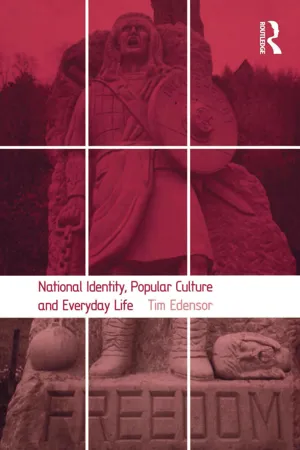
National Identity, Popular Culture and Everyday Life
About this book
The Millennium Dome, Braveheart and Rolls Royce cars. How do cultural icons reproduce and transform a sense of national identity? How does national identity vary across time and space, how is it contested, and what has been the impact of globalization upon national identity and culture?This book examines how national identity is represented, performed, spatialized and materialized through popular culture and in everyday life. National identity is revealed to be inherent in the things we often take for granted - from landscapes and eating habits, to tourism, cinema and music. Our specific experience of car ownership and motoring can enhance a sense of belonging, whilst Hollywood blockbusters and national exhibitions provide contexts for the ongoing, and often contested, process of national identity formation. These and a wealth of other cultural forms and practices are explored, with examples drawn from Scotland, the UK as a whole, India and Mauritius. This book addresses the considerable neglect of popular cultures in recent studies of nationalism and contributes to debates on the relationship between 'high' and 'low' culture.
Information
– 1 –
Popular Culture, Everyday Life and the Matrix of National Identity
Theories of Nationalism: Reductive Cultural Perspectives
The literature on nationalism and national identity has been dominated by a focus on the historical origins of the nation and its political lineaments. Nevertheless, so powerful is the allure of the nation that is has proved to be ‘an imaginative field on to which different sets of concerns may be projected, and upon which connections may be forged between different aspects of social, political and cultural experience’ (Cubitt, 1998: 1). Strangely, however, the nation has been subject to very little critical analysis in terms of how it is represented and experienced through popular culture and in everyday life. This absence masks a supposition that ‘nation’ is equivalent to ‘society’, a popular assumption that also afflicts social scientists and cultural theorists. For as James avers, ‘the concepts of the nation, this society, and this community are often used as coterminous’ (1996: 123). Accordingly, notions of society remain ‘embedded within notions of nation-state, citizenship and national society’ (Urry, 2000: 6) and, as Billig further elaborates, ‘the “society” which lies at the heart of sociology’s self-definition is created in the image of the nation-state’ (1995: 53). Thus despite appearances to the contrary, not least at the level of common sense, the nation persists as a pre-eminent constituent of identity and society at theoretical and popular levels. Despite the globalisation of economies, cultures and social processes, the scalar model of identity is believed to be primarily anchored in national space. Partly, then, the space in which culture and everyday life operates is conceived to be indisputably the nation, and this has resulted from a lack of enquiry into how such cultures are (re)produced and experienced, how they are sustained to succour the illusion that the nation is somehow a natural entity, rather than a social and cultural construct.
At the level of culture, then, there is a reification of the nation, as if different cultures can be identified, ticked off according to a preconceived set of national characteristics. Bounded and self-evident, a nationally rooted culture is not imagined as ‘the outcome of material and symbolic processes but instead as the cause of those practices – a hidden essence lying behind the surface of behaviour’ (Crang, 1998: 162). For instance, in a recent account of national identity, the contention was advanced that the nation ‘represents the socio-historical context within which culture is embedded and the means by which culture is produced, transmitted and received’ (Guibernau, 1996: 79) This, of course, considers culture (and national identity which expresses it) to be singular and fixed instead of multiple and dynamic. But as Clifford declares culture is not ‘a rooted body that grows, lives, dies’, but is rather a site of ‘displacement, interference and interaction’ (1992: 101).
Thus whilst there are many studies of particular ‘national’ cultural forms and practices (many to which I will be referring), at a general theoretical level, the idea of popular culture seems to be mysteriously absent. And paradoxically, although it is believed that discrete national cultures exist, a sophisticated account of how popular culture is manifest and expressed as national has not been attempted. As I will shortly discuss however, there are the stirrings of a more considered approach, and there have been several highly suggestive accounts that have not yet been utilised.
The aim of this first section is to explore the ways in which some of the best-known writers on nationalism and national identity, namely Ernest Gellner, Eric Hobsbawm, Benedict Anderson, Anthony Smith and John Hutchinson, have considered the cultural and its relationship with the national. I will argue that these accounts are seriously distorted in their consideration of ‘high’, ‘official’ and ‘traditional’ culture to the exclusion of popular and everyday cultural expression, and that their conception of culture is rather undynamic.
Ernest Gellner
Ernest Gellner’s work on nationalism has been enormously influential. Yet his emphasis on the essentially modern origins of nations utilises a particular perspective towards culture. He maintains that the institutionalisation of cultural norms shared over a large geographical area, and the dissemination of national ideologies, can only occur in modern, mass societies. Thus the nineteenth-century bureaucratisation of education, hygiene and medicine, the rise of organised, rational recreation, and the rise of centralised institutions of scientific knowledge which classified criminals, insanity and nature are part of a wider reorganisation of social and cultural life (Lloyd and Thomas, 1998). Primarily, the authority for organising this transformation is national, and responsibility for establishing common adherence to centralised policies, structures and norms devolves to regional and local authorities to reinforce the cultural homogeneity demanded by the centre to facilitate nation building. Gellner’s account of this drive towards the modern formation of national identity focuses upon the establishment of what he terms ‘high cultures’, defined as ‘a school-mediated, academy supervised idiom, codified for the requirements of reasonably precise bureaucratic and technological communication’ (1983: 57). More specifically, these are referred to as ‘garden cultures’ (ibid.: 7), which are presumably surveyed, tended and codified by specialist experts. Thus a mass education system binds state and culture together, canons are devised, museums are established, official histories written, scientific bodies set up to subtend the propagation of ‘official’ knowledge, so that specific bodies of knowledge, values and norms are ingested by all educated citizens.
Crucially, for Gellner, the extension of an authoritative knowledge to all denizens of the nation marks a break from the cultural differentiation in medieval worlds, where, for instance, it was not imperative for the inhabitants of regions to communicate with each other, or for the peasantry to share the language of the elite; indeed, distinct courtly cultures were designed to differentiate elites from masses. Instead, with ‘standardised’
homogeneous, centrally sustained high cultures, pervading entire populations and not just elite minorities, a situation occurs in which well-defined educationally sanctioned and unified cultures constitute very nearly the only kind of unit with which men [sic] willingly and often ardently identify. (ibid.: 55)
For Gellner, nationalism is a function of modernity and the process of modernisation, where education, technologies of communication and bureaucracy, the very structure of the modern state, are driven by rationalist, administrative imperatives rather than any manipulating caste. Nations are thus the forms which are best suited to carry these modernising imperatives. Whilst plausible, the account tends to focus on the Appollonian features of modernity – the rational elements – whilst ignoring other dimensions such as the continual change and fluidity which challenges the ordering processes that nations, amongst other agents of rationality, attempt to reinforce. This incessant transformation of economic, social and cultural life means that bodies of thought and knowledge are inherently unstable, open to challenge as new adaptations are sought by individuals and institutions. Therefore, national organisations must keep pace with change whilst simultaneously reinforcing authoritative cultural delineations if they are to retain their authority. I am suggesting that Gellner’s account overemphasises the rigidity of (national) cultures – and indeed, processes of modernity.
This also raises the issue as to whether all subjects willingly give up their cultural values in the face of the nation? Perhaps, as Smith argues as part of his argument that nations are based on pre-existing ethnies, in certain cases, selective ancestral cultures have been adopted as official cultures by nations (1998: 42). The position of the state towards already existing cultures is complex, for certain cultures may be eradicated (especially in the case of ethnic or religious particularity), or they may be adopted and adapted by the cultural establishment. Questions are also raised about who is left out of the national culture, how are ethnicity, religion, language and region accommodated by the state and who is marginalised or rejected as unsuitably national. Gellner’s assertions seem to suggest that subjects passively accept knowledge and identities, are effectively interpellated by all-powerful national cultural organisations. However, the struggle for inclusion is an ongoing battle which cultural guardians cannot always control. For example, the British state permits freedom of worship but has insisted upon the provision of compulsory teaching of Christianity in primary and secondary education. Nevertheless, heterodox and dissenting religious cultures have abounded and church attendance has dwindled despite the preferential conditions provided for this official cultural consolidation.
Moreover, we must be careful that we do not assume that the educationalists, academic bodies and arts organisations are composed of an homogeneous membership. For instance, as Smith argues, many national education policies are shaped by a desire to transmit cultural diversity via multicultural education strategies (ibid.: 41) rather than reinforcing rigid cultural norms.
Most serious in my opinion, however, is Gellner’s focus on ‘high’ cultures as those which contrast with the ‘low’ cultures of the majority – what Gellner refers to as ‘wild’ cultures, local, spontaneous and unreflexive. There is no doubt that historically, in the first instance, there were attempts to formulate a nationally codified body of knowledge which foregrounded ‘high’ culture. However, once the nation is established as a common-sense entity, under conditions of modernity, the mass media and the means to develop and transmit popular culture expands dramatically, and largely escapes the grip of the state, being transmitted through commercial and more informal networks. The rise of popular forms of entertainment, leisure pursuits, political organisations and a host of vernacular commonalities is not generated by national elites but is facilitated through the mobilities engendered by advances in transport and communication technologies. Whilst I concede that Gellner’s account has historical salience, it is important that strong contemporary parallels are not drawn, for a cultural elite propagating high culture is but one aspect of the production of national identity.
In fact, the ‘wild’, vernacular, ‘traditional’ and regional cultural elements, ignored or reviled by national cultural elites, have returned as repressed knowledge and have been reconstructed as part of alternative kinds of national identity. Cast into what has been called the ‘cultic milieu’, a resource into which rejected ideas are deposited, they have been reclaimed by ‘alternative’ groups, partly because the rational, establishment organisations against which such groups react disdained their utility. In some cases, these cultural elements have been curiously re-enchanted with a nationalist slant. Goddess and tree worship, druidic rites and pagan sites are celebrated as epitomising the spirit of a pre-Christian Britain, as containing alternative origins of a national spirit in contrast to ‘official’ Christian and over-rationalist constructions of national identity.
Eric Hobsbawm
In The Invention of Tradition, Eric Hobsbawm and co-editor Terence Ranger also contend that the nation is essentially a modern construct. They focus upon the ways in which the powerful ‘invent’ traditions to create the illusion of primordiality and continuity, to mask the fact that nations are invariably of recent vintage, to ‘inculcate certain values and norms of behaviour by repetition, which automatically implies continuity with the past’ (1983: 2). The traditions they and their contributors discuss focus particularly upon the large-scale pageants and rituals devised in the nineteenth century by European elites for a range of purposes: to symbolise a cohesive sense of belonging; to legitimise the power vested in institutions, elites and ruling authorities; to transmit ideologies which sustain common values and beliefs.
I will discuss these rituals in greater length in Chapter 3, but here I want to take issue with some of the implicit cultural assumptions in Hobsbawm and Ranger’s account. The identification of a historical process whereby national elites try to construct culturally an ancient national lineage is undoubtedly valuable. The (re)staging of ceremonies, and attempts to encode selective cultural forms and practices as evidence of primeval traditions, remains an important theme, and persists in the contemporary cultural constructions of national identity (for instance, see Vlastos, 1998).
However, the cultural assumptions of Hobsbawm and Ranger reveal a Frank-furtian understanding that the masses are drawn together by such ceremonies, and are powerless to resist the overwhelming appeal that they impart, passively ingesting ideological messages. Rather than the culture industries, it is the cultural elite who bewitch them with their designs. And these elites are always assumed to be concerned with developing fiendish tactics to control the masses, to bend them to their will. Thus, too much credence is given to the idea that they are primarily concerned with ideological manipulation rather than issues of authenticity and spectacle, to control rather than notions about protocol. Again, there is a conspicuous dearth of cultural dynamism in the assertion that these cultural productions achieve elite objectives in pacifying the masses and coercing them into line with the national project. The popular seems to be collapsed into the ceremonial traditions they discuss, for these cultural expressions are foregrounded as key to the formation of national identity and the vernacular and the everyday is conspicuously absent from their analysis
However, a theme of this book is that the meaning of symbolic cultural elements cannot be determined or fixed. In fact, particularly powerful symbols need to be flexible in order to retain their relevance over time and their appeal amongst diverse groups. As Guibernau says, ‘symbols not only stand for or represent something else, they also allow those who employ them to supply part of their meaning’; they do not impose upon people ‘the constraints of uniform meaning’ (1996: 81). For instance, she discusses how the Catalan flag is wielded for different purposes by a range of groups, socialist, nationalist, republican and right wing. Individuals are required constantly to reproduce established symbols in accordance with changing circumstances. This is a dynamic process whereby the identification with such symbols needs to be continually worked upon to safeguard meaning.
The idea of the invention of tradition also overemphasises the novelty of national cultures by failing to identify earlier cultural continuities. For instance, Morgan’s chapter on the nineteenth-century revival of the Welsh eisteddfod in Hobsbawm and Ranger’s (1983) volume undercuts the idea that such traditions were new, but reveals their small-scale popularity across Wales before they were revamped. The basis for their co-option by the state already existed because they were grounded in popular culture. While vernacular and popular elements may have been codified by national folklorists, dragooned into anthologies and given ceremonial status, it hardly means that they have not had enduring popular appeal, merely that they are restaged on a larger scale. More crucially, a focus on large-scale spectaculars and easily identifiable traditions ignores a host of other ‘traditions’ which are grounded in everyday life; in leisure pursuits, work practices, families and communities, as I will show.
There is an implicit assumption that a dynamic modernity repackages aspects of a reified tradition. This misconceives tradition contra modernity. For rather than being ossified and archaic, traditions are continually reinvented in a range of different contexts. As Pickering argues, ‘when vibrant, traditions are always in the process of being recreated . . . and subject to evaluation in terms of what they bring to a contemporary situation’ (2001: 105). For instance, as Thompson remarks, tradition has become ‘deritualised’ but is re-installed in contemporary societies in the media, which ‘provides a form of temporal continuity which diminishes the need for re-enactment’ of the ceremonial kind Hobsbawm and Ranger discuss (1995: 195). As I will discuss in greater detail in Chapter 3, although large-scale ceremonies frequently aim for fixity, this can be difficult to attain given that each performance needs to mimic exactly the previous, minutely detailed sequence of actions. Thus tradition can be dynamic, contested and claimed by different groups at different moments in time. And this has always been the case: to conceive of societies which precede modernity as ‘traditional’ is to reify the past, as if traditional rituals were endlessly replicated for centuries, denying improvisation, change and contestation. Given that tradition was not recorded in oral societies, it is hard to imagine that locally rooted tradition progressed without change (Giddens, 1994).
Benedict Anderson
Benedict Anderson also adopts a set of assumptions about culture in his famous notion that the nation can be considered an ‘imagined community’, united by a ‘deep, horizontal comradeship’ (1983: 7) whereby national co-fellows are believed to constitute a bounded, ‘natural’ entity. While some have complained that Anderson’s focus on the imagined seems to ignore the socio-political realities of power and the organisational structures of the state, perhaps a more nuanced understanding is to consider that nations emerge out of contexts of social and cultural experience which are imaginatively conceived.
The key to Anderson’s argument is the invention of the printing press and the subsequent rise of print media, which provided a technological means for the widespread dissemination of the idea of the nation. Anderson remarks that the regular, synchronic shared reading of the daily or weekly newspaper produced the idea that readers shared a set of interests – the content and focus of the news for instance – in which they were explicitly and implicitly addressed as co-nationals. The experience of the nation is rooted in the quotidian, for, as he pronounces, the newspaper bolsters the assumption that ‘the imagined world is visibly rooted in everyday life’ (ibid.: 36). This is very suggestive. Rather than the periodic displays of spectacle, the staging of tradition and the academic urge to classify races, customs and nature, this cultural process operates at a more mundane level. For the idea of what constitutes the ‘national’ interest is part of that which grounds national identity in unreflexive forms of ‘common sense’.
I am much persuaded by Anderson’s idea of the nation as imagined community. However, his excessive focus on literacy and printed media proffers a reductive view of culture. Whilst the historical importance of print is important, it is curious that there is no reference to the multiple ways in which the nation is imagined in, for instance, music hall and theatre, popular music, festivities, architecture, fashion, spaces of congregation, and in a plenitude of embodied habits and performances, not to mention more parallel cultural forms such as television, film, radio and information technology. For instance, as Barker says, ‘imagining “us” as “one” is part of the process of nation building and there is no medium which has been able to speak to as many people in pursuit of that goal as television’. Citing a list of sporting events, political and royal ceremonies and soap operas, he argues that ‘they all address me in my living room as part of a nation and situate me in the rhythms of a national calendar’ (Barker, 1999: 5–6). Anderson’s focus on the idea that the nation is reproduced and represented textually tends to efface the spatial, material and embodied production of communal identities. Although there is a tacit recognition that national culture is both popular and everyday, his analysis remains rooted in a historical perspective which reifies the sources (literature) through which the nation is (re)produced and thereby reduces the rich complexity of cultural production to one field.
Anthony Smith
Anthony Smith has been particularly critical of Hobsbawm’s and Gellner’s insistence on the mode...
Table of contents
- Cover
- Title Page
- Copyright Page
- Contents
- Acknowledgements
- Preface
- 1 Popular Culture, Everyday Life and the Matrix of National Identity
- 2 Geography and Landscape: National Places and Spaces
- 3 Performing National Identity
- 4 Material Culture and National Identity
- 5 Representing the Nation: Scottishness and Braveheart
- 6 Exhibiting National Identity at the Turn of the Millennium
- Bibliography
- Index
Trusted by 375,005 students
Access to over 1.5 million titles for a fair monthly price.
Study more efficiently using our study tools.
Frequently asked questions
Yes, you can cancel anytime from the Subscription tab in your account settings on the Perlego website. Your subscription will stay active until the end of your current billing period. Learn how to cancel your subscription
No, books cannot be downloaded as external files, such as PDFs, for use outside of Perlego. However, you can download books within the Perlego app for offline reading on mobile or tablet. Learn how to download books offline
Perlego offers two plans: Essential and Complete
- Essential is ideal for learners and professionals who enjoy exploring a wide range of subjects. Access the Essential Library with 800,000+ trusted titles and best-sellers across business, personal growth, and the humanities. Includes unlimited reading time and Standard Read Aloud voice.
- Complete: Perfect for advanced learners and researchers needing full, unrestricted access. Unlock 1.5M+ books across hundreds of subjects, including academic and specialized titles. The Complete Plan also includes advanced features like Premium Read Aloud and Research Assistant.
We are an online textbook subscription service, where you can get access to an entire online library for less than the price of a single book per month. With over 1.5 million books across 990+ topics, we’ve got you covered! Learn about our mission
Look out for the read-aloud symbol on your next book to see if you can listen to it. The read-aloud tool reads text aloud for you, highlighting the text as it is being read. You can pause it, speed it up and slow it down. Learn more about Read Aloud
Yes! You can use the Perlego app on both iOS and Android devices to read anytime, anywhere — even offline. Perfect for commutes or when you’re on the go.
Please note we cannot support devices running on iOS 13 and Android 7 or earlier. Learn more about using the app
Please note we cannot support devices running on iOS 13 and Android 7 or earlier. Learn more about using the app
Yes, you can access National Identity, Popular Culture and Everyday Life by Tim Edensor in PDF and/or ePUB format, as well as other popular books in Social Sciences & Ethnopsychology. We have over 1.5 million books available in our catalogue for you to explore.