- 224 pages
- English
- ePUB (mobile friendly)
- Available on iOS & Android
eBook - ePub
About this book
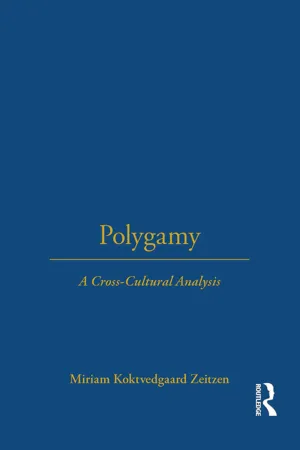
Forms of plural marriage, or polygamy, are practiced within most of the world's cultures and religions. The amazing variation, versatility and adaptability of polygamy underscore that it is not just an exotic non-Western practice, but also exists in modern Western societies. Polygamy: A Cross-cultural Analysis provides an examination and analysis of historical and contemporary polygamy. It outlines polygamy's place in anthropological theory and its rich sociocultural diversity in countries ranging from the USA and UK to Malaysia, India, regions of Africa and Tibet. Polygamy also addresses often difficult and controversial issues facing modern polygamists, such as prejudice, HIV/AIDS and women's emancipation. Polygamy: A Cross-cultural Analysis offers an anthropological overview of the fascinating yet often misunderstood institution of polygamy.
Information
Part I
Defining Polygamy
– 1 –
Forms of Polygamy
Introduction
Aims
This book is an ethnography of polygamy with a cross-cultural scope. Polygamy is the practice whereby a person is married to more than one spouse at the same time, as opposed to monogamy, where a person has only one spouse at a time. In principle, there are three forms of polygamy: polygyny, in which one man is married to several wives; polyandry, where one woman is married to several husbands; and group marriage, in which several husbands are married to several wives, i.e. some combination of polygyny and polyandry. This broad definition is based on the etymology of the word polygamy, which contains polys (= many) and gamos (= marriage). Polygamy literally means ‘often married’ in Late Greek.
During the Winter Olympics at Salt Lake City, UT, in 2002, Mormon polygamy grabbed the headlines because an advertising campaign for a new beer named Polygamy Porter had offended members of the Mormon faith. In the state of Utah, in Southwest USA, 70 per cent of the population are Mormon, and officially monogamous. But the Wasatch Beers Company played on deep-seated American stereotypes linking Mormons with polygamy to promote its new product. The beer label featured a man with several women along with the inscription ‘Why have just one’. The advertising slogan urged buyers to bring some home ‘for the wives’. Mormons were not amused, but the brewery countered that since the Mormon Church is officially against polygamy, it had not anticipated that the campaign would offend. It had been more concerned about the risk of targeting minors, since ‘so many polygamists marry under-age girls’, a barbed reference to arrests of Mormons accused of marrying and having sexual relations with very young girls.1 The furore over the beer illustrates the peculiar circumstances surrounding contemporary Mormon polygamy: officially banned by the Mormon Church, but still practised by small groups of Mormon fundamentalists, and thus still associated with Mormonism by the American public. The fact that Mormons reacted angrily to the commercial reinforced non-Mormon beliefs that Mormons still endorse polygamy even though it is illegal, whereas mainstream Mormons felt targeted once more by a resentful American public who will not acknowledge that Mormons have rejected the practice over 100 years ago.
The beer incident underscores that polygamy is not an exotic non-Western custom, practised by people who have not yet entered the modern world. Polygamy is worldwide, cross-cultural in its scope, it is found on all continents and among adherents of all world religions. Its practitioners range from modern feminists to traditional patriarchs, illustrating the great versatility of polygamy as a kinship system. An overview of the many peoples practising polygamy, in contemporary as in past societies, illustrate that a majority of the world’s cultures and religions have condoned some form of polygamy. For many of the societies described here, polygamy used to be an integral part of their kinship systems, but modern times have brought a streamlining of marriage patterns to all societies around the world. The spread of Christianity and European-based legal codes through colonialism, and the imposition of state laws on aboriginal peoples living within the borders of modern nation-states, have spelt the end of polygamy for many people. The Arctic Inuit (Eskimo), for example, practised polygamy in the recent past, as described in older ethnographic literature; if still practised, it may be in clandestine or irregular ways. This is the case for numerous populations that used to practise polygamy, but have now become integrated in the global community where monogamy dominates.
There are few books dealing exclusively with polygamy, and they are mostly concerned with polyandry in the Himalayas or Mormon polygyny in the USA. The more numerous articles tend to focus on Africa, the world region with the highest prevalence of polygamy. Polygamous practices in Africa are perhaps better described and analysed than anywhere else in the world. Africa is where much of the early anthropological scholarship was developed, and a practice as alien as polygamy was inherently interesting to Western observers. The resilient polygamy–Africa equation thus came into being. Those untroubled by anthropological wisdom may have some vague image of a polygamist as an old African chief surrounded by numerous wives servicing his every need. Those with some anthropological exposure might have read such classic ethnographies as Rebecca Reyher’s wonderful Zulu Woman (1948) or Mary Smith’s Baba of Karo (1953), confirming their views that polygamy was and is an African institution. As this book will hopefully show, polygamy is so much more than an exotic African custom. Africa remains synonymous with polygamy, nonetheless, a treasure trove of ethnographic information, which will be used prodigiously throughout this book.
It should be noted that many of the book’s descriptions of polygamous practices are based on old ethnographies, requiring the usual ‘suspended ethnographic reality’. For example, the Mende people of Sierra Leone lived through a brutal civil war in the 1990s, which undoubtedly influenced their polygamous patterns. Those patterns are here described as they were in the pre-1990s, however, because most of the available Mende research was carried out prior to this period (e.g. Crosby 1937; Little 1951; Bledsoe 1990).
A further point is that the study of polygamy in Africa has often been biased by Western perceptions of African society and matrimonial arrangements (Clignet and Sween 1981: 467). ‘Most Whitemen see polygamy as an attribute of primitiveness, and they think that the African cannot really attain civilization unless he has discontinued polygamy and adopted monogamy’ (Maillu 1988: 1). Western research agendas informed by such (subconscious?) views may as a result linger between contradictory concerns of nostalgia for traditional African culture versus critique of polygamy as oppressive to women or detrimental to development. Such conflictual views of polygamy appear to have been internalized by Africans themselves. Many Africans (and other peoples practising polygamy) now consider polygamy less socially, morally and culturally legitimate than monogamy, in line with Western views. This tends to make polygamous practices ethnographically ‘invisible’, making studies of polygamy increasingly difficult in many societies. Men will present their official wife to the world (and the researcher) and ‘hide’ their other wife. It comes back to the anthropological truism that what is legal, and is advocated as the ideal or the right way with respect to marriage, does not necessarily represent the reality people practise.
A study of polygamy in contemporary societies must not only grapple with the practical problem of identifying such ‘irregular’ and perhaps ‘invisible’ unions. It must also grapple with a theoretical problem that has existed since the earliest attempts at anthropological analysis of polygamy, namely its definition. In China, as well as among diaspora Chinese worldwide, it is customary for rich men to have more than one wife. With the advent of marriage laws abolishing polygamy in most countries where it used to be practised (including China), the practice did not disappear, but simply took another form. According to state laws a Chinese man can only be married to one wife, but he may then ‘marry’ a second wife by performing a ceremony according to customary laws. But is the couple in fact married if the state legal system says they are not? If the marriage is not socially accepted, then the second ‘wife’ is only a concubine, and it is not polygamy. If it is socially accepted as a marriage because the man has a committed, long-term relationship with, and maintains, the second ‘wife’, as well as acknowledges paternity of the children born, then it may be called de facto polygamy (see below). The definition of polygamy in other words hinges on the definition of marriage, and there is no consensus in anthropology about what exactly marriage is.
This definitional challenge is further complicated by the vast variety of polygamous systems cross-culturally, many of which are borderline cases and hence difficult to categorize. Australian Aborigines in the Northwest Territory, for example, practised a diffuse form of polygamy, in which polygamous males would ‘lend’ wives to younger men or ignore their wives’ adultery. In doing so, senior men could create political ties with ‘brothers’ who might otherwise become their enemies in their competition for wives. Similarly among the Arctic Inuit, polygamous males would ‘lend’ wives to other men. It is difficult, however, to define a system as polygamous in which wife-sharing is common, because the line between ‘marriage’ and a woman’s extension of sexual services to men other than her official husband is blurred.
The book will therefore deal not only with the three main forms of polygamy – polygyny, polyandry and group marriage – but with the endless variations on the polygamous theme that exist in matrimonial systems across the world as well. Theoretical considerations form a natural part of the ethnographic analysis, ranging from an examination of the foundations of modern anthropological theory regarding polygamy to addressing contemporary concerns facing modern polygamists such as Westernization, HIV/AIDS and women’s emancipation. Polygamy is faced by numerous economic, sociocultural and political challenges wherever it is practised today. At issue is polygamy’s survival as an institution in a world where monogamy is dominant. Thus, one effect of globalization, and its concomitant sociocultural streamlining of the world’s societies, has been the emergence or reinforcement of internal opposition to polygamy even in societies where it has formed part of the cultural repertoire for generations. In traditionally polygamous non-Western societies, where such ‘modern’ factors as economic progress and women’s emancipation have challenged polygamous practices, these practices have not disappeared, however. Rather, they have adapted to the new circumstances, perpetuating old ways in new forms. In monogamous Western societies, contemporary individualistic culture and lifestyle choices are used a basis for promoting polygamous practices by some segments of the populations. The various polygamous forms that exist today encourage research outside traditional polygamous homelands to include new grounds, not least by following the slipstream of the modern world’s migrating peoples. Polygamy has become part of the social and political discourse in contemporary societies.
The aim of the book is thus to give readers a general understanding of polygamy, its forms, foundations and functions, as well as providing insights into polygamous patterns and practices in contemporary societies. This cross-cultural examination of polygamy ultimately aims to illustrate that a majority of the world’s cultures have some form of polygamous practice and to demystify it as an exotic non-Western practice into one found also in Western societies.
Outline
The book contains nine chapters divided into three parts. Part I, containing chapters 1–3, is an examination of the forms and foundations of polygamy. It seeks to define polygamy and polygamous society, as well as examines polygamy in anthropological theory. First, it seeks to establish the parameters that would allow researchers to differentiate between various forms of polygynous and polyandrous systems. An important variation in polygamous practices concerns formal or legal polygamy versus informal or illegal polygamy. Today, many countries have banned polygamy, but because it remains culturally entrenched, people continue to practise it informally. Another fundamental distinction concerns polygamy based on religious doctrine versus polygamy based on cultural practice. Particular attention is therefore paid to polygamy’s place in the major religions, as well as the cultural foundations of polygamy. American Mormons are a contemporary example of people practising polygyny despite its illegality. Christian polygamy is probably the most alien form of polygamy to Western observers: a majority of Westerners will share some religious and cultural understanding with the polygamists, but are conditioned to think of monogamous marriage as the only acceptable form. In the USA, the surrounding Christian populations reject polygamy, both as a marriage form and a religious right. This is quite different from other Christian populations who have polygamists in their midst. In West Africa, for example, polygyny is a traditional cultural custom that is independent of the religion practised by the polygynist, inasmuch as Christians, Muslims, followers of native religions and others practise it. Polygyny in West Africa is thus an accepted part of local culture and kinship systems, though not necessarily accepted by Church or State. In the USA, in contrast, polygyny is a religiously based custom practised by a very small subset of a religious minority, the Mormons, which enjoys no support from the majority population.
Second, Part I outlines the main anthropological theories concerning the foundations of polygamous practice. Early theorists worked on kinship systems in order to trace the development of human culture. Polygamy formed an integral part of their theories that humanity had in its early stages of cultural evolution gone through various developmental phases, and ideas about ‘primitive man’ and his polygamous tendencies influenced the formulation of early anthropological theories of man, kinship and culture. Modern anthropological explanations fall, with some overlap and variation, into two main groups, focusing on production and reproduction versus power, politics and prestige. On some level, they cannot be differentiated, because any particular polygamous system will probably contain elements of all those aspects of polygamy. Production and reproduction are intimately linked in many polygamous systems, just as polygyny may confer prestige precisely because it confers political power. The explanations are not meant to be mutually exclusive, but rather to highlight those aspects of polygamous systems which anthropologists have found important in understanding polygamy.
Part II, containing chapters 4–6, deals with polygamy cross-culturally and provides selected ethnographic examples of polygamy: Muslim polygyny in Malaysia, Christian polygyny in the USA and Hindu polyandry in India. For each ethnographic example provided, patterns of polygamous marriage, family life, sex life and social life are examined. Examining each population through the same set of parameters will help the reader compare and contrast the great variety of polygamous arrangements that exist worldwide.
Part III, containing chapters 7–9, deals with polygamy in contemporary societies. It expands on the theoretical and ethnographic overview of polygamy given in parts I and II by moving the analysis to polygamy’s place in contemporary societies. Polygamy as it relates to gender and modernity is examined, involving such elements as female emancipation, economic development and cultural globalization. Finally, the future of polygamy is discussed, with particular emphasis on the contemporary cultural and legal challenges facing polygamists.
Polygamy is, by its very nature, a gender issue. It is important to address the gender dimensions of polygamy because of its inherent gender asymmetry; the fact that one man can be married to several women but one woman can only be married to one man, or vice versa, paves the way for potential conflict between the sexes. In polygamous societies that have seen the emancipation of women through education and economic opportunities, polygamy’s creation of inequality and power differentials has become a key aspect of contemporary gender relations. The ‘threat of polygamy’, the possibility that their present or future husband might take another wife, is influencing women’s perception and management of relationships, marriage and family life. In a polygamous society, it may on some level be wrong to call any marriage monogamous because all marriages are potentially polygamous, and both men and women organize their relationships on this assumption. This in turn has a profound effect on gender relations both inside and outside marriage. Particular attention is therefore paid to power relations between husbands and wives as well as gender-based status differentials in polygamy. A key theme within a gender-based examination of polygamy is the notion that polygyny subjugates women, and the associated idea that economic development and women’s emancipation will undermine and eventually eradicate polygyny.
Like gender, modernity is a crucial determinant of contemporary polygamous systems, their future form and function. There is a widespread notion, in Western as well as non-Western minds, that modernity will make the ‘traditional’ practice of polygamy disappear. It appears to go against modern ideas of nuclear families as espoused in most state development and population policies. Particularly in urban areas, people feel that being monogamous projects a more modern image. Urban areas also cannot provide the same socio-economic foundations for polygamy as rural areas. As women become more emancipated, better educated and increasingly independent socially and economically from their families and husbands, polygamy is seen by many as a form of ‘development reversal’, a wrong direction to take with respect to gender relations. In urban areas, however, a reinvention and adaptation of traditional ways to modern conditions has given new life to polygamy, which appears to be increasing rather than disappearing. In urban Ghana, for example, sugar daddies (de facto polygynous husbands) and gold-diggers (their de facto polygynous wives) redefine polygamy, both as a theoretical concept and as a practical lived institution. For many urban Ghanaians, to be polygamous is to be modern.
Forms of Polygamy
Polygyny
Polygyny is a form of plural marriage in which a man is permitted more than one wife. Where co-wives are customarily sisters this is called sororal polygyny. The other main form is non-sororal polygyny, where co-wives are not related. Polygynous marriage is generally correlated with those economic and political systems where the most important resources are human resources. Polygyny allows a man to have more children, providing him with a broader productive base, as he controls the labour of his wives and children to a large extent. It also provides him with more affines,2 permitting him to manipulate factional and/or kin group ties to his advantage. In some societies, polygyny may be the exclusive privilege of leaders or chiefs; an Amazonian Indian leader’s multiple wives are both a sign of his power and an important element in building up and maintaining his power base, for example. Polygyny is often associated with age asymmetry in the marriage relationship, such that older men marry young girls, and younger men are obligated to remain celibate for extended periods, or alternatively marry widows of older men. Polygyny may in such cases be interpreted as part of the age-gender stratification, where older men control human resources and thus control the productive and reproductive resources in a society. Where resources such as land or other forms of private property predominate, like in Western societies, monogamous nuclear family forms tend to be the rule (Seymour-Smith 1986: 228). Polygyny does exist in Western capitalist societies, but then always as a result of religious doctrine. A contemporary example is American Mormons who practise Plural Marriage, a form of polygyny associated with the nineteenth-century Mormon Church and its present-day splinter groups (see Chapter...
Table of contents
- Cover
- Half Title
- Title Page
- Copyright Page
- Contents
- Part I Defining Polygamy
- Part II Polygamy Cross-culturally
- Part III Living Polygamy
- Notes
- References
- Ethnographic Index
- Subject Index
Trusted by 375,005 students
Access to over 1.5 million titles for a fair monthly price.
Study more efficiently using our study tools.
Frequently asked questions
Yes, you can cancel anytime from the Subscription tab in your account settings on the Perlego website. Your subscription will stay active until the end of your current billing period. Learn how to cancel your subscription
No, books cannot be downloaded as external files, such as PDFs, for use outside of Perlego. However, you can download books within the Perlego app for offline reading on mobile or tablet. Learn how to download books offline
Perlego offers two plans: Essential and Complete
- Essential is ideal for learners and professionals who enjoy exploring a wide range of subjects. Access the Essential Library with 800,000+ trusted titles and best-sellers across business, personal growth, and the humanities. Includes unlimited reading time and Standard Read Aloud voice.
- Complete: Perfect for advanced learners and researchers needing full, unrestricted access. Unlock 1.5M+ books across hundreds of subjects, including academic and specialized titles. The Complete Plan also includes advanced features like Premium Read Aloud and Research Assistant.
We are an online textbook subscription service, where you can get access to an entire online library for less than the price of a single book per month. With over 1.5 million books across 990+ topics, we’ve got you covered! Learn about our mission
Look out for the read-aloud symbol on your next book to see if you can listen to it. The read-aloud tool reads text aloud for you, highlighting the text as it is being read. You can pause it, speed it up and slow it down. Learn more about Read Aloud
Yes! You can use the Perlego app on both iOS and Android devices to read anytime, anywhere — even offline. Perfect for commutes or when you’re on the go.
Please note we cannot support devices running on iOS 13 and Android 7 or earlier. Learn more about using the app
Please note we cannot support devices running on iOS 13 and Android 7 or earlier. Learn more about using the app
Yes, you can access Polygamy by Miriam Koktvedgaard Zeitzen in PDF and/or ePUB format, as well as other popular books in Social Sciences & Anthropology. We have over 1.5 million books available in our catalogue for you to explore.