- 336 pages
- English
- ePUB (mobile friendly)
- Available on iOS & Android
eBook - ePub
About this book
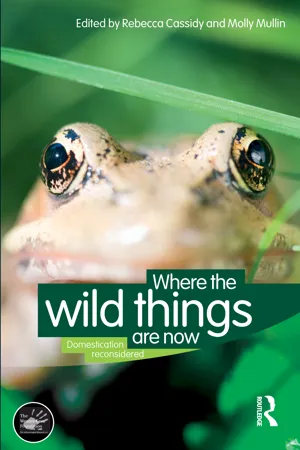
Domestication has often seemed a matter of the distant past, a series of distinct events involving humans and other species that took place long ago. Today, as genetic manipulation continues to break new barriers in scientific and medical research, we appear to be entering an age of biological control. Are we also writing a new chapter in the history of domestication? Where the Wild Things Are Now explores the relevance of domestication for anthropologists and scholars in related fields who are concerned with understanding ongoing change in processes affecting humans as well as other species. From the pet food industry and its critics to salmon farming in Tasmania, the protection of endangered species in Vietnam and the pigeon fanciers who influenced Darwin, Where the Wild Things Are Now provides an urgently needed re-examination of the concept of domestication against the shifting background of relationships between humans, animals and plants.
Information
one The Domestication of Anthropology
Nerissa Russell
In July 2004, Bleda Düring called me to the building he was excavating at Çatalhöyük, a large Neolithic site in central Anatolia (Turkey). While working on a burial pit, he encountered a closely grouped set of sheep’s feet, pointing straight up. Together, we excavated what turned out to be the first animal burial at Çatalhöyük: a lamb, lying next to a human skeleton but separated from it by the remains of a mat or blanket that lay over the human and under the lamb (Russell and Düring in press). The lamb lay on its side, with its legs pulled awkwardly straight up, as they must have been carefully held while the pit was filled, perhaps to prevent them from falling across the human body. The intimacy and ambivalence evident in this burial makes the human-animal relationship preserved in this grave hard to label. The lamb’s young age (ca. 12 months) prevents an assessment of its morphological domestication, but because the vast majority of the sheep at Çatalhöyük are domestic, this one probably came from someone’s flock. None of the other numerous sheep at the site ended up intact in a grave. Why would a pet be so carefully held away from its owner? The enigma posed by this strangely positioned animal encapsulates the multiplicity of relations included under the rubric of domestication.
My purpose in this chapter is to explore some of the uses of the concept of “domestication” in anthropology and archaeology, to point out some of the difficulties of the concept, and to suggest how these very ambiguities can provide fertile ground for future work. Although I will discuss a number of different applications of “domestication,” I focus mainly on animal domestication. This is both closer to my own expertise and arguably the arena in which the definition of “domestication” has been most problematic.
For the most part, the concept of domestication has been applied within anthropology to the domestication of plants and animals. Decades of discussion have shown that this is not a simple concept, at least as applied to animals. Many anthropologists have found that biological definitions of animal domestication, drawn from other disciplines, inadequately describe the phenomenon of husbandry. They have tended instead to emphasize social–legal (property rights) aspects, or psychological (domination) factors. The form of biological definition that has found the most favor with anthropologists (chiefly archaeologists) is domestication as symbiosis. At present, the major locus of debate is whether domestication is best understood as symbiosis or a change in social relations.
Meanwhile, in recent decades there has been an increasing tendency to use “domestication” in a broader sense, both beyond but especially within anthropology. These applications play on one or the other of two senses of “domestication”: as equivalent to “taming” (although most who address animal domestication in fact distinguish between these two concepts), or drawing on the original roots of the word, referring to the house or household (i.e., playing on the dual sense of “domestic”). An exception is “domiculture,” which retains the original biologically based sense of domestication as control but applies it to the environment at large rather than individual plant and animal species (Chase 1989). Although rare or absent in anthropology, in other disciplines “domestication” is occasionally also used in a sense opposing “domestic” to “foreign,” as in “the domestication of industry.”
The concept and study of domestication has already provided fertile ground for communication and collaboration across disciplinary and subdisciplinary boundaries. In general, archaeologists and biologists and animal scientists find common ground in exploring the biological aspects of domestication. Biologists, archaeologists, and biological anthropologists could fruitfully explore further the similarities between the physical changes of domestication and those seen in human evolution, notably neoteny (Coppinger and Smith 1983; Leach 2003). Sociocultural anthropologists and archaeologists have already joined in the consideration of the social and cultural dimensions of animal domestication. This could usefully be pushed further through analysis of animal domestication as a form of kinship. The broadening use of domestication suggests that many disciplines and subdisciplines could benefit from the work on domestication by others. However, it is also necessary to be explicit about the meaning of “domestication” in each case, and to be precise about which aspects of this multifarious concept are invoked. I propose that approaching the topic in terms of the specific practices of domestication at work in each case will aid in bringing together these various approaches.
The Anthropology of Domestication: A Very Brief History
Although there are earlier discussions, serious studies of plant and animal domestication begin to appear in the second half of the 19th century (e.g., Candolle 1885; Darwin 1868; Galton 1865; Geoffroy Saint-Hilaire 1861; Hahn 1896; Roth 1887). At that point they are based on speculation, textual sources that we now know to be many millennia too late to be useful, and observations of contemporary plants and animals. These accounts tend to be cast in terms of glorious human progress, with humans consciously taking control of animal species. After proposing that plants were domesticated by women, Mason (1966/1895: 258–260), in a chapter entitled War on the Animal Kingdom, gives the following account of animal domestication (condensed here):
In his contact with the animal kingdom, the primitive man developed both militancy and industrialism. He occupies two attitudes in the view of the student, that of a slayer, and that of a captor and tamer. . . . It is important to ask how our species came to be masters of the brute kingdom, and what intellectual advantages were gained in the struggle. . . . By and by they turned the artillery of Nature on herself. The dog raised a flag of truce and came in to join the hosts of man against the rest. The mountain sheep and the wild goat descended from their rocky fortresses, gave up the contest, and surrendered skins and fleece and flesh and milk to clothe and feed the inventor of the fatal arrow. . . . Those that refused to enter in any way into these stipulations are doomed sooner or later to extinction, and many species have already disappeared or withdrawn to the waste places of earth in despair.
With the exception of Pumpelly’s (1908) innovative work at Anau in the early 20th century (also now known to involve societies much later than the earliest farmers), there was little archaeological evidence to address plant and animal domestication until after 1950. Notably, the work of Braidwood (Braidwood and Howe 1960) in the Near East and MacNeish (Byers 1967) in Mesoamerica began to provide some direct information on the processes of domestication. The need to identify the beginnings of plant and animal domestication stimulated attention to the nature of this process, first by natural scientists collaborating with archaeologists (e.g., Bökönyi 1969; Ducos 1969; Harlan 1967; Mangelsdorf 1958; Reed 1961; Zeuner 1963), and later by archaeologists specializing in the study of plant and animal remains (e.g., Flannery 1969; Hecker 1982; Jarman 1977; Meadow 1983). Probably in response to these discussions, sociocultural anthropologists have also offered perspectives on the nature and origin of domestication (e.g., Alexander 1969; Haudricourt 1962; Ingold 1980; Sigaut 1980).
Definitions
I have discussed varying definitions of animal domestication and their implications elsewhere (Russell 2002), and will only summarize briefly here. Domestication is difficult to pin down, partly because it involves both biological processes of alteration to organisms and social and cultural changes in both humans and animals. Additionally, a wide range of human–animal relationships is included, at least by some, in the rubric of domestication. It is not easy to find a meaningful definition that includes barnyard animals, ranched livestock, pets, animals such as honeybees (but also pigs in some New Guinea societies) that until recently were routinely captured from the wild and never bred in captivity, tuna confined outside the Straits of Gibraltar and fed with herring imported from the North Sea (Bestor 2001), laboratory mice (Rader this volume), and urban pigeons (Feeley-Harnik this volume) yet excludes wildlife culled or even managed through birth control, restored through captive breeding programs, or held and often bred in zoos (Suzuki this volume). Some of these problems arise through casting definitions in dichotomous terms: “wild” or “domestic.” Although some (e.g., Jarman 1977) solve this by arranging human–animal relationships in a continuum of control from random predation to factory farming (or today direct genetic manipulation), I find it more fruitful to think in terms of a spectrum of different kinds of relationships. Pets, for example, can be members of either wild or domestic species and represent a fundamentally different relationship from livestock.
Definitions of domestication generally stress either the biological or the social aspects. Those from zoological and animal science backgrounds (e.g., Bökönyi 1989; Clutton-Brock 1994) have tended to stress control of breeding, in particular, along with control of feeding and movement. It is control of breeding that produces biological changes observed in domestic organisms. It must be stressed that control of breeding does not necessarily mean deliberate selective breeding, although this tends to be viewed as the fullest expression of domestication, but in essence refers to practices that lead to genetic isolation from the wild population. Indeed, recent work increasingly tends to view early changes in plants and animals as adaptations to the conditions of cultivation and herding rather than the results of human selection (e.g., Crockford 2000; Harlan 1995: 30–39; Hillman and Davies 1999; Price 2002: 10–11; Zohary, Tchernov, and Horwitz 1998). Given this, some have sought to remove intentionality entirely from the domestication process, characterizing it as an instance of symbiosis or coevolution (e.g., Leach this volume; O’Connor 1997; Rindos 1984). Although this term has not yet entered the archaeological literature, the currently popular ecological concept of “facilitation” may be even more appropriate (Fuentes this volume).
Although coevolutionary models are embraced by many archaeologists, other archaeologists and anthropologists, with their focus on the human end of domestication, have emphasized the social aspects in their definitions. Here, the transformation of animals into property is generally seen as the key to domestication, and as initiating profound changes in both human–human and human–animal relations (e.g., Ducos 1978; Ingold 1980). Suzuki’s (this volume) proposal that designated game animals are domestic in the eyes of the state (because they are appropriated as property) while wild in the eyes of the individual takes this in a fruitful direction that helps to resolve some of the difficulties of a simplistic wild–domestic dichotomy. Some sociocultural anthropologists have examined the psychological underpinnings of domestication (e.g., Digard 1990), stressing human domination as the motivating factor for animal domestication, an argument that has been taken up by some archaeologists (Cauvin 1994; Hodder 1987).
Domestication Beyond Plants and Animals
“Domestication” is thus a multifarious concept as applied to plants and animals, where “domestic” is opposed to “wild.” It becomes more so thanks to the trend in the last 25 years or so to apply the term to other spheres of human activity, particularly within anthropology. The pioneer in this regard appears to be Jack Goody (1977), whose title The Domestication of the Savage Mind plays off Lévi-Strauss’s (1966) The Savage Mind to cast writing metaphorically as a taming influence, transforming human thought. This sense of domestication as metaphorical taming is followed by other authors. Interestingly, those who study animal domestication generally distinguish between taming and domestication with “taming” referring to a relationship between an individual animal and an individual human whereas “domestication” involves populations and successive generations. This distinction goes back at least as far as the mid–19th century (Geoffroy Saint-Hilaire 1861). Taming is a necessary precursor to domestication but does not inevitably lead to it. However, when applied to aspects of human life, this distinction is lost.
Wilson (1988, this volume) played on the major significance attached to plant and animal domestication (the Neolithic Revolution) in the evolution of human societies (domestic as not wild), while primarily referring back to the etymological roots of “domestication” (domus, the house or household in Latin), in arguing that substantial architecture was more important than the origins of agriculture for human societies in The Domestication of the Human Species (domestic as not public).
Outside of anthropology, domestication applied to humans almost always harkens back to an earlier meaning: “to habituate to home life” (Webster 1913: 444) and to feminize (containing senses of domestic as not public, not male, and not wild or out of control). This usage has boomed beginning in the 1990s. Third-wave feminists are reclaiming this older meaning as they explore gender issues in various contexts, usually prior to or outside of...
Table of contents
- Cover
- Half Title
- Series Page
- Title Page
- Copyright Page
- Dedication
- Contents
- Acknowledgements
- List of Figures
- Participants in the Wenner-Gren Foundation International Symposium "Where the Wild Things Are Now"
- Introduction: Domestication Reconsidered
- 1 The Domestication of Anthropology
- 2 Animal Interface: The Generosity of Domestication
- 3 Selection and the Unforeseen Consequences of Domestication
- 4 Agriculture or Architecture? The Beginnings of Domestication
- 5 Monkey and Human Interconnections: The Wild, the Captive, and the In-between
- 6 "An Experiment on a Gigantic Scale": Darwin and the Domestication of Pigeons
- 7 The Metaphor of Domestication in Genetics
- 8 Domestication "Downunder": Atlantic Salmon Farming in Tasmania
- 9 Putting the Lion out at Night: Domestication and the Taming of the Wild
- 10 Of Rice, Mammals, and Men: The Politics of "Wild" and "Domesticated" Species in Vietnam
- 11 Feeding the Animals
- Index
Trusted by 375,005 students
Access to over 1.5 million titles for a fair monthly price.
Study more efficiently using our study tools.
Frequently asked questions
Yes, you can cancel anytime from the Subscription tab in your account settings on the Perlego website. Your subscription will stay active until the end of your current billing period. Learn how to cancel your subscription
No, books cannot be downloaded as external files, such as PDFs, for use outside of Perlego. However, you can download books within the Perlego app for offline reading on mobile or tablet. Learn how to download books offline
Perlego offers two plans: Essential and Complete
- Essential is ideal for learners and professionals who enjoy exploring a wide range of subjects. Access the Essential Library with 800,000+ trusted titles and best-sellers across business, personal growth, and the humanities. Includes unlimited reading time and Standard Read Aloud voice.
- Complete: Perfect for advanced learners and researchers needing full, unrestricted access. Unlock 1.5M+ books across hundreds of subjects, including academic and specialized titles. The Complete Plan also includes advanced features like Premium Read Aloud and Research Assistant.
We are an online textbook subscription service, where you can get access to an entire online library for less than the price of a single book per month. With over 1.5 million books across 990+ topics, we’ve got you covered! Learn about our mission
Look out for the read-aloud symbol on your next book to see if you can listen to it. The read-aloud tool reads text aloud for you, highlighting the text as it is being read. You can pause it, speed it up and slow it down. Learn more about Read Aloud
Yes! You can use the Perlego app on both iOS and Android devices to read anytime, anywhere — even offline. Perfect for commutes or when you’re on the go.
Please note we cannot support devices running on iOS 13 and Android 7 or earlier. Learn more about using the app
Please note we cannot support devices running on iOS 13 and Android 7 or earlier. Learn more about using the app
Yes, you can access Where the Wild Things Are Now by Rebecca Cassidy,Molly Mullin in PDF and/or ePUB format, as well as other popular books in Social Sciences & Zoology. We have over 1.5 million books available in our catalogue for you to explore.