Smooth Sailing enhances our understanding of the family's transition through adolescence by examining qualitative data about the experiences of parents and teens across multiple relationships and social contexts. This volume follows the same 60 families described in the authors' first book, Becoming a Family (2000), relating their stories about their transition from childhood to adolescence. Collectively, the two books provide a unique longitudinal perspective on family development using two distinct data collection formats and time frames. Interdisciplinary in nature, the book draws on theory and practice from the fields of social work, psychology, and sociology.
Smooth Sailing reveals a picture of the transition to adolescence as it is influenced by intrafamily relationships as well as social context factors. Initial chapters lay the foundation for the study's methods. Proceeding chapters present the participants' stories, organized by context - developmental changes, interpersonal relationships, education, and work. Each chapter follows a similar format: an overview of past research; interview and coding techniques; and a presentation of parents' and teens' qualitative descriptions. Chapters also include an analysis of gender and conclude with implications for practice and policy. The final chapter in the book summarizes this work and looks ahead to the next developmental period, emerging adulthood.
Intended for researchers in a variety of disciplines such as social work, psychology, and sociology, this volume also serves as a supplementary text for courses on the family and/or adolescent development.
Checking the Compass: Looking at the Family Inside and Out
Adolescence is typically portrayed as a time of “storm and stress,” both for the individual adolescent and for his/her family. Much has been written about the influenee of hormones and peer groups during this developmental period (e.g., Steinberg & Levine, 1990), about relationships with parents (e.g., Luster & Okagaki, 1993), and about the need to “separate and individuate” (Erikson, 1982). Few, however, consider the multiple influences on the kind of transition that adolescents and their families experience. The data analyzed for this book present a picture of the transition to adolescence as it is influenced bidirectionally inside the family through parental and sibling relationships, and outside the family through relationships with a variety of systems including extended family, peers, school, and work.
As we showed in our first book, Becoming a Family, the movement from young adulthood, through partnering, and the transition to parenthood may be among the most universal adult developmental transitions. The transition from childhood through adolescence to adulthood, however, is not only universal, but is seen as perhaps the most crucial that we each undergo. This transition impacts not only each individual, but the entire familial and ecological system with which individuals interact, thus existing at the interface of individual and family systems models of understanding behavior (Goldberg, 1988). To really understand this developmental life transition, each person should be viewed both from an individual psychological perspective and within his/her own family system, with all its powers to mold and influence attitudes, values, and behavior, and to be influenced in its turn by the changes its members experience.
Once again, we have gone to the “source” to explore this developmental stage, from the perspectives of the adolescents themselves, and their parents. The qualitative methodology, described in chapter 2, allowed us to inquire about the inner subjective perceptions of self from the perspective of each individual (Borden, 1992). Through the use of a structured narrative tool, the study participants were able to define their lives, relationships, and experiences, sharing interpretive sys-terns for explaining themselves in relation to the world as they move through the life span in their ecological environments (Laird, 1989).
Progress in the use of a narrative method as a tool for exploring the subjective nature of individual and family life transitions has occurred within the context of the “new epistemology” and of the constructivist movement in family research. This signifies a movement away from the traditional positivistic approach and from standard notions of family structure and functioning, from the search for “truth” to a search for meaning, and toward new ways of comprehending how families construct their worlds (Laird, 1989). One of the richest sources of meaning lies in the narratives through which individuals and families explain themselves, their thinking, and their behavior. Within family narratives are indicators of individual and family identity, as well as descriptions of connections to others.
Fiese and Sameroff (1999) report that there has been an increase in the study of narratives, particularly as a way to glimpse an individual’s thought processes and how they put together pieces of their life story. There has been less work done on using narratives with families as a whole. This, they suggest, would “move beyond the individual and deal with how the family makes sense of its world, expresses rules of interaction, and creates beliefs about relationships” (p. 3). Further, it appears that “meaning-making” for a family may be related to adapting to stressful situations as well as to normal life transitions, such as the changes accompanying adolescent development.
The primary purpose of this book is to look at one of those “meaning-making” times, to explore the transition through adolescence, as experienced by the teens themselves, and by their families, in relationship with the rest of their social worlds. This exploration will enhance understanding of family-life development as we seek to give voice to the experiences of each generation, looking within and across families, as they transit through this important life stage. Sixty families, each with at least two children, who were part of a much larger longitudinal research project, were asked if they would be interested in participating in our first study where we gathered and analyzed their stories about becoming families. For this book, we recontacted those families, as described in chapter 2. It is their views of life, the strengths and struggles of adolescence, that we use to highlight issues that families deal with in the course of this family-life developmental transition.
The specific issues that are discussed in the book emerged through the process of qualitatively analyzing the expressions and explanations of the study participants. The first two chapters of the book place the stories in context, describing the theoretical foundation of the study and the methodology used in collecting and analyzing the data. Chapters 3 through 6 present particular issues and developmental themes that were important to different members in the family and include a review of seminal literature and participants’ comments and ideas about the topic.
Steinberg (1985) suggests that there are five key psychological issues in adolescence: identity, autonomy, intimacy, sexuality, and achievement, and these are certainly represented in these chapters. He also states that “development during adolescence is the result of an interplay among three fundamental forces—biological, cognitive, and social—and the context in which young people live” (p. 3). Each chapter sheds some light on these psychological issues and fundamental forces. We also explore relationship dynamics between family members, as well as individual and familial patterns of presenting the relationships within the family, looking at the consistency between how family members chose to graphically (that is, the types of lines they used) describe relationships and the words that they used in talking about those same relationships (Harold, Mercier, & Colarossi, 1997). In addition, each of these chapters includes some interpretations of the issues presented in a discussion of practice, policy, and research implications that are relevant to the topic. The final chapter summarizes the themes and issues that were important in the lives of our participants, and offers a developmental glimpse into the future.
Family
The first issue that must be addressed in any discussion of family development is what we mean by “family.” Despite the fact that in recent years, the definition of family has entered the arena of political debate, it has always been a concept that is somewhat difficult to pin down. White and Epston (1990) suggest that this is due to the many levels of analysis with which one can view the family. Thus, we can talk in terms of “a family"—a single group or organization; we can talk in terms of “families"—a population of such groups; or we can talk in terms of “the family"—a social institution. Elkind (1994) might say that the difficulty in defining family has to do with the fact that “the modern nuclear family, often idyllically portrayed as a refuge and a retreat from a demanding world, is fast disappearing. In its stead we now have a new structure—the postmodern permeable family—that mirrors the openness, complexity, and diversity of our contemporary lifestyles” (p. 1).
Today there are “traditional” (that is, heterosexual) two-parent nuclear families, multigenerational families, single-parent families, blended families, gay and lesbian families, extended families, families of choice, and so on. However, there is some consensus among family researchers that a necessary characteristic of a family is that it be intergenerational (White & Epston, 1990). According to this definition, the affinal relationship between two adults does not constitute a family. It is only when a child is brought into the adult dyad for long-term nurturing and socialization that a family is formed. Although we would argue for the broadest, most inclusive definition of family possible, and have done so in our earlier work (Harold, 2000), the families represented in this book all began as “traditional” intergenerational groups, and it is this particular relationship, that is, parent and adolescent children, on which we focus.
Adolescence
Steinberg (1985) tells us that the word adolescence comes from the Latin verb adolescere, meaning “to grow into adulthood” (p. 6). Although there may be culturai differences in how adolescence is defined, when it begins, and what markers are considered, adolescence is a time of coming of age, both literally (chronologically) and figuratively (the meaning we ascribe to this life passage) in all societies, a bridge or crossroads from being a child to being an adult (Nurmi, 2004). In considering the impact of the transition to adolescence on both the teen and the family as we are in this book, we include Steinberg and Levine’s (1990) advice to parents: “Your relationship with your child will not change for the worse in adolescence, but it will change” (p. 3) and that “friends don’t subtract from the adolescent’s affection for his [her] family but add to his [her] circle of significant others” (p. 4).
Adolescence is a developmental period when individuals are faced with many tasks that intersect and influence one another, for example, increased desire for autonomy, salience of identity issues, peer orientation, self-focus and self-consciousness, and a continuing need for a safe environment in which to explore autonomy and identity. Many factors make distinct and potent demands on adolescents. These include rapid biological changes associated with puberty, cognitive changes associated with more sophisticated thinking abilities, new psychosocial and sexual demands such as beginning intimate peer relationships, identity development, and changes in social roles that may bring with them such environmental transitions as movement into the work world and moving away from the family of origin. In addition, there are educational changes as teens enter middle and/or high school and legal changes as they attain certain statuses.
Theories have postulated that the stress of these demands produces vulnerability to mental health problems, and research studies have linked these changes, as well as other, more chronic social factors such as poverty and discrimination, to problems of low self-esteem, depression, and academic difficulties (Simmons & Blyth, 1987). An additional concern is the widening of sex differences during adolescence in the areas of mental health and academic achievement. Pipher (1994) writes, “Something dramatic happens to girls in early adolescence. Just as planes and ships disappear mysteriously into the Bermuda Triangle, so do the selves of girls go down in droves. They crash and burn in a social and developmental Bermuda Triangle” (p. 19). She suggests that there are three factors that account for vulnerability in adolescent girls: First, that fact that it is a developmental level where everything is changing; second, American cultural stereotypes such as body image and gender roles; and third, the expectation that girls will distance themselves from parents at a time when they need their support the most. Adolescence, Pipher says, is “a time for cutting bonds and breaking free” (p. 24).
There exists one real cure for adolescence, and only one, and this cannot be of interest to the boy or girl who is in the throes. The cure for adolescence belongs to the passage of time and to the gradual maturation processes; these together do in the end result in the emergence of the adult person. (Winnicott, 1965, p. 79)
Theoretical Models
Family Life Span Development
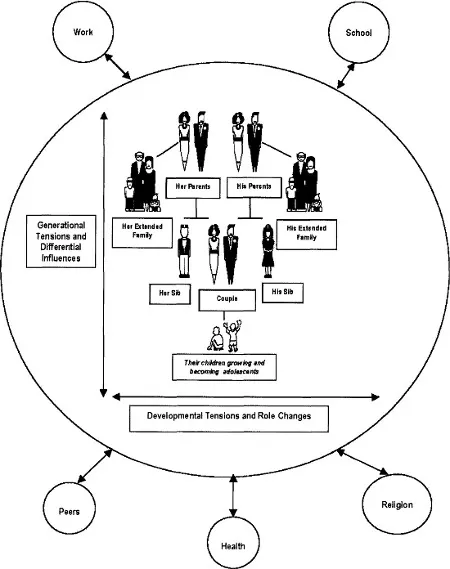
As in our earlier work, this book also has its underpinnings in three theories that can be used to interpret the data (see Fig. 1.1). For this book, however, the first two models can be seen as a backdrop for the third and most important model, which focuses on ecological systems. The first model draws on social and developmental psychological literature, including a model that considers family development across the life span, milestones or transitions in the life of the family, for example, a family life cycle, and the family’s internal processes (Carter & McGoldrick, 1988, 1988; Steinberg, 1985; Thomas, 2001; White & Klein, 2002).
Figure 1.1 Each child’s transition to adolescence both impacts and is impacted by the multigenerational interactions and dynamics in this depiction of a family as a three-generational system moving through time at the center of a larger ecological systems model where examples of outside systems impact and are impacted by the central family system.
This developmental lifespan/family life course development model includes a conceptualization of the nuclear family as a three-generational system that reacts to pressure from generational tensions as well as developmental transitions, depicting this interactive process with a vertical and horizontal axis in their model. It also considers that the family may have its own “adolescent” period, during which it may go through development stresses and strains that correspond to those of the adolescent member, and that threaten the family’s cohesiveness and primacy for its members.
In assessing families, Carter and McGoldrick (1988) incorporate activities of the entire three-generational system as it moves through time. Relationships with parents, siblings, and other family members go through stages as one moves along the life cycle. This is a useful framework to consider as we look at the impact of the transition to adolescence on the individual and his/her family, as well as looking at the impact of family life issues/events (e.g., birth, death, moving, divorce, going off to college) on the adolescent’s development and interactions with his/her family and social environment. The family life cycle, then, interacts with the individual members’ life cycles such that to understand the changes in relationships that occur during this transitional period, we must consider the adolescent’s development as well as that of his/her parents and the family. This model that looks across individuals and across time, also fits with the notion expressed by Fiese and Sameroff that “the process of creating family narratives and the themes inherent in the stories may be shared across generations, regulating family beliefs and interaction patterns” (1999, p. 3) over time.
Carter and McGoldrick (1988) do not consider the influence of the family to be restricted to the members of a particular household or to a given nuclear family branch of the system. Although they acknowledge the stere...
Table of contents
Cover
Half Title
Title Page
Copyright Page
Contents
Dedication
Preface
1 Checking the Compass: Looking at the Family Inside and Out
2 Navigating the Research Process: Methods and Processes
3 A Sea Change: Developmental Changes From Childhood to Adolescence
4 All Hands on Deck: Relationship Processes Within and Outside Families
5 Learning the Ropes: Education
6 Taking on Provisions: Work in the Lives of Families With Adolescents
7 Sailing Toward the Horizon: Moving Into Adulthood
References
Author Index
Subject Index
Trusted by 375,005 students
Access to over 1.5 million titles for a fair monthly price.
Study more efficiently using our study tools.
Frequently asked questions
Yes, you can cancel anytime from the Subscription tab in your account settings on the Perlego website. Your subscription will stay active until the end of your current billing period. Learn how to cancel your subscription
No, books cannot be downloaded as external files, such as PDFs, for use outside of Perlego. However, you can download books within the Perlego app for offline reading on mobile or tablet. Learn how to download books offline
Perlego offers two plans: Essential and Complete
Essential is ideal for learners and professionals who enjoy exploring a wide range of subjects. Access the Essential Library with 800,000+ trusted titles and best-sellers across business, personal growth, and the humanities. Includes unlimited reading time and Standard Read Aloud voice.
Complete: Perfect for advanced learners and researchers needing full, unrestricted access. Unlock 1.5M+ books across hundreds of subjects, including academic and specialized titles. The Complete Plan also includes advanced features like Premium Read Aloud and Research Assistant.
Both plans are available with monthly, semester, or annual billing cycles.
We are an online textbook subscription service, where you can get access to an entire online library for less than the price of a single book per month. With over 1.5 million books across 990+ topics, we’ve got you covered! Learn about our mission
Look out for the read-aloud symbol on your next book to see if you can listen to it. The read-aloud tool reads text aloud for you, highlighting the text as it is being read. You can pause it, speed it up and slow it down. Learn more about Read Aloud
Yes! You can use the Perlego app on both iOS and Android devices to read anytime, anywhere — even offline. Perfect for commutes or when you’re on the go. Please note we cannot support devices running on iOS 13 and Android 7 or earlier. Learn more about using the app
Yes, you can access Smooth Sailing or Stormy Waters? by Rena D. Harold,Lisa G. Colarossi,Lucy R. Mercier in PDF and/or ePUB format, as well as other popular books in Psychology & Developmental Psychology. We have over 1.5 million books available in our catalogue for you to explore.