eBook - ePub
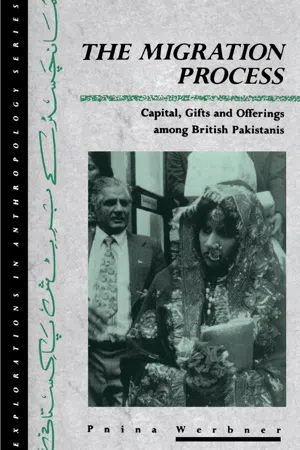
The Migration Process
Capital, Gifts and Offerings among British Pakistanis
- 400 pages
- English
- ePUB (mobile friendly)
- Available on iOS & Android
eBook - ePub
About this book
This study, which breaks new ground in urban research, is a comprehensive and definitive account of one of the many communities of South Asians to emerge throughout the Western industrial world since the Second World War - the British Pakistanis in Manchester. This book examines the cultural dimensions of immigrant entrepreneurship and the formation of an ethnic enclave community, and explores the structure and theory of urban ritual and its place within the immigrant gift economy.
Information
Part I
Capital Accumulation
Chapter 1
Chains of Migrants: Culture, Value and the Housing Market
In Manchester ... one grew accustomed to one's friends being Jews or Germans or both, or Armenians or Turks or both, but to be a Tory - now, that was the stigma of uncleaness. (R. Ryan, granddaughter of C.P. Scott, editor of the Manchester Guardian; cited in Kennedy 1970: 130).
Manchester: Growth and Decline
Manchester has been a city of immigrants since its emergence as a great industrial metropolis at the end of the eighteenth century. The industrial growth of the city and its prominence throughout the nineteenth century in the world cotton trade attracted to it many 'strangers' or 'foreigners': German merchants, Jewish tailors, Italian and Greek traders, Irish workers. Immigrants came to the city as pedlars and hawkers, traders and merchants.1 Often despised initially, they nevertheless came to play a major role in the industrial growth of the city. Immigrants not only built great warehouses, exporting cotton goods and machinery throughout the world, but also a city of culture and radicalism, bringing with them new ideas and founding such cultural landmarks as the Halle orchestra or the University. As a city in transition, nineteenth-century Manchester encapsulated the contradictions of its age: while ideas of liberalism pervaded the fight for free trade and abolition of the corn laws, nineteenth-century Manchester, with its squalor and poverty, was also a city renowned for its sordid slums. Engels, who recorded them for posterity, was himself a merchant of German origins. Because of its commanding industrial position in the North it was the seat of constant industrial ferment and many trade unions, indeed the trade union movement itself, were founded in Manchester. A long tradition of liberalism has made it a place where foreigners and immigrants, nonconformist and radicals, are familiar figures.
1. For the history of Manchester see Kennedy (1970), Shercliff (1960), Williams (1976), and Frangopulo (1962; especially 109-23).
Twentieth-century Manchester is still, perhaps, the most cosmopolitan northern provincial city. Although it has long lost its focal position in world trade, Manchester remained a large administrative and commercial centre, and until the 1960s it retained its prominence in distribution, wholesaling and manufacturing. Most industries in the city today are concentrated in small-scale manufacturing, particularly in the garment industry, and in relatively sophisticated secondary industries such as food processing, high technology or engineering. The service sector has come to be of prime importance, and Manchester is also one of the largest educational centres in Europe.
Throughout the nineteenth century, Manchester remained a reception centre for immigrants. Apart from Armenian, Mediterranean, Middle Eastern, Jewish and European merchants, there was also a large Irish, Scottish and Welsh immigration to the city (cf. Mellor 1984: 9; 1985). As Mellor points out, the social conditions and occupational structure formed during the nineteenth century constitute 'the inheritance for the inner city' today.
For the local economy there remained labour intensive industries, vulnerable to international competition or operation in outdated plants; a manual labour force divided between the skilled workers of artisan industries - such as engineering, and the low wage unprotected occupations required in the city centre and small firm sector. For the extensive inner city neighbourhoods [the inheritance was of] low social status confirmed by unhealthy living conditions and their continued role as reception centres for low status migrants. (1984: 11)
In its heyday during the nineteenth century Manchester had a thousand warehouses in the central city, alongside ninety-nine spinning mills, dyeing and printing works (ibid: 7). Inner Manchester districts such as Ancoats and Cheetham Hill had a sweatshop sector built on a long tradition of outwork (ibid: 8). By the 1950s, however, Manchester was a deindustrialising city with a declining population and a contracting labour force. The textile industry had all but collapsed, with employment in 1981 only 10 per cent of that in 1951. Plant closures occurred across the board (ibid: 13). The centrifugal forces pushing both industries and people away from the centre hit the inner city particularly hard. Industrial employment declined by 43 per cent. Moreover, Mellor argues, 'the small firm sector which had characterised the core since the nineteenth century was collapsing' (ibid: 4). By 1976, 72 per cent of Manchester's employed population were in the service sector (ibid: 15).
Within this context of general industrial and commercial contraction, the social economy of Pakistani immigrants represents a remarkable counter-trend. Like the Chinese and other Asian immigrants, they settled in a declining industrial city which was fast losing its prominence even as a regional metropolis. They have shifted during this thirty-year period of decline into manufacturing, wholesaling, and distribution, primarily in the food and garment sectors. To facilitate this move, they utilised empty warehouses and workshop space, creating new businesses in the abandoned landmarks of Manchester's former industrial glory.
The flourishing of immigrant entrepreneurship in an apparently declining economy raises general theoretical questions. If, for example, we are to argue that immigrant entrepreneurship must be understood as responsive to favourable 'opportunity structures' (cf. Ward 1986), then the Manchester case illustrates that such opportunities, if they exist, must nevertheless be perceived, recognised or discovered. In other words, the construction of meaning crucially determines economic strategy. Manchester, a city apparently in inexorable decline, has become for Asian immigrants a base for potential economic prosperity.
Migrants also counter the general trend of settlement patterns and household structure in the inner city. By 1981, 86 per cent of housing in the 'core' area of Manchester was local authority owned (Mellor 1984: 19). The area also displayed a profile of so-called cultural 'marginality' and economic 'peripherality' by comparison to the wider society. Hence, for example, it had a remarkably low rate of marriage, a large proportion of single parent families and illegitimate births, and very high unemployment rates. Yet within this context, the majority of Pakistanis are, like other Asian immigrants, owner occupiers who uphold highly conventional marital norms, strong familial authority structures and, with few exceptions, relatively enduring and stable households.
What emerges, then, is a picture of a group moving against the trend towards industrial decline, dependency on the state and household restructuring. Asians may be a peripheral or marginal group within British society, yet in a contracting economy they display the same energetic search for opportunities which has characterised many immigrant groups before them.
Seen in a broader perspective, however, Pakistanis in Manchester, like recent immigrants throughout Britain, are an extremely vulnerable population. Thus, for example, immigrants from the New Commonwealth and Pakistan are more likely to be made redundant as a result of industrial cutbacks and plant closures than their white counterparts (Brown 1984: 150-89; Newnham 1986). Unemployment rates for Asians in Manchester, as elsewhere, compare unfavourably with those for whites.2 Although specific figures are difficult to obtain, it does appear that levels of Asian unemployment have risen steeply with the growing recession, which began in the mid-1970s. At the start of my fieldwork, in 1975, Pakistani workers were already losing their jobs as major externally-owned factories in the region were closed. Most of these workers failed to find alternative factory work in the city. They either left for factory jobs elsewhere or opened their own businesses. Some of the older workers have remained unemployed.
2. Race relations in the city have been marked, on the whole, by a measure of tolerance and mutual accommodation, although there have been sporadic protests, especially in the Moss Side area, and relations with the police are sometimes strained. The current recession has been associated with an increase in violent racial attacks and harassment, but overall, the city remains cosmopolitan and relatively open to strangers. In an early essay Beetham (1969) argues that by contrast to Wolverhampton, the Sikh 'turban' battle in Manchester was settled without violence, through democratic procedures, and contributed positively to race relations in the city.
Asians are also the immigrant group most subject to racial harassment and abuse, including severe attacks on property and persons. The vast majority of (reported) incidents in Manchester have occurred in the inner city 'core' area, in neighbourhoods of high Asian settlement. Many of them appear to take place on council estates adjacent to these neighbourhoods (such as North Longsight) (MCCR 1986). A recent notorious case which hit the national press headlines was that of racism in an inner city comprehensive high school (The Burnage Report, Macdonald 1988).
Yet, with all this, Manchester has remained, if not the 'shock' city of the post-war period, a highly cosmopolitan urban centre. Immigrants not only form a residential mosaic throughout the city and its suburbs, but they are highly evident in its workforce and in its business community, at home as much in the city's commercial centre as in its outer suburbs.
Immigrant Settlement and the ‘Phenomenology of Housing’
For positivist social scientists studying immigrant settlement patterns the value of housing is often confused with its exchange value (i.e. its current market price). They find, not surprisingly, that immigrants are concentrated in low-cost housing (see Phillips 1987). From this flows the false conclusion that immigrants are a marginal group in the society, passive victims of a wider system of oppression (see Werbner 1987a). Such a view ignores the fact that immigrant settlers create value. They are able to do so because collectively they perceive housing in terms of a parochial set of economic priorities. They are, in other words, active agents pursuing a set of autonomous, culturally inspired economic goals. In collectively creating value, they establish — indirectly — a basis for the accumulation of capital.
The social and spatial distribution of Pakistani immigrants in Manchester during the 1980s is the outcome of processes of settlement and movement which have occurred over more than three decades. The hallmark of this settlement has been the propensity of these migrants to move, and to appreciate the significance of this movement, we need to examine how systems of meaning codify and determine spatial distribution within a city. The issue of housing and residence is, at its core, a profoundly phenomenological one. Values, markets and meaning interrelate to create both immigrant ghettos and exclusive suburbs. What a house or a neighbourhood is is, first and foremost, what it means. Even within a single city, the 'natural' concept of housing varies both synchronically, over time, and diachronically for different local populations.
The meanings constructed around housing and urban localities are both personal and collective, and they need, moreover, to be analysed in processual terms. From an individual perspective, the significance of a house or neighbourhood varies systematically according to his or her age and familial life cycle phase. For immigrants, it also varies according to migration phase. The intersection of these two axes (of migration and familial phases) has determined for Pakistanis the values allocated to space, privacy and locality. Where one phase has been marked by a stress on sociability, gregariousness and an obliteration of spatial divisions, the next phase has been marked by a stress on spatial segregation into areas of sociability and privacy. In one phase residents were inwardly oriented, towards the house and its occupants; in the next phase much greater value has come to be attached to the neighbour...
Table of contents
- Cover
- Half Title
- Title Page
- Copyright Page
- Dedication
- Contents
- Illustrations
- Preface
- Preface to the Paperback Edition
- Introduction
- Part I: Capital Accumulation
- Part II: The Gift Economy: Women, Gifts and Offerings
- Part III: Conspicuous Giving and Public Generosity
- Conclusion
- Appendix 1: Maps and Figures of Chapter 1
- Appendix 2: Marriage
- Appendix 4: Symbolic Associations of Wedding Substances
- References
- Index
Trusted by 375,005 students
Access to over 1.5 million titles for a fair monthly price.
Study more efficiently using our study tools.
Frequently asked questions
Yes, you can cancel anytime from the Subscription tab in your account settings on the Perlego website. Your subscription will stay active until the end of your current billing period. Learn how to cancel your subscription
No, books cannot be downloaded as external files, such as PDFs, for use outside of Perlego. However, you can download books within the Perlego app for offline reading on mobile or tablet. Learn how to download books offline
Perlego offers two plans: Essential and Complete
- Essential is ideal for learners and professionals who enjoy exploring a wide range of subjects. Access the Essential Library with 800,000+ trusted titles and best-sellers across business, personal growth, and the humanities. Includes unlimited reading time and Standard Read Aloud voice.
- Complete: Perfect for advanced learners and researchers needing full, unrestricted access. Unlock 1.5M+ books across hundreds of subjects, including academic and specialized titles. The Complete Plan also includes advanced features like Premium Read Aloud and Research Assistant.
We are an online textbook subscription service, where you can get access to an entire online library for less than the price of a single book per month. With over 1.5 million books across 990+ topics, we’ve got you covered! Learn about our mission
Look out for the read-aloud symbol on your next book to see if you can listen to it. The read-aloud tool reads text aloud for you, highlighting the text as it is being read. You can pause it, speed it up and slow it down. Learn more about Read Aloud
Yes! You can use the Perlego app on both iOS and Android devices to read anytime, anywhere — even offline. Perfect for commutes or when you’re on the go.
Please note we cannot support devices running on iOS 13 and Android 7 or earlier. Learn more about using the app
Please note we cannot support devices running on iOS 13 and Android 7 or earlier. Learn more about using the app
Yes, you can access The Migration Process by Pnina Werbner in PDF and/or ePUB format, as well as other popular books in Social Sciences & Anthropology. We have over 1.5 million books available in our catalogue for you to explore.