eBook - ePub
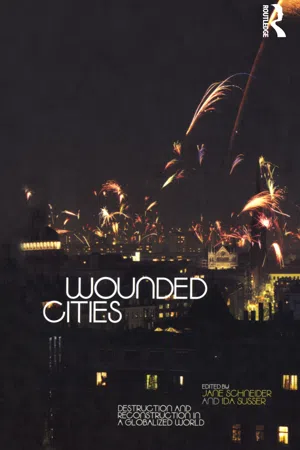
Wounded Cities
Destruction and Reconstruction in a Globalized World
- 256 pages
- English
- ePUB (mobile friendly)
- Available on iOS & Android
eBook - ePub
Wounded Cities
Destruction and Reconstruction in a Globalized World
About this book
Although the seemingly apocalyptic scale of the World Trade Center disaster continues to haunt people across the globe, it is only the most recent example of a city tragically wounded. Cities are, in fact, perpetually caught up in cycles of degeneration and renewal. As with the WTC, from time to time these cycles are severely ruptured by a sudden, unpredictable event. In the wake of recent terrorist activities, this timely book explores how urban populations are affected by wounds inflicted through violence, civil wars, overbuilding, drug trafficking, and the collapse of infrastructures, as well as natural disasters such as earthquakes. Mexico City, New York, Beirut, Belfast, Bangkok and Baghdad are just a few examples of cities riddled with problems that undermine, on a daily basis, the quality of urban life. What does it mean for urban dwellers when the infrastructure of a city collapses transport, communication grids, heat, light, roads, water, and sanitation? What are the effects of foreign investment and huge construction projects on urban populations and how does this change the look and character of a city? How does drug trafficking intersect with class, race, and gender, and what impact does it have on vulnerable urban communities? How do political corruption and mafia networks distort the built environment? Drawing on in-depth case studies from across the globe, this book answers these intriguing questions through its rigorous consideration of changing global and national contexts, social movements, and corrosive urban events. Adopting a grass roots up approach, it places emphasis on peoples experiences of uneven development and inequality, their engagement with memory in the face of continual change, and the relevance of political activism to bettering their lives. It is especially attentive to the historical interaction of particular cities with wider political and economic forces, as these interactions have shaped local governance over time.
Information
1
Wounded Cities: Destruction and Reconstruction in a Globalized World
Ida Susser and Jane Schneider
Across the world people who live in, have abandoned or been expelled from cities can testify to the mounting crises of contemporary urban life. Tempestuous "acts of nature," no doubt intensified by global warming, stir up crises as do civil wars and preemptive wars of occupation pursued on urban turf. Increasingly, urban wounds also result from globalization processes, unfolding with few constraints since the 1980s. Whatever the source of the affliction, wounded cities, like all cities, are dynamic entities, replete with the potential to recuperate loss and reconstruct anew for the future. Globalization processes are ever more evident in the rebuilding, too. Implicit in this understanding is a framework of analysis that conceptualizes cities from two contrasting, irreducible points of view. On the one hand is the city as a body politic, capable of being collectively wounded and of responding as such; on the other hand, the city is a site where powerful external forces intersect, intensifying differences and conflicts among local groups.
This framework evolved out of a series of informal exchanges in the late 1990s among urban ethnographers in New York City, several of whom were also engaged with urban researchers elsewhere. It was further elaborated at an April 2000 workshop, sponsored by the Wenner-Gren Foundation for Anthropological Research. There a debate emerged regarding the idea of urban "wounding" which, as an organic metaphor, implies a vision of collective well-being that must be negotiated within an identifiable, bounded place. Participants were concerned that this implication deflects attention from the wider field of forces penetrating cities and transforming their internal relations. It also seduces us into forgetting that cities are nested within regional and national entities, not to mention ringed by suburbs, whose taxing and spending practices can help or harm, at times quite dramatically. And yet the image is crucial and compelling. When we take past histories and external pressures into account, it has the power to evoke collective action, imaginative construction in the face of destruction, creative initiatives in the face of decay.
The decision to refine and publish the workshop papers under the title Wounded Cities, Destruction and Reconstruction in a Globalized World, was reinforced on September 11th 2001, when New York City succumbed to a shocking and unforgettable urban wound. Subsequent shocking images from cities in Afghanistan and Iraq, considered in an epilogue, powerfully confirm this direction. New York, and the World Trade Center within it, are, of course, ultimate symbols of global finance and wealth. From the mid-1970s, New York's corporate leaders pioneered the core globalizing processes of privatization, the privileging of markets, the reorientation of government finance away from collective public services, all with the effect of widening the gap between rich and poor. Significantly, we believe, the people who died on September 11th, and the populations that have suffered most from the attack, disproportionately represent immigrant entrepreneurial and working-class groups already at the mercy of globalizing trends. They, too, have a stake in the recovery.
If the word "wounded requires some explanation, so too does the phrase "globalized world." Although clearly referencing the contemporary ubiquity of globalization, it begs the question what globalization means. Generally, two definitions are asserted: on the one hand a series of cultural, informational, and commodity "flows" in which loci of power are difficult to detect, and, on the other hand, a "neo-liberal," finance-driven form of corporate capitalism that subordinates competing institutions, including nation states, to a "new world order". In urban studies, this second meaning has led to the development of a "global cities" framework, inspired by Saskia Sassen's 1991 book of that tide. Her identification of New York, London and Tokyo as standard bearers of the "global city" tempted many to classify urban sites in relation to a hierarchy of global engagement. At one extreme are the great financial centers, which coordinate a series of critical functions for the rest of the world; at the other are cities which, as Manuel Castells might put it (1996), languish "off the grid"—so lacking in electronic and telecommunications sophistication as to be irrelevant to the movement of capital and information driving globalization.
In contrast to this view, we look upon globalization as an integrated phenomenon, bringing all of the world's cities into a single, interconnected web. The roster of cities considered in this volume spans a wide range of both scale and geographical location. Drawn from the "third" and "second," as well as "first" worlds, they include (in alphabetical order) Bangkok, Thailand; Beirut, Lebanon; Belfast, Northern Ireland; Ho Chi Minh City, Vietnam; Kingston, Jamaica; Medellin, Columbia; Mexico City and Xalapa, Mexico; Philadelphia and New York City (specifically Harlem), U.S.; Palermo, Sicily (Italy); and Ulan Ude, Siberia (Russia). Except for New York, none is a major hub of global capital. Yet all are subject, without exception, to pressures emanating from the core institutions of global capitalism to deregulate markets, privatize services like waterworks and electrical energy, pave the way for corporate control of media airwaves, and cut government funding for health, education, and welfare. Variation among them is hardly attributable to a rank order of "more" or "less" engagement with these globalizing pressures.
Regrettably, no African city is considered; two initees to our conference, specialists on the South African cities of Johannesburg and Durban, were unable to attend. The lacuna is unfortunate, as it reinforces the tendency to caricature much of Africa as peripheral to globalization. South African cities have long been industrialized, their factories managed by global capital. In the post-apartheid South African state, H.I.V./AIDS is now ravaging the cities, affecting both men and women, albeit differently. The poor are dying while a few of the better off, both black and white, have access to treatment. Contemporary processes of revitalization are being undermined as well as promoted by links to global capital, as is the treatment of disease.
Readers will also find a forceful challenge to the viewpoint that African cities are peripheral to globalization in a recent study of Dakar, Senegal, which uses the lenses of youth culture and youth consumption practices to explore recent urban change. Having grown explosively during the 1960s and 1970s when a post-independence national government invested freely and heavily in infrastructure, housing, and local industry, Dakar was then plunged into debt and the shock of structural adjustment in the 1980s. Government spending collapsed, and with it industrial and infrastructural investment, but there has since emerged a flourishing informal economy, including the artisan-level reworking of many imported commodities. Youth, demographically by far the largest group, work and spend in, borrow and steal from, this economy as they envision their futures. Rendering the city a vibrant and exciting place, they also often leave it, or dream of leaving it, to join diaspora Senegalese communities in France, Italy, and especially the U.S. Just as it has been reinvigorated by their presence, Dakar also risks being undermined by their exodus, even though migration remittances are the bread and butter of the informal economy (see Scheld 2003).
As these examples suggest, there is something misleading about arranging cities in a single, seemingly stateless, hierarchical scheme according to which some are more "global" than others. We have preferred to pursue comparisons based on the effects of, and responses to, the globalizing processes of neo-liberalism since the 1970s. Among the most salient processes are the redirection of public investment away from collective services and the transfer of service provisioning to the private sector. In many of the cities described here, neo-liberal economic restructuring has also marginalized poor residents, increased or concretized ethnic and racial divisions, increased the subordination of women in new ways, and opened the door to a burgeoning criminal economy resting heavily on drug traffic.
Perhaps most important, this book envisions globalizing processes in relation not only to urban wounds but also to urban recovery. As will be shown, the necessity or opportunity for reconstruction exposes a city immediately and powerfully to neo-liberal capitalist pressures. Often large-scale corporate developers target damaged locations. Here they can transform the landscape in their own image at relatively low cost, thanks to, among other things, tax advantages, the prior reduction of many buildings to burned out hulks or rubble, and the likely absence of organized political protest. A foremost and often over-riding goal is to generate profits for transnational corporate interests associated with finance, name-brand shopping, and tourism. Although hardly a "wounded city," Rome offers a leitmotif for this approach. Having relocated most of its working classes to the outer rim, it presents strolling tourists with boutique-lined streets and, hiding the scaffolding of monumental restoration projects, billboard-scale ads for luxury cars and cosmetics. (The Fascist regime of the 1930s, seeking to identify with Caesar Augustus, also dislocated working classes from the ancient core of the city, but its goal was to create vast spaces for parades and political-military spectacles, not consumption.)
To attract tourist dollars and, in association with this, convention dollars and multimillion dollar sports events, cities must recreate themselves as commodities, investing heavily in representation. Several studies, well summarized by Low (1999: 16-18), note the resulting dislocations of people, whether through legally sanctioned eviction procedures or because of suddenly rising rents and land values. Atlanta, for example, "re-imagined" itself to garner the Olympic games, removing its poor and black population from the central city (Rutheiser 1996). Often, in their effort to create a certain appearance or image, the new projects obliterate spaces where, in the past, a variety of groups and classes crossed each others' paths and interacted. Pristine new tourist- and consumer-friendly zones might well mask a precipitous decline in social solidarity.
At the same time, the commoditization of urban sites requires the creation of a massive underpaid service sector (Harvey this volume, Mollenkopf and Castells 1989). In New York City this sector is comprised largely of recent immigrants, people who would otherwise be working in the sweatshops of the Caribbean, Mexico, China or other parts of the world. Even under planning regimes committed to socialist values, the move toward "cultural consumption" (see Zukin 1995) can lead to the "reification of division and subordination in the city," as Mcdonogh (1999: 369) has described for Barcelona.
Commoditization is sure to spell the bleeding of commerce and commercial values into formerly enclaved locales. Architect and urbanist Rem Koolhaas, writing about successfully commoditized cities, puts it this way: "Shopping is surreptitiously becoming the way in which urban substance is generated" (quoted in Lubow 2000: 42). The U.S. leads a world list, he points out, with 31 square feet of real estate per person devoted to shopping. Many of its cities, like cities across the world, have witnessed the penetration of the "shopping industry" into every category of building: churches, temples, museums, means of transportation, and schools—even now into the hallowed ground of the World Trade Center disaster (see Hurley and Trimarco fc; Tucker fc). Furthering this hegemony is the discovery that people spend more money in spaces they perceive to be not fully commercial—where, in particular, cultural performances are also going on.
Just as the causes of urban destruction are multiple and varied, the forms of reconstruction everywhere reflect a battle over the control of the direction of the urban body politic. As global capital, accompanied by neo-liberal policies and privatization, extends its reach, a critical question is whether struggles for humanitarian principles can find expression in rebuilding. By way of an introduction, this essay first lays out the globalization processes that threaten contemporary cities. Subsequent sections frame the chapters in relation to four general themes—urban degradation; crises of crime and criminalization; rapid, inconsistent expansion; and reconstruction and recovery. It should be noted that all of the chapters are based on ethnographic research, some of it rendered difficult by violence and the disruption of tenuous urban services. As ethnographers, the authors have tapped into the lived experiences of people who suffer when cities are wounded, and also into people's changing capacities to respond.
Globalization: an Overview
The power of globalizing processes to wreak havoc in cities around the world is best assessed through an historical lens. As documented by urban anthropologists, in the 1940s through 1960s, working people in cities, whether industrial working classes or participants in informal economies, created vibrant neighborhood organizations, constructed kinship and social networks, and actively bettered their lives through protest and struggle. Working people, in response to the demands of capital (socialist cities were less well studied in this period), fought for space, political power and economic resources, in turn contributing to the ever-changing cityscape of buildings, parks and roadways. Although, as Mumford taught us, the city represented and reflected the structures of power of the era, the ongoing demands of workers and their families also mattered (Mumford 1961).
Following the upheavals of the 1960s, the emergence of volatile social movements directed renewed attention to class inequalities in the centers of industrial capitalism. David Harvey (1973), Manuel Castells (1972) and others described the city as structured by the history of class struggles. Focusing on the U.S., the economist, David Gordon (1978) outlined how, as working-class people coalesced in their neighborhoods and workplaces to demand higher wages, they made the northeastern industrial cities the crucible of labor's power, leading to a historical change in the structuring of these cities. Feeling intimidated and disadvantaged, industry moved to the non-unionized South and, especially, to the sprawling, de-centered settlements of the Southwest, taking advantage of the poor, underemployed populations on both sides of the Mexican border. European and Caribbean immigrants who had been recruited along with African-American migrants from the rural South for manufacturing work in the northeast were left stranded.
As if to crystallize these developments, one American city—New York—pioneered a novel response. Following an abrupt (although engineered) fiscal crisis in 1975, it was saved from bankruptcy by national governmental and financial institutions that dictated unprecedented cutbacks in spending for collective services such as health, education, public transportation and housing (Tabb 1982, Susser 1982, 1998). This was in direct contrast to the reduction of poverty and the enhanced spending on public health and education in the 1960s. In fact, it reversed more than a century of progressive social policies in New York, including the founding of the first free urban university in the U.S., one of the first free city hospitals, and the proliferation of community social services for which the city had become famous.
New York's fiscal crisis represented a watershed, not because the city became poorer but because city government, under the wing of Wall Street and Washington, was forced to reorient its priorities towards business interests and the global economy (Henwood 1998). As part of this transformation, widespread arson was directed against working-class and minority apartments, often precipitated or fostered by landlords, exacerbating the effects of the withdrawal of public funds from low-and middle-income housing, and accelerating the disappearance of the stable working class (Freeman 2000). The numbers of unemployed poor mounted, as did the gap between rich and poor, creating what was soon to be described as the Dual City (Mollenkopf and Castells 1989). By the time that it was named a global city in 1991, New York well represented a model for what we now understand as the pervasive effects of globalization: privatization, investment in monumental construction in place of public housing, and a new population of poor and homeless people, not seen in U.S. cities since the Great Depression (Susser 1996, 2002).
As key discussions by Stightz (2001), Gneder (2001) and others, have exhaustively demonstrated, global institutions such as the I.M.F, and the W.T.O. have fostered increased inequality between rich and poor countries and also between the rich and the poor in any particular country. The consequences for the social fabric of cities are substantial. "Urban removal," followed by reconstruction or gentrification and the revaluation of real estate, has for decades relocated poor people as they find themselves surrounded by expensive properties and unaffordable rents. The additional impetus under globalization reflects the changing balance of power within the ...
Table of contents
- Cover
- Half Title
- Title Page
- Copyright Page
- Contents
- List of Figures
- List of Contributors
- Acknowledgments
- 1 Wounded Cities: Destruction and Reconstruction in a Globalized World
- 2 The City as a Body Politic
- Part I The Degradation of Urban Life
- Part II Crises of Crime and Criminalization
- Part III Rapid, Inconsistent Expansion
- Part IV Reconstruction and Recovery
- Epilogue: Baghdad, 2003
Trusted by 375,005 students
Access to over 1.5 million titles for a fair monthly price.
Study more efficiently using our study tools.
Frequently asked questions
Yes, you can cancel anytime from the Subscription tab in your account settings on the Perlego website. Your subscription will stay active until the end of your current billing period. Learn how to cancel your subscription
No, books cannot be downloaded as external files, such as PDFs, for use outside of Perlego. However, you can download books within the Perlego app for offline reading on mobile or tablet. Learn how to download books offline
Perlego offers two plans: Essential and Complete
- Essential is ideal for learners and professionals who enjoy exploring a wide range of subjects. Access the Essential Library with 800,000+ trusted titles and best-sellers across business, personal growth, and the humanities. Includes unlimited reading time and Standard Read Aloud voice.
- Complete: Perfect for advanced learners and researchers needing full, unrestricted access. Unlock 1.5M+ books across hundreds of subjects, including academic and specialized titles. The Complete Plan also includes advanced features like Premium Read Aloud and Research Assistant.
We are an online textbook subscription service, where you can get access to an entire online library for less than the price of a single book per month. With over 1.5 million books across 990+ topics, we’ve got you covered! Learn about our mission
Look out for the read-aloud symbol on your next book to see if you can listen to it. The read-aloud tool reads text aloud for you, highlighting the text as it is being read. You can pause it, speed it up and slow it down. Learn more about Read Aloud
Yes! You can use the Perlego app on both iOS and Android devices to read anytime, anywhere — even offline. Perfect for commutes or when you’re on the go.
Please note we cannot support devices running on iOS 13 and Android 7 or earlier. Learn more about using the app
Please note we cannot support devices running on iOS 13 and Android 7 or earlier. Learn more about using the app
Yes, you can access Wounded Cities by Jane Schneider, Ida Susser, Jane Schneider,Ida Susser in PDF and/or ePUB format, as well as other popular books in Social Sciences & Urban Planning & Landscaping. We have over 1.5 million books available in our catalogue for you to explore.