- 262 pages
- English
- ePUB (mobile friendly)
- Available on iOS & Android
eBook - ePub
About this book
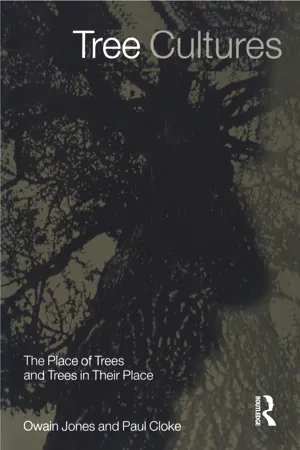
The relationship between nature and culture has become a popular focus in social science, but there have been few grounded accounts of trees. Providing shelter, fuel, food and tools, trees have played a vital role in human life from the earliest times, but their role in symbolic expression has been largely overlooked. For example, trees are often used to express nationalistic feelings. Germans drew heavily on tree and forest imagery in nation-building, and the idea of 'hearts of oak' has been central to concepts of English identity. Classic scenes of ghoulish trees coming to life and forests closing in on unsuspecting passers-by commonly feature in the media. In other instances, trees are used to represent paradisical landscapes and symbolize the ideologies of conservation and concern for nature. Offering new theoretical ideas, this book looks at trees as agents that co-constitute places and cultures in relationship with human agency. What happens when trees connect with human labour, technology, retail and consumption systems? What are the ethical dimensions of these connections? The authors discuss how trees can affect and even define notions of place, and the ways that particular places are recognized culturally. Working trees, companion trees, wild trees and collected or conserved trees are considered in relation to the dynamic politics of conservation and development that affect the values given to trees in the contemporary world. Building on the growing field of landscape study, this book offers rich insights into the symbolic and practical roles of trees. It will be vital reading for anyone interested in the anthropology of landscape, forestry, conservation and development, and for those concerned with the social science of nature.
Information
1 Introduction
Trees are large and conspicuous objects in the landscape, and they endure over long periods of time. We cannot ignore them even if we should wish to do so, and happily they are lovely at every season.
(Edlin, 1970: 165)
Our culture is rich with trees, wood and green-men - from pollards and timber barns to painting and poetry, from the Green Knight and Robin Hood to Constable and Elgar. We urgently need to find new ways of living with trees as cultural, spiritual and emotional companions - as well as for ecological reasons.
(Sinden, 1990: 9)
Every tree counts.
(Common Ground slogan)
This book is set within the context of recent attempts within the social sciences to construct closely theorized and firmly grounded analyses of the interconnections between nature-society relations and place relations. Our contention is that nature-society relations are continually unfolding in the contexts of specific places, in which meanings will arise from particular interactions between different assemblages of social, cultural and natural elements.
The last twenty years of the twentieth century witnessed a very significant increase in the importance of understanding nature-society relations as an integral part of the political, economic, social and cultural constitution and reconstitution of changing places. Not only has the prominence of environmental issues placed nature firmly in the glare of the media and of the political and academic discourses on conservation, but also there has been an increasing theoretical sophistication by which nature has been accepted as something more than an 'empty canvass' onto which society and culture are constructed. It is now recognized that nonhuman life-forms and materials can be thought of as having 'agency', and that the biological and physical dynamics of life-forms and processes need to be recognized both in their own terms and in terms of the relational agencies which are established among themselves with humanity. Structures of nature-social articulation will be spatially as well as historically specific. As a living complex of lifeforms and processes, natural relations will always be embedded in. and thereby interact with and condition, human social relations to varying extents and in different ways in specific times and spaces.
In order to explore these themes, this book chooses trees as its focus. This trajectory can be understood partly in terms of the status of trees as a major global icon of terrestrial nature conservation and nature destruction (Schroeder, 1995), The fate of trees is often emblematic of the wider environment; Gates (2000: 1), for example, writes, 'if we can't protect threatened tree species, it does not bode well for the rest of the biosphere'. In Britain, trees have on the one hand been the focus or touchstone of the most prominent and bitter conservation battles in recent years, yet on the other they form the core of other initiatives such as the Community Forests or the National Forest which are held up as emblematic of progressive environmental policies. As well as these more 'immediate' discourses of nature and the environment concerning trees, they are also embedded in other cultural contexts which assemble complex layers of meaning. For example, Schama (1995) has produced a historical account of how the meanings of forests differ dramatically in the differing national cultures of Germany, France, England, America and Poland. In the context of Britain, Schama (2000) tells us that the greenwood was seen as a refuge from state tyranny, and also the provider of England's 'Heart of Oak' (see also Tsouvalis, 2000). Such images of England as pastoral and 'green at heart' had hedgerow trees, patchworks of deciduous woodland and the great forests as central icons. This iconography, for example, is confirmed in many of the famous war posters, travel posters, and covers of the Batsford's guide books which proliferated in such a distinctive style in the middle decades of the twentieth century, yet Britain is the least wooded country in Europe (Evans, 1992; Shoard, 1980) and contemporary discourses from media and pressure groups tell us that trees continue to fall under the spread of development and modern agricultural processes. In urban contexts, trees are vital in hopes of 'greening' the cities to make them more habitable. Consequently, there is now a plethora of organizations which are solely or partially dedicated to some or other aspects of tree conservation and/or management in Britain.
Our fascination with trees has also to be acknowledged in personal terms. When planning the research on which this book is based, we realized that we both were variously inspired by trees as an attribute of nature. We were drawn to their aesthetic beauty and their shadowy meaningfulness. We had both previously compiled personal photographic essays on different aspects of trees, and the patterns, colours and emotions they project. These fascinations resonated with our desire to accentuate the importance of the non-human in studies of nature-society and place. It also quickly occurred to us that trees in particular places could be highly valued. Indeed our research was partly inspired by one of the direct action tree protests which marked Britain in the 1990s. In this instance, in Bristol, a row of street lime trees was to be cleared to make way for the development of a new Tesco supermarket. This threat to the trees prompted a 90-day protest, where a sustained presence was kept at the base of the trees and in the trees themselves. In the end, the protestors were removed and the trees felled, all in front of the cameras of local and national media.
It was clear there was much to learn from this protest, as from other tree protests in Britain and further afield. The first thing which we were interested in was that these lime trees were not of particular 'scientific' or 'aesthetic' interest, and they had therefore slipped through the net of conservation discourses and legislation. Despite this, the trees were significant to local people; their meaning had a local dynamic, and they were obviously valued by those who were concerned with their felling. This concern appeared to enrol both broad disquiet over the destruction of natural habitats at whatever scale, and very specific disquiet over the destruction of particular trees which were regarded as palpable living individuals. From the complex interconnections visible in this one 'tree-place', we wanted to think through all kinds of wider considerations of what we began to call 'arbori-culture' especially relating to myriad social constructions which positioned trees as anything from sources of timber to living spirits. We further realized that arboriculture was itself placed, and represented as an integral part of nature-society relations in the places concerned. As with the lime trees, such relations are refolded, resisted, and magnified in the complex milieu of any particular place where trees stand or fall.
In this book, then, we want to bring together these two strands of arbon-culture. We want to discuss particular trees and tree places, and we want to deploy theoretical ideas about nature, place, agency and ethics. Do trees represent a particularly vivid and important articulation of ideas about social nature (Cloke et al., 1996a/b)? How does the agency of particular trees fit in with current popular perspectives associated with Actor Network Theory (ANT) about the relational and networked nature of nature-society relations? Do ideas of place and geography tend to be lost in ANT's view of the world as topographically fluid networks, and if so, how do trees fit into such networks when they are so palpably rooted in particular places? Is there any value in pursuing nature-society relations in terms of ideas of dwelling, which Ingold (1993, 2000) famously illustrates using a painting by Bruegel in which a lone pear tree takes centre stage both visually and in the narrative? What emphasis should be given to environmental philosophy's pursuit of the intrinsic value of nature and natural beings, taking a relational view of the world as co-constituted by biosphere systems in which humans form a small and somewhat problematic part? 'Should', as Christopher Stone (1972) asks, 'trees have standing'?
We address these strands and questions in the book by considering trees contemporaneously as both social constructions and as real dynamic material entities. In so doing we seek to respond to Philo's (2000) concern about the dematerialized nature of much contemporary cultural geography, which ignores 'stubbornly there-in-the-world kind of matter' (33). There is nothing more stubbornly 'there-in-the-world' than the trees which, we guess, you could now take a look at by moving to a window, or taking a short stroll outside. Yet trees also have an extraordinary range of symbolic places within human imagination. We need to deal with things in more nuanced ways which acknowledge these and other dynamics of being and becoming, and the knowing of being and becoming.
Here, then, we are joining the ranks of expanded 'human geographies' into which nature is being incorporated. This perspective has gained momentum particularly via a reconsideration of animals in social processes and formations. Fitzsimmons and Goodman (1998: 194) suggest that across the social sciences and humanities there has emerged a broad if somewhat disjointed front, the concern of which is to bring 'nature' 'back in' to social theory by contesting its abstraction from 'society'. There is a growing corpus of studies (see for example Anderson, 1995, 1997; Philo, 1995; Philo and Wilbert, 2000; Whatmore, 1997; Whatmore and Thome, 1998, 2000 and Wolch and Emel, 1995, 1998) which suggest that human geography can play an important role in contesting nature's abstraction from society through the development of animal geographies. Gaps remain, however, in the canon of non-human geographies. For example, Whatmore and Thorne (1998: 436) point out that 'geographers have paid remarkably little attention to wildlife in recent times'; and addressing that part of the non-human world not seen as 'wild', Anderson (1997: 464) feels that the human sciences have mostly failed to engage critically with the processes of animal domestication, and that this failure 'continues to constrain the imagining of alternative ethical and practical relations between humans, animals and environments'. Similar concerns have been expressed by Philo (1995) about animal geographies in general:
The tendency has been to consider animals as marginal 'thing-like' beings devoid of inner lives, apprehensions or sensibilities, with little attempt being made to probe the often take-for-granted assumptions underlying the different uses to which human communities have put animals in different times and places. (656-7, our emphasis)
If all this neglect is so for fauna, it is even more so in the case of flora, which remains an even more ghost-like presence in contemporary theoretical approaches. Moving 'beyond' animals to plants, and in our case, to trees, represents a further expansion and development of the 'geographical imagination'. Trees, we suggest, are a pressing and vibrant case because of their powerful presence in all manner of lives and spaces. In studying arbori-culture, we are responding to Burgess's (2000) call for cultural geographers to consider society-environment issues 'worthy of attention' (273).
This is not to say that plants, or even trees, woods and forests, have been entirely absent from recent geographical and related discourses. Woodland has been considered through notions of the iconography of landscape (Daniels, 1988); as a symbolic other to western civilisation (Harrison 1992) and in terms of social nature (Cloke et al., 1996a). Tsouvalis (2000) has discussed the meanings and the materiality of British forests and woodlands, while Watkins (1998a) and McManus (1999) have considered national and international histories of how woodlands and forests have been constructed. In addition, Rival's (1998) edited collection has considered the rich range of symbolisms which attach to trees in national and international contexts. In sympathy with much of this endeavour we are in this book beginning to articulate a particular form of hybrid geography (Whatmore, 2000) which has the aim of
exploring ways of recognising and accommodating the presence of non-humans in the worlds we inhabit [and] is concerned with the spaces of social life, relational configurations spun between the capacities and effects of organic beings, technological devices and discursive codes. (247, our emphasis)
In pursuit of this aim in the case of trees, we use the first half of the book to explore four conceptual spaces. These are: culture - the meanings which orbit around trees and woods in culture; agency - the bewildering range of creative capacities trees bring to 'heterogeneous geographies'; place - the places which form as trees relate along with particular spun configurations of ensembles of various actors; and ethics - considerations of the duties that individuals and societies may owe trees in the light of seeing them as living actors in geographical and conceptual spaces. Each of these conceptual themes will be briefly introduced. But we are also interested in the interactions, or the interstices between these forms and how meaning and practices form within them.
Culture
Trees are implicated in a huge range of cultural formations. There are common understandings of trees and woods, which may be at large in society at a number of scales (national, regional, local) and locations (e.g. the media, the local, state, national state and NGO initiatives), and which come to contribute to the specific matrix of differing place milieu. Places are, in part, dynamic outcomes of the coming together of local, regional, national and international cultural constructions, in co-present material, social, economic, and historical contexts. Cultural attributes are often particularly significant in the consideration of places where trees are characteristic of place milieu, as in Schama's (1995) telling of differing national-scaled cultural inscriptions of tree meanings, which influence the complex ways in which tree-places are constructed locally. Trees in Britain and elsewhere have become carriers of some people's environmental anxiety and love for nature, cropping up in various discourses on environmental crisis, countryside change and habitat loss, and quality of urban life. More generally, trees have long been symbols for all manner of key social meanings and practices (Rival, 1998b), for example being associated with fear and spirituality as well as with recreation (Cloke et al., 1996a). Within these broad but often very powerful understandings of trees, more specific variations occur. For instance in Britain, trees are commonly understood as native or alien; evergreen or deciduous; wild or planted; young or ancient. Each of these labels of understanding comes with a raft of meanings which will be influential in how a tree is regarded and understood culturally and, perhaps, acted upon. This coming together of local and national cultural constructions, with the particular presences and juxtapositions of elements making up particular places, makes for an extremely fine-grained set of relations, meanings and significances, which provide both potential opportunities and problems for the interpretations of, and the (environmental) management of, any type of site. This is particularly so where trees are involved, given the huge amount of cultural, emotional and even spiritual baggage certain trees in certain places can carry.
This book accesses tree discourses in various cultural locations which range through novels, poetry, and accounts of ancient spirituality to coverage of 'tree issues' in the press. It is through such representations that discourses circulate in an 'active process of cultural creation and destruction .. . moments in a cumulatively historical spiral of significati...
Table of contents
- Cover
- Half Title
- Title Page
- Copyright Page
- Dedication
- Contents
- Acknowledgements
- List of Figures
- 1 Introduction
- Part I Placing Trees In Cultural Theory
- Part II Trees in their Place
- Bibliography
- Index
Trusted by 375,005 students
Access to over 1.5 million titles for a fair monthly price.
Study more efficiently using our study tools.
Frequently asked questions
Yes, you can cancel anytime from the Subscription tab in your account settings on the Perlego website. Your subscription will stay active until the end of your current billing period. Learn how to cancel your subscription
No, books cannot be downloaded as external files, such as PDFs, for use outside of Perlego. However, you can download books within the Perlego app for offline reading on mobile or tablet. Learn how to download books offline
Perlego offers two plans: Essential and Complete
- Essential is ideal for learners and professionals who enjoy exploring a wide range of subjects. Access the Essential Library with 800,000+ trusted titles and best-sellers across business, personal growth, and the humanities. Includes unlimited reading time and Standard Read Aloud voice.
- Complete: Perfect for advanced learners and researchers needing full, unrestricted access. Unlock 1.5M+ books across hundreds of subjects, including academic and specialized titles. The Complete Plan also includes advanced features like Premium Read Aloud and Research Assistant.
We are an online textbook subscription service, where you can get access to an entire online library for less than the price of a single book per month. With over 1.5 million books across 990+ topics, we’ve got you covered! Learn about our mission
Look out for the read-aloud symbol on your next book to see if you can listen to it. The read-aloud tool reads text aloud for you, highlighting the text as it is being read. You can pause it, speed it up and slow it down. Learn more about Read Aloud
Yes! You can use the Perlego app on both iOS and Android devices to read anytime, anywhere — even offline. Perfect for commutes or when you’re on the go.
Please note we cannot support devices running on iOS 13 and Android 7 or earlier. Learn more about using the app
Please note we cannot support devices running on iOS 13 and Android 7 or earlier. Learn more about using the app
Yes, you can access Tree Cultures by Paul Cloke,Owain Jones in PDF and/or ePUB format, as well as other popular books in Social Sciences & Ecology. We have over 1.5 million books available in our catalogue for you to explore.