- 240 pages
- English
- ePUB (mobile friendly)
- Available on iOS & Android
eBook - ePub
About this book
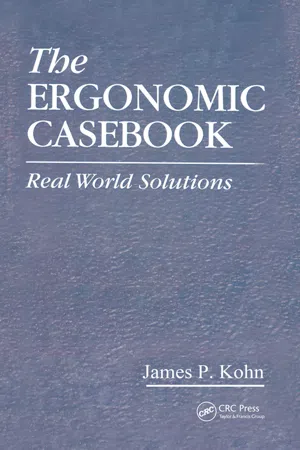
One of the greatest challenges in the occupational health and safety profession is the application of theory to actual workplace practice. The difference between how the workplace should be ideally designed and the limitations that occur in pre-existing facilities are often difficult to overcome. With examples from the service industry, heavy industry, agriculture, and the office, this text bridges these gaps between theory and practice by using case studies to illustrate sound ergonomic practices.
The Ergonomic Casebook is a resource that professionals and students can use as a guide for solutions to real-world ergonomic problems. Working examples from ergonomic programs in a variety of industries are included. Case studies describe methods for identifying ergonomic problems, and specific causes are reported. Recommended strategies for the elimination of identified stressors are indicated. Implemented strategies and evaluated results are discussed and explained.
Applications of this book are endless. Whether you are a health and safety professional with limited expertise in ergonomics or a student taking a health and safety course, you will gain extensive insight into ergonomic problem solving as a result of the case studies presented in The Ergonomic Casebook.
Information
CHAPTER 1
INTRODUCTION
WHAT IS ERGONOMICS?
Most individuals know that ergonomics has something to do with people. They may not be aware of the fact that ergonomics examines human behavioral, psychological, and physiological capabilities and limitations. By understanding these capabilities and limitations, professionals in the field of ergonomics can then design new work environments, or modify established work environments, to maximize productivity, worker comfort and overall efficiency.
The primary objective of ergonomics is to improve human health, safety and performance through the application of sound people and workplace principles. The exciting feature of this approach is that it is a “win-win” situation where everyone benefits from the successful implementation of the ergonomic process. You may be asking yourself, “why is this objective so exciting?” If you were a health and safety professional practicing during the early 1970’s, you could understand the advantages of this approach.
During the early years of the occupational health and safety movement in the United States, practitioners were often viewed as police officers. Their role was to enforce rules and regulations that often were viewed as interfering with the primary organizational objective of production. Recent history has revealed, however, that many organizations that have implemented ergonomic programs have observed a legal, moral, and financial advantage. Testimony by ergonomists indicate that they are actually being sought out by production supervisors because of the accomplishments and benefits that they have achieved in other departments. These benefits include decreases in injuries, absenteeism, complaints, and grievances experienced by the workers. These benefits also include increased productivity, decreased down time, improved materials handling and product flow.
For many organizations ergonomics can work hand-in-hand with a quality control program. By improving worker performance and production processes, superior products can be manufactured with less waste and fewer defects. As you can see, effectively establishing an ergonomic process in an organization can reap many benefits.
Terminology
Ergonomics is the discipline that examines the capabilities and limitations of people. The term ergonomics is based upon two Greek words: ergos meaning “work,” and nomos meaning “the study of” or “the principles of.” In other words, ergonomics refers to “the laws of work.” The goal of ergonomics is normal to design the workplace to conform with the physiological, psychological, and behavioral capabilities of workers.
Most ergonomics problems arise out of pre-existing operations. It is then important for specially trained professionals to anticipate, recognize and identify ergonomic hazards. Evaluation and controls measures would be some of the activities that would have to be performed and implemented to eliminate ergonomic hazards and minimize ergonomic risk factors.
According to the OSHA meatpacking guidelines, “ergonomic hazards refer to workplace conditions that pose a biomechanical stress to the worker. Such hazardous workplace conditions include, but are not limited to, faulty work station layout, improper tools, excessive tool vibration, and job design problems. They are also referred to as (ergonomic) stressors.” The meatpacking guidelines defines ergonomic risk factors as “conditions of job, process, or operation that contribute to the risk of developing CTDs. Examples include repetitiveness of activity, force required, and awkwardness of posture.” In addition, an ergonomist or ergonomics professional is defined in that same publication as “a person who possesses a recognized degree or professional credentials in ergonomics or a closely allied field (such as human factors engineering), and has demonstrated, through knowledge and experience, the ability to identify and recommend effective means of correction for ergonomic hazards in the workplace.”
WHY IS ERGONOMICS IMPORTANT?
According to the Bureau of Labor Statistic’s (BLS) report titled Annual Occupational Injury/Illness Survey: Workplace Injuries and Illnesses in 1994, the work related injury/illness frequency rate has declined steadily during the period between 1992 and 1994. The Bureau of Labor reported that in 1992 the injury/illness rate was 8.9 cases per 100 full-time workers. In 1993 the rate had declined to 8.5 cases and again in 1994 the injury/illness rate further decreased to 8.4 cases per 100 full-time workers. While the overall occupational health and safety statistics appear to be decelerating, ergonomic related incidences were found to be actually accelerating. Ergonomic incidents in the form of repeated trauma increased by more than 15 percent between 1992 and 1994 (Bureau of Labor Statistics, 1995). Considering Bureau of Labor data, it is obvious why ergonomics has been called the occupational injury/illness epidemic of the 1990s.
This ergonomic epidemic phenomenon, however, is not limited to the United States. Reports from Australia, Canada, Germany, New Zealand, Sweden, and the United Kingdom indicate that this is a global problem. According to a recent German medical journal study, Carpal Tunnel Syndrome was reported to be the most common compression syndrome in Germany accounting for almost 20 percent of all nerve lesions (CTDNews, 1995). New Zealand, for example, reported that in the year ending March 31, 1989, over $16.5 million in compensation had been paid to 6,200 recipients filing ergonomic related claims. The Ontario Workers Compensation Board reports that soft-tissue musculoskeletal disorders represented one-third of the disabilities among Ontario construction workers and accounted for two-thirds of their compensation costs (MacKinnon, 1995).
Health and safety professionals are aware of the growing magnitude of the ergonomic problem. In response to the ergonomic epidemic, some state and federal agencies have proposed the enactment of ergonomic legislation. For example, California has proposed legislation to address repetitive motion injuries in the occupational environment. California Title 8, General Industry Safety Orders, Article 106, Section 5110, was proposed as a result of the California Division of Labor Statistics and Research study of repetitive motion injuries. This study indicated that over 28,000 employers reported disorders associated with repetitive trauma. The federal government has not ignored the ergonomic problem. The proposed ergonomic standard has been in draft form for several years, but the moratorium on all new federal safety and health legislation has detained its passage. This standard was intended to address the repetitive motion injury problem as well as lifting and vibration issues.
Regulators are aware of the ergonomics problem. Health and safety professionals are also aware of the ergonomic epidemic. Even the public has been made aware of these issues through newspaper and television articles on the topic. Professionals and laypersons all agree that ergonomics is an issue that must be addressed.
Ergonomics has become an occupational problem of major proportions. National and international data point to ergonomic injuries and illnesses as the primary health issue of the 1990s. The medical and legal costs associated with ergonomically related dysfunctions are spiraling with no apparent end in sight. Ergonomic costs to employers are rising and are impacting their ability to compete in the global marketplace. An examination of ergonomic incidents and related costs seems appropriate.
HOW BIG A PROBLEM IS ERGONOMICS?
The Bureau of Labor Statistics (BLS) published 1994 workplace injury and illness statistics on December 15, 1995. This annual survey provided estimates of the frequency and associated incident rates of workplace injuries and illnesses based on OSHA 200 logs maintained by employers and submitted to BLS. The BLS survey indicated that 65 percent of all illness in 1994 were disorders associated with repeated trauma. Approximately 332,100 new repetitive motion cases were reported that year resulting in an incidence rale of 0.41 cases per...
Table of contents
- Cover
- Title Page
- Copyright Page
- About the Author
- Acknowledgments
- Preface
- Table of Contents
- List of Figures and Tables
- Chapter 1. Introduction
- Chapter 2.1 Agriculture Case Studies
- Chapter 2.2 Chemical Industry Case Studies
- Chapter 2.3 Electronics Industry Case Studies
- Chapter 2.4 Hospital/Health Care Case Studies
- Chapter 2.5 Manufacturing Case Studies
- Chapter 2.6 Mercantile Case Studies
- Chapter 2.7 Office Environments Case Studies
- Chapter 2.8 Service Industry Case Studies
- Chapter 2.9 Utility Industry Case Studies
- Index
Trusted by 375,005 students
Access to over 1.5 million titles for a fair monthly price.
Study more efficiently using our study tools.
Frequently asked questions
Yes, you can cancel anytime from the Subscription tab in your account settings on the Perlego website. Your subscription will stay active until the end of your current billing period. Learn how to cancel your subscription
No, books cannot be downloaded as external files, such as PDFs, for use outside of Perlego. However, you can download books within the Perlego app for offline reading on mobile or tablet. Learn how to download books offline
Perlego offers two plans: Essential and Complete
- Essential is ideal for learners and professionals who enjoy exploring a wide range of subjects. Access the Essential Library with 800,000+ trusted titles and best-sellers across business, personal growth, and the humanities. Includes unlimited reading time and Standard Read Aloud voice.
- Complete: Perfect for advanced learners and researchers needing full, unrestricted access. Unlock 1.5M+ books across hundreds of subjects, including academic and specialized titles. The Complete Plan also includes advanced features like Premium Read Aloud and Research Assistant.
We are an online textbook subscription service, where you can get access to an entire online library for less than the price of a single book per month. With over 1.5 million books across 990+ topics, we’ve got you covered! Learn about our mission
Look out for the read-aloud symbol on your next book to see if you can listen to it. The read-aloud tool reads text aloud for you, highlighting the text as it is being read. You can pause it, speed it up and slow it down. Learn more about Read Aloud
Yes! You can use the Perlego app on both iOS and Android devices to read anytime, anywhere — even offline. Perfect for commutes or when you’re on the go.
Please note we cannot support devices running on iOS 13 and Android 7 or earlier. Learn more about using the app
Please note we cannot support devices running on iOS 13 and Android 7 or earlier. Learn more about using the app
Yes, you can access The Ergonomic Casebook by James P. Kohn in PDF and/or ePUB format, as well as other popular books in Technology & Engineering & Agriculture. We have over 1.5 million books available in our catalogue for you to explore.