- 448 pages
- English
- ePUB (mobile friendly)
- Available on iOS & Android
eBook - ePub
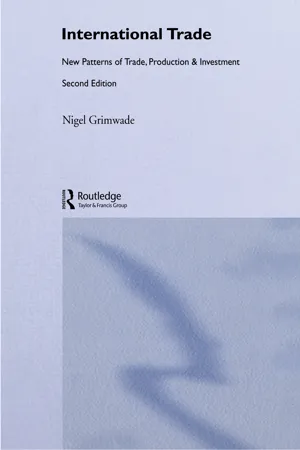
About this book
This new edition has been rewritten to provide an up-to-date, clear and comprehensive account of the most important developments currently taking place in the world economy. The text introduces the major economic theories and models with an emphasis on changes within the world trading system and how governments respond. New features include:
* an expansion of chapter three to include formal models of intra-industry trade under imperfect competition
* two separate chapters on Japan and newly industrialising countries, updating and incorporating new material
* new sections on Strategic Trade Policy and on the Political Economy of Protectionism
* a new chapter on the institutional aspects of world trade in discussing the deliberations of the World Trade Organisation
Chapter 1 The Changing Structure of World Output and Trade
CHAPTER OUTLINES: Introduction. The Growth of World Output - historical perspective, post-war trends in world output, the 1973-74 Oil Crisis, the 1979-80 oil crisis, the 1990-93 downturn, the East Asian financial crisis. The Growth of World Trade. Changes in the Commodity Composition of World Trade - primary products: food, agricultural raw materials, ores and minerals and non-ferrous metals, fuels; manufactures. Changes in the Geographical Composition of World Trade. The Regional Structure of World Trade. Conclusion.
Introduction
The fifty years or so that have passed since the ending of the Second World War have been a period of extremely rapid economic growth. On average, world output has grown at a faster rate than in any other period of history. A major cause of the growth in output has been the rapid growth of world trade. Throughout this period, world trade consistently grew faster than world output. This, in turn, was the result of a major increase in the degree of international specialisation between countries. An increase in the degree of specialisation would result in an increase in world trade even with no increase in world output. Hence, the fact that trade has been growing faster than output implies an increase in the degree of specialisation. Although this has taken place in all sectors, the trend has been most pronounced for manufacturing.
The much faster expansion of trade relative to output has also meant that those countries that have shared in the process, have become increasingly interdependent. The proportion of output that is traded has increased in most regions of the world. This means that 'shocks' in one part of the world economy are much more quickly transmitted to other parts. For example, a downturn in the level of economic activity in one country is likely to cause a similar downturn in those countries that depend on the former for export markets. It has also meant that it is more difficult than ever before for governments to pursue independent macroeconomic policies.
At the same time, the growth of world trade has brought important changes in the structure or composition of world trade. First, there have been some important changes in the geographical composition of world trade. This shows the share of world trade accounted for by different countries or regions. Secondly, structural shifts have also taken place in the commodity composition of world trade. This shows the share of different product groups in world trade. For example, the share of primary products has tended to fall while that of man...
Table of contents
- Cover
- Half Title
- Title Page
- Copyright Page
- Contents
- Figures
- Tables
- Preface to the Second Edition
- Introduction
- List of abbreviations
- 1 The Changing Structure of World Output and Trade
- 2 Basic Theories of International Trade and Production
- 3 Intra-Industry Trade and Specialisation
- 4 Multinational Companies and World Trade
- 5 More Recent Forms of International Economic Involvement
- 6 Japan and the World Economy
- 7 The Emergence of the Newly Industrialising Countries
- 8 Free Trade versus Protectionism
- 9 Multilateralism versus Regionalism
- 10 Trade in Services
- References
- Glossary
- Index
Trusted by 375,005 students
Access to over 1.5 million titles for a fair monthly price.
Study more efficiently using our study tools.
Frequently asked questions
Yes, you can cancel anytime from the Subscription tab in your account settings on the Perlego website. Your subscription will stay active until the end of your current billing period. Learn how to cancel your subscription
No, books cannot be downloaded as external files, such as PDFs, for use outside of Perlego. However, you can download books within the Perlego app for offline reading on mobile or tablet. Learn how to download books offline
Perlego offers two plans: Essential and Complete
- Essential is ideal for learners and professionals who enjoy exploring a wide range of subjects. Access the Essential Library with 800,000+ trusted titles and best-sellers across business, personal growth, and the humanities. Includes unlimited reading time and Standard Read Aloud voice.
- Complete: Perfect for advanced learners and researchers needing full, unrestricted access. Unlock 1.5M+ books across hundreds of subjects, including academic and specialized titles. The Complete Plan also includes advanced features like Premium Read Aloud and Research Assistant.
We are an online textbook subscription service, where you can get access to an entire online library for less than the price of a single book per month. With over 1.5 million books across 990+ topics, we’ve got you covered! Learn about our mission
Look out for the read-aloud symbol on your next book to see if you can listen to it. The read-aloud tool reads text aloud for you, highlighting the text as it is being read. You can pause it, speed it up and slow it down. Learn more about Read Aloud
Yes! You can use the Perlego app on both iOS and Android devices to read anytime, anywhere — even offline. Perfect for commutes or when you’re on the go.
Please note we cannot support devices running on iOS 13 and Android 7 or earlier. Learn more about using the app
Please note we cannot support devices running on iOS 13 and Android 7 or earlier. Learn more about using the app
Yes, you can access International Trade by Nigel Grimwade in PDF and/or ePUB format, as well as other popular books in Economics & Business General. We have over 1.5 million books available in our catalogue for you to explore.