Indigenous children, like all children, deserve a future they choose for themselves. This book aims to empower teachers to help halt the cycle of disadvantage for Aboriginal and Torres Strait Islander students and make a real difference to their relationships, learning outcomes and opportunities in the short and long term.
Based on their many years of experience in teaching and research, the authors provide approaches that have been proven to be effective. There are strategies for developing sensitivity to a student's cultural background, creating a tone in the classroom conducive to learning, building strong teacher-student relationships and effectively managing student behaviour. The authors show how to bridge the demands of the curriculum with the learning Indigenous students bring with them to the classroom and how to work with the learning styles of Aboriginal and Torres Strait Islander students. There is a focus on the best approaches for assessment and an exploration of the particular challenges for teachers of students in remote locations.
Both practical and inspiring, this is an essential reference for all teachers working with Indigenous students, whether they be in the city or rural areas, in a class of twenty-five or just one student.
'Teaching Indigenous Students should be essential reading for all educators. This book will challenge the mind and stir the spirit of the practitioner and will help forge a new future for the teaching of Aboriginal and Torres Strait Islander students. A seminal piece of work.' - Professor Mark Rose, Executive Director of Indigenous Strategy and Education, La Trobe University
'Hayward and Perso provide the knowledge, wisdom and insights that guarantee success to any teacher who is prepared to embrace their messages, and work hard to make Indigenous students stronger and smarter.' - Dr Chris Sarra, Chairman, Stronger Smarter Institute
'This is a quality piece of work that will contribute to a more informed Australian teaching workforce and more happier and successful Indigenous learners.' - Professor Peter Buckskin PSM FACE, Dean, Indigenous Scholarship, Engagement and Research, University of South Australia
Teaching Indigenous Students has been shortlisted for the 2016 Educational Publishing Awards in the category Tertiary (Wholly Australian) Student Resource.
eBook - ePub
Teaching Indigenous Students
Cultural awareness and classroom strategies for improving learning outcomes
- 304 pages
- English
- ePUB (mobile friendly)
- Available on iOS & Android
eBook - ePub
Teaching Indigenous Students
Cultural awareness and classroom strategies for improving learning outcomes
About this book
Information
CHAPTER 1
Cultural competence and cultural responsiveness in schools
Increasingly, there are more and more people from different cultural backgrounds in Australian schools. In a school, teachers and school leaders need to deal effectively, fairly and equitably with each student. It is difficult to do this unless we truly believe that all people are equal and that all students have the right to achieve the same learning outcomes no matter what their background.
A person is culturally competent if they have the capacity or ability to understand, interact and communicate effectively, and with sensitivity, with people from different cultural backgrounds. Having this ability doesn’t mean they actually do these things, and the mere possession of cultural competence is not enough. Someone once said that ‘actions speak louder than words’. Hence, if we are culturally competent and put that competence into practice, we will demonstrate our cultural responsiveness. In other words, it is how we respond to people from other cultures that counts, not merely what we believe and have the capacity to do. Cultural responsiveness is enacted cultural competence.
This distinction is important. We draw a parallel with the distinction between someone who has the ability to be literate; that is, they know a lot about the language in which they are fluent and when and how to use it) and someone who is literate; that is, they successfully apply their language knowledge to a range of contexts and for a range of audiences). We show this relationship between cultural competence and cultural responsiveness in Figure 1.1.
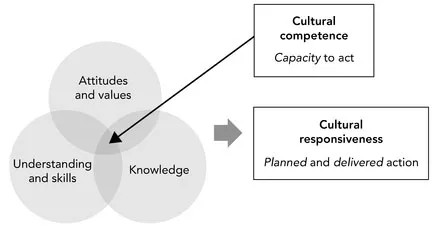
FIGURE 1.1Relationship between cultural competence and cultural responsiveness
You can see that an individual’s cultural competence is made up of their knowledge, understanding, and attitudes and values. All are essential and interact or combine when someone demonstrates culturally responsive behaviours. This means that on their own, these aspects are insufficient to support cultural responsiveness; knowledge of other cultures, for example, is not enough to enable cultural responsiveness. It needs to be demonstrated.
Knowledge, attitudes and skills for teaching in culturally responsive ways
Research indicates that teachers need to know their students and know about their students (Sowers-Hoag & Sandau-Becker, 1996; Manoleas, 1994; Nicholls et al., 1998). They also need to know about:
- the various cultural groups that make up their class in any one year
- the differences and similarities between students (or other individuals) within cultural groups
- the historical and current relationships that may have caused, or are causing, distrust between minority groups and the dominant society, and
- the power relationships that can and do occur between teachers and students/cultural groups.
Schools as places of power
Every classroom is a microcosm of society, or a ‘mini-version of society’ (Friere, 1972, 1976). The relationships that occur in a classroom generally mirror those in the world outside schools and classrooms. Teachers have a powerful role in either supporting or challenging this status quo.
This means that teachers can either continue to mirror the social inequities that occur in our society, or deliberately choose to challenge them. A teacher can make a challenge directly, through their language, relationships, pedagogies (teaching styles) or behaviour management, or indirectly, through inclusive practices such as the way they set up their classroom, materials they display on their walls, and the ‘mood’ or ‘tone’ they create by providing genuine warmth, care and affirmations.
If prejudice and racism exist in a society, we can either continue the prejudice and racism (including by failing to recognise it) or we can deliberately act to eliminate it. This means that, as teachers, we are in a position of being very powerful change agents. We can model and nurture equity or we can model and nurture the inequitable status quo (Freire, 1972; Villegas & Lucas, 2002).
‘Whiteness’ is a social construction made by society to describe the cultural, historical and sociological aspects of people who are defined as being ‘white’. It is an ideology linked to social status and power and is not based on skin colour.
The knowledge, ideologies, norms, and practices of whiteness affect how we think about race, what we see when we look at certain physical features, how we build our own racial identities, how we operate in the world, and what we ‘know’ about our place in it. HEFLAND (N.D.)
McLaren (2002, p. 133) maintains that ‘whiteness [is] a cultural marker against which Otherness is defined’. Other researchers have suggested that ‘whiteness’ is about political domination, since those who are ‘white’ use their ‘whiteness’ to perpetuate systems of privilege and consolidate their property and status (see, for example, Gillan, 2008, p. 54; Marable, 1996, p. 6).
To understand these ideas, we need to examine our own identity and how we operate in the world, asking ourselves how much is a result of the ways in which we are seen by others and the ways that they expect us to operate. As teachers, we need to consider the expectations (or power) that we and our practices place on (or give to) our students, together with the impact of policies (for example, discipline and behaviour) within the schooling system of which we are part.
PERSONAL REFLECTIONS for sharing
What do you know about the social inequities in the society in which you live and/or work?
In order to understand prejudice and racism, we need to understand ourselves. How would you respond if somebody asked ‘Who are you?’ Do you know who you are, so that you would be able to answer this question?
Understanding identity
PERSONAL REFLECTIONS for sharing
How would you answer the question ‘Who are you?’
Indigenous people are likely to answer the question ‘Who are you?’ by describing who their people (cultural group) are, what their country (the land that their people belong to) is, what their traditional language is, and something about their cultural tradition or family history. They may provide information about their lineage; that is, their genealogy or family line. They might even talk about their values, beliefs and attitudes.
It has only been relatively recently that Australian educators have spoken explicitly about Australian identity in terms of values, beliefs and attitudes. In 2005, Australian schools were provided with a set of national Australian values that they were required to display. This list was created in national dialogue, and groups of people from all cultural groups and walks of life were convened to discuss what they believed were the values of Australians (DEST, 2005). Nine Australian values resulted from this work:
- care and compassion
- doing your best
- a fair go, freedom
- honesty and trustworthiness
- integrity
- respect
- responsibility
- understanding
- tolerance and inclusion.
Many mainstream Australians know very little about their cultural background and what it means to identify as Australian, including how their cultural background ‘fits’ with being Australian. One of the reasons for this is that, relatively speaking, Australia has only a short national history, and because we are physically and to some extent socially isolated from the rest of the world, we are rarely asked about it (unless we are travelling abroad) and hence have little need to consider it.
This is not always the case. In the Japanese occupation of Singapore from 1942 to 1945:
[t]o remove Western influence the Japanese promoted the Japanese spirit (Nippon Seishin). Every school, government building and Japanese company began with a morning assembly. Those present at such gatherings had to stand facing the direction of Japan and sing the Japanese national anthem (Kimigayo). Tai sho or mass drills were made compulsory for students, teachers, staff of companies and government servants. Teachers had to learn Japanese several times a week. The students received their daily Japanese lessons on the schools’ broadcasting service. (Er, 2013)
A range of sources inform us that when the Japanese invaded Singapore in 1942, they made it compulsory for all school children to learn the Japanese language, Nippon, and children and teachers had to speak Nippon in school. In addition, people were expected to learn about Japanese culture and to conduct business in ways approved by the Japanese. The Indigenous Malays were not permitted to actively continue practices aimed at maintaining their culture and heritage, although their practices had existed for thousands of years.
If the Japanese had successfully invaded Australia, then it is possible that Australians might have been forced to make the same sorts of changes; Australian children could have been made to learn Nippon instead of the English language; Australians might not have been able to celebrate Australia Day; the Japanese might have made it illegal for Australians to teach their children openly about Australian culture or history, or to instruct them in speaking the English language.
If this had happened, it is possible that Australian culture might actually have been strengthened. People would, more than likely, have been in a position to define and describe Australian culture precisely because they would know what it wasn’t, through comparison with Japanese culture. So, it could be argued that non-Indigenous Australians don’t always have a strong position about Australian culture because they don’t have anything with which to compare it (unless, of course, they have recently come from or had a rich experience of a different cultural background, as some Australians have).
Our history helps define us. Many Australian values, as listed above, come from our history. The concept of the ‘fair go’, for example, may have developed in part from the culture that emerged following the convict period of Australian history when class values brought here from English society during colonisation didn’t seem to have a place anymore and people were more willing to take others at face value than judge them by their social standing in the ‘old country’. Similarly, the value of ‘mateship’ may have been strengthened during the two World Wars when Australian soldiers fought side by side against the enemy.
PERSONAL REFLECTIONS for sharing
What is Australian culture? What is Australian identity? How important is the history of a cultural group in understanding their worldview and perspective?
Identifying personal values
Values can differ from person to person. Answering and reflecting on the following questions might help in understanding your own personal values.
PERSONAL REFLECTIONS for sharing
What values influenced your upbringing? How did your parents and family talk about people from different cultural backgrounds? Did they use derogatory words to group these people, or use terms that showed respect? Did they judge people who were different? Did they treat them differently to those of their own cult...
Table of contents
- Cover
- Title Page
- Copyright Page
- Contents
- About the authors
- Preface
- Acknowledgements
- List of figures and tables
- Introduction Curriculum alignment and professional standards for teachers
- Chapter 1 Cultural competence and cultural responsiveness in schools
- Chapter 2 Understanding who your students are
- Chapter 3 Managing and setting expectations for relationships and behaviour
- Chapter 4 Intended curriculum, standards, literacy and numeracy
- Chapter 5 Culturally responsive teaching and learning strategies
- Chapter 6 Assessment, feedback and reporting
- Chapter 7 Challenges of teaching students in remote contexts
- Chapter 8 Conclusion: Learning to teach in a culturally responsive way
- Bibliography
- Index
Trusted by 375,005 students
Access to over 1.5 million titles for a fair monthly price.
Study more efficiently using our study tools.
Frequently asked questions
Yes, you can cancel anytime from the Subscription tab in your account settings on the Perlego website. Your subscription will stay active until the end of your current billing period. Learn how to cancel your subscription
No, books cannot be downloaded as external files, such as PDFs, for use outside of Perlego. However, you can download books within the Perlego app for offline reading on mobile or tablet. Learn how to download books offline
Perlego offers two plans: Essential and Complete
- Essential is ideal for learners and professionals who enjoy exploring a wide range of subjects. Access the Essential Library with 800,000+ trusted titles and best-sellers across business, personal growth, and the humanities. Includes unlimited reading time and Standard Read Aloud voice.
- Complete: Perfect for advanced learners and researchers needing full, unrestricted access. Unlock 1.5M+ books across hundreds of subjects, including academic and specialized titles. The Complete Plan also includes advanced features like Premium Read Aloud and Research Assistant.
We are an online textbook subscription service, where you can get access to an entire online library for less than the price of a single book per month. With over 1.5 million books across 990+ topics, we’ve got you covered! Learn about our mission
Look out for the read-aloud symbol on your next book to see if you can listen to it. The read-aloud tool reads text aloud for you, highlighting the text as it is being read. You can pause it, speed it up and slow it down. Learn more about Read Aloud
Yes! You can use the Perlego app on both iOS and Android devices to read anytime, anywhere — even offline. Perfect for commutes or when you’re on the go.
Please note we cannot support devices running on iOS 13 and Android 7 or earlier. Learn more about using the app
Please note we cannot support devices running on iOS 13 and Android 7 or earlier. Learn more about using the app
Yes, you can access Teaching Indigenous Students by Thelma Perso,Colleen Hayward in PDF and/or ePUB format, as well as other popular books in Education & Classroom Management. We have over 1.5 million books available in our catalogue for you to explore.