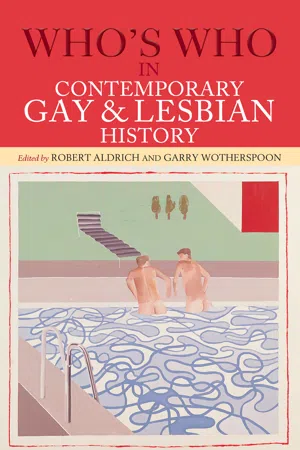
eBook - ePub
Who's Who in Contemporary Gay and Lesbian History
From World War II to the Present Day
- 480 pages
- English
- ePUB (mobile friendly)
- Available on iOS & Android
eBook - ePub
Who's Who in Contemporary Gay and Lesbian History
From World War II to the Present Day
About this book
Provides a comprehensive modern biographical survey of homosexuality in the Western world. Among those included are:* controversial political activists - Peter Tatchell; Guy Hocquenghem; Harvey Milk* pop icons - David Bowie; k d lang; Boy George* groundbreaking artists, writers and filmmakers - Pier Paolo Pasolini; Derek Jarman; David Hockney* intellectuals who have shaped and changed the modern understanding of sexuality - Michel Foucault; Simone de Beauvoir; Alfred Kinsey* over 500 entries - clear, informative and enjoyable to read - build up a superbly thorough overview of gay and lesbian life in our time.
Information
A
Abba, Swedish pop group. Unleashed on to an unsuspecting world by the Eurovision Song Contest in 1974, the Swedish group Abba became one of the most enduring of the 1970s pop sensations. Garbed in a glam-trash 1970s aesthetic, with a long list of eminently singable tunes, they acquired a cult following among gays and lesbians which both pre-dated and outlived their mass appeal.
Formed in Stockholm in 1972, the group consisted of Agnetha Faltskog, Anni-Frid Lyngstad, Bjorn Ulvaeus and Benny Andersson. Despite some early chart success, it was really the 1974 hit ‘Waterloo’ that propelled them to European prominence. By the late 1970s the Abba sound had reached a worldwide audience with hits such as ‘Money, Money, Money’ and ‘The Name of the Game’.
In many ways the initial appeal of the group to gay audiences derived from the sheer straitlaced image projected by the foursome. The quintessential boys-and-girls-next-door, they were so straight they were camp!
However, two Abba songs more than any others also endeared the group to gay audiences: ‘Dancing Queen’ and ‘Gimme! Gimme! Gimme! (A Man after Midnight)’. To the general bewilderment of the group, these songs quickly became disco anthems amongst gay audiences, their lyrics playfully subverted into paeans of sexual marginality and freedom. Meanwhile the Abba aesthetic – with its glitzy 1970s sheen, elaborate costuming, and liberal application of blue eye-shadow – has been gleefully appropriated (and satirised) by many a drag queen.
The Australian movie The Adventures of Priscilla, Queen of the Desert (1994) riotously captured the gay cult of Abba, and ushered in a huge revival of interest in the group.
Peter Gammond, The Oxford Companion to Popular Music (Oxford, 1991); Contemporary Musicians, vol. 12 (Detroit, 1994).
C. Faro
Abse, Leo (b. 1917), British politician and law reformer. Abse was born in Cardiff, the son of a Jewish solicitor. He served in the RAF during World War II and became a lawyer himself. In 1958 he became Labour MP for the safe Welsh mining seat of Pontypool. Abse saw himself as a crusader for liberal reforms. He worked for abolition of the death penalty, reform of the laws relating to suicide, adoption, vasectomy and divorce, and for prison reform. He remained, however, violently opposed to abortion.
The year before Abse’s arrival in Parliament the WOLFENDEN Report had recommended the decriminalisation of consenting sex between adult males in private. Abse, whose brother was a psychiatrist, took a strict Freudian view of homosexuality: that it was an unfortunate disorder caused by a hostile father and dominant mother. This enabled him to support homosexual law reform while generally disliking and disapproving of homosexuality. Married with two children, and fond of the publicity that came with associating himself with unpopular causes, he was well positioned to take up the case for law reform in the House of Commons.
In 1960 Labour MP Kenneth Robinson had moved a motion calling on the government to implement the Wolfenden Report’s recommendation. He was supported by, among others, Margaret THATCHER, Roy Jenkins, Tony Benn, Enoch Powell, Keith Joseph and Barbara Castle, by the majority of Labour and Liberal members, and by younger and better-educated members generally, but the motion was defeated by the conservative mass of Tory backbenchers. The party leaders on both sides remained silent. Nevertheless this debate set the stage for the long campaign to repeal Britain’s antihomosexual laws.
In March 1962 Abse moved the first of his private member’s bills on the subject. This would not have led to full decriminalisation, but would have required all prosecutions to be approved in advance by the Director of Public Prosecutions, would have required offences to be prosecuted within twelve months of their commission, and would have required a psychiatric report before sentencing in all cases. These proposals were intended to curb the zeal of homophobic chief constables and introduce uniformity in prosecutions: in practice they would have greatly reduced the number of prosecutions. The bill was ‘talked out’ by Tory backbenchers led by Sir Cyril Osborne.
The issue then lapsed for three years, despite the campaigning efforts of the Homosexual Law Reform Society, the Albany Trust and a galaxy of supporters from the universities, the press, the churches and the arts. The problem was not marshalling parliamentary numbers but securing parliamentary time, since the Conservative government controlled the House of Commons timetable. No such problem existed in the House of Lords, and in 1965 the Earl of Arran, an eccentric Scottish peer whose homosexual elder brother had died tragically after being committed by his family, moved a private peer’s bill which was passed after a prolonged debate. The real importance of the Lords debate was that the Archbishop of Canterbury, Michael Ramsay, took the opportunity to announce his support for reform.
By 1965 there was a Labour government and a number of Cabinet ministers, notably Roy Jenkins, were determined to move the issue forward, although Prime Minister Harold Wilson, a Yorkshire puritan, was unsympathetic. In February 1966 a Conservative MP, Humphrey Berkeley, moved a private member’s bill which passed the second reading stage by 164 to 107, but which lapsed when the 1966 election – at which Berkeley lost his seat – intervened. In April 1966 Arran tried again in the Lords and again gained support for his bill. The 1966 election gave Labour a large majority, bringing in a flood of younger and more liberal MPs, making the passage of a bill in the next Parliament a near certainty.
In July 1966 Abse brought in another bill, drafted by the Home Office under instructions from Jenkins. Abse’s crucial contribution was to persuade John Silkin, the government whip, to allow parliamentary time. Abse’s bill set an age of consent of 21 and provided severe penalties for sex with persons under that age. This, Abse noted, ‘aroused anger among supporters of the Homosexual Reform Society, who considered 21 far too high an age: but I would not accommodate them, both because I was unconvinced they were right and for tactical reasons’. Abse’s bill was carried on the first reading by 244 to 100, with 70 Tories and 30 Labour MPs opposed. The second reading passed by 194 to 84. Thereafter parliamentary opposition faded and the bill became law in July 1967.
Paradoxically, Abse’s views on homosexuality were backward even by the standards of the 1960s. He supported de-criminalisation in the hope that this would allow ‘a diminution in the incidence of homosexuality’ through better education and support for fatherless boys, whom he believed were the most likely to fall victim to ‘the curse, for such it must be, of a male body encasing a feminine soul’.
Despite his good works on a variety of subjects, Abse stayed on the backbenches until his retirement in 1987.
Leo Abse, Private Member (London, 1973); Patrick Higgins, Heterosexual Dictatorship: Male Homosexuality in Post-War Britain (London, 1996).
Adam Carr
Abzug, Bella (Savitsky) (1920–98), American politician and activist. Born in New York City to Russian Jewish immigrant parents, Abzug was educated in New York public schools and at Hunter College, where she graduated in 1942 as president of the student council. She then entered Columbia University Law School, dropping out during World War II to work in a shipbuilding factory. Returning to law school after marrying stockbroker Martin Abzug, she graduated in 1947 and began to specialise in labour law. She did pro bono work for the American Civil Liberties Union and defended individuals accused of subversive activities. Often dismissed or ignored because of her sex, Abzug began wearing flamboyant hats, a signature style that increased her visibility and public notoriety.
In the early 1960s, Abzug was active in the peace and women’s movements. She helped form Women Strike for Peace in 1961, served as its Legislative Director from 1961 to 1970, and worked closely with Senator Eugene McCarthy’s 1968 anti-war campaign for the US presidency.
In 1970, Abzug, a Democrat, was elected to represent New York’s ethnically diverse 19th District in Congress. Abzug actively included women in her campaign, offering day care at her headquarters so that mothers could work on her behalf. In the House, Abzug challenged the chamber’s complex seniority system, led the House peace movement (introducing on her first day in the House a resolution calling for the removal of all US troops from South Vietnam), opposed the draft, supported women’s rights legislation (including the Equal Rights Amendment), and helped write the Freedom of Information Act. Abzug served three terms in the House, narrowly losing the 1976 Democratic Senate primary to Daniel Patrick Moynihan and the 1977 New York City mayoral primary to Edward I. Koch.
Abzug was a leading supporter of equal rights for gay and lesbian people. As early as 1971, she had made public statements of support for gay rights at a New York City hearing, and Abzug and twenty-three co-sponsors introduced H.R. 5452, known as the Civil Rights Amendments of 1975, the first proposed national gay rights legislation in American history. The bill aimed to extend the protections of the Civil Rights Act of 1964 and the Educational Amendments of 1972 to end discrimination on the basis of ‘affectional or sexual preference’. The bill failed to pass, but has been reintroduced in every session of Congress since then.
Although Abzug’s electoral defeats were more numerous than her victories and her legislative accomplishments were few, she wielded a great deal of influence among legislators, within social movements for peace and gender equality, within the Democratic Party and in New York City politics. Her high profile, long-time commitment to social justice, and safe position in a very liberal constituency allowed Abzug to raise gay and lesbian equality as an issue when few other political leaders were willing or able to do so.
Bella Abzug, ‘Seeks Equal Protection’, Congressional Record, vol. 121, pt. 7 (25 March 1975), pp. 8581–2; Bella Abzug with Mim Kelber, Gender Gap: Bella Abzug’s Guide to Political Power for American Women (Boston, 1984); Doris Faber, Bella Abzug (New York, 1976); Mel Ziegler (ed.), Bella! (New York, 1972).
Christopher Capozzola
Achmat, Zackie (b. 1961), South African writer, filmmaker and activist. Born in Fietas/Vrededorp in Johannesburg, Achmat grew up in Salt River, Cape Town, in a conservative Muslim family. As told in his autobiographical story My Childhood as an Adult Molester, he abandoned the madrassa and Islam at age ten, and began cruising for sex with older white men. He was arrested in student riots following the 1976 Soweto rebellion and was later active in underground Trotskyist organisations. From the mid-1990s he was a key advocate for the rights of people with HIV through the University of Witwatersrand-based AIDS Law Project and the National AIDS Convention of South Africa (NACOSA). He has made several films including Scorpion under a Stone (1996), which reframes the history of the Afrikaans language, Gay Life is Best (1992), and Die Duiwel Maak My Hart So Seer (1993). In 1994 he became a founding leader of the National Coalition for Gay and Lesbian Equality, and was a key figure in the inclusion and retention of sexual orientation in the equality clauses of the Bill of Rights in the Constitution of 1994, the subsequent striking down of the anti-sodomy laws, and the recognition of same-sex couples in immigration regulations. He publicly announced his HIV-positive status in mid-1998, and became a key activist in the campaign to make HIV treatments available in South Africa.
Ken Davis
Ackerley, J(oe) R(andolph) (1896–1967), British writer. Born in London, the second son of Roger and Netta, brother to Nancy Ackerley, his father was a prosperous businessman, his mother an actress. The family was peculiar in more than one respect. Roger and Netta did not marry until 1919. Netta was a depressed hypochondriac, his father a bon vivant away from home a good deal on business and pleasure. Ackerley discovered after his father’s death that one of those pleasures was a second family – he had two half-sisters – that his father had established soon after he settled down with Netta. During World War I, his brother Peter was killed and Ackerley himself was wounded and taken prisoner; his experience became the basis for his first foray into literature, his only play, The Prisoners of War (1925). It was an artistic but not financial success. While there are no explicit homosexual references in the play, it was obvious that two of the prisoners were homosexuals, one of the earliest unapologetic presentations of gay men on the English stage. The play influenced other gay writers like Siegfried Sassoon and especially E. M. Forster, who wrote a note of admiration to the author. Thus began their life-long friendship, one of the most important relationships for both men. Forster arranged for Ackerley to go to India as a secretary to a rich maharajah who was flagrantly homosexual. That experience was recorded as Hindoo Holiday: An Indian Journal (1932).
Ackerley was the literary editor of The Listener between 1935 and 1959 and turned his section of the magazine into one of the most prestigious and intellectual voices in book reviewing, soliciting work from every important writer of the time, from T. S. Eliot to W. H. Auden. But the demands of his position kept Ackerley from writing much himself. He wrote a remarkable memoir about his dog Queenie which he called My Dog Tulip: Life with an Alsatian (1956) and a novelisation of the same material, We Think the World of You (1960). His masterpiece, the autobiography My Father and Myself (1968), was published posthumously, as were his letters (1975) and his diaries (1982).
The memoir about his father was begun thirty years before its publication, but he delayed its public appearance because it was both too intimate and too bold. The book is regarded as one of the best examples of modern autobiography. In it, Ackerley details his own homsexual life, one beset with disappointment and unhappiness, as well as the astonishing life of his father, which he reconstructs to tell the story of both of Roger Ackerley’s marriages as well as his experience as a male prostitute when he was a young man in the Guards. The book is a unique exploration of the journey towards self-discovery of a talented, handsome homosexual at a time when most gay men were constrained if not silenced on the subject, a document about gay life when closetry caused gay men and women much pain personally and professionally.
Peter Parker, Ackerley: The Life of J. R. Ackerley (London, 1989).
Seymour Kleinberg
Adam, Barry (b. 1952), Canadian academic and activist. Teaching sociology at the University of Windsor (Ontario) since 1976, Adam has been a pioneer in the comparative analysis of lesbian/gay political movements, and prominent in developing networks among sexual minority academics in Canada and the United States.
Adam is well known internationally as one of the very few social scientists to examine lesbian/gay/bisexual/transgendered movements cross-nationally. He first established a significant profile by writing The Rise of a Gay and Lesbian Movement (1987, rev. edn 1995), a wide-ranging and widely cited analysis of oppression and activist response in Europe and North America from the early twentieth century to the present. More recently, he has edited an important collection of original essays on gay activism in a variety of countries – The Global Emergence of Gay and Lesbian Politics (1998). He has also authored significant articles on AIDS activism, social-movement theory and other topics.
Adam’s activism dates from 1970, when he was a member of Vancouver’s Gay Liberation Front. In 1976, he was a founding member of the American Sociological Association’s Gay Caucus (now Lesbian, Gay, Bisexual, Transgender Caucus). He was a key member of the founding committee of the Canadian Lesbian and Gay Studies Association, and has served as its president. He was also a founding member and first president of Windsor’s AIDS Committee.
Janice L. Ristock and Catherine G. Taylor (eds), Inside the Academy and Out: Lesbian/Gay/Queer Studies and Social Action (Toronto, 1998).
David Rayside
Aggleton, Peter (b. 1952), British gay health educator and co-editor of the Social Aspects of AIDS series of books and of the journal Culture, Health and Sexuality. Aggleton is Professor of Education and Director of the Thomas Coram Research Unit at the Institute of Education, University of London.
HIV/AIDS is a very modern disease which has produced a response appropriate for the times in which it has emerged. It is a disease which has transcended the traditional medical barriers of an epidemic, and particular attention has been placed on the non-medical aspects of the disease. For instance, many social and political issues associated with the disease have been highlighted, particularly as these relate to attempts to contain the spread of the virus. Thus, the epidemic has spawned an industry beyond the scientific and medical communities. Each polity has produced a group of non-medical experts and commentators relevant to their respective needs – in many fields there has been extensive international collaboration in these non-medical aspects of AIDS.
An example of this international collaboration can be found in the work of Peter Aggleton in his role as editor of the book series The Social Aspects of AIDS, published by Taylor and Francis. Aggleton’s involvement with HIV/AIDS commenced with the development of AIDS-related health-education materials at the former Bristol Polytechnic (University of the West of England) in the 1980s. Agglet...
Table of contents
- Cover
- Half Title
- Series Page
- Title Page
- Copyright Page
- Contents
- Introduction
- Contributors
- Acknowledgements
- WHO'S WHO IN CONTEMPORARY GAY AND LESBIAN HISTORY: FROM WORLD WAR II TO THE PRESENT DAY
Trusted by 375,005 students
Access to over 1.5 million titles for a fair monthly price.
Study more efficiently using our study tools.
Frequently asked questions
Yes, you can cancel anytime from the Subscription tab in your account settings on the Perlego website. Your subscription will stay active until the end of your current billing period. Learn how to cancel your subscription
No, books cannot be downloaded as external files, such as PDFs, for use outside of Perlego. However, you can download books within the Perlego app for offline reading on mobile or tablet. Learn how to download books offline
Perlego offers two plans: Essential and Complete
- Essential is ideal for learners and professionals who enjoy exploring a wide range of subjects. Access the Essential Library with 800,000+ trusted titles and best-sellers across business, personal growth, and the humanities. Includes unlimited reading time and Standard Read Aloud voice.
- Complete: Perfect for advanced learners and researchers needing full, unrestricted access. Unlock 1.5M+ books across hundreds of subjects, including academic and specialized titles. The Complete Plan also includes advanced features like Premium Read Aloud and Research Assistant.
We are an online textbook subscription service, where you can get access to an entire online library for less than the price of a single book per month. With over 1.5 million books across 990+ topics, we’ve got you covered! Learn about our mission
Look out for the read-aloud symbol on your next book to see if you can listen to it. The read-aloud tool reads text aloud for you, highlighting the text as it is being read. You can pause it, speed it up and slow it down. Learn more about Read Aloud
Yes! You can use the Perlego app on both iOS and Android devices to read anytime, anywhere — even offline. Perfect for commutes or when you’re on the go.
Please note we cannot support devices running on iOS 13 and Android 7 or earlier. Learn more about using the app
Please note we cannot support devices running on iOS 13 and Android 7 or earlier. Learn more about using the app
Yes, you can access Who's Who in Contemporary Gay and Lesbian History by Robert Aldrich, Garry Wotherspoon, Robert Aldrich,Garry Wotherspoon in PDF and/or ePUB format, as well as other popular books in Social Sciences & Social Science Biographies. We have over 1.5 million books available in our catalogue for you to explore.