This book examines how working-class high school students' identity construction is continually mediated by discourses and cultural practices operating in their classroom, school, family, sports, community, and workplace worlds. Specifically, it addresses how responding to cultural differences portrayed in multicultural literature can serve to challenge adolescents' allegiances to status quo discourses and cultural models, and how teachers not only can rouse students to clarify and change their value stances related to race, class, and gender, but also provide support for and validation of students' self-interrogation.
Highlighting the influence of sociocultural forces, the book contributes to understanding the role of institutions in shaping adolescents' lives, and identifies needs that must be addressed to improve those institutions. Current theory and research on critical discourse analysis, cultural models theory, and identity construction is meshed with specific applications of that theory and research to case-study profiles and analysis of classroom discussions. The instructional strategies described enable pre-service and in-service teachers to develop their own literature curriculum and instructional methods.
eBook - ePub
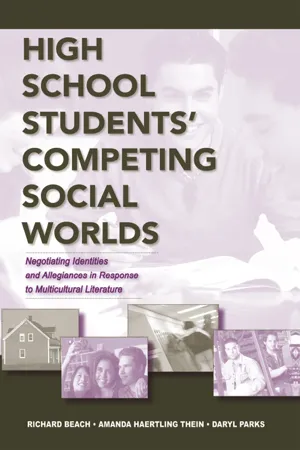
High School Students' Competing Social Worlds
Negotiating Identities and Allegiances in Response to Multicultural Literature
- 350 pages
- English
- ePUB (mobile friendly)
- Available on iOS & Android
eBook - ePub
High School Students' Competing Social Worlds
Negotiating Identities and Allegiances in Response to Multicultural Literature
About this book
Information
CHAPTER 1
Constructing Mediated Identities across Different Social Worlds
Meet Troy1, a clean-cut, White, working-class, 11th-grade student. In his third year at Thompson High School, Troy already had one foot out the door into the “real world,” as he put it. Troy spoke candidly about the past three years: “For me, high school is dumb; it’s a waste of time.” For Troy, school was a temporary stepping-stone that served as a gateway to the larger world of opportunity. He did not participate in school activities and enrolled in as many college-credit courses as possible via the Post-Secondary Enrollment Options (PSEO) program to save money and to speed his college entrance.
Troy perceived the high school world as unfairly privileging and as marginalizing certain types of students: “If you don’t play sports or work on the prom committee, then you aren’t cool.” He also identified a disparity in the relationship between teachers and the popular students: “There’s only like two teachers in the school who are cool with all of the students.” Troy also questioned the “fairness” of Thompson’s administrators and teachers, explaining that they were more concerned with “giving students a bunch of busy work” than with preparing students for college or ensuring that all students were adequately equipped for success in the real world. Troy’s beliefs about school and about the kind of person he wanted to be were bound up in the many competing social worlds in which he participated.
Troy’s parents both grew up in the inner-ring suburbs around Thompson. He was two years old when his parents divorced. He attributed the divorce primarily to his father’s substance abuse, explaining that both parents “partied a lot when I was young.” Though his biological father was not in his life, Troy explained that he learned “not to use drugs” and “not to have kids when you’re young” through his father’s negative modeling.
While Troy’s father struggled, Troy’s mother found an entry-level job working for the state government. Over the years, she received government assistance, worked second jobs, took classes, and ultimately completed a degree in social work that allowed her to find stable employment and upward mobility. Troy described her as a “super tough” parent but also cited her as the primary influence on his path to success. He said, “No matter how much I may not like her as a person, she has given me the tools in life to get a little farther than others might.”
Troy’s mother remarried when he was five, and his stepfather became a key adult in his life. His stepfather worked at a bakery and then a printing press during Troy’s childhood. Since his stepfather worked at night and slept during the day, Troy explained that it was a tense environment at home. Troy, however, came to perceive his stepfather as a role model for overcoming life’s challenges: “He had kids when he was sixteen. He didn’t graduate high school and he has dyslexia. He did drugs, did dumb things. But he taught me that to be a man is to work. If it is 60 or 80 hours a week, you don’t cry or whine. You don’t get sick, you don’t get tired; you just do it.”
Troy learned other important lessons in life through his involvement in his community—the East Side neighborhood. His earliest connections around the neighborhood were through athletic leagues in which he played organized football, baseball, and hockey. However, Troy quit these leagues during middle school, explaining that “it got too tough having the neighbors take me and pick me up from practices. My mom could never come to one game.”
Troy’s other connections to the neighborhood were more problematic. Many evenings found him and his friends running from the police because of the “crazy stuff we did.” He noted, “I was a thief when I was younger, a hoodlum. I’ve seen a lot, been through a lot, been beat up, beat up kids, once beat up a kid so bad I broke my middle finger on his nose, went to juvi [juvenile incarceration] and didn’t know how to get out, to stop it.”
At age 16, Troy left his parents’ home and began to live on his own. He recognized that it is unusual to be self-sufficient at this age but chose to make the best of his current arrangement: “When I got kicked out at age 16, I couldn’t say I was a man. But I owned a fridge and air conditioner and vacuum. I’ve had to work hard all through high school, 32 hours a week. If I didn’t go to school, if I didn’t do my work, then I knew I would end up being a nobody … a shift supervisor at McDonalds: I had more potential and the knowledge and the power and the faith to get through things.”
Consistent with research that finds that working-class adolescents have strong ties to the local neighborhood community or workplace, stronger often than with school (Eckert, 1989, 2001; Phelan, Davidson, & Yu, 1998; Seitz, 2004a, 2004b), Troy reflected positively on his upbringing and his community. He said, “I take pride in growing up on the East Side because of what I had to come through.” He recognized that his neighborhood might be considered “the ghetto” to outsiders, but he saw it as providing him with a definitive set of values. He contrasted his hardscrabble childhood with those of people from more affluent backgrounds: “I think being rich would have turned me personally into a rich bastard. I’d be greedy, have no friends, and have everything.”
Troy’s development as an adolescent was strongly related to his ties to specific social worlds of his family, neighborhood, church, school, and workplace. As he moved across these different worlds, he was exposed to multiple perspectives on issues related to race, class, and gender—issues such as desegregation, affirmative action, gender wage gaps, immigration policy, antipoverty government programs, and same-sex marriage. Through his participation in competing social worlds, Troy acquired and developed beliefs, attitudes, and practices associated with becoming a certain kind of person (Hicks, 2001).
The Study
Troy was a participant in our research study of high school students’ responses to multicultural literature in a class taught in fall 2001 at Thompson High School—a diverse, working-class high school of 1,583 students in a large Midwestern city. Students in this study were enrolled in a College in the Schools course on modern literature that operated in conjunction with a local university through which students earned college credit. Students elected to take this course based on their assumption that they would attend college. However, in contrast to an advanced placement (AP) or honors English class within a tracked system, the students in the class represented a range of ability levels.
Thompson High School was chosen for its diversity—the student body is 39% White, 32% Asian American (largely Hmong), 19% African, 8% Hispanic, and 1% Native American—and because the recent demographic shifts in the school and the community created a unique site for studying racial and social class tensions. Although White students were increasingly the minority in this school, the school and community’s long history of a statistical White majority remained discursively intact; Whiteness functioned as the invisible norm against which “others” were judged. The prevailing discourses of athleticism and competition in the school reflected the community’s value placed on hard work, competition, and adherence to a controlling authority. Student athletes were often held up as exemplars of the values of hard work and competition in all aspects of life.
The participants in this one-year qualitative research study consisted of 14 11th- and 12th-grade students: eight females and six males. In this group of 14, nine were White, three were Asian American, one was Hispanic, and one was a student of African descent. Two of the 14 students were 11th graders. Of these 14 students, based on information about parental occupations, only two students—the African student and one of the White students—could be characterized as middle class in terms of family income. The other students could be characterized as working class. The research team consisted of Richard Beach, a professor at local university who is White and middle class; Amanda Thein, a doctoral student at the time of the study who is White and middle class; and Daryl Parks, the White teacher of the class that was the focus of this study, who was also a doctoral student at the time of the study. As we will demonstrate, the fact that Parks came from a working-class background was critical to his success in engaging students in responding to multicultural literature.
Much of the previous research on responses to multicultural literature finds that high school students have difficulty interpreting characters’ practices because they are not familiar with the cultures portrayed in these texts (Hemphill, 1999; Jordan & Purves, 1993). They also have difficulty interpreting larger cultural or institutional forces associated with race, class, and gender systems, adopting an individualistic stance to interpret characters in terms of their personal agendas and motives as opposed to an institutional perspective in which they interpret characters as shaped by larger social and cultural forces (Beach, 1997a, 1997b; Vinz, Gordon, Lundgren, LaMontagne, & Hamilton, 2000). White students in particular often struggle to see the institutional aspects of Whiteness and, as a result, often impose discourses of White privilege onto their readings of texts (Miller & Legge, 1999; Möller & Allen, 2000).
In this study, we examined students’ responses to multicultural literature over a period of six months. We were particularly interested in how the students’ responses reflected the discourses and cultural models constituting their identities. Also, we were interested in the ability of students to interpret the cultural differences portrayed in multicultural literature.
In designing the course, Parks selected texts that represented a range of different racial and ethnic groups and perspectives as well as texts that revolve around characters coping with dialogic tensions, including The House on Mango Street (Cisneros, 1991), Bless Me, Ultima (Anaya, 1995), Kindred (Butler, 1979), Their Eyes Were Watching God (Hurston, 2000), Obasan (Kogawa, 1993), the film Smoke Signals (Eyre, 1998), Woman Warrior (Kingston, 2000), Love Medicine (Erdrich, 2000), Bastard out of Carolina (Allison, 1993), and A Yellow Raft in Blue Water (Dorris, 1987).
Parks encouraged exploration around issues of race, class, and gender that were rarely addressed in the larger school culture or in the students’ other courses. He employed journal writing and group discussions to foster critical response to the texts in the course, frequently supporting student expression of minority or alternative interpretations to foster dialogic tensions in discussions.
In this study, we analyzed selected classroom discussions, student interviews, focus-group discussions, and an interview with Parks and coded them using NVivo (QSR International, 2005) qualitative software. Employing a grounded theory perspective (Lincoln & Guba, 1985), codes were generated inductively through extensive discussions among the three researchers. We devoted multiple meetings to sharing our perceptions of the transcripts, noting consistent themes related to student identity construction, social practices, discourses, stances, and norms operating in the classroom, school, community, family, and workplace cultures. We generated a tentative set of codes, which were then applied to samples of the data. Comparisons of each of our uses of the codes to analyze the data led to further revisions and refinements of the coding system. A final version of the coding system (see Appendix A) was again used in coding a sample of the data to determine interjudge reliability, and a relatively high level of agreement (more than 75%) was achieved. These codes focused on the frequency of students’ use of different discourses and cultural models related to gender, class, race, sports, schooling, historical–cultural contexts, psychology and family, and religion. This analysis identified participants’ voicing of discourses, cultural models, and narratives related to various topics, for example, adoption of discourses of individual prejudice or race-talk (Bonilla-Silva, 2001) related to discussions of race.
Constructing Identities across Social Worlds
In conducting this study, we assumed that adolescent identity development is more than simply a matter of an individual’s solo projection into adulthood. Individualist models of adolescent identity construction frame adolescent development primarily in terms of their personal traits and behaviors without considering how development occurs through participation in social worlds (Phelan, Davidson, & Yu, 1998; Vadeboncoeur, 2005). These models are reflected in literature units such as “The Individual versus Society,” in which students study individual characters such as Holden Caulfield in The Catcher in the Rye (Salinger, 1996) as resisting the conformist demands of society. Such models presuppose that individuals exist outside of rather than coterminous with society.
On the other end of the spectrum, postmodern theories of identity positing that adolescents adopt entirely different identities or relational selves across different contexts (Gergen, 1994) fail to consider how in enacting or improvising certain versions of the self (Moje & Helden, 2005), adolescents may still subscribe to certain consistent beliefs or value stances that transcend particular contexts (Erickson, 2004).
Adolescents do not simply construct their identities on their own; they construct their identities through their participation, competing social worlds of peer group, family, school, community, and workplace (Beach & Myers, 2001; Phelan, Davidson, & Yu, 1998). In this socialization, they learn particular race, class, and gender practices associated with being perceived as certain kinds of persons in certain social worlds. Troy acquired gendered practices of masculine assertiveness and resistance to authority through his experiences in his family, sports, and workplace worlds. At the same time, he also acquired practices in his working-class worlds related to resentment toward middle-class norms prevailing in school and workplace worlds.
The purpose of our study was to examine how adolescents construct their identities through their participation in social worlds, including participation in worlds portrayed in multicultural literature. We began with the premise that identity construction is mediated by discourses and cultural models acquired through participation in social worlds and in text worlds. For example, from their experiences in working-class family and school worlds, students acquire certain discourses of race that shape not only their own identity construction but also their interpretations of characters’ identities. Rather than perceive these students’ identities as fixed entities, we explored the ways their identities continually shift as students take up, revise, and amend discourses of race, class, and gender across the time and space of various social worlds (Holland & Leander, 2004; Leander & Sheehy, 2004).
Understanding adolescent identity construction therefore requires analysis of the particular race, class, and gender practices operating in particular social worlds. Based on previous research on identity construction through membership in subcultural groups (e.g., jocks, burnouts, preps, rednecks, punks [Eckert, 1989, 2001; Willis, 1977, 1998]), it is important to examine how adolescents’ practices associated with these group memberships vary across different worlds. Rather than simply identifying Troy as working-class rebel who resists the school culture, understanding his identity requires analysis of how his practices vary across his peer group, family, school, and workplace worlds. Troy’s perceptions of the value of schooling and the need to persist against overwhelming odds likely stems from the influence of his mother and stepfather, as well as Parks, the teacher of the multicultural literature class that we studied.
Qualitative researchers have also moved away from assigning traits to adolescents based on the reasoning that if X adolescent is of Y type, he or she must have Z traits (Gutierrez & Rogoff, 2003). For example, it could be argued that if Troy is a White working-class male, then he will probably be less likely to enjoy reading or discussing literature than do females. Applying these static, essentialist categories such as White, working-class male limits our understanding of the ways adolescents learn to engage with others in communities. For example, through participation in particular communities or social worlds, a White, working-class male may acquire certain practices that challenge stereotypes of that person as uneducated and racist. These essentialist categories are particularly problematic when applied to students of color based on individual traits, for example, that African American male adolescents lack motivation to achieve in school (Gutierrez & Rogoff, 2003).
Identity Construction as Performing Different Versions of the Self
Rather than apply these static labels of identity traits, researchers have studied identity construction as performing different versions of the self in specific social worlds (Bennett & Fabio, 2004; Bettie, 2003; Moje, Ciechanowski, Kramer, Ellis, & Callazo, 2004). Drawing on performance theory (Schechner, 2002), these researchers examine how adolescents’ perform different versions of the self in response to challenges of specific social situations or the dictates of social worlds (Bettie, 2003; Erickson, 2004). Rather than simply learning to follow rules, adolescents employ practices that serve to define their footing (Goffman, 1981) or agency in specific situations or events related to how they want others to perceive their identities. As Erickson (2004, p. 148) noted, “People must have ways of telling one another who they want to be regarded as being, for the purposes of that particular moment in the encounter.”
In these performances, there is always a tension between bottom-up, innovative attempts to circumvent norms or dictates versus the need to conform to norms and dictates operating in specific contexts. Adolescents will vary in how they enact these tensions...
Table of contents
- Cover
- Half Title
- Title Page
- Copyright Page
- Table of Contents
- Preface
- Acknowledgments
- Chapter 1 Constructing Mediated Identities across Different Social Worlds
- Chapter 2 The Social Worlds Constituting Students’ Identities
- Chapter 3 Responding to the lnfluence of Social Worlds on Characters and Readers
- Chapter 4 Critiquing Social Worlds through Grappling with Dialogic Tensions
- Chapter 5 Parks’s Methods for Teaching Multicultural Literature
- Chapter 6 Identity Construction Congruent with the School World: Corey and Michelle
- Chapter 7 Identity Construction Challenging the School World: Devin and Kayla
- Chapter 8 Identity Construction and Racial Positioning: Kathy and Mai
- Chapter 9 Dialogic Tensions in ClassroomDiscussions of Three Novels
- Chapter 10 Summary and Implications for Teaching Multicultural Literature
- References
- Appendix A: Methods
- Appendix B: Literature Used in the Course: Recommended Literature
- Index
Trusted by 375,005 students
Access to over 1.5 million titles for a fair monthly price.
Study more efficiently using our study tools.
Frequently asked questions
Yes, you can cancel anytime from the Subscription tab in your account settings on the Perlego website. Your subscription will stay active until the end of your current billing period. Learn how to cancel your subscription
No, books cannot be downloaded as external files, such as PDFs, for use outside of Perlego. However, you can download books within the Perlego app for offline reading on mobile or tablet. Learn how to download books offline
Perlego offers two plans: Essential and Complete
- Essential is ideal for learners and professionals who enjoy exploring a wide range of subjects. Access the Essential Library with 800,000+ trusted titles and best-sellers across business, personal growth, and the humanities. Includes unlimited reading time and Standard Read Aloud voice.
- Complete: Perfect for advanced learners and researchers needing full, unrestricted access. Unlock 1.5M+ books across hundreds of subjects, including academic and specialized titles. The Complete Plan also includes advanced features like Premium Read Aloud and Research Assistant.
We are an online textbook subscription service, where you can get access to an entire online library for less than the price of a single book per month. With over 1.5 million books across 990+ topics, we’ve got you covered! Learn about our mission
Look out for the read-aloud symbol on your next book to see if you can listen to it. The read-aloud tool reads text aloud for you, highlighting the text as it is being read. You can pause it, speed it up and slow it down. Learn more about Read Aloud
Yes! You can use the Perlego app on both iOS and Android devices to read anytime, anywhere — even offline. Perfect for commutes or when you’re on the go.
Please note we cannot support devices running on iOS 13 and Android 7 or earlier. Learn more about using the app
Please note we cannot support devices running on iOS 13 and Android 7 or earlier. Learn more about using the app
Yes, you can access High School Students' Competing Social Worlds by Richard Beach,Amanda Haertling Thein,Daryl L. Parks in PDF and/or ePUB format, as well as other popular books in Education & Education General. We have over 1.5 million books available in our catalogue for you to explore.