The end of a command-and-control regulatory system … insurance breaks … easier access to financing. These were among the expectations heaped onto ISO 14000 even before the voluntary series of environmental management system (EMS) standards left the starting blocks. Although the standards in the series have been developed at a varying pace, the series cornerstone — ISO 14001 — was published September 1, 1996. It provides the framework for organizations to implement an EMS. But much like Christmas morning, the heightened anticipation for ISO 14001 created a collective letdown when the standard finally arrived. Just three years into the life of the standard, some are actually disappointed that command-and-control is alive and well. And they’ve seen precious little evidence of insurance and financial breaks for companies sporting an ISO 14001 EMS.
But what did they expect, Santa Claus? Wouldn’t you hate to be judged so harshly while you were still a toddler?
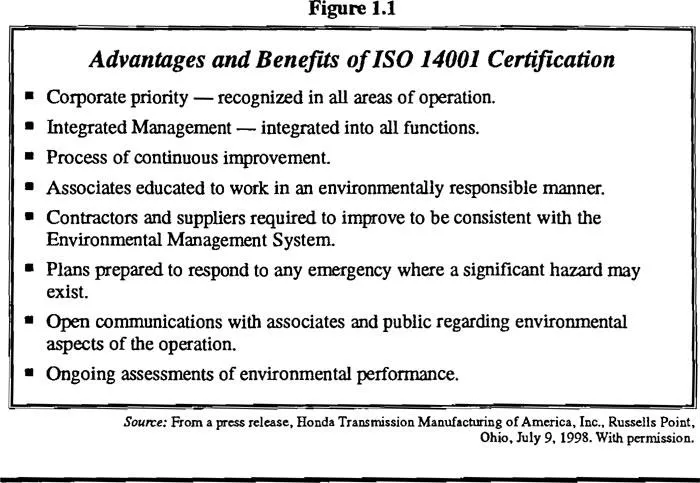
ISO 14001 does translate into business advantage. At the time of this writing, more than 10,000 certificates to ISO 14001 have been issued worldwide. Also, organizations have reported phenomenal savings and a quick return on investment (ROI). While much of the data is anecdotal, companies report many business benefits of ISO 14001: improved employee morale, enhanced relationships with regulators, waste minimization, better community relations, and process efficiencies. They also indicate that movement is afoot on the regulatory, insurance, and banking fronts, but the progress remains understandably slow (Figure 1.1).
The origins of ISO 14000 can be traced to the 1972 U.N. Conference on Human Environment in Stockholm, Sweden. That meeting resulted in a 1987 report that initially referenced “sustainable development,” calling for industry to develop environmental management systems. Then, the United Nations convened an environmental summit in Rio De Janeiro, Brazil, in June 1992. In preparation for that meeting, the International Organization for Standardization (ISO), a worldwide organization of national standards bodies from more than 120 countries, formed the Strategic Advisory Group on the Environment (SAGE) in 1991. SAGE invested two years probing BS 7750, the precursor to ISO 14000, resulting in the establishment of ISO Technical Committee 207 (TC 207), which was tasked to develop ISO 14000. The specification document, ISO 14001, anchors the series, and it requires companies to identify their environmental aspects and impacts and then to set targets and objectives for reducing those impacts1 (see Appendix F).
ISO 14001 is the only international EMS standard on the market, and it has been adopted as an American national standard. That fact notwithstanding, another major criticism often hurled at ISO 14001 is that certification is sluggish in the United States. At this writing, about 350 of the total certifications are in the United States, which pales next to Japan and other certification leaders.
But the certification numbers don’t tell the whole story. Many companies are implementing the system but stopping short of paying for a third-party auditor to examine their EMS. These companies are certification-ready, but they are waiting to see what the market will demand. Implementation and certification are two separate business decisions. The standard allows for an alternative, known as self-declaration. Rather than having an outside third-party place its stamp of approval on the EMS, a company may choose to police itself and declare its conformance to the standard. And many companies are choosing self-declaration over certification. Another major reason U.S. companies may appear to be slow in accepting the international standard is that they have been toeing the line for a tough regulatory system for years. Environmental management systems are nothing new in the United States, where they have been prevalent for years.
Suzan L. Jackson, director of environmental services at Excel Partnership in Sandy Hook, Connecticut, discounts the notion that the certification numbers are low. “I hear that all the time,” said Jackson, who provides training for companies to implement the standard. “I don’t agree.”
She continued, “I think people went into 14001 with much too high of an expectation. If you look at the progress of 14001 registrations and compare that to the progress of 9000 registrations at the same point in their lifetime, it is about the same. If anything, 14001 has been quicker to catch on because some people already knew about it and more people were involved in developing it.”2
ISO 9000 is a series of standards for quality management systems that predates ISO 14000 by about a decade. ISO 9000 has its origins in BS 5750, a specification published in 1979 in the United Kingdom. ISO 9000 was published in 1987, and at this writing, more than 226,000 certifications are reported around the globe.3
Many credit ISO 9000 as putting the International Organization for Standardization on the map. Founded in 1947, ISO promotes the development of standardization and related activities to facilitate international trade. Headquartered in Geneva, Switzerland, ISO has churned out 11,000 international standards, but despite the volume of standards development work, ISO was relatively obscure until ISO 9000 hit the market. “We used to complain that not enough people knew what ISO was about,” said ISO Secretary-General Lawrence Eicher. “Now we complain that too many people think that ISO 9000 is the only thing we do.”4
But ISO continues to produce new standards — each business day some 15 meetings of the nearly 3000 ISO technical groups with a total of 30,000 participating experts are held around the world.5
And some, like Jackson, believe ISO 14001 is doing as well, if not better, than ISO 9000 did in its first few years. Registrations, another term for certifications, at least in the United States, are progressing at a reasonable level, said Jackson, who is an active member of the U.S. TAG to TC 207. She said it makes sense for companies to approach registration cautiously.
“There may not be a business driver for some companies right now,” she said. “Registration is an out-of-pocket cost. Implementing an EMS that meets ISO 14001 requires an internal investment; it requires some money to be spent mainly in reallocating resources internally, because everyone thinks they don’t have time to work on anything else right now. So something else has to be able to slip in order for you to be able to work on improving your EMS. But it has immediate payoff, and it is an investment rather than a cost. When it comes to registration, that is very much an individual business decision, or it should be. And some companies simply don’t see any need for it yet, or any driver, and they are waiting until they see a driver.
“And I think that is a very appropriate, very reasonable response to this. In fact, that is what we advise our customers to do. Use the standard to implement or improve your EMS now, get the benefits out of it. Keep an eye on the registration drivers, and make a business decision about whether or not you need registration.”
Another consultant, who served as an expert on Subcommittee 1 that wrote ISO 14001, agreed with Jackson. Marilyn R. Block, president of MRB Associates in Potomac, Maryland, said one of the reasons U.S. certifications appear to be lagging is the difference between implementation and certification; some companies are just declining to get certified.
“I’m not sure that we are lagging as far behind as the certification numbers would suggest,” said Block, who was honored by the TAG in 1998 for outstanding achievement.6
“We’ve had command-and-control regs in place for a long time, and frankly that puts us way ahead of most of the rest of the world in terms of many of the kinds of activities that need to be put into place. And I think a lot of companies feel that they don’t need to be certified because they are already doing many of these things.”
One such company is Wilton Armetale in Mount Joy, Pennsylvania, which is the only foundry in America to self-declare conformance to the standard. David J. Schell, the company’s environmental specialist, said organizations should decide why they are pursuing ISO 14001 before they jump into it. The decision to earn ISO 14001 certification is market-driven, and Wilton Armetale’s market has yet to call for this particular seal of approval.7
“I don’t think people should just go ahead and implement it because it is the newest thing out there; because in some companies, it may not be necessary,” he said. “If you have a good, sound environmental management system to begin with, I don’t know what real benefits you’d get from just doing ISO 14000. It is certainly a great tool to take the systems that you have and make sure it meets standards that other companies would be attaining, but some companies will implement it and some won’t. We self-declared our certification about one-and-a-half years ago, and to this day, no one has forced us to get third-party audit.”
Some companies aren’t seeking certification, he said, because the three-year audit cycle prices are so high.
“If you are doing it because it is the right thing to do, in my mind, you don’t need someone else to come in and say, ‘Yeah, you’re doing it, here’s a certificate.’ You’ll know if you are doing it by seeing your waste costs come down and seeing your waste volumes decrease. That’s what you need to see. A certificate on the wall isn’t something people should strive for. We sell internationally in Germany, Canada, Japan, all the countries at the forefront [of the ISO 14000 movement] and not one person has asked us to get a third-party certification. So I would say right now the market is not there for our product; it might be product-specific.”
Echoing Schell, Block said the cost is not prohibitive, but many companies don’t yet see the value in the certificate. Implementation costs are nearly impossible to estimate, she said, noting the nature of the company and size of the business affects the cost. Also, companies that have an ISO 9000 system in place sometimes can implement ISO 14000 much cheaper, because they can piggyback procedures, building on their previous experience. Indeed, estimates from various companies have been all over the map.
“I’ve heard that people have done it for as low as $25,000 or $30,000 and as high as half a million,” Block said. “I find both figures a little weird. One being very low and the other being incredibly high, but it really depends on where they are starting from. A company that has an existing quality system will do it for far less money than a company that doesn’t.”
Implementation costs also depend upon what assumptions the companies make when they come up with the numbers, she said. Block said companies use a variety of factors in determining cost. Some calculate the lost productivity of workers who are receiving training rather than producing widgets. But other companies look at the employee training cost as a nonfactor because they are already paying the salaries, so there’s no out-of-pocket cost.
“You have to know what they have factored into the cost estimate in order to know what you’ve really got.”
Another company that provides ISO 14000 training and information services also has tried to pinpoint the cost of implementing an EMS. CEEM, Inc., a member of the BSI group of companies, said the cost of certification varies according to the company size and its existing EMS. According to information on CEEM’s web site, the average cost for one site within a multinational company, such as Akzo Nobel, averages about $100,000, with small- and medium-sized enterprises (SMEs) estimating an average cost of between $50,000 and $75,000 per facility.8 Those estimates include a variety of factors depending upon the individual company. Among the cost factors is the development and implementation of the EMS, staff time, and consultant fees (see Appendix F).
Block noted that while implementation costs are hard to nail down, the actual certification costs are a bit easier to estimate. The reason? Registrars have published most of their rates. Registrars charge per auditing day and, typically, two auditors will spend two or three days evaluating the EMS, with another day to pull together a final audit report, Block said. But she quickly noted the time spent varies depending on the size and complexity of the system. Most registrars are charging, or at least listing, prices at around $1400 a day, she said. So, by calculating $1400 at eight auditor days, the total comes to $11,200. Thus, depending on the complexity of the system, it could cost between $10,000 and $15,000 to audit a single facility.
“That’s not a lot of money when you consider what you’ll spend to implement a system.”
Block also added that some registrars are offering discounted rates at a substantial savings from the list prices, which means certification costs could be even lower.
Another highly respected consultant, Wayne Tusa, estimated the costs associated with implementation at $100,000 per site.9 Tusa, president of Environmental Risk and Loss Control, Inc., in New York City, said that “incredibly round number” includes the cost of a consultant and doing the aspect and impact analysis that helps a facility set its objectives and targets. The actual implementation of programs to carry out those objectives and hit those targets comes with an additional cost that is very site and organization specific.
Tusa admitted that little historical data on the specific success of ISO 14001 has been collected to date, but he believed that the standard’s business potential is undeniable.
“Whenever you take a step back and take a hard look at the organization and identify opportunities and liabilities in a systematic way, there are real business benefits,” Tusa said. “I think that is th...