Teams That Lead: A Matter of Market Strategy, Leadership Skills, and Executive Strength strikes a balance between the current scholarly literature that exists in these fields and its impact on teams. The focus on leading executive teams makes this book unique. It provides three lenses with which to view team leadership and how those various lenses can assist in making teams more effective. The first focuses on paying close attention to the market strategy of the organization and how it should drive key decisions. The second focuses on the multiple roles of the designated leader of a team. The third focus shifts to executive teams and how to be a highly effective team player in the executive environment.
Each section is grounded in theoretical and empirical evidence. How this information can then be translated into useful knowledge for practitioners and researchers follows. To make it practical, however, the book provides examples, cases, measuring tools, and questions. This book will be of interest to students and professors in MBA programs, organizational behavior, public policy, and psychology courses. Practitioners, such as consultants, facilitators, trainers, and executive coaches will also be interested.
The purpose of this book is to provide three perspectives, or lenses, through which to view team leadership and how those various lenses can assist in making teams more effective. The first lens is one that focuses on paying close attention to the market strategy of the organization and how it should drive key decisions. These decisions include creating ap propriate cultures, selecting and rewarding members for activities aligned with the strategy, and setting up structures and processes that align team activities with the organization’s market focus.
The second lens focuses on the multiple roles of the designated leader of a team. Leaders need to interact with their teams differently de pending on the team’s needs. Activities that any given leader should fo cus on should be those most beneficial to their particular team.
The third lens shifts to executive teams. These teams need to be popu lated by those who have honed their team skills well. To be a highly effec tive team player in the executive environment poses unique challenges. These three lenses are not meant to exhaust all possible ways to examine or facilitate team leadership. They are, instead, presented as useful ways of thinking about teams and leadership.
The book is structured so that the practical implications rest on theoretical and empirical grounds. That is, first relevant theoretical perspectives and results from studies are reviewed. After these introductions, how this information can be useful to practitioners follows using examples, cases, measuring tools, and questions. These are provided to transform the abstract theories and sometimes far-flung, esoteric research findings into practically useful information. This approach should be particularly valuable to those who work with teams and develop team leadership as part of their professional lives and who desire to have their activities grounded in state-of-the-art theory and research.
WHY THE INTEREST IN TEAM LEADERSHIP?
Teams have too often been the wrong solution to an organizational problem. They have been seen as a way to get around the fact that organizations have all but eliminated their middle layers of managers; teams were used to make up for these position deficiencies. They were a way for organizations to adopt aspects of total quality management (TOM) practices without having to bite off the whole TOM philosophy. Teams were seen as a way to increase employee commitment to organizations in the hope that members would feel a sense of loyalty to their teammates that they might not feel toward the organization as a whole. One of the results of these misapplications of teams has been an underestimation of the amount of resources it takes to make teams a viable organizational entity. Another has been a growth in the belief that teams don’t work. The latter is an outgrowth of the former.
Some of the concerns associated with the poor realization of what teams were supposed to accomplish have been remedied by several empirical studies accompanied by reports of the practical applications of that research. Most promising have been the findings highlighting the management of the team’s context as a primary driving force in team success or failure (e.g., Guzzo & Shea, 1992; Kline, 1999; Mohrman, Cohen, & Mohrman, 1995).
One of the most important contextual variables that keeps cropping up is that of team leadership. However, the complexity of this “leadership” phenomenon has not allowed teams and organizations to capitalize on the opportunities that excellent team leadership can provide. So what do we mean by “team leadership"? Given the high degree of interest by organizations in developing both teams as well as leadership, this phenomenon needs to be systematically understood.
There are many sources on and various perspectives about what constitutes team leadership (e.g., Manz & Sims, 1987; Tjosvold & Tjosvold, 1991; Wellens, Byham, & Wilson, 1991). A major difficulty is wading through this voluminous information and finding out what is relevant for which organizational context and to solve which problem. If the purpose is to increase team leadership capability, then we need to first go back and think through how team leadership is defined. Once defined, the hunt for an appropriate intervention or development strategy can be fo cused and effective.
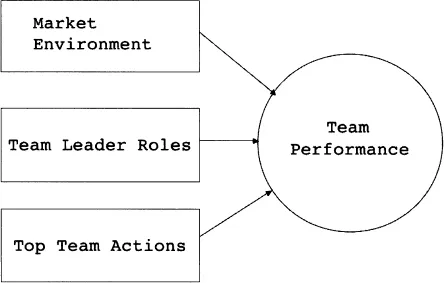
This book operationally defines three fundamentally distinguishable, but complementary, aspects of team leadership; these are shown in Fig.1.1. This model provides one team leadership framework. The various per spectives will assist in developing teams that lead in a particular context.
FIG. 1.1. Aspects of team leadership
The model indicates that high performing teams are the result of (a) the team being in tune with its market environment, (b) the roles of team leaders being allocated and executed appropriately, and (cl the top management team modeling effective team actions. When these are in alignment, the environment is set for successful team performance.
MARKET ENVIRONMENT
The first perspective focuses attention on the importance of the orga nization’s market environment. Treacy and Wiersema (1995a) argued convincingly that for an organization to be a market leader, it must ad here to primarily one market principle. They noted that market leaders are leaders because they typically have excelled at one value discipline; however, a small handful of companies have mastered two (Treacy & Wiersema, 1993).
The three options proposed are: (a) product leadership, (b) operational excellence, and (c) customer intimacy (Treacy & Wiersema, 1995a). Treacy and Wiersema (1995b) noted that pursuing a value discipline is not the same thing as choosing a strategic goal. The choice of discipline cannot simply be grafted onto existing operating policies. It is not a marketing campaign ploy or a way to woo stockholders. Choosing a discipline for focus shapes every other act and practice within the organization; it defines what an organization does and therefore what it is.
Product leadership means that a conscious decision has been made to put organizational resources into “doing new things,” in other words, being the first to market with a new or innovative product or service. Research and development are areas of high resource consumption in these organizations.
Operational excellence means that a conscious decision has been made by the organization to improve on what is already in place. Efficiency is the hallmark of these organizations. They deliver a product or service at low cost; and they strive to do so in record time and with no errors. The resources of these organizations focus on process innovation.
Customer intimacy means that a conscious decision has been made that the organization will not be all things to all people. The customer niche has been selected and all systems are set up (including the team systems) to enhance the effectiveness of developing, cultivating, and sustaining a select group of customers.
The decision of the organization to focus on a particular market strategy-or discipline-has clear implications for all the systems in the organization. Teams labeled as “high-performance” or “top-performing” are leaders because of an alignment with their organization’s market discipline; that is, they are leading teams because the organization has clearly defined its market strategy and has set up the context for its teams to be leaders. Part I, which includes chapters 2 through 5, defines and explains this feature in detail.
TEAM LEADER ROLES
When I was beginning a project on team leadership, I went to the existing literature to see what others had to say about the topic. What I found was a confusing array of no fewer than 71 various and sundry roles for which the designated “team leader” was supposedly responsible (e.g., Parker, 1994; Yeatts & Hyten, 1998; Zaccaro & Marks, 1999). After carrying out these 71 roles, I’m not sure when this individual would actually have time to do their own work!
There did appear to be a way to organize these roles into meaningful and, more important, manageable categories. The first category is that of a team manager. The team reports to and is responsible to this individual, and this individual has position authority over the team. The second category includes roles that are primarily operational in nature—getting the tasks done and being mindful of team member needs. I call this category team coach. The final category is that of a team facilitator. This individual is interested in improving the processes by which the team’s work is accomplished.
By grouping the roles into categories, a useful way to assign, monitor, assess, and train team leadership skills becomes apparent. Better yet, you can actually get someone to be pleased to be assigned the position of “team leader.” Part II, which includes chapters 6 through 9, expands on this team feature.
TOP TEAM ACTIONS
I interviewed an individual who had recently become a member of his firm’s executive team. He pointed out that he was surprised at how little attention executive team members paid to the fact that they were closely watched by the rest of the organization’s members. Executive teams have been of interest to scholars and practitioners alike (e.g., Bantel & Jackson, 1989; Carpenter & Fredrickson, 2001; Finkelstein & Hambrick, 1990; Nadler, Spencer, & Associates, 1998). However, their effective functioning as a team has remained elusive.
There do appear to be several ways to enhance the function of these teams. These include: a clear understanding of their role in the organization, definitive accountability for their actions, excellent chairship, a common goal, a sense of personal accomplishment at the individual level, interpersonal skills, functional expertise, and appreciation of diverse perspectives. Executive team actions are carefully monitored by other organizational members as well as members of the public. The degree to which these teams, made up of functional experts, are capable of modeling cohesive team leadership determines to a large extent the degree to which other teams in the organization can be leaders. Part III, which includes chapters 10 through 13, highlights the important functions of executive teams.
BOOK PURPOSE AND OUTLINE
No single perspective, nor single text can do justice to all of the variables associated with the complex, interrelated, and dynamic nature of team leadership within an organizational context. This book is not meant to be a comprehensive review of every current theory and research study associated with teams and leadership. Nor is it meant to examine a model of interpersonal team dynamics. Rather, it is a contribution to the growing need for taking what we know and applying that knowledge to team leadership and team leadership development. Part I focuses on de veloping “leading teams” by ensuring that the market strategy meshes with organizational systems that impact teams. Part II is devoted to iden tifying and developing specific team leader roles. Finally, Part III de scribes how teams of leaders-executive teams-can be most effective.
Each of these parts is divided into sections. The first section sets the stage with existing theory and research that speak directly to the issue under consideration. This may seem somewhat tedious or superfluous for those who want a quick answer on how to use the information. How ever, a firm understanding of what we actually do know-and the ques tions still left unanswered-is useful in providing a framework for why team interventions work or don’t work. The next sections in each part are devoted to cases, examples, and measuring tools. These are practical tools that will help individuals or organizations develop team leadership in all three domains of market environment, team leadership roles, and executive team actions.
I
Market Environment
By way of a brief introduction, the focus of the next four chapters is on the market environment faced by all organizations, regardless of sector or industry type. That is, determining the best market focus for the organization must set the stage for all else that occurs in the firm. Teams, of course, are part of the firm and as such are greatly affected by the market strategy of the organization. This book takes the approach that if the or ganization actively targets a market approach, then the structure, cul ture, policies, and personnel systems must be aligned closely with such a strategy. In chapter 2, a clearer picture of three market foci is introduced and exemplars of firms that exhibit these characteristics are described. In chapter 3 the market focus is innovation, in chapter 4 the focus is on process effectiveness, and in chapter 5 the focus is on customer service. In each of these chapters, how to set up the organizational features most critical to success is defined.
CHAPTER 2
Organizational Strategy
How do organizations create an environment that is conducive to the development of leading teams? By this I mean that others point to these teams as being special; they are able to elicit interest from outsiders as to why they are so good at performing their work; they are the ones that are called “high-performing.”
CONTEXT FROM THE ORGANIZATIONAL BEHAVIOR FRAME OF REFERENCE
In most models of team performance, based on organizational behavior perspectives, there has been a conspicuous absence of the important role of the organization’s external environment and its influence on team performance. This is the case even in many of the most well-known models of team performance. Table 2.l summarizes the major work done in this area and highlights the fact that this perspective on “context” has largely meant the internal organizational environment.
TABLE 2.1 Summary of the Team Context Research From the Organizational Behavior ...
Table of contents
Cover
Half Title
Title Page
Copyright
Contents
List of Tables
List of Figures
Preface
1 Introduction: Defining Leading Teams
Part I Market Environment
Part II Team Leadership Roles
Part III Top-Team Actions
References
Author Index
Subject Index
Trusted by 375,005 students
Access to over 1.5 million titles for a fair monthly price.
Study more efficiently using our study tools.
Frequently asked questions
Yes, you can cancel anytime from the Subscription tab in your account settings on the Perlego website. Your subscription will stay active until the end of your current billing period. Learn how to cancel your subscription
No, books cannot be downloaded as external files, such as PDFs, for use outside of Perlego. However, you can download books within the Perlego app for offline reading on mobile or tablet. Learn how to download books offline
Perlego offers two plans: Essential and Complete
Essential is ideal for learners and professionals who enjoy exploring a wide range of subjects. Access the Essential Library with 800,000+ trusted titles and best-sellers across business, personal growth, and the humanities. Includes unlimited reading time and Standard Read Aloud voice.
Complete: Perfect for advanced learners and researchers needing full, unrestricted access. Unlock 1.5M+ books across hundreds of subjects, including academic and specialized titles. The Complete Plan also includes advanced features like Premium Read Aloud and Research Assistant.
Both plans are available with monthly, semester, or annual billing cycles.
We are an online textbook subscription service, where you can get access to an entire online library for less than the price of a single book per month. With over 1.5 million books across 990+ topics, we’ve got you covered! Learn about our mission
Look out for the read-aloud symbol on your next book to see if you can listen to it. The read-aloud tool reads text aloud for you, highlighting the text as it is being read. You can pause it, speed it up and slow it down. Learn more about Read Aloud
Yes! You can use the Perlego app on both iOS and Android devices to read anytime, anywhere — even offline. Perfect for commutes or when you’re on the go. Please note we cannot support devices running on iOS 13 and Android 7 or earlier. Learn more about using the app
Yes, you can access Teams That Lead by Theresa J.B. Kline in PDF and/or ePUB format, as well as other popular books in Psychology & Developmental Psychology. We have over 1.5 million books available in our catalogue for you to explore.