- 208 pages
- English
- ePUB (mobile friendly)
- Available on iOS & Android
eBook - ePub
About this book
As more employees work non-routine hours, often in critical safety and security positions, recognizing and reducing stress and the human error it causes is more important than ever. Performance problems caused by unconventional work schedules and resulting fatigue are a significant cause of industrial accidents, lost productivity, and high medical costs. Shiftwork Safety and Performance offers practical solutions to managing fitness and health, improving alertness and sleep quality, and maintaining a social life while performing shiftwork. The author, an experienced safety consultant and trainer who has studied shiftwork around the country, explains the often disastrous consequences of inadequate alertness, and offers ways to improve morale and reduce accidents. If you supervise or train shiftworkers, this book will help you identify opportunities to improve workplace and worker safety.
This easy-to-read, practical manual introduces scheduling strategies to improve alertness, enhance the quality of time away from work, and assist crew communications. It is the first and only complete guide on the complex subject of shiftwork and human performance, and the first book addressing the serious subject of shiftworker burnout.
Information
CHAPTER ONE
Performance Improvement and Critical Jobs
OBJECTIVES OF CHAPTER ONE
You will be able to describe the relationship between Technical Empowerment and critical 24-hour jobs.
You will understand that changes to shift schedules or implementing a performance improvement program should be done without assessing all areas to be impacted.
After you finish the first chapter of this book, you will see that 24-hour operations carry a unique load on the human performer. Technical empowerment and pressure on employees will only increase, along with set-ups for potential human error.
CAN YOU IMAGINE …
To feel the importance of our message, we usually begin our management training session with the following…
Imagine that you’ve won the lottery … a big lottery, of course. And with your fortune, you’ve decided to purchase a winning professional football team. In fact, since you own the team, you’ve selected yourself to be the new head coach!
“Oh, what a manager’s job!” you’re saying as the full impact of your responsibilities hits you. Just a minute though, the job turns out a little differently than you anticipated.
As you enter the main training facilities at 9 a.m. on that first Monday morning, you stroll by a large room to the right with twenty staff members doing aerobics. Further down the hallway off to the left, you overhear a group of office professionals talking about the new high alertness and weight control menus in the cafeteria. As you near your brand new office, you pass a conference room with a committee talking to a hard-bodied fitness consultant, apparently planning the next quarter’s physical activities for the managers and office staff.
You can hardly wait! With all of this office pro-active health activity, your new football team must have a heck of a fitness and performance improvement program. Eager to meet the team, you drop into the office of your number one offense coach and introduce yourself and say, “Wow, Charlie! I can’t wait to meet the team and see the team’s training schedule.”
So Charlie takes you down the hall, down to the big double doors that say, Coaches and Team Only. He opens the doors and there are your team players sitting on benches with fast food bags crumpled in all shapes, sausage and biscuit sandwiches, fried potato breakfast wedgies, soft drinks, croissant sausage sandwiches and fried apple pies. High-dollar players looking a little over-filled and over-saturated.
You stand there shocked … “Charlie,” you say, “what’s the deal? Where’s the performance diet — the wellness program — the aerobics for the players?”
Charlie responds, “Well, we’ve thought a little about it, but right now only the managers and office staff get the aerobics and fitness training. Some of the players who are performing poorly get some performance improvement training. It’s just not in the budget for everyone. Some of the better team members workout and watch their own fitness a little, but it’s strictly something they do on their own. Everyone is expected to learn the procedures and plays. It’s what we call our new League Compliance Program.”
Just imagine! How would you feel? How do you think your team will perform this next season? Think you’ve got a coach’s job cut out for you? You bet! Are you ready to wake up from your dream … or do you want to stay and reeducate your coaching staff and try to save the team?
Okay, so you probably don’t own your own football team and you’re probably not the head coach … but you’re not dreaming the unusual. Unless the team you work with is one in a million, it is in the exact same situation of those imaginary football players. This is what we call the “minimum compliance syndrome” in our 24-hour workers. The term “performance improvement program” is often reserved for those problem cases where employees perform unsatisfactorily!
Training attention tends to become focused on complying with Federal Regulation; there are less resources to apply to front-line performance improvement. Even management and office staff seem to find the resources to address personal performance improvement.
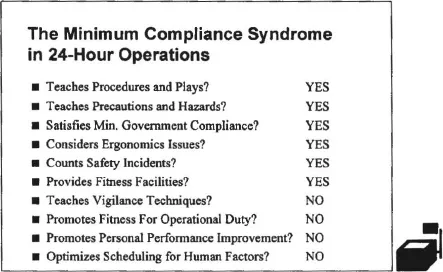
In operations with fitness facilities, we occasionally find the doors locked at 6 p.m. until 6 a.m. when the office staff arrives. What kind of signal does this give the night shiftworker? High fat snacks and “foods” are kept stocked in the vending machines for workers needing nourishment at 3 a.m. How alert will they be at shift change after their 90g fat burritos and 35g fat pastry?
The plant nurse comes on shift at 8:30 a.m. to begin “wellness program” blood pressure and cholesterol testing. Your night shift gets off work at 7:00 a.m. Do you think they’ll wait around to begin their program? Where is their performance improvement program? How do you get your front-line operations motivated and actively involved with changes to promote better alertness, fitness, health and energy? This book will help answer those questions and give you some ideas about where to find opportunities for front-line performance improvement.
PERFORMANCE IMPROVEMENT IN CRITICAL JOBS!
Fortunately, training and performance improvement are very high priorities in some jobs in this country. What about fighter pilots? Reconnaissance troops! Shuttle astronauts! What if there was no alertness, fitness or general performance improvement push in these critical jobs?
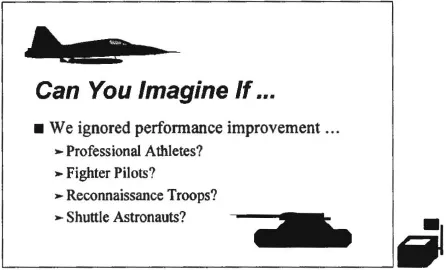
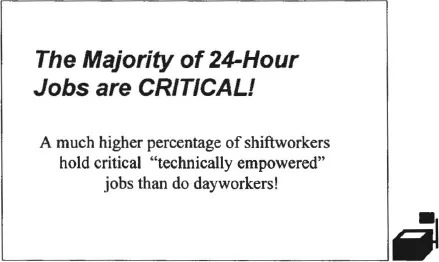
And yet, this very omission is occurring across the United States. Everywhere we see American employees working critical 24-hour jobs without continuous performance improvement … those jobs where it should be absolutely necessary to be in top notch readiness and condition. Those jobs where acuity of judgment must be 100% … 100% of the time! A much higher percentage of shiftworkers hold critical jobs than do dayworkers. This doesn’t mean our supervisors and managers don’t have important jobs; what it means is that the opportunity for cataclysmic disaster in many cases is in the hands of the people who work on-shift — people who can suffer jetlag and extreme fatigue. For these critical jobs, performance tracking and improvement at the individual level should become a job style.
Country-wise, this issue has become very important.1 In the 1990s, about one in five American workers is working a 24-hour job.2 A shiftwork job. This number is increasing according to the Bureau of Labor Statistics. If you look closely, 90 percent of these jobs are critical … chemical plant and refinery workers, nuclear plant operators, police officers, mill and food processing workers, truckers, pharmaceutical workers, airliner crews, train crews,3 emergency and medical crews, mining operations, an...
Table of contents
- Cover
- Half Title
- Title Page
- Copyright Page
- Authors
- Acknowledgments
- Preface
- How to Use this Book
- Table of Contents
- Chapter One: Performance Improvement and Critical Jobs
- Chapter Two: Two Views of the Shiftworker
- Chapter Three: Shiftwork and Safety
- Chapter Four: Scheduling Shiftworkers
- Chapter Five: F.A.S.T. Tracking Techniques
- Chapter Six: Promoting and Using Performance Tracking and Improvement
- Appendix One: Surveys and Checklists
- Appendix Two: Incidents and Costs
- Appendix Three: Additional Resources
- Glossary
- Index
Trusted by 375,005 students
Access to over 1.5 million titles for a fair monthly price.
Study more efficiently using our study tools.
Frequently asked questions
Yes, you can cancel anytime from the Subscription tab in your account settings on the Perlego website. Your subscription will stay active until the end of your current billing period. Learn how to cancel your subscription
No, books cannot be downloaded as external files, such as PDFs, for use outside of Perlego. However, you can download books within the Perlego app for offline reading on mobile or tablet. Learn how to download books offline
We are an online textbook subscription service, where you can get access to an entire online library for less than the price of a single book per month. With over 1.5 million books across 990+ topics, we’ve got you covered! Learn about our mission
Look out for the read-aloud symbol on your next book to see if you can listen to it. The read-aloud tool reads text aloud for you, highlighting the text as it is being read. You can pause it, speed it up and slow it down. Learn more about Read Aloud
Yes! You can use the Perlego app on both iOS and Android devices to read anytime, anywhere — even offline. Perfect for commutes or when you’re on the go.
Please note we cannot support devices running on iOS 13 and Android 7 or earlier. Learn more about using the app
Please note we cannot support devices running on iOS 13 and Android 7 or earlier. Learn more about using the app
Yes, you can access Shiftwork Safety and Performance by Peggy Westfall in PDF and/or ePUB format, as well as other popular books in Technology & Engineering & Human Resource Management. We have over 1.5 million books available in our catalogue for you to explore.