- 192 pages
- English
- ePUB (mobile friendly)
- Available on iOS & Android
eBook - ePub
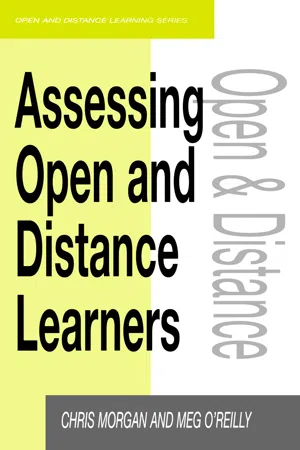
Assessing Open and Distance Learners
About this book
Research has indicated that assessment is a key factor in student learning. This book details the issues of assessment in the open and distance learning field, where changes in budgets, the location and environment of the students and other factors have prompted innovations in assessment.
Information
Part C
Case studies
Introduction
In this final section we present a collection of short case studies that illustrate assessment from many angles. Our overall aim is to provide a series of easy to read stories about how assessment is managed in a broad range of contexts. Our primary concern has been to present a broad sample of innovative, contemporary practice, although these case studies are by no means the ‘last word’ in assessment. Indeed, there are both strengths and weaknesses identified in most cases, and contributors were at pains to stress that they considered their assessment activities to be ‘work in progress’. We encourage you to dip into this selection and browse the contents of these case studies over and over again, while also considering how they may be applied to your own situation and student groups.
Some of the case studies describe whole programmes of study and the assessment strategies that have been developed to support them. Others describe subject-based (or unit-based) assessments, while some describe only a portion of a much larger assessment task. We have given a brief indication of the relative weighting of each example within its own context.
In order to also provide a useful resource for assessment practitioners we have structured the case study examples to make explicit the relationship of assessment to curriculum design and workplace or organizational contexts. While there are only a couple of examples from the industry sector included here, it is clear from the case study table (Table C.1) that many academics are now encouraging and supporting students to ground their responses to assessment tasks in authentic practices with immediate relevance to themselves.
No. | Title of case study | Discipline area | Attend/ support | Online | Sector based | Postgrad |
|---|---|---|---|---|---|---|
1.1 | Think-aloud protocols | Library Education | • | |||
1.2 | Discussion among learners | Social Science | • | • | ||
1.3 | Diary to the teacher | Education | • | • | • | |
1.4 | Analytical thinking | Religious Studies | ||||
2.1 | Collaborative decision making and clinical problem solving | Nursing | • | • | ||
2.2 | Creative problem solving and constructive autonomy | Business | • | • | ||
2.3 | Integrated planning project | Geography | 2 day | • | ||
2.4 | Developing consulting skills | Business | • | • | • | |
3.1 | Developing expertise in neonatal resuscitation | Nursing | • | • | ||
3.2 | Dissecting rats and providing evidence | Biology | • | |||
3.3 | Developing competences in writing research proposals | Business | 1 day | • | ||
4.1 | Contract for personal change | Rural management | 3 teleconfs | |||
4.2 | Participation in open learning | Education | 1 teleconf | • | • | |
4.3 | Becoming an OZKidsConnect volunteer | Library Education | • | • | • | |
4.4 | Whole-of-course portfolio | Education | • | • | ||
5.1 | Delivering a scientific research paper to an audience of peers | Natural Resource Science | 3 day | |||
5.2 | Sharing development and discussion of case study method | Public Health | • | • | • | |
5.3 | Presenting an exhibit at an arts conference | Teacher Education | 2 day | • | • | |
5.4 | Writing a proposal, researching and reporting findings | Anthropology | • | |||
6.1 | Testing knowledge using online multiple choice quizzes | Economics | • | |||
6.2 | Reasoning and logic | Philosophy | • | |||
6.3 | Simultaneous off- and on-campus multiple choice tests | Business and Law | • | |||
6.4 | Mathematics self-assessment on cd rom | Mathematics | ||||
7.1 | Designing online training | Professional Development | • | • | ||
7.2 | Video report of artistic development in ceramics | Visual Arts | Interview | • | ||
7.3 | Conference and Web site for a science community | Agriculture | 1 day | • | ||
7.4 | Creating and appreciating photographic expression | Visual Arts | ||||
8.1 | Oral communication and audiotape interview | Agriculture | 1 day opt | |||
8.2 | Computer conferencing | Education | • | • | ||
8.3 | International debate | Business | • | |||
8.4 | Online collaboration | Psychology | • | • |
Gathering the case studies
The cases were gathered between March 1998 and April 1999 by a number of means. Visits to several Australian and New Zealand universities provided some good leads initially, and e-mail requests to four discussion lists (DEOS-L, WWWDEV, ITFORUM and ISL-mailbase) yielded the majority of overseas examples. The list of contributing countries includes the UK, the Netherlands, South Africa, New Zealand, Canada and Australia.
Although examples were sought from the USA, none were finally forthcoming that represented good open and distance practice as we have conceptualized it in this book. Assessment in open and distance education in the USA still seems to rely heavily on essays and examinations. Where innovations are evident, it is usually in the use of online technologies to provide quizzes, e-mail submission of assignments or as a supplement to classroom activities.
The emerging use of online technologies for teaching and assessment was an added factor in our hunt for cases. We started with the aim of finding innovations in teaching, learning and assessment in open and distance education that were not solely dependent on online technologies for their success. Several examples showcase creative and innovative uses of older technologies such as audio, video, teleconferences and television programmes.
The possibilities for blurring the distinctions between modes of study through the use of computer mediated means has impacted upon our selection. Therefore, approximately half of the case studies show a purposeful use of computer mediated communications and learning activities in dual-mode delivery, and in this way our collection reflects the emerging use of online technologies in face-to-face as well as distance teaching.
No doubt there are many other (and better) examples of the assessment practices to be found in the open and distance education field. Please feel free to contact us if you have assessment innovations that would be appropriate to showcase in future editions of this book.
Organization of case studies
For our organizing structure, we have chosen to use the eight categories of learning outcomes used by Nightingale et al (1996) in their collection of case studies, Assessing Learning in Universities:
- Thinking critically and makingjudgements.
- Solving problems and developing plans.
- Performing procedures and demonstrating techniques.
- Managing and developing oneself.
- Accessing and managing information.
- Demonstrating knowledge and understanding.
- Designing, creating, performing.
- Communicating.
This structure was chosen in preference to the more usual ‘assessment methods’ categorization of case studies as it highlights the close connection between assessment, learning and the development of generic, transferable skills and abilities. Although Nightingale et al (1996) were illustrating on-campus assessment procedures, the same set of outcomes seemed to comprehensively take account of most if not all possible areas for learning by open and distance mode. Table C.1 summarizes the case studies and features.
We hope these case studies will prompt considerable reflection on the kinds of abilities you wish to engender in your learners, and some innovative ways of achievring your assessment goals, as well as those of your learners.
1. Thinking critically and making judgements
- 1.1 Think-aloud protocols
- 1.2 Discussion among learners
- 1.3 Diary to the teacher
- 1.4 Analytical thinking
The ability to think critically is a central goal of university education and our capacity to develop this ability through traditional distance education has been relatively straightforward. Through essays, reports and journals students have been able to demonstrate their ability to plan, research, develop and communicate a sustained and supported argument or belief. However, with the creative use of media including the rapid communication of networked computers, the higher order skills of reflection, analysis and critique can be supported more effectively through interaction and dialogue.
The four case studies in this selection each illustrate the incremental process of personal and professional development. Although only two of the cases (1.2 and 1.3) use e-mail to support the learning process, the other two are also concerned with students’ learning processes, though in contrasting ways. The first case study describes a unit designed to challenge students from the start and to document their own development process. The second case provides a community of learners with opportunities for critical dialogue and discussion on assigned topics. The third illustrates a developmental conversation with a teacher and the fourth develops thinking skills through intensive feedback from the teacher.
Norris and Ennis (cited in Nightingale etal, 1996) identify four elements of critical thinking:
- reasonable thinking, which relies on sound evidence and leads generally to the best conclusions or judgements;
- reflective thinking, which reflects on the reasonableness of one’s own and others’ arguments;
- focused thinking, which is purposeful and consciously directed towards an end goal;
- decision orientation, which is about making judgement...
Table of contents
- Cover
- Series Page
- Half Title
- Title Page
- Copyright Page
- Table of Contents
- Series editor’s foreword
- Acknowledgements
- Introduction
- Part A: Issues and themes in open and distance assessment
- Part B: Assessing learners in open and distance learning
- Part C: Case studies
- Appendix A Terms commonly used in assessment
- Appendix B Sample marking guide
- Appendix C Clinical competence assessment criteria
- References
- Index
Trusted by 375,005 students
Access to over 1.5 million titles for a fair monthly price.
Study more efficiently using our study tools.
Frequently asked questions
Yes, you can cancel anytime from the Subscription tab in your account settings on the Perlego website. Your subscription will stay active until the end of your current billing period. Learn how to cancel your subscription
No, books cannot be downloaded as external files, such as PDFs, for use outside of Perlego. However, you can download books within the Perlego app for offline reading on mobile or tablet. Learn how to download books offline
Perlego offers two plans: Essential and Complete
- Essential is ideal for learners and professionals who enjoy exploring a wide range of subjects. Access the Essential Library with 800,000+ trusted titles and best-sellers across business, personal growth, and the humanities. Includes unlimited reading time and Standard Read Aloud voice.
- Complete: Perfect for advanced learners and researchers needing full, unrestricted access. Unlock 1.5M+ books across hundreds of subjects, including academic and specialized titles. The Complete Plan also includes advanced features like Premium Read Aloud and Research Assistant.
We are an online textbook subscription service, where you can get access to an entire online library for less than the price of a single book per month. With over 1.5 million books across 990+ topics, we’ve got you covered! Learn about our mission
Look out for the read-aloud symbol on your next book to see if you can listen to it. The read-aloud tool reads text aloud for you, highlighting the text as it is being read. You can pause it, speed it up and slow it down. Learn more about Read Aloud
Yes! You can use the Perlego app on both iOS and Android devices to read anytime, anywhere — even offline. Perfect for commutes or when you’re on the go.
Please note we cannot support devices running on iOS 13 and Android 7 or earlier. Learn more about using the app
Please note we cannot support devices running on iOS 13 and Android 7 or earlier. Learn more about using the app
Yes, you can access Assessing Open and Distance Learners by Chris Morgan,Meg (both Lecturers O'Reilly in PDF and/or ePUB format, as well as other popular books in Education & Comparative Education. We have over 1.5 million books available in our catalogue for you to explore.