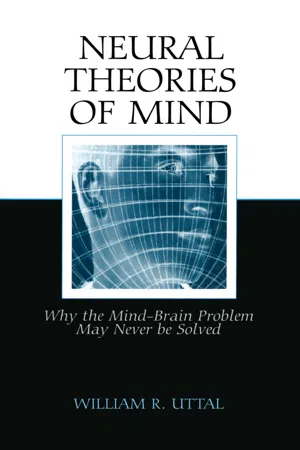
In this fascinating book, William R. Uttal raises the possibility that, however much we learn about the anatomy and physiology of the brain and psychology, we may never be able to cross the final bridge explaining how the mind is produced by the brain. Three main classes of mind-brain theory are considered and rejected: field theories, because they are based on a superficial analogy; single cell theories, because they emerge from a massive uncontrolled experimental program; and neural net theories, because they are constrained by combinatorial complexity.
To support his argument, Uttal explores the empirical and conceptual foundations of these theoretical approaches and identifies flaws in their fundamental logic. The author concludes that the problems preventing solution of the mind-brain problem are intractable, yet well within the confines of natural science.
- 304 pages
- English
- ePUB (mobile friendly)
- Available on iOS & Android
eBook - ePub
About this book
Information
Publisher
Psychology PressYear
2020Print ISBN
9781138004207
9780805854848
Edition
1eBook ISBN
9781000149401
CHAPTER
1
An Introduction to the Concept of Theory
1.1 Questions Pertaining to Cognitive Neuroscientific Theories
This is a book about epistemology—the part of philosophy that is concerned more with what we can know than with what we do know. It is about epistemology as it is applied in a very important modern field of scientific endeavor—cognitive neuroscience—the field asking: How does the brain make the mind? In particular, it is concerned with the nature of the theories that have emerged, mainly in the last half-century or so. During this period, this field of science has matured far beyond the most imaginative expectations of its speculative antecedents.
The outline of this book is clear-cut. After reviewing the meaning of theory in general, I seek the intellectual roots of this science as it has developed over its history. It is there that the fundamental assumptions that govern modern cognitive neuroscience are to be found. I then review a sampling of the theories that have been offered in this modern and exciting field of science. Finally, some concluding and summarizing judgments and opinions are expressed concerning the direction that cognitive neuroscience should most profitably take in the future.
Such a project is quite timely now, not only because of the importance of the research program undertaken by workers currently active in the field, but also because cognitive neuroscience has subsumed much of classic scientific psychology within itself, in particular cognitive psychology. Unfortunately, because of the intrinsic complexity of the subject matter, cognitive theory has left a trail of uncertainty, contentious debate, and confusion behind it.
The epitome of this confusion and uncertainty is found in the plethora of theoretical ideas that populate this field. Cognitive neuroscience, dealing as it does with some of the most important issues of human existence, has not developed a consensus concerning the relation of the mind and the brain beyond the monistic ontology that the former is a function of the latter. Herein is the thesis of this book; no satisfactory solution to the mind–brain yet exists. The first corollary of this thesis is more speculative and contentious. This corollary argues that such an explanation may be beyond the powers of even a future science. This future intractability is not because of any deep-seated mystery; rather, it arises out of knowledge and proofs with which we are already familiar.
Unfortunately, many denizens of psychological and neurophysiological laboratories currently active around the world are often so driven by the demanding requirements of their empirical search for new discoveries that they do not often deal with the underlying assumptions, constraints, and conceptual limits of their work. Perhaps, because so many exciting results are waiting to be uncovered, there has been little perceived need for reflection and epistemological inquiry.
In a certain sense this belies the antiquity of the field. Humans from their origins have always sought to answer some of the grand questions that still motivate cognitive neuroscience. Whether framed in terms of the supernatural continuity of the spirit, the mind–body problem, or the relationship between cognition and the brain, it is likely that humans have always asked questions about their self-awareness and its relation to their physical being. The recent emphasis on empirical research may actually have the negative effect of preventing or delaying consideration of profound epistemological concerns.
There are substantial reasons that an increased interest in theory should begin to capture the attention of modern cognitive neuroscience. It was only recently that the idea of formal computer and mathematical models were anathema to most biologists. In the last few years, however, enormous changes have been occurring in the theoretical sophistication of cognitive neuroscientists. New equipment, broader interdisciplinary training, and the increasingly predictive impact of those formal models that have appeared have accelerated a reinvigorated theoretical approach to the resolution of the mind–brain problem. Clearly, this is a wonderful and timely opportunity to reconsider how theory can and should develop in this all-important field of science.
A major premise of this work is that the development of comprehensive theory is the raison d’être of science, in general, and should be of cognitive neuroscience, in particular. I argue here that all our laboratory skills, resources, and energies should be aimed at the ultimate goal of determining a comprehensive understanding of our world and ourselves. The simple accumulation of empirical or factual knowledge, although forming the basis of such a comprehensive understanding, is not the ultimate goal of science. Rather, science aspires (or should aspire) to the integration of that empirical knowledge into inclusive theoretical understanding. In the words of the distinguished philosopher of science Abraham Kaplan (1964):
Whether or not theory formation is the most important and distinctive scientific activity, in one sense of the term “theory”, this activity might well be regarded as the most important and distinctive for human beings. In this sense it stands for the symbolic dimension of experience, as opposed to the apprehension of brute fact. (p. 294)
It is the purpose of this book to look at the current status as well as the epistemological limits of cognitive neuroscience theory. To begin progress toward this goal, it is useful to tabulate some of the questions that are implicitly, if not explicitly, asked by cognitive neuroscientists as they make the transition from observation, on the one hand, to explanation or description, on the other. The following queries preview topics discussed in this book.
Some Questions About Cognitive Neuroscience Theory
- 1. What is a theory?
- 2. What is an acceptable theory in cognitive neuroscience?
- 3. Is a unified theory of mind–brain relationships possible? (Will it always be a system of microtheories?)
- 4. What are the conditions of necessity and sufficiency that make a theory or law acceptable?
- 5. Are the methods of a science evolved from the needs of physical sciences appropriate for the development of theories of cognitive neuroscientific processes?
- 6. Is there a psychological or physiological “uncertainty principle” (which says that we cannot examine mental or neural processes without altering them) that will obstruct theory development in this field of science?
- 7. Why is description not the same as explanation?
- 8. Does it matter to cognitive neuroscience which particular ontological approach—monism or dualism (“mindless materialism or baseless spiritualism”)—underlies theory?
- 9. Is there some kind of a biophysical reality that is the ultimate target of our theories?
- 10. Can the controversy between identity theory and other monisms, on the one hand, and dualisms on the other, be resolved?
- 11. What is the relation between mathematics and computer models to the processes they describe?
- 12. How can analogies mislead us into assuming that some processes are homologous rather than coincidental? In other words, how can functional isomorphisms mislead us into assuming that some processes are identical with regard to their origins when, in fact, they are examples of convergent evolution?
- 13. Can a semantic engine be successfully simulated by a syntactic one?
- 14. What are the crucial differences among the various schools of cognitive neuroscience theory?
- 15. What kind of a balance should be established between achievable pragmatic concerns and what may be an unachievable biopsychological theory? Should such a balance be sought?
- 16. What kinds of theories are useful for cognitive neuroscience?
- 17. Which so-called “theories” are only superficial restatements of intuitions, experimental results, or anecdotal observations?
- 18. Finally, for cognitive neuroscience the big question is: Are the data of cognitive neuroscience sufficiently objective, simple, robust, and comprehensive so that the great question can be resolved? In other words, are there intractable barriers to developing reductive theories that bridge between mental and neurophysiological constructs? Alternatively, can we look forward to theories that are as well structured and axiomatic as are those found, for example, in physics?
To answer questions such as these for cognitive neuroscience in particular, we must first look abroad to see what has been said about theories in general. That is the purpose of the rest of this chapter.
1.2 Traditional Definitions of Theory
In this section, I seek a broadly acceptable definition of theory. In doing so, I must warn my readers that the definition at which I finally arrive may differ from that used by others. A consensus definition is not likely to be achieved; one only has to examine the abundant literature that seeks to answer the question—What is a theory?—to appreciate how diverse are the views that seemed at first to be a simple matter of lexicographic definition. However, by comparing a number of points of view, perhaps some convergence on a useful definition, if not a consensus, can be achieved.
Definitions come in many guises. Some are highly technical, some metaphorical, and some are strings of words that sometimes strain credulity and clarity. It is not always clear which are the most useful. Some intentionally fuzzy definitions are intended to help us to “feel” a meaning more than to delineate an exhaustive list of properties and characteristics. For example, note Popper’s (1959) metaphorical, almost poetic, statement to sense the grandeur of the term:
Theories are nets cast to catch what we call ‘the world’: to rationalize, to explain, and to master it. We endeavour to make the mesh ever finer and finer. (p. 59)
Hooker (1987) also proposed a metaphor—the pyramid—for theory, but one that moves slightly further from Popper’s somewhat romantic expression toward a more precise idea of what is meant by the term. Indeed, it has embedded within it some connotations that help us make the next step toward a definition of theory.
At the bottom of the deductive pyramid lie the so-called observation sentences—those sentences whose truth can be checked experimentally—whilst at the apex of the pyramid lay the most general theoretical principles of the scheme. Just exactly where the twin elements of theory and observation permeate this structure is a matter of contemporary controversy. . . . (p. 109)
The metaphor of the pyramid introduces some important initial ideas into our quest for a definition of theory. First, it emphasizes the idea that a mass of observational findings must provide the underlying foundation for what is a reduced number of theoretical terms. Theory without a sustaining foundation of empirical observations would be meaningless. The end product of such a nonempirical theory would inevitably invoke supernatural concepts that should have no place in science.
A second contribution of Hooker’s pyramid metaphor is the idea that theories are inclusive of a large mass of data (i.e., they are intended to be universal synoptic statements of particular observations). Thus, theories may be thought of as intellectual generalizations that condense the information content of a science by expressing a huge mass of specific observations in a much smaller number of comprehensive terms and concepts.
Nevertheless, as scientists, we wish to be a little less metaphorical and a little more precise in arriving at a definition of a theory than have been Popper or Hooker. One of the best places to seek understanding about any word is to trace its use in the past. Clearly, a diluted and imprecise, but still useful, kind of insight can come from checking the dictionary. However unsatisfactory the various interpretations may be, they do provide a preliminary framework and reminder of what some of the issues are likely to be in considering the real meaning of the word theory. My on-line dictionary defines theory as follows:
- 1: the analysis of a set of facts in their relation to one another
- 2: abstract thought: SPECULATION
- 3: the general or abstract principles of a body of fact, a science, or an art <music theory>
- 4a: a belief, policy, or procedure proposed or followed as the basis of action <her method is based on the theory that all children want to learn> b: an ideal or hypothetical set of facts, principles, or circumstances—often used in the phrase in theory <in theory, we have always advocated freedom for all>
- 5: a plausible or scientifically acceptable general principle or body of principles offered to explain phenomena <wave theory of light>
- 6a: a hypothesis assumed for the sake of argument or investigation b: an unproved assumption: CONJECTURE c: a body of theorems presenting a concise systematic view of a subject <theory of equations>
- Synonyms see HYPOTHESIS
- (Merriam-Webster’s Collegiate Dictionary, 2000)
Although this set of definitions begins to suggest a meaning (actually several different...
Table of contents
- Cover
- Half Title
- Series Page
- Title Page
- Copyright Page
- Dedication
- Table of Contents
- Preface
- 1 An Introduction to the Concept of Theory
- 2 Mind and Brain Before the Modern Cognitive Neuroscience Era
- 3 The Limits of Cognitive Neuroscience Theory— An Epistemological Interlude
- 4 Field Theories—Do What You Can Do When You Can’t Do What You Should Do!
- 5 Single Neuron Theories of the Mind–The Undue Influence of a Point in Space
- 6 Network Theories—Truth Denied
- 7 Summary and Conclusions
- References
- Author Index
- Subject Index
Trusted by 375,005 students
Access to over 1.5 million titles for a fair monthly price.
Study more efficiently using our study tools.
Frequently asked questions
Yes, you can cancel anytime from the Subscription tab in your account settings on the Perlego website. Your subscription will stay active until the end of your current billing period. Learn how to cancel your subscription
No, books cannot be downloaded as external files, such as PDFs, for use outside of Perlego. However, you can download books within the Perlego app for offline reading on mobile or tablet. Learn how to download books offline
Perlego offers two plans: Essential and Complete
- Essential is ideal for learners and professionals who enjoy exploring a wide range of subjects. Access the Essential Library with 800,000+ trusted titles and best-sellers across business, personal growth, and the humanities. Includes unlimited reading time and Standard Read Aloud voice.
- Complete: Perfect for advanced learners and researchers needing full, unrestricted access. Unlock 1.5M+ books across hundreds of subjects, including academic and specialized titles. The Complete Plan also includes advanced features like Premium Read Aloud and Research Assistant.
We are an online textbook subscription service, where you can get access to an entire online library for less than the price of a single book per month. With over 1.5 million books across 990+ topics, we’ve got you covered! Learn about our mission
Look out for the read-aloud symbol on your next book to see if you can listen to it. The read-aloud tool reads text aloud for you, highlighting the text as it is being read. You can pause it, speed it up and slow it down. Learn more about Read Aloud
Yes! You can use the Perlego app on both iOS and Android devices to read anytime, anywhere — even offline. Perfect for commutes or when you’re on the go.
Please note we cannot support devices running on iOS 13 and Android 7 or earlier. Learn more about using the app
Please note we cannot support devices running on iOS 13 and Android 7 or earlier. Learn more about using the app
Yes, you can access Neural Theories of Mind by William R. Uttal in PDF and/or ePUB format, as well as other popular books in Psychology & Cognitive Neuroscience & Neuropsychology. We have over 1.5 million books available in our catalogue for you to explore.